



Are agriculture and economic development still antithetical? Reflections for a post-COVID recovery plan

If evidence were still required, the coronavirus pandemic and the consequent nosedive of oil prices has once more reminded us of the shortcomings of Nigeria’s oil dependence.

Despite decades of rhetoric on the merits of diversification, oil still represents more than 90 percent of the total value of Nigerian exports, and more than half of all government revenue, thus largely determining the government’s expenditure potential. The federal government’s budget for 2020 was designed on an assumed average oil price for the year of US$57 per barrel — a price that has proved a mirage since the start of the health and economic crisis.

Since strategic, and preferably abundant, government expenditure is a necessary requirement on Nigeria’s path towards achieving the Sustainable Development Goals (SDGs), it therefore follows that the fate of Nigeria’s development project remains hostage to the unpredictable fortunes of the oil industry.

When the pandemic eventually subsides, finding different, less volatile sources of government revenue, foreign exchange and employment will need to be an absolute priority for policymakers. This will have to begin with a modernisation of Nigeria’s agricultural sector.

The world is changing, development theory should too

Following Arthur Lewis’ research in the 1950s, traditional development economics has envisioned the shifting of a rising portion of labour into higher productivity activities as the centrepiece of an economy’s development. In this light, economists have mostly employed a convenient tripartite division of economic activities into agriculture, manufacturing and services — with increasing employment in the latter two sectors seen as the Promised Land. This was mostly with good reason: industrial development promised highly productive, labour-intensive economic activities that traditional agrarian economies could only dream of.

Yet this has ceased to be the case. As Cramer et al. (2018) point out in their brilliant study of Ethiopian horticulture, excessive neglect of agricultural activities in the obstinacy to promote transition towards industrial manufacturing can lead to the loss of numerous opportunities — ones Nigeria can hardly afford.

The changing tastes of international consumers, coupled with the increased efficiency of global cargo transportation, have opened up a market for agricultural products that would never have been possible just decades ago. Processing agricultural goods, therefore “industrialising”, is no longer the only way to add value to primary commodities. The ever-growing global demand for a year-round, fresh, and increasingly higher quality (think “organic”, “fair trade” etc.) supply of “raw” agricultural products is turning the once archaic practice of agriculture into a knowledge intensive, highly productive activity, often much more complex than many forms of manufacturing.

To illustrate this point, Cramer et al. discuss the astounding complexity and coordination required in the production for export of poinsettia flowers in Ethiopia — in comparison, Adam Smith’s proverbial pin factory comes across as child’s play.

While the final good is ultimately unprocessed and may appear the product of little more than traditional agricultural practices (several botched attempts make it hard for the author to believe, but you need not be a botanist to grow a flower), the surface-level simplicity masks a sea of highly-technical knowledge and expertise in fields as far apart as biology, supply-chain logistics and marketing that make modern horticulture no less valuable than many industrial activities. Throughout the process, jobs are created along the supply chain, steady streams of foreign exchange are generated and the economy’s overall productivity is increased — the three main purposes of seeking industrialisation in the first place.

It is therefore no wonder that development economists are starting to develop theories surrounding what Cramer et al. call the “industrialisation of freshness”, but the same concept of adding value within agriculture can be extended to the quality of the good and the efficiency of yield, not just the freshness with which it is brought to developed markets.

All of this should be more than sufficient to convince Nigerian policymakers that investing in agriculture must at least be considered in the country's post-COVID recovery.

Cutting out chocolate

To illustrate what this paradigm shift could mean, let us take the case of Nigeria’s most important agricultural product: cocoa. Cocoa beans remain Nigeria’s largest agricultural export, yet the sector has witnessed a steady decline since the heydays of the post-independence period: in the decades from the 1960s to 2016, average yearly cocoa production declined from 420,000 tons to just 192,000 tons.

Talk of reviving the sector has been a constant feature of political debate particularly since the return to democracy in 1999, but the vast majority of the conversation has centred around statements such as: “Nigeria is yet to fully capitalise on cocoa production, as most of the beans are sold unprocessed” — as quoted from the Proshare intelligent investment platform.

While it may certainly be true that strengthening Nigeria’s fairly meagre processing capacity could be a job-creating, productivity-enhancing, forex-attracting development — you will certainly not find opposition to strategic forms of ‘traditional’ industrial policy here — the narrowness of this vision neglects the potential for generating positive outcomes from the improvement of cocoa bean production itself.

Yield-enhancing practices could certainly be explored, but even more important would be government support for the specialisation in higher quality cocoa bean production.

To the untrained eye, different varieties of cocoa bean may appear rather similar. However, in truth, cocoa quality is assessed through a plethora of complex criteria including: the genetic origin of planting material; morphological characteristics of the plant; flavour characteristics of the cocoa beans produced; chemical characteristics of the cocoa beans; colour of the cocoa beans and nibs; degree of fermentation; drying; acidity; off-flavours; percentage of internal mould; insect infestation and percentage of impurities.

Obtaining the desired levels of each parameter requires sophisticated expertise that makes the notion of agriculture as a ‘backwards’ trade seem rather inapt.

As the International Cocoa Organisation (ICCO) points out, there is growing value in producing ‘fine and flavour’ cocoa as most major chocolate manufacturers include premium quality chocolate products in their range that “require fine or flavour cocoa from specific origins in their recipes, in order to achieve the required distinctive taste or colour of the chocolate. Many new chocolate artisans are emerging as well, bringing more demand for this cocoa type”.

However, as with most African producers (Madagascar being the exception), Nigeria has exclusively produced lower grade ‘bulk’ beans, where productivity and value-addition is lower and margins are tighter, leaving the dominance of the fine and flavour production to South American competitors.

Moving forward, strategic partnerships with top-of-the-line chocolate producers to develop capacities to enter niche final product markets should certainly be explored. In so doing, the Nigerian cocoa sector could cut out a strategic angle into the northern markets, guaranteeing higher value exports, and protecting itself from regional competitors that have often outperformed Nigerian producers due to, among other things, better infrastructure and more efficient organisation of the cocoa markets.

In general, policies to facilitate knowledge production and dissemination, strengthen infrastructural support and incentivise quality upgrading within agriculture can form the basis of a successful industrial policy without the imperative to industrialise.

Moving industrial policy beyond ‘industry’

With the (frankly, too slow) fall from grace of the Washington Consensus, a new consensus is emerging surrounding the paramount importance of government industrial policy to foster structural change. This development is welcome. However, the return to prominence of industrial policy must take stock of the changes in the global economy that have occurred since the peaks of government-led development in the post-war, post-independence period. This article has sought to echo Cramer et al. in highlighting the risks of maintain the monolithic view of structural change as a unidirectional move away from agriculture.

While the Nigerian cocoa beans example would require a much more in-depth evaluation than that provided above to guide policy design, it is important that this sort of thinking — one that sees the value of agriculture beyond being a breadbasket and labour source for industry — enters the mindset of development practitioners and policymakers.

Ultimately, industrial policy to engender structural change is about investing in activities that are able to foster employment, generate foreign exchange and shift larger portions of the workforce into higher productivity occupations. Traditionally, this has been synonymous with prioritising industrial manufacturing over agriculture. This should no longer be the case.

This article was first published by the Africa Portal

(Main image: A cocoa plant at Shofolu village in Ogu State, southwest Nigeria, on 30 August 2016. - Pius Utomi Ekpei/AFP via Getty Images)
Read More

COVID-19 and the Shrinking Fiscal Space for Education in Nigeria

The immediate costs of the coronavirus (COVID-19) pandemic on education in Nigeria are evident. With school closures that have persisted for ten weeks, students - especially the most vulnerable, are missing out on learning. The government and individual schools are adapting by switching mediums and delivering learning through digital platforms. However, the stark digital divide (in terms of both infrastructure and knowledge) that plagues the country is resulting in an exacerbation of pre-existing educational inequalities. The cost of recovery will be high, but the sector will inevitably be confronted with a costlier issue: between the effects of the pandemic and crashing oil prices, the fiscal space to fund basic education will shrink significantly. 

Revised Budget - Fall in revenue from the dual shock of COVID-19 and crashing oil prices

The prolonged disruption in economic activity due to the pandemic, combined with the collapse of oil prices and the reduction in demand for Nigeria’s oil products are severely impacting Nigeria’s fiscal position. The International Monetary Fund projects that the economy will contract by 3.4 percent in 2020, a fall from the previously anticipated 2 percent growth. The total budget, which was set at N10.59 trillion is in the process of being revised downward by about 15 percent. Oil and gas exports, which make up around 76.1 percent of Nigeria’s total exports and more than half of revenue, are predicted to fall drastically, with oil revenue being revised downward to N924 billion from N2.64 trillion. Non-oil revenue targets have also been revised downward by 10 percent, as industries across all sectors continue to grapple with the effects of the pandemic-induced disruption in economic activity. In sum, total revenue has been adjusted downward by 34 percent.

With regard to actual performance, the projected numbers are close to performance as at the end of Q1. The reported gross and net oil and gas revenues were short by over 28 percent and 31 percent respectively, and non-oil tax revenue was N269.41 billion, representing a shortfall of about 40 percent of the predicted amount for Q1.

Dissecting the effect on education financing

While we don’t know the full extent of the economic crisis on education spending, we attempted to make a prediction by looking at education spending during and after the most recent oil crisis in 2014, and factoring in accessible education expenditure information at both the federal and state levels. This section is divided into two: what we know (information that is readily available), and what we don’t know (unavailable information).

What we know: Looking at a past oil crisis and the Federal Budget

  • Looking at a past oil crisis - a decline in education prioritization

We analysed GDP and education spending during the 2014 oil price crash, where a fall in crude oil prices from $100/barrel to $52.65 led to a decline in total budgetary allocation from N4.694 trillion to N4.493 trillion in 2014. The fall in crude oil prices negatively affected total allocation to education, as it declined from N496.783 billion to N484.26 billion, but the share of education budget was maintained, increasing slightly to 10.7 percent. 

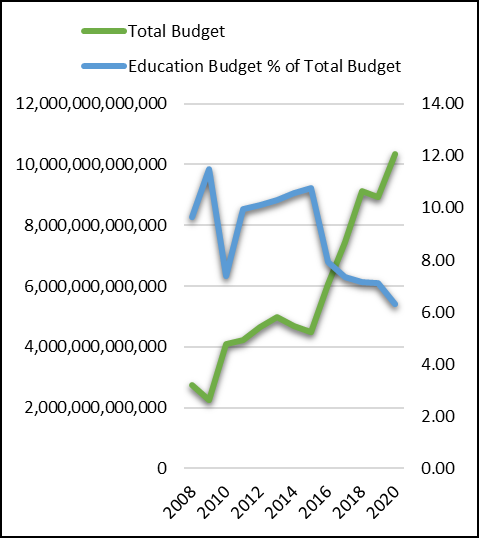
In 2016, crude oil prices further declined to $43.73, but total budgetary allocation grew to N6.06 trillion. At the time, the government was able to increase the budget (by increasing debt), however given the country’s current debt burden and the global nature of the pandemic, borrowing conditions could be unfriendly, and borrowing could further worsen the country’s fiscal crisis. Despite this increase, the budget for the education sector was reduced to N480.278 billion in 2016. The increase in budget and the decline in education spending led to a decline in education budget by 3 percentage points in 2016. Since 2016, and before the current oil crisis, oil prices have been recovering slowly, and both the total budget and allocation to the education sector have increased consistently. However, the education sector budget, as a share of total budget allocation, has steadily declined since, reaching its lowest level of 6 percent in 2020. 

This trend is revealing. The value placed on education in Nigeria by the current administration can be gleaned by the drop in the share of education expenditure in the national budget, despite yearly increases in the budget. While both the national budget and the nominal amount allocated to education have increased, the share of education has been in a steady decline. Given that research has linked funding to education quality, to the extent that this decline persists, our education system will remain stagnated. 

  • Federal budget

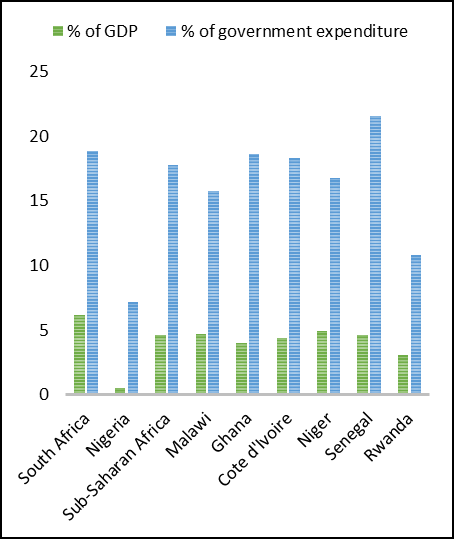
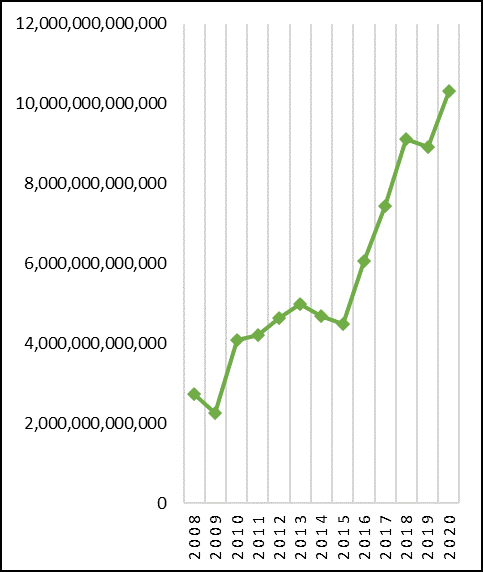
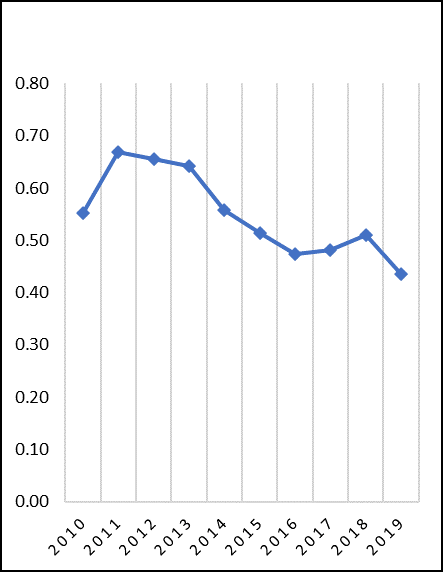
Nigerian budgets have tended to neglect the education sector in the past. In general, government spending is relatively small when compared with other African countries [see figure 2]. Prior to the current economic crisis, the education financing budget wavered around 9 - 10 percent of public expenditure {between 2008 and 2014: see figure 1}, against the recommended 15 percent to 20 percent.  Despite an increase in the total budget by over 255 percent between 2008 and 2020 {see figure 3}, the education expenditure as a share of total budget has fallen from 9.64 percent to 6.32 percent within the same period. Public spending on education as a share of GDP has remained below 1 percent since 2010 against the recommended 4 percent to 6 percent, and has decreased steadily since 2011, from 0.67 percent to 0.44 percent in 2020 {see figure 4}. 

Figure 1: Total Budget (Naira) and Education Budget (% of Total Budget)

Source: Authors’ Compilation

Figure 2: Education Budget (% of GDP) and (% of government Expenditure)                                       

Source: World Bank Database


Figure 3: Total Budgetary Allocation (Naira)                        

Source:2008-2010 Appropriation Act

Figure 4: Education Expenditure as a Share of GDP (Percent)

  Source: Authors’ compilation

The current economic crisis signifies that there will be a reduction in total budgetary allocation to the education sector, which would further dent the already neglected sector. The original education allocation for 2020 was N653  billion, roughly 6 percent of the total budget expenditure. Of this, N111.789 billion is the statutory transfer from the Federal Government (FG) to the Universal Basic Education (UBE) fund, which covers the FG’s contribution to basic education in Nigeria. The UBE fund is the main tool the government uses to influence spending on basic education at the state level. The remainder covers recurrent and capital expenditure for all education expenditure that fall within the purview of the FG. 

Given the proposed cut in the budget,  dataphyte, an open data organisation, reports that the FG has proposed a reduction in its budgetary allocation to education by almost 55 percent. This reduction is reflected in the government’s statutory transfer to the UBE Fund. Outside of the UBE fund contribution, funding of basic education is wholly within the purview of the state governments. Other than the proposed UBE cut, we don’t yet know how the total education budget will be impacted by the proposed budget cut; however, if the proportion of education spending were to remain the same (6 percent), and the budget was cut by 15 percent, the federal education budget is expected to be around 541 billion. This means that there could be a further reduction in education spending by N51 billion, which will affect other aspects of education spending outside of basic education. 

Further, a quick back-of-the-envelope calculation that accounts for Nigeria’s revised growth projection, current education spending as a percent of total budget reveals that education spending could fall as low as N500 billion this year. 

What we don’t know - State funding and availability of aid.

  • State Funding

Provision of basic education (9 years between primary school and junior secondary school) is in the purview of state governments. Unfortunately, there is a dearth of information on state budget and spending on education across all states, which makes it difficult to infer the potential impact of the present economic crisis on state education expenditure. However, we do know two things that shed light on both the states’ ability to spend, and their current economic situations. 

First, available state funding for basic education is limited for many states. The UBE funds available to the states can only be accessed upon meeting certain conditions, one of which is the provision of   a 50 percent counterpart funding to match the FG’s contribution (which is why the UBE Fund is called a matching grant). Unfortunately, many states are unable to meet this condition; as of February 2020, over N73 Billion is yet to be accessed by several states. Their inability to match the FG grant is reflective of the fact that their education budgets are small, inadvertently affecting basic education in their states - a fact that is evident in the poor quality of both infrastructure and learning at the basic education levels. 

Secondly, given the fact the lockdown measures and restriction on movements across states have taken a massive toll on the country’s economy, it is inevitable that this would result in budgetary shortfalls across all states in the country due to decreased tax revenue from all revenue streams. In 2019, the majority of state revenue was accrued through two sources: The Federation Accounts Allocation Committee (FAAC) (N2.47 trillion or 65 percent) and Internally Generated Revenue (IGR) (N1.33 trillion or 35 percent). The FAAC is a function of revenue derived through oil, which we know has been revised down by 35 percent. Of the IGR, 83.4 percent of IGR generated are from taxes while 16.6 percent are generated from state Ministries, Agencies and Departments (MDAs). Tax revenue through the IGR is also expected to decline given the reduction in sales, job losses and income cuts induced by lockdown measures and the slow down in the economy. Compounded by the need to increase public health spending across states in order to combat the virus, state budgets will also be adversely affected. 

Given that we don’t know how much is being spent on education at the state levels, we cannot make a confident projection of how much state education budgets will fall by. But what we know is this: public (basic) education will suffer both during and after the pandemic. 

  • Education Aid - Can it plug the gap? 

Measuring the contribution of aid to education spending in Nigeria is tasking. First, aid to the sector is highly decentralised, with donations focusing primarily on specific projects within individual states, and secondly, in general, there is paucity of data with regards to incoming funds into the sector. However, a report on the effect of aid on education financing in Nigeria found that external aid only contributed marginally to public expenditure of basic education in Nigeria. The report suggested that even a substantial increase in aid would do little to bridge the gap in the current level of funding and the amount required to achieve education goals. It found that between 1999 and 2009, education aid only contributed to 1.5 percent of total domestic expenditure (on primary education alone). Additionally, recent data from USAID reveals that in 2019, education aid to Nigeria was at its lowest after a peak in 2015 (at $84 million), falling 78.6 percent between 2015 and 2019.

Given this, and the global nature of the pandemic-induced economic crisis, it is unlikely that aid to the education sector will fill the education finance void. At best, education aid will remain at the same level, or at worst case, it will reduce. Though international organisations, the World Bank for example, have committed to boosting aid to support developing countries in their recovery, it will be difficult to extrapolate how much of this total aid will reach education sectors around the world. 

Recommendations

Nigeria continues to lag behind in terms of education financing, and with the current national and global economic outlook, the prospects for increased financing in the immediate future are bleak. Given this, the government will need to make difficult decisions about how and where to channel scarce resources available at both the national and sectoral levels. With this in mind, there are a few key things to consider:

National level

  • Prioritizing education funding: While there are a lot of moving parts involved in improving the access to quality education and inadvertently education outcomes, one key thing remains significant: money matters. 

Empirical evidence suggests that lack of equitable and adequate funding is a key driver of unrealized education goals. Researchers have found that adjusting school spending by 10 percent leads to a reduction in test scores by around 7.8 standard deviation (10 percent cut), and increase in test scores by 0.05 to 0.09 standard deviations (10 percent increase). Access to financing has been attributed as one of the reasons why Nigeria did not achieve its Millennium Development Goal (MDGs) targets for Universal Primary Education and Education for All, and is probably an underlying factor behind the fact that no state in Nigeria is on track to meet the SDG Goal 4 target - ensuring inclusive and equitable education for all. 

Money is a necessary underlying condition for achieving education goals. Increased access to financial resources provides the scope to achieve non-finance related education targets {indicators}. Education at all levels has suffered as a result of the pandemic, and by all estimates, students are lagging behind. We are at a critical juncture; ideally, the government would need to channel more resources into the sector to catch up, however, in a best case realistic situation, it will be important to at least maintain the pre-pandemic levels of financing. 

Sector level

  • Immediate - Supporting evidence-informed decision making: Money matters, but how money is spent is critical too. Given the scarcity of resources, it is important to monitor how resources are being allocated, and to determine if resources are achieving expected results/outcomes in order to maximize scarce resources for maximum impact. The government must channel resources and efforts toward creating a culture of learning through results-based monitoring and evaluation. All resource allocation decisions made within the sector should be augmented by three activities: tracking use of funds, measuring its outcomes/impacts against expected results, and making necessary adjustments based on findings. This should be supplemented by incorporating a results-based financing approach that removes the current arbitrary nature of funding, and directly links funding decisions to achieved results.
  • Long-Term - Develop a strong National Education Account: There is paucity of readily accessible data on state level education financing and education aid across the country, making it difficult to determine how much is being spent on education financing across Nigeria. Additionally, data about private financing/household spending on education is also limited. Collating this data is important because it allows us to glean vital information, such as whether our problem is inadequate funding, or improper use of available funding. A solution to this is to build a strong and holistic National Education Account (NEA). An NEA provides a framework for comprehensive data collection and analysis that covers all sources of funding at all levels of education and across all types of education providers. A holistic NEA will allow us to see not just how much money is spent on education across Nigeria, but it will allow us to determine who is spending money, and what money is being spent on. Developing an NEA will be difficult, but UNESCO offers a step by step guideline to help countries in developing NEAs. 

To conclude, increasing education financing, and improving data collection, tracking and impact of financing is no panacea for all of Nigeria’s education ills, but it offers a step in the right direction. Monitoring the flow of money through the system and ensuring effective use, provides a necessary condition for improving all other factors that matter for equitable access to quality education and improved outcomes. 

Read More

Covid-19: Opportunity for reflecting on prospects for inclusive growth in Nigeria

There is huge uncertainty regarding the extent to which the current coronavirus pandemic would impact globalization and economic growth in the near future. Some experts have predicted an initial decline in international trade and economic integration, and subsequent improvement upon recovery from the pandemic, as seen in the aftermath of the global financial crisis. While others foresee a complete overhaul of how the global market system works, with a greater focus on national self-sufficiency. Regardless of the consequences, the present situation provides an opportunity for reflection, and proactive planning for the future of the Nigerian economy. It is imperative for the national economic management team and relevant stakeholders, to assess how globalization has fared in Nigeria especially in relation to inequality, and what can be done going forward, to promote sustainable and inclusive growth.

Globalization, economic growth and inequality in Nigeria

Adoption of neoliberal or free market policies in Nigeria can be traced to the Structural Adjustment Programs of 1986 imposed by the International Monetary Fund and World Bank, as pre-conditions for loans. These policies included deregulation of the interest rate and foreign exchange system, privatization of state owned enterprises, elimination of import tariffs, and so on. All of these measures were put in place to enhance globalization in Nigeria, through increased integration into the global economy to encourage free flow of goods, services and capital across international borders and to attract foreign direct investment.

Nigeria has recorded consistent increase in pace towards globalization and embraced more liberalization polices over the last three decades, with more internationalization into global economic system. In determining the relationship between globalization, economic growth and inequality in Nigeria, it is important to understand the channels through which globalization interacts with distribution of opportunities and resources within the country, in order to draw up appropriate policies that empower the poor to contribute and benefit from increased shared prosperity.

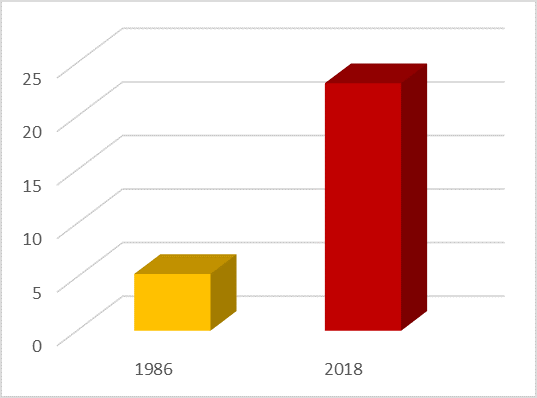
The discovery of crude oil in Nigeria caused an economic shift from agriculture to dependence on oil, resulting in Dutch disease syndrome whereby other sectors of the economy suffered because of increased international trade in oil and gas. Oil and gas production is capital-intensive and makes use of imported advanced technologies with minimal high skilled labour. Therefore, despite Nigeria having abundant supply of labour, expansion of trading activities in the oil sector has not necessarily translated to increased demand for labour. In addition, the crippling of the local agro-allied and manufacturing sectors has led to gross unemployment for unskilled/semi-skilled workers and higher premium on skilled labour, thus expanding the wage gap between the formal and informal sectors of the economy. Figure 1 shows a significant spike in unemployment rate since the liberalization policies commenced, rising from 5.3% in 1986 to 23.1% in 2018.

Fig. 1: Unemployment rate – Authors elaboration (National Bureau of Statistics, 2018)

Asides changes in demand and supply of labour, the Nigerian economy has become susceptible to fluctuations in the global oil market, often experiencing unfavourable terms of trade such that net exports are unable to cover imports. The lull in non-oil exports has also worsened, and can be attributed to a flawed national framework and weak institutions. Consequently, imports generally tend to be cheaper than made-in-Nigeria goods and services, thereby fueling failure of local small and medium enterprises (SMEs). This in turn reduces available jobs for low-income earners and ultimately, heightens the risk of transient poverty. Other channels through which globalization, growth and inequalities interact include; market concentration brought about by economies of scale, high entry costs, and non-tariff related entry barriers such as product or service requirements. All of these restrict market access and growth opportunities available to Nigerian SMEs, further widening income inequality gap among citizens.

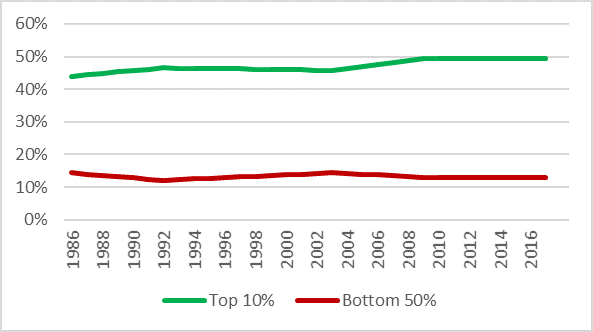
In addition, increased deregulation and privatization have resulted in reduced state spending on social goods and services, thereby limiting access and affordability for the poor. Although the country has recorded relatively stable growth for an extended period, this has not translated into shared prosperity. The WorldInequalityDatabase (Figure 2) shows that the proportion of national income accruing to the top 10% of the country’s population is currently more than triple the proportion accruing to the bottom 50% of the population, with no improvement in this trend for the last two decades. Asides income inequality, other dimensions of exclusion are prevalent in Nigeria. This growing divide has the potential to undermine national stability and development. Therefore, the country is faced with the challenge of recovering from the effects of the global pandemic, and ensuring that going forward; growth brought about by increased global integration translates into equal economic opportunities for Nigerians.

Fig. 2: Share of national income – Authors elaboration (WID, 2019)

By inference, Nigeria appears to have embraced globalization prematurely, evidenced by its weak institutions, poor human capital development, unsophisticated entrepreneurship, inadequate technologies and low financial assets. This has prevented its human and capital assets from competing favourably on the global stage. Thus, only a few already privileged citizens are able to enjoy the gains of globalization, by creating monopolies in certain sectors. Consequently, reform strategies to improve efficiency and capacity of local institutions, labour and capital assets are required.

Rethinking liberalization policy in Nigeria

Globalization can be valuable for emerging markets like Nigeria, when the right institutions are in place. Therefore, Nigeria needs to build strong and resilient institutions to provide a platform for driving innovative policies geared towards diversifying the economy, building capacity and a conducive environment for business growth, while considering the impact on marginalized groups. Export promotion strategies should identify priority sectors based on potential to create jobs, boost export earnings, and have robust market linkages. Policies on port reforms, simplification of export procedures, stable exchange rate, and indigenous technology advancement should be implemented. E-commerce should also be encouraged due to its potential for levelling the playing field between small and large firms in global markets. In addition, hindrances to business growth must be fixed, for example; power supply, distribution networks, and access to finance, with extra emphasis on rural communities.

Human capital and enterprise development are also a critical factor for inclusiveness, in terms of policies that improve affordability, availability and effectiveness of education and skills acquisition programs. This has the potential of boosting labour productivity, creating more opportunities for labour mobility and increased wages for low-income earners. In order to achieve this, it may be necessary to realign budgetary allocation to the education sector to expand access for disadvantaged groups. Finally, it is imperative to revisit existing redistributive policies, to ensure social protection programs adequately cater for marginalized individuals, and that the tax system is efficiently progressive and capable of promoting shared gains from national growth. Also, it is necessary to put in place measures to curb illicit capital flight and tax evasion by multinational corporations operating in Nigeria as these could play an important role in reducing inequality of outcomes within the country.

This article was written by Sone Osakwe, Research Intern at CSEA

Read More

The Impact of Covid-19 on Africa’s Pre-Existing Vulnerabilities

The COVID-19 pandemic has had devasting effects in many countries across the globe, affecting every aspect of humanity. The scale of the crisis was unprecedented, with both developed and developing countries under immense pressure to curtail the spread of the virus and the associated negative consequences on the economy. With the exemplary health systems in the rich world being overwhelmed by the scale of the outbreak, it became worrisome what the impact would be on low-income countries, particularly in Africa, with very weak health systems among other persistent challenges.

Most countries in Africa met the crises in a weak position. A host of pre-existing vulnerabilities signalled an impending disaster of massive scale. The region was battling with socio-economic challenges: rising debt; huge health infrastructure gaps; weak governance systems; unemployment and informality of labour; inequality and high poverty incidence, among others. But quite surprisingly, the evidence so far has shown relatively low levels of cases and fatalities, which have given rise to debates about several factors that may be driving the limited spread, albeit with limited factual backing. Some argue that the predominantly young population, higher temperatures, and previous exposure to similar diseases like malaria might be the cause(s) of the limited spread; while others contend that the official figures may be misleading, as poor testing facilities limit the number of overall tests conducted, and thus grossly underestimates the reality of the incidence of coronavirus in Africa.

Aside from the heath/mortality effects of the pandemic in Africa, the seemingly clearer effect is the impact of the social distancing and lockdown measures on the economy. While these measures were necessary to curb the spread of the virus following standard medical/epidemiological advice, the imposition of the measures in African countries had widespread negative impacts on several economies in the region. Restrictions to movement led to a general halt in economic activities, and importantly a disruption in the income of workers in the predominantly informal sector (66 percent of total employment in sub-Saharan Africa), who rely on small daily earnings. These workers in the gig economy in Africa have very limited savings to ease consumption, and thus the lockdown became a threat to their livelihoods.

In line with most countries in different regions, governments in several African countries provided a combination of fiscal, monetary and social protection responses, such as increased health and other crisis-related spending; easing of tax and duty payments for private enterprises; decrease in policy rate and lending facility rates; moratoria for COVID-19-related repayment difficulties; distribution of aid to the less privileged, among others. However, several factors have grossly limited the effectiveness of these policy responses. The first is that the spending plans of countries in SSA is only 0.26% of GDP on average, given the limited fiscal space and the high debt burden on the continent. The second is the high commodity dependence of many African countries, and the recent fall in demand for/prices of commodities have reduced their revenue-generating capacity and ability to ease tax payments. The third is the combination of high levels of informality of businesses and financial exclusion, inadequate data for the effective targeting of poor households, weak institutions and governance systems to ensure transparency and accountability in aid distribution, have all undermined the social protection responses.

The worry in Africa seems to be more about the negative effects of the disruptions/halts in economic activities and livelihoods, than the morbidity and mortality of COVID-19 itself. With the pre-existing vulnerabilities in the region, the crisis poses a genuine threat to livelihoods , and the adverse effects are expected to linger in the absence of concrete mitigation strategies. Other sources of finance such as remittances, which have increasingly become a major source of income and are used to ease household consumption for the poor, have been badly affected as the pandemic affected both the givers and the recipients. The World Bank estimates a decline of 23.1 percent in SSA as a result of COVID-19, the highest drop in history.

The situation has led to calls for global attention to supporting Africa, particularly for creditors to provide some debt relief for countries with high debt burdens, in order to create some fiscal room to tackle the pandemic. Different actors, including governments, private sectors, bilateral and multilateral organisations, International donors, civil society, among others, have come to the rescue of the continent in these perilous times. But the question remains: will Africa learn lessons from this pandemic to make conscious efforts to tackle these persistent vulnerabilities that continuously undermine their preparedness and response to outbreaks?

The pandemic can serve as a wake-up call for African governments to resolve the persistent challenges that continue to place the continent in a weak position. It is high time African governments take concrete and practical steps towards diversifying their economies to limit their exposure to commodity price shocks. The pandemic should stimulate efforts to move away from commodity dependence, particularly on oil extraction, to sectors which build and strengthen productive capacities, create jobs, and generate non-oil revenues. Governments in the region need to strengthen their public financial management by building and managing fiscal buffers to cushion the effects of commodity revenue shocks. Fiscal responsibility mechanisms should be enforced and backed by law, to limit wasteful expenditure and reckless accumulation of debt. There is need to provide incentives for businesses to formalize, as that would increase internally generated revenues, as well as improve the effectiveness of social protection initiatives, especially during periods of crisis. Governments can collaborate with development partners to strengthen data-based management systems to enhance the targeting of social safety net programs, particularly during emergency/crisis periods. Lastly, national governments and regional bodies should empower the knowledge industry to provide African solutions to the numerous African problems and challenges. Higher education, research organisations, civil society organisations, and other knowledge-oriented bodies should be adequately funded, to generate credible evidence and create awareness that will contribute to tackling future outbreaks in the region.

This article was first published by the Italian Institute for International Political Studies

Read More

Six Ways To Improve Nigeria’s Crumbling Transmission Network

Context: Nigeria’s transmission network has long been a weak link in the country’s electricity value chain. Despite recent improvements, the Transmission Company of Nigeria (TCN) has never dispatched more than 5.4GW of power to a country of 200 million inhabitants.1 The national grid frequently suffers from system collapses and regularly fails to transmit available generation (a peak of 7.6 GW).2 In 2017-18, about 28 system collapses occurred due to faults and load disturbances leading to partial or total blackouts nationwide.3 The government aims to reach the transmission capacity of 20GW by 2021 and has raised over $1.6 billion from donors for this effort.4 To achieve this target, the TCN should:

  1. Procure more reserves for generating power stations with functional automatic generation controls to manage frequency variations and reduce system collapse. The TCN needs an average of 400MW of spinning reserves but currently has none.5 In the meantime, the Nigerian Electricity Regulatory Commission (NERC) must approve the 260MW of spinning reserves recently procured by TCN.
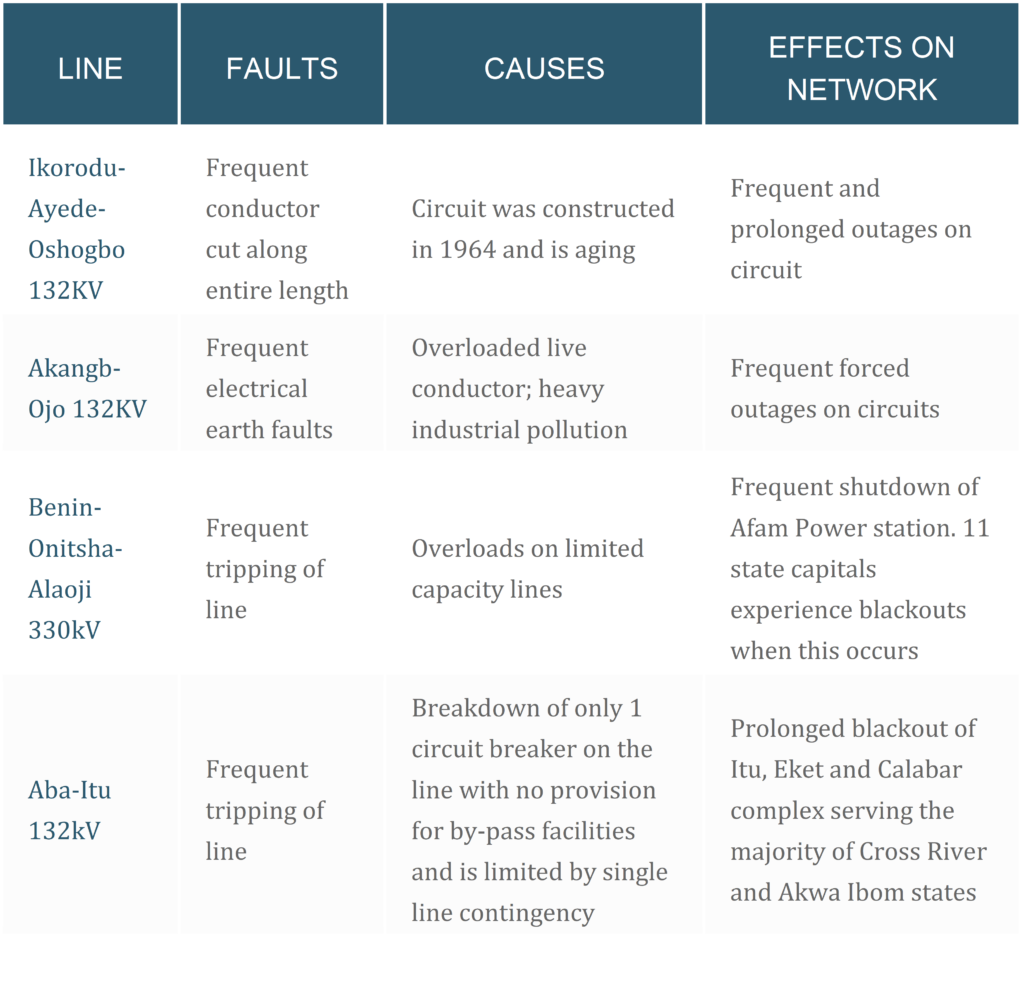
  2. Expand transmission lines and construct more substations to extend reach and improve the reliability of power. Construct additional relief lines to critical 330kV lines, such as the Alaoji-Onitsha line to correct current disturbances within its coverage.
  3. Refurbish sky wires and transmission equipment. Replace vandalized sky wires that expose the lines to lightning strikes, and replace obsolete transmission equipment to minimize the incidence of equipment failures.
  4. Tidy-up distribution network lines by erecting poles and properly tensioning lines to free them from overgrown vegetation. Rainstorms and other inclement weather can damage vulnerable lines, causing sudden large-scale loss of distribution loads.
  5. Initiate protection schemes for critical transmission-distribution interfaces to minimize the tripping of crucial transmission lines and damages to substations from faults. Currently, protection failure contributes to over 60% of system shutdowns, as nearly half of the 738 interfaces are not protected at the injection substations nor monitored in real-time.6
  6. Fast-track construction of digital control centers. Once built, the Supervisory Control and Data Acquisition (SCADA), Electricity Management System (EMS), and telecommunication networks will enable the TCN to digitally monitor the grid in real-time, trace, and repair system collapse faults, and minimize “blame game” in the industry.

Conclusion: Nigeria’s power supply reliability largely depends on the ability of the TCN to expand the transmission network and absorb more generated power. While significant funds have been raised to hit transmission expansion targets, the TCN must carefully consider its investment options, select vital upgrades, and closely monitor expenses.

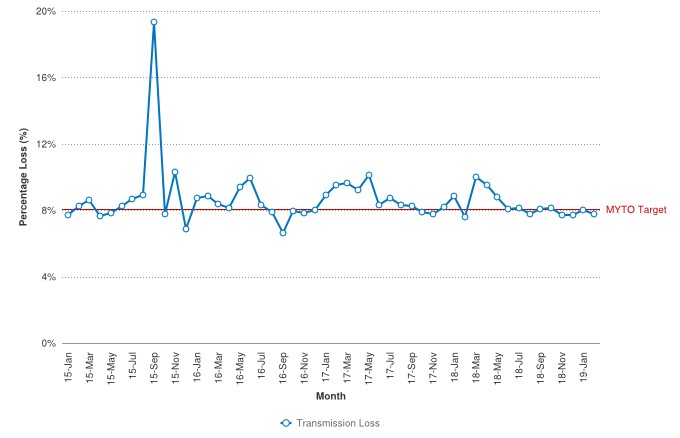
FIGURE 1: Transmission Loss Factor (%)7

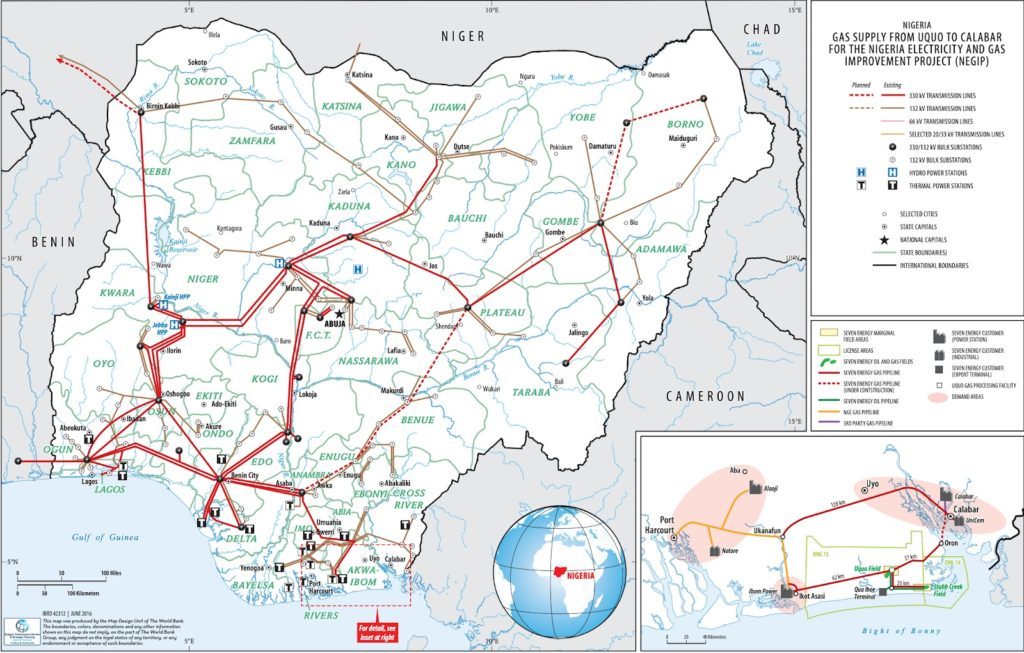
FIGURE 2: Map of Nigeria’s Major Transmission Lines8

FIGURE 3: Examples of Transmission Lines and Associated Problems9


Endnotes

  1. Nigerian Electricity Systems Operator (2019), TCN Announces New National Peak Of 5,375MW.
  2. TCN (2019), Transmission Expansion Plans
  3. NERC Quarterly Report 2017-2019
  4. Energy Mix Report (2019), TCN gets $1.6bn from multilateral donors to boost Nigeria’s power supply
  5. TCN gives reasons for frequent grid collapse despite $1.6b investments
  6. TCN (2019), TCN Newsletter -March 2019.
  7. NERC 2019
  8. Map design unit of the World Bank (2016)
  9. Oladipo F. and Temitayo, o. (2014), The Nigerian Power System Till Date: A Review. International Journal of Advance Foundation and Research in Science & Engineering (IJAFRSE), Vol. 1 (5).


Written in collaboration with Nextier Advisory and Published on
Energy for Growth Hub

Read More