



Student kidnappings threaten collapse of Nigerian education system

The Nigerian education system is deep into crises on multiple fronts, including in areas of access and quality of education. However, the recent spate of mass kidnappings of schoolchildren arguably represents the gravest existential threat and crisis to the education system. In less than three months between December 2020 and March 2021, more than 600 children have been kidnapped while in school, in three separate incidents

More worrisome is the fact that the heightened insecurity is predominant in northern Nigeria, which is already the most educationally disadvantaged region. Of the estimated 10.5 million out-of-school children in the country, 69 percent come from the North, where cultural practices and economic deprivation limit children’s active participation in school, particularly females. The Boko Haram crisis, with its debilitating effects on economic and education systems, is also heavily concentrated in the region. Now, with the spate of recent school kidnappings, community and parental trust in the education system could shrink significantly, and the problem of access to quality and equitable education could become severely amplified. Furthermore, with the Nigerian education system still recovering from the devastating effects of the prolonged school closure from COVID-19, adding insecurity concerns to the basket of challenges could lead to its irrecoverable collapse.

Nigerian policymakers, school leaders, and communities must effectively and creatively come together to help reverse the current economic and education dynamics to avoid a catastrophic collapse.

STEPS TO MAKE SCHOOLS SAFER AGAIN

Targeted kidnapping of schoolchildren began in 2014 with the mass abduction of 276 female students in Chibok by Boko Haram insurgents. That event was ideologically motivated, and designed to extort concessions from the government. Recently, abductions have become more profit-driven, involving organized and unorganized criminal groups. The profit dimension to the kidnappings can easily complicate Nigeria’s security problems, as they could become more frequent given the high level of poverty and youth unemployment in the region amid the stark absence of legitimate economic opportunities. If education is to survive, it is crucial to urgently change the current dynamics and make schools safe again. This crisis requires swift and comprehensive action, both in prevention and supporting victims to minimize long-term damages. While the scope for improvement is vast and complex, here we outline four focus areas that—if addressed—might garner meaningful traction toward avoiding future school kidnappings and averting the further dismantling of education in Nigeria’s North.

1. Comprehensive threat assessment of schools in the entire Northern region, with subsequent closures and relocation

In all areas of the North, even those removed from the Boko Haram-controlled Northeast, numerous armed groups are increasingly seeing the potential to “cash in” on insecure schools through a “kidnap and ransom” approach. Conducting a threat assessment in all areas of the country deemed vulnerable to such armed groups—including evaluating the location of the schools, their relationship to the surrounding communities (through consultations with local traditional leaders), and the state of their infrastructure—should be a first step to assessing which schools are most at risk. Institutions determined to be unsafe should immediately be shut, with contingency plans in place to facilitate temporary alternative learning arrangements (here the lessons learned during the COVID-19 crisis may be useful), together with strategies for relocating students to safer environments. Preventing more kidnappings should be the priority, not only for the welfare of potential future victims, but also with a view to salvaging any remaining public confidence in the safety of schools and avoiding further insecurity-related dropouts, which Nigeria’s education system can ill afford.

2. The development of a strong community support network to ensure affected communities are not left behind

Children and their parents who fall victim to armed kidnapping groups cannot be left unaided. Ensuring that they mentally recover from their trauma should be a central tenet of any intervention strategy that seeks to limit the adverse impacts of kidnappings on education. Children need strong community support networks tailored to the needs of children in conflict zones, including the training of teachers to help students recover from traumatic experiences and a greater availability of guidance counselors experienced in assisting trauma victims. If children are not to become permanently disillusioned with education, the fostering of positive emotions through affirmative training and building happier school-associated memories is crucial.

3. A reevaluation and revamping of the Safe Schools Initiative

The Safe Schools Initiative (SSI) was launched with much fanfare in the aftermath of the globally publicized abduction of the Chibok girls by Boko Haram in 2014. After a promising start—including several tens of millions of dollars pledged by a coalition of the Nigerian government, international donors, and Nigerian business leaders; a plan to relocate students in high-risk areas; and strategies to strengthen education in camps for internally displaced persons (IDPs)—it remains unclear how impactful the program has been so far.

While evidence of SSI’s success is lacking, this should not automatically lead to a disregard of its main principles. A reevaluation of its strong points, including its emphasis on the training of school staff to deal with emergencies and a focused extension of the initiative beyond the original scope for only the BAY states (Boko Haram mainly operate in Borno, Adamawa, and Yobe states), should be examined. The SSI was originally designed with the aid of international organizations such as UNESCO, and the government should not shy away from leaning on the foundations of a program that, if well-managed and sufficiently funded, could be effective in the North.

4. Addressing the long-term insecurity threat

The importance of dealing with the surge of economically motivated school kidnappings directly in schools cannot be understated. However, it is naive to assume that a school- or community-level intervention could suffice in the long run. Nigeria continues to suffer from perennial multipronged insecurities ranging from terrorism—there were at least 1,600 terrorism-caused deaths in the 11 months between January and November 2020—to the violent, ethnically tinged herder-farmer communal conflicts over agricultural land, which kill several thousands of people yearly. Without a comprehensive strategy to deal with the persistent state of violence, including a coherent plan to regain control of Nigeria’s “ungoverned spaces,” imagining a safe space for education is difficult.

Schools are only safe in so far as the larger society is safe. Nigerian policymakers, school leaders, and communities must effectively and creatively come together to help reverse the current economic and education dynamics to avoid a catastrophic collapse.

This Article was first published on Brookings

Read More

How Aba Shoe Industry can harness the Potentials of the AfCFTA

The African Continental Free Trade Agreement (AfCFTA) presents a major opportunity for African leaders to bolster trade in the region, as the region has become the largest trading bloc in history since the creation of the World Trade Organisation.

Specifically, the AfCFTA has the objective of creating a single market to deepen economic integration in Africa, aid the movement of human and capital resources across Africa, improve food security for Africa and agricultural development, encourage economic diversification, and improve the competitiveness of African countries among other objectives.

Africa’s population of about 1.3 billion people, and a combined market of $2.6 trillion means that Nigeria can gain enormously from this economic bloc. Currently, Nigeria has the largest economy in Africa. In the Economic Community of West African States (ECOWAS), Nigeria contributes 76 percent of its total trading volume, implying that the country has strong potentials to be a major player in AfCFTA.

The Aba shoe industry has the potential of driving Nigeria’s export and enabling Nigeria to become a net exporter of shoes, but the industry is constrained by infrastructural deficit such as power and good road network, financial access and the use of crude tools for production. Located in Aba, Abia State, South Eastern zone of Nigeria, the industry concentrates majorly on small and medium scale production, with a large number of artisans. Aba is well known for manufacturing products such as shoes, bags, and clothes. Mostly informal in nature, the industry is huge with an estimate of more than 100,000 shoemakers. The shoe industry has continued to compete favourably in the Nigerian local market with a rough estimate of about 500,000 pairs of daily production. While there is a general acknowledgement that Aba shoes are exported to other neighbouring African countries, there is hardly any documentation to back the claim, highlighting the informal nature of the shoe industry.

Figure: Aba-made Shoes

Benefits of the AfCFTA for the Aba Shoe Industry

The AfCFTA has every tendency to expand the market base of the shoe industry in Aba and increase productivity. This is because the industry is nowhere near its production possibility frontier as productivity can still expand to meet demand. An increased market base means that Nigeria can generate substantial revenue from shoe production coupled with improved employment opportunities and an enhanced quality of life. Full implementation of the AfCFTA means the creation of new markets for Aba shoemakers, accompanied with the removal of trade restrictions. Shoemakers in Aba can produce goods locally and get them across borders to sell without having to pay excise duty.

With the implementation of the AfCFTA, the likelihood of technological transfer, in the long run, becomes huge, from leading shoe manufacturing countries such as Ethiopia and Ghana, particularly through partnership and joint venture arrangements. This benefit would not only improve local productivity but can as well reduce the average cost of production. Improved benefits from the AfCFTA could also be achieved through collaboration with marketers from other countries in Africa. These marketers are familiar with the market arrangements of the recipient countries and thus information asymmetry is reduced, enabling proper linkages between the Aba shoe producers and potential customers in other African countries.

Measures required to Optimise the Benefits of the AfCFTA

However, in order to optimise the benefits of the AfCFTA, various measures need to be put in place. One of such measures is improving available infrastructure around the market clusters for ease of goods transportation. Hence, deliberate actions and measures are required to significantly reduce infrastructural deficits.

Improving the access to finance is also mandatory for the Aba shoe industry in the emergence of a larger market. In 2018, the Bank of Industry (BoI) introduced the Aba Finished Leather Goods Cluster Financing programme targeting over 150,000 artisans. The programme aimed to boost import substitution, with beneficiaries accessing about N300,000 to acquire raw materials needed to increase productivity. While this is commendable, the emergence of the AfCFTA has expanded the market frontiers for an increase in demand and further financial access policies which could boost productivity for export promotion becomes important.

Automation of the Aba shoe industry cannot also be over emphasized. While commendable efforts have been made by the Abia state government to improve automation by setting up the Enyimba Automated Shoe Factory, more still needs to be done to improve the tools utilised by small scale shoe manufacturers and artisans. In this line, the Abia state government and other key stakeholders can help with providing superior tools for artisans at a subsidized cost such as sewing machines, folding machines, eyelet pressers, smoothing and nailing machines among other tools that improve the efficiency of shoe production, which is beyond the conventional scissors and leather gums used for shoemaking by these artisans.

It is important to note that commendable efforts have been made to also improve the power supply to the industrial clusters in Aba. One of such is the Energising Economies Initiative which connected 4,000 shops in Ariaria international market to clean, stable, and affordable electricity, generating 9.5 megawatt (MW) of electricity.  Additionally, the Geometric Power Company is poised to provide constant electricity to Aba with its 141 MW power plant. The importance of these developments cannot be overemphasized in improving productivity. This makes it mandatory that various stakeholders ensure the smooth running of the electricity sector in Aba.

Furthermore, the utilisation of the internet for advertisement is important. Producers can create pages in popular social media platforms to advertise their goods beyond the borders of the country in which they operate. Aba manufacturers need to start developing social media networking and advertising skills and platforms for better patronage to reap the benefits of a larger market.

Conclusion

Tackling the challenges of production and marketing can improve the potentials of the industry in reaping the benefits of the AfCFTA, which is a big win for the Nigerian economy as the country struggles to diversify her economy. On this note, the government and the relevant stakeholders must address the challenges of Aba shoe producers for optimality in production to take place. 

Read More

Are Conventional Monetary Policies Regulating the Nigerian Economy?

The commitment of the Central Bank of Nigeria (CBN) to stimulate the economy following the      distortions caused by the coronavirus pandemic prompted the decision to reduce the Monetary Policy Rate (MPR) from 12.5% to 11.5% . However, the cash reserve ratio was retained at 27.5% and the liquidity ratio at 30%. 

The major goal of the CBN’s monetary policy has been to ensure price stability in order to avoid distortions and disequilibrium in the Nigerian economy and achieve improved economic activities and employment.

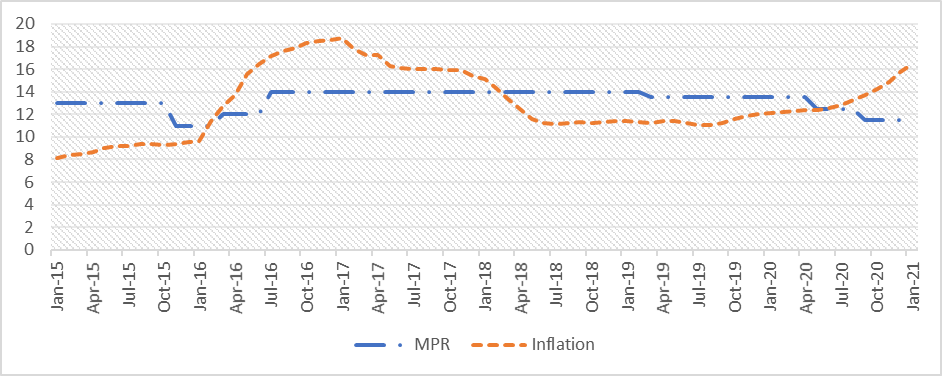
Prior to the reduction of the MPR to 11.5%, the CBN had consistently retained the MPR at 14% in 2018, and 13.5% between March 2019 to April 2020. Before 2018, similar patterns were observed. In those periods, as revealed in figure 1, the rate of inflation did not follow the expected pattern to changes in the MPR, even when considering time lags. Also, the correlation coefficient between the MPR and the inflation rate in Nigeria stood at 0.299 between January 2015 and January 2021, revealing a weak correlation between both variables. This suggests that inflation may not be responding to the MPR and that the CBN monetary policy may have been counterproductive.

Figure 1: Monetary Policy Rate and Inflation (M1, 2015 to M1, 2021)

Source: Central Bank of Nigeria (2021)

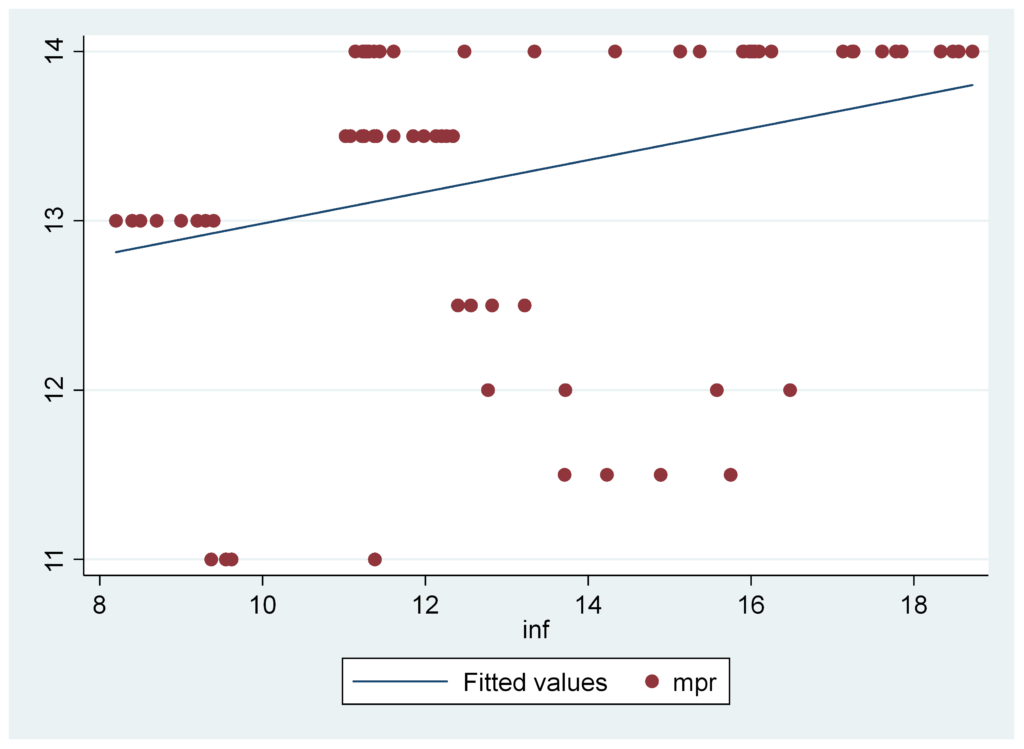
Figure 2 illustrates the relationship between the MPR and the inflation rate utilising the scatterplot and a regression line. It is revealed that there exists a positive association between the MPR and inflation that does not follow a priori expectations, implying that inflation increases with the MPR.

Figure 2: Scatter Plot and Regression Line of Monetary Policy Rate and Inflation (M1,2015 to M12, 2020)


Why does Inflation Rate not necessarily respond to MPR?

The major reason why the CBN’s monetary policy has not had a negative impact on Nigeria’s inflation rate over time is due to the factors that cause rising prices in the country.  Inflation in Nigeria is influenced by the aggregate supply side of the economy and not the aggregate demand side of the economy which the CBN can influence with its monetary policy tools. This is evident in the continued depreciation of the Nigerian Naira and the subsequent rise in prices. In other words, the Nigerian inflation is a cost-push inflation while monetary policies are most effective in demand pull inflation.

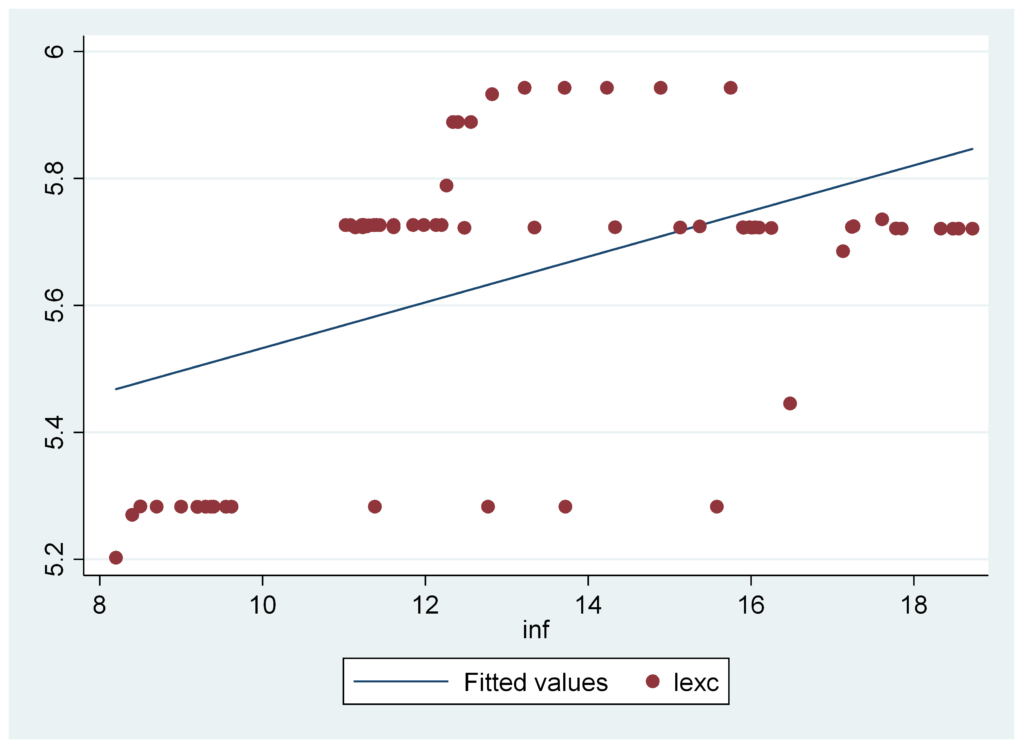
Figure 3: Scatter Plot and Regression Line of the logarithm of Exchange Rate and Inflation (M1,2015 to M12, 2020)

As revealed in figure 2, a scatter plot and a regression line observes this positive relationship between the natural logarithm of exchange rate and the inflation rate in Nigeria.

The Nigerian inflation problem has continued to emanate majorly from exchange rate depreciation due to crude oil price shocks. The fallen crude oil price level has led to the fall in the value of our exports compared to the value of imports. This has led to pressure on the Naira and has caused both currency depreciation and devaluation over recent times. Because Nigeria is heavily dependent on both imported consumer and producer goods, currency depreciation immediately transmits to rising prices, through the prices of imported consumer and producer goods and further multipliers in the economy.

Aggregate supply side inflation makes conventional monetary policy almost obsolete as they are engineered for demand pull inflation. Furthermore, as Nigeria battles with boosting her economy, the mandate of the Nigerian government should be to provide policies that can aid in improving the level of aggregate supply in the Nigerian economy.

Answering the question on what factors lead to the fall in aggregate supply is one way that can propel Nigeria out of a stagflation type economy—a situation where falling output level and rising unemployment is accompanied with rising prices.

Reducing the Monetary Policy Rate to boost Domestic Production

The goal of the double-digit MPR has been to stabilise prices over time. However, as previously acknowledged, the country's inflation problem is not caused by an excess of money supply in the economy. Instead, it has risen from low productivity and high cost of production in the Nigerian economy. If the CBN maintains its double-digit MPR, it will continue to transmit to high lending rates in the financial sector, making borrowing from the financial sector very expensive.

This in turn would keep productivity down and those who can still borrow for productive purposes would increase their price levels in order to make enough profit to repay their debt. This means that the double-digit MPR may be insignificant in terms of curbing inflation, or worse, it may act as a determining factor in raising Nigeria’s inflation level and even limiting the economic growth

While the CBN has taken steps to boost the Nigerian economy by reducing the MPR, further reduction in the MPR is imperative to bring significant increase in domestic production, particularly for Small and Medium Scale Enterprises (SMSEs). The importance of local production, economic diversification and improving the Nigeria’s  export base should be taken      into consideration by the CBN as they reduce the MPR. It is only when the local economy grows that Nigeria’s export base can grow and bring lasting solutions to Nigeria exchange rate problem.

Conclusion

Finally, given the peculiarity of the Nigerian inflationary problem – such that, inflation is propelled by cost push phenomenon and not demand-pull inflation, thus rendering the conventional monetary policies counterproductive. For the Nigerian economy to experience an increase in economic activities, it is essential that a key lever for facilitating this would be to significantly reduce the monetary policy rate to a single digit.

Moreover, lowering interest rates in the banking system, and making credit available would enable SMSEs maximise financial flow for development – thereby improving productivity, lowering commodity prices, and a reduction in unemployment. Policy makers must work to ensure economic policies are aimed at improving export base, as this would reduce the exchange rate problem which transmits to inflationary pressures.

Read More

The Imperativeness of Data Governance In The AfCFTA

The adoption of the African Continental Free Trade Agreement (AfCFTA) promises to bring together over 1.2 billion people to a single market with a combined Gross Domestic Product (GDP) of more than 3 trillion dollars. According to the World Bank, it is expected to lift 30 million people out of extreme poverty and raise the incomes of another 68 million living in moderate poverty. By easing customs procedures and removing red  tapes, the implementation of the AfCFTA will create up to $292 million in potential income gains.

Like every initiative in the digital age, the AfCFTA holds a promise of serving as an essential catalyst for the digital economy by facilitating more trade within Africa. For example, the trade bloc will provide access to a single digital market for the thousands of digital startups and e-commerce services on the continent. Furthermore, with significant gains already being harnessed in Africa's digital space despite the impediments caused by the lack of integration, the full implementation of the AfCFTA will see businesses achieving their full potentials. 

The AfCFTA has the prospects to expand E-commerce as internet and mobile phone penetration across Africa has been consolidated. With E-commerce, boosting Intra African trade and achieving the main objective of the AfCFTA will be made easier. According to Ajay Kumar Bramdeo, the African Union's ambassador to the United Nations in Geneva, "E-commerce has the potential to lift intra-African trade from the current rate of 18% and to boost Africa's share of global trade, currently estimated at less than 3%".

Moreover, the cost of data infrastructure needed to expand internet penetration further in Africa, which is a requisite in achieving a single digital market on the continent, will be cheaper if the said infrastructure serves wider markets. As a result of the scale economies that will arise as member countries open up their markets, instalment of digital infrastructure shall become cheaper, thus making Single Digital Market’s dream by 2030 a realistic target. Nevertheless, it is not the digital economy alone that stands to gain from the free trade area. The digital economy can facilitate multiple value chains and lessen the traditional boundaries for the exchange of goods and services thereby improving the effectiveness and gains of the AfCFTA. This reflects a somewhat simultaneous relationship between the AfCFTA and the digital economy.

It is safe to say that going digital exposes nascent enterprises to international counterparts who enjoy some basic standards that make them globally competitive. Africa is full of digital startups that hold so much promise for stimulating economic activity. Therefore, given these promises of the African Continental Free Trade Agreement and the digital economy, a data governance framework becomes necessary. Winnie Byanyima, the immediate past Executive Director of Oxfam International in 2019 noted that Africa has to avoid the earlier trade blocs' mistakes who had no ‘referees’ and no ‘rules’ at some point. Situating Byanyima's concern in the digital context justifies the need for data governance if a continental free trade area with minimal mistakes is what Africa wants to have.

The adoption of the AfCFTA in 2018 coincided with a record $700 million in annual investments in African startups. This points to the sheer amount of potential that the sector has to make the African continental free trade area even more worthwhile. Creativities in the tech space would continue to attract large investments into the African economy. In 2020, payment startup Paystack founded in Lagos Nigeria was acquired by Silicon Valley giant Stripe for $200 million. Such acquisitions, if sustained, drive foreign exchange earnings and facilitate the knowledge exchange and technology transfer needed to leapfrog the nascent AfCFTA.

Companies in the digital and telecoms industry have been calling for harmonization of data to enable them create efficient data and digital services. Africa must look beyond setting fair rules of the game in trade in goods and services only. The digital and data ecosystems have to be governed according to universal standards. In order to protect our trade bloc from becoming a safe haven for foreign tech companies seeking  to operate within our domain and  take unfair advantage of the lack  of data regulations, Africans must  develop a framework that will guarantee safety, privacy, and dignity of individuals and businesses alike.

The timeliness of the AfCFTA cannot be overemphasized. The digital economy poses an immense employment capacity which is likely to widen significantly from what would become the world’s largest free trade area. On the one hand, the massive growth of e-commerce is assured and the minimum investment required to install data infrastructure becomes within reach as cost per state reduces due to economies of scale. On the other, more non-aid investments are expected to continue flowing into the African digital sector, which will transform into jobs for a wider pool of Africa’s teeming youth. It is now left for Africans to reasonably exploit this huge advantage. What is needed is a consolidation of the opportunities in the digital economy with comprehensive data governance enforcement. However, this cannot be left on to the private sector to address, as one cannot be a judge in their own court, the government of the various African countries must take up the responsibility to come up with concise and universal regulations to govern data usage. Nigeria has already enacted a data protection regulation and expanded the purview of its communication ministry to include the digital economy. While this institutional move is worth replicating in African countries that are yet to govern the use of data, each country must ensure strict enforcement and constant updating of the data protection regulation for it to serve its purpose.

Read More

Delivering Basic Education Amidst Information Asymmetry, Resource Constraints, and Sticky Social Norms in Nigeria

Beyond the relationships that empirical papers try to establish between proximate determinants of education and learning outcomes, little is known about the mechanisms through which developing countries’ education systems transform inputs into learning outcomes. The Research on Improving Systems of Education (RISE) Nigeria team seeks to explore how these interactions occur and to influence both the investment in education inputs as well as learning outcomes. With 13.2 million out-of-school children and a 19 percent literacy rate among primary school completers age 18 to 37 (WBG 2018), Nigeria is an important case study for research on the political economy of basic education.

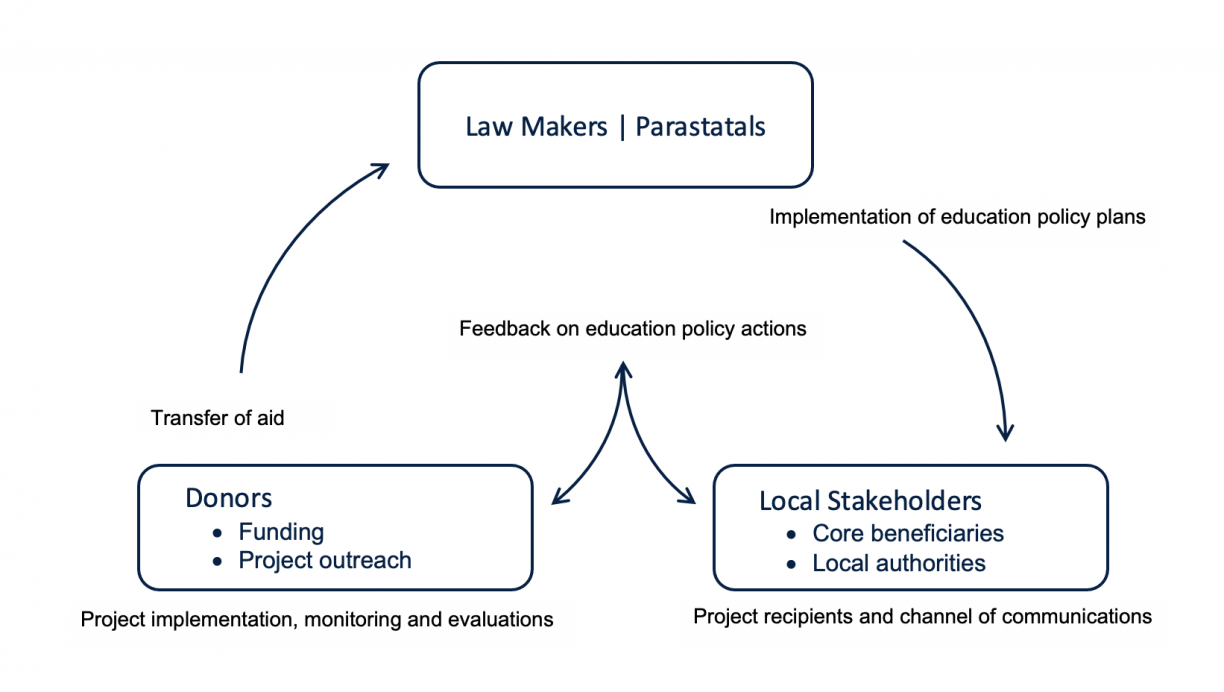
Several actors are involved in Nigeria’s basic education system. On the supply side, public institutions and agents are responsible for education policy and service delivery. The demand side includes students, parents and communities. The interactions between these actors—which are governed by resource constraints, social attitudes and norms, individual aspirations and incentives—produce not only the allocation of effort and resources but also the observed learning outcomes.

Figure 1: Political Economy Chart Flow in Nigeria

Chart showing connections between law makers, local stakeholders, and donors
Source: RISE-Nigeria Country Research Team (CRT) 2019

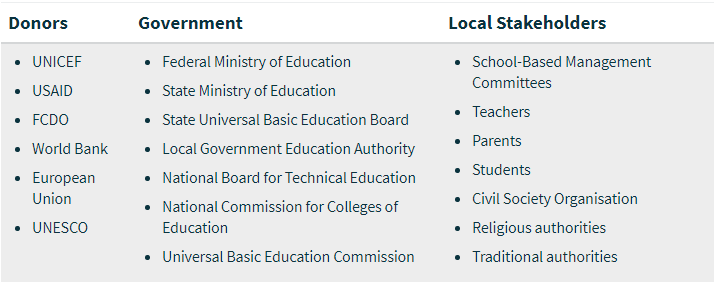
These actors can be further categorised under Donors, Government and Local Stakeholders. There is heterogeneity among local stakeholders, notably along income lines; wealthier families can exit the public education system in favour of private schools and are thus less reliant on education policy. These stakeholders’ engagement in the education sector remain interwoven, as each category of actors is indispensable to the others.

Table 1: Recurrent Actors in the Basic Education System of Nigeria

Generally, there is a disconnect between users of public services and the service providers in Nigeria. This dynamic may be due to the legacy of military rule, whose traits have lingered on till this day. Information asymmetry on the quality of education arises due to limited interaction among politicians, education policy makers, bureaucrats, practitioners, and the served public. This leads to inefficient resource allocation and poor outcomes. One way of addressing the disconnect between education stakeholders is through a process that generates a constructive dialogue, commitment to a set of shared targets and actions for achieving desired outcomes.

Such a process that bridges the supply and demand side of education is absent in many Nigerian states. Influenced by the different experiences of two Nigerian states (Ekiti and Oyo) in pursuing education reforms, the social contract component of the RISE Nigeria project seeks to study the political economy of education reform. Particularly, the study investigates how a process that brings together politicians and other education stakeholders to deliberate on education issues influences attitudes, behaviour, investment, and outcomes in education. The vehicle for formalizing this commitment is the social contract, which serves as a tool for stakeholders to seek accountability from each other.

The RISE Nigeria CRT is exogenously facilitating this process across five Nigerian states: Enugu, Oyo, Jigawa, Delta and Bauchi. The first phase of the study took advantage of the 2019 general elections cycle to initiate this process by conducting Education Awareness Workshops (EAWs) in select treatment states1. EAWs provided a platform for engagement and information exchange between stakeholders in the education sector and gubernatorial candidates. In addition, the EAWs provided a forum for research and information about education in the state to filter into the political process.

While each state has its unique challenges and policy directions, the issues identified and discussed by stakeholders touched on access, quality, finance, and equity. In the northern states, conservative social norms, insurgency, and severe school resource constraints (infrastructure and human) limit access to education, especially for girls. Stakeholders were enthusiastic about debating these issues and proffering context-appropriate solutions. Financing education and the debate about the role of private education featured prominently in the southern states and Kano. These initial engagements with key stakeholders indicated a willingness of actors to participate in discussions and paved the way for data collection leading up to the Political Economy Summits.

To prepare for each Summit, a data collection team researches the condition of schools in the Local Government Areas (LGAs) under consideration and administers tests to students to determine the current learning levels. The data collection team also carries out a power mapping activity to determine Summit attendance, and surveys stakeholders about policy preferences and hypothetical budget decisions.

To date, data collection activities have taken place in six Local Government Areas (LGAs) in Enugu and six LGAs in Oyo. Surveyed stakeholders considered the most pressing issues to be access to education, the quality of education, and the financial management of the education sector. Respondents also highlighted the need to improve infrastructure and to ensure professional development of teachers. The general conditions of the 60 schools surveyed in the three treated LGAs are quite concerning, particularly in terms of Water Sanitation and Hygiene (WASH) facilities, and ventilation. The majority of surveyed classrooms had inadequate access to power supply. Finally, the standardized test results show a low level of performance of pupils in primary schools, with girls performing slightly higher than boys, on average, in four core subject areas.

At the Summits themselves, education stakeholders convene and agree upon social contracts. This study will examine the efficacy of the social contract process in influencing education systems change, as described by school governance and outcome improvements. The study gets at the heart of the political economy of education reform in Nigeria, identifying ways through which political economy considerations might be important for the successful implementation of systemic reforms. This project is ongoing. We look forward to the results and to advancing knowledge about how education systems can be improved.

This article was first published on RISE

Read More