


The implication of Covid-19 pandemic on the Nigerian Economy

The Global Health Hazards and Economic Impacts of COVID-19

In December 2019, a cluster of pneumonia cases from an unknown virus surfaced in Wuhan, China. Based on initial laboratory findings, the disease named Coronavirus disease 2019 (abbreviated as COVID-19), was described as an infectious disease that is caused by severe acute respiratory syndrome coronavirus 2. The COVID-19 outbreak has since spread to about 196 countries and territories in every continent and one international conveyance across the globe. While there are ongoing efforts to curtail the spread of infection which is almost entirely driven by human-to-human transmission, it has accounted for over 400,000 confirmed cases with over 18,000 deaths[1].

Beyond the tragic health hazards and human consequences of the COVID-19 pandemic, the economic uncertainties, and disruptions that have resulted come at a significant cost to the global economy. The United Nations Trade and Development Agency (UNCTAD) put the cost of the outbreak at about US$2 trillion in 2020. Most central banks, finance ministries and independent economic experts around the world have taken solace in the prediction that the impacts might be sharp but short-lived, and economic activities would return to normal thereafter. This line of thought mirrors the thinking of the events that shaped the 2007 global financial crisis. However, it is quite instructive to note that the 2007 crisis which emanated from the United States’ subprime mortgage crisis was mainly an economic phenomenon, with its fallout spreading across many regions of the world. When compared to COVID-19, the 2007 crisis could be described as minor and manageable. The tumultuous events that COVID-19 had spread across the globe cut across every facet of human existence and the consequences may linger beyond the second half of 2020.

The slowdown in the global economy and lockdown in some countries, such as Italy, Spain and most Eurozone economies and beyond, as a result, COVID-19 has also taken its toll on the global demand for oil. The decline in oil demand is estimated to surpass the loss of nearly 1 million barrels per day during the 2007-08 recession. This is also coming at a time when two key players in the global oil industry – Russia and the OPEC cartel – are at loggerheads on the decision to cut output. The unequivocal oil price war started between these two global oil market giants may have more dire consequences on the oil price that has started to dive. .  

Sector-specific implications and impacts could vary. For example, the impacts on the global aviation and tourism sectors are a result of the implications of the pandemic on global travel. As discretionary spending by consumers continues to decline, cruise companies, hotels, and hospitality are facing declining demand and patronage. For example, in Hungary alone, about 40 to 50% of hotel reservations have been canceled. Also, the pandemic is placing up to 8 million jobs in the leisure and hospitality sector at risk, with travel crashes and cancellations expected to continue. Moody’s Analytics, a rating agency, stated that more than half of the jobs in the United States which is about 80 million may be in jeopardy.

The virus is also taking its toll on health facilities and infrastructures across the globe. Italy is currently the largest affected country with a number of deaths surpassing China, since the outbreak of coronavirus. Across northern Italy, the virus has pushed the country’s National Health Service to a breaking point, emphasizing the test that other countries, especially developing and low-income countries, might face in their approach to contain the virus spread. Most hospitals and health facilities that could not handle the hazards are resulting to operating below their capacity by taking a few regular health-related cases or shutting down. What could be more devastating is the fact that the economic pains that accompanied the virus might not go away soon as envisaged. 

The conventional policy measures currently being taken such as reducing interest rates and costs of borrowing, tax cuts and tax holidays are quite remarkable. However, these conventional policy measures are quite potent when there are demand shocks. There are limitations to the successes that can be recorded when demand shocks are combined with supply shocks. It is already apparent from the emergence of the current crisis that there are implications on the economy from both the demand and supply sides. Some of the demand factors include social distancing with consumers staying at home, limitations in spending and declining consumptions. On the supply side, factories are shutting down or cutting down production and output, while in other instances, staff work from home to limit physical contact.

The decision to close educational institutions and schools around the globe in an attempt to contain the pandemic has also led to a soaring number of children, youth and adults not attending schools. According to UNESCO Monitoring report on COVID-19 educational disruption and response, the impact of school closures in the over 100 countries that have implemented the decisions around the world has impacted over half of the global students’ population. These educational disruptions are being escalated particularly for the most vulnerable members of society.

Bracing up for COVID-19 consequences on the Nigerian economy

For most developing economies, the odds of sliding into a downturn are gradually expected as the global coronavirus outbreak puts severe pressure on the economy. For Nigeria, the country is still sluggishly grappling with recovery from the 2016 economic recession which was a fall out of global oil price crash and insufficient foreign exchange earnings to meet imports. In the spirit of economic recovery and growth sustainability, the Nigerian federal budget for the 2020 fiscal year was prepared with significant revenue expectations but with contestable realizations. The approved budget had projected revenue collections at N8.24 Trillion, an increase of about 20% from 2019 figure. The revenue assumptions are premised on increased global oil demand and stable market with oil price benchmark and oil output respectively at $57 per barrel and 2.18 Million Barrels Per Day.

The emergence of COVID-19 and its increasing incidence in Nigeria has called for drastic review and changes in the earlier revenue expectations and fiscal projections. Compared to events that led to recession in 2016, the current state of the global economy poses more difficulties ahead as the oil price is currently below US$30 with projections that it will dip further going by the price war among key players in the industry. Unfortunately, the nation has grossly underachieved in setting aside sufficient buffers for rainy days such as it faces in the coming days. In addressing these daunting economic challenges, the current considerations to revise the budget downward is inevitable. However, certain considerations that are expected in the review must not be left out. The assumptions and benchmarks must be based on realizable thresholds and estimates to ensure optimum budget performance, especially on the non-oil revenue components.

Furthermore, cutting expenditures must be done such that the already excluded group and vulnerable are not left to bear the brunt of the economic contraction. The economic and growth recovery program which has the aim of increasing social inclusion by creating jobs and providing support for the poorest and most vulnerable members of society through investments in social programs and providing social amenities will no doubt suffers some setbacks. Besides, the downward review of the budget and contractions in public spending could be devastating on poverty and unemployment. The last unemployment report released by the National Bureau of Statistics (NBS) ranks Nigeria 21st among 181 countries with an unemployment rate of about 23.1%. The country has also been rated as the poverty capital of the world with an estimated 87 million people living on less than $2 a day threshold.

The decision to cut the retail price of gasoline under a price modulation arrangement is a welcome development. The cut is expected to curb rising inflation, especially food price inflation which will mainly benefit the poor. However, rather than the price capping regime introduced, by which it is expected of the Petroleum Products Price Regulation Agency (PPPRA) to constantly issues monthly guide on appropriate pricing regime. It is expected that the government will use this opportunity to completely deregulate the petroleum industry in line with existing suggestions and reports. In the event that the global economy becomes healthier and crude oil prices increases, the government might return to the under-recovery of the oil price shortfall by the Nigerian National Petroleum Corporation (NNPC). A policy that annually costs the government huge revenue and recurring losses to the NNPC.

Basically, the Nigerian government essentially must lead economic diversification drive. It is one practicable way to saddle through the current economic uncertainties and instabilities. What the consequences of COVID-19 pandemic should further offer the Nigerian economic managers and policymakers, is that the one-tracked, monolithic reliance on oil is failing. Diversification priorities to alternative sectors such as agriculture, solid minerals, manufacturing and services sectors, should be further intensified.
 

[1] These figures were recorded as a 24th March, 2020.
Read More

COVID-19 in Nigeria – Internally Displaced Persons (IDPs) as Vulnerable Populations at Risk

Here is what we know – COVID-19 has no known cure (at the time of writing this article). We also realize that given the dearth of medical infrastructure in Nigeria, a full-blown pandemic would pose a rather dangerous threat. On the bright side, the mechanism of the disease’s transmission is clear – we know that it happens primarily through close contact with carriers of the causal Coronavirus, either by imbibing virulent bodily fluids (mucus, sputum) from them aerially, or through tactile contact with virus-riddled surfaces. In light of all established knowledge, the primary defence against the spread of the pandemic has therefore been the enforcement of social distancing and self-isolation within affected and at-risk populations, to minimize contact between the infected and uninfected. Countries like China have achieved significant declines in rates of new infections, largely by this method.

What may not be very clear at this point however, is precisely how profound the Nigeria (COVID-19) disease-scenario is. In-country data on infected persons may very well not be completely accurate representations of reality, as tested persons so far have predominantly emerged from the upper end of the income divide – most probably for reasons of limited resources and low knowledge-access among populations at the other end. What is more, the vast majority of Nigerians exist on that poverty side of things, and live in impoverished physical conditions. These groups (who will almost certainly not present for testing, except when compelled to by personal crisis) are potentially a tinderbox for the exponential spread of the pandemic, given the unsanitary environments and lifestyles that their impoverishment reinforces, as well as the fact that the methodologies of social distancing and self-isolation are hardly feasible among their ranks. They are, in addition, significantly less able to access and utilize vital information regarding prevention and management of the disease (for reasons of education and resource-limitation). The point is this – the COVID-19 situation in Nigeria at this time is precarious (in terms of risk to life and health) – perhaps more so than is apparent – and this is largely because of that poverty-dimension. What is more, the current government response of enforced shutdown of economic and other activities within most-hit states ( shutdown will probably be effected in other states soon) will also deeply and adversely affect the livelihoods, and therefore, lives of the poor, whose incomes are often earned and exhausted on the same day.

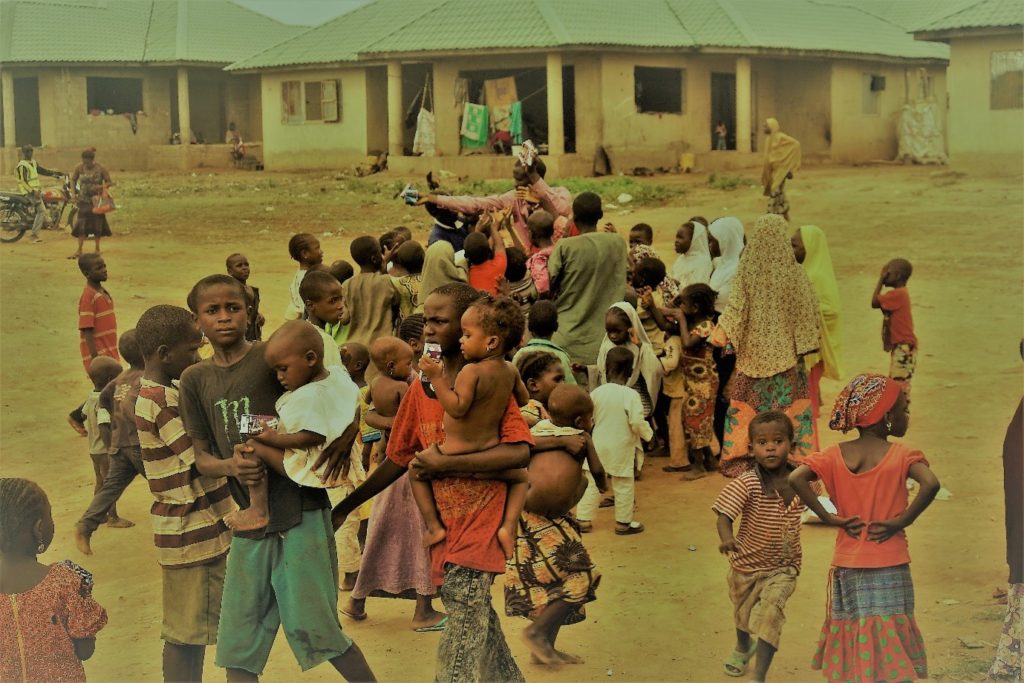
For these reasons, Internally Displaced Persons (IDPs) in Nigeria are in very significant jeopardy. According to the United Nations High Commission on Refugees (UNHCR), over 2 million Nigerians have been displaced from (Boko Haram) insurgency hotspots in Northeast Nigeria since 2009. These migrants have settled into IDP Camps across the country, which are characterized for the most part by overcrowded populations amidst severe infrastructure deficits. IDP populations in Nigeria are dominated by poorly educated, rural, farm-folk, who are hardly able to achieve meaningful livelihoods in their new, mostly urban settlements. They are for this reason typically impoverished and dependent on humanitarian-aid for even their sustenance; and have very limited access to healthcare or water, sanitation and hygiene (WASH) amenities as well. In the past, these terrible living conditions have rendered IDP camps a cesspool for dangerous medical crises – in 2017 for example, there were over 4,800 cases of Cholera and 61 deaths, in an outbreak across IDP Camps in Nigeria.

One can therefore see how this looming COVID-19 pandemic would give cause for grave concern regarding the level of risk their situation exposes Nigeria’s IDPs to – and further to that, how much risk they might  pose to the larger population (could IDP settlements for instance inadvertently become repository-populations for the virus, and vehicles for its proliferation?). In the event that it is not immediately clear, here are some of the reasons for this concern:

WITH CHARACTERISTICALLY LIMITED LIVING-SPACES IN IDP CAMPS, SOCIAL DISTANCING AND SELF-ISOLATION WILL BE DIFFICULT TO ACHIEVE

The reality is that, with regard to how overcrowded they are, most IDP camps in Nigeria are unfit for a healthy living anyway. Typical camps consist of makeshift or poorly-built housing that hold multiple times the number of occupants that they should; while common areas and outdoor spaces, even amidst recent events, constantly have numerous people congregating within them. These IDP Camps are in essence, in the current climate, accidents waiting to happen.

POOR INFORMATION-ACCESS AND LOW EDUCATION-LEVELS COULD HEIGHTEN SPREAD

Information and knowledge have proved formidable, and effective, weapons so far in the fight against the spread of COVID-19. Across the globe, we have seen and learned from other sources, accounts from different countries of how to successfully prevent incidence. Information of this sort might however not be fully appreciated by poorly educated persons such as IDPs, even when they can access it – for lack of proper comprehension of the situation. For instance, some Nigerians still had to be forcibly barred from gathering publicly only recently. This is an attitude that represents a potential to enable spread of the disease amidst measures to curb it. Until the time when observing the reality of the pandemic foists an understanding of the situation’s true gravity upon them, demographics such as the IDP, might function as loopholes for the propagation of COVID-19; in their disregard of safety conventions.

LIMITED ACCESS TO HEALTHCARE MIGHT CAUSE MULTIPLE TYPES OF ADVERSE OUTCOMES

If one envisages a scenario of panic where a great number of IDPs require urgent, life-saving medical care that is in short supply, it is easy to understand how things might escalate at that point. Caregivers to, and family of the dangerously ill (even the moderately ill themselves) might easily in that time succumb to a desperation in their actions, which would put everyone else at risk – in both health and civil terms.

TRUNCATION OF INCOME (FROM LOCKDOWNS) WILL AFFECT IDPs MORE THAN MOST

IDP populations typically have no means of cushioning a cessation of earnings, even for short periods. A situation such as the one that has been imposed in some places, and which portends in others – where all monetary inflow is stopped (during state-wide lockdowns) – simply holds the implication of potential starvation for IDP families. They will not survive without external help.

The state of things is deeply concerning all round, but there are measures that can be taken to  forestall doom:

  • Government, as well as humanitarian players, should scale up current response-plans, to cover vulnerable and at-risk populations such as IDPs in every foreseeable dimension during this pandemic – this means adequate healthcare for treatment and prevention, as well as food and other resources needed.
  • Communication strategies should be formulated and enacted, which will effectively demonstrate the full dimensions of the current problem to IDPs, alongside proper methods of preventing spread and managing infections. The consequences of aberrant behaviour on everyone involved should be fully explained to them as well – it is paramount at this time to communicate acceptance to IDPs into their host communities, so that within crises they would think and act constructively as community-members, and not destructively as disgruntled outliers.
  • Basic, healthcare and WASH facilities should be provided at this time to IDP Camps across the country as preventive measures, to enable them stem spread within their communities.

With all (sanitized and/or washed) hands on (a properly disinfected) deck, we should, IDPs and non-IDPs alike, prevail in the end.

Read More

The Growing Livelihood-Problem for Internally Displaced Persons in Nigeria

“I was almost killed”

Amos is perched on the edge of the bench, next to me, underneath the broad shade of an old mango tree. It is mid-afternoon, and the heat is sweltering in this Internally Displaced Persons Camp in Sabo Kuchinguro, Abuja Federal Capitol Territory Nigeria. He is absently kicking the pebbles at his feet with the tip of his worn sandals, and is staring blankly into a crowd of noisy, playing schoolchildren in the distance.

“I was almost killed”, he says to me, his face lost in the contemplation of that troubling memory.

“They murdered my next-door neighbour, right in front of my eyes. When they came into our village, they simply set upon slaughtering everyone in sight. All we could do was run fast and far, away from the gunshots and the screams. We left everything behind and ran. We ran up to the mountains and hid for days with no food. We snuck back down in the middle of the night and kept running; we ran all the way to Cameroun. It was from there that some of us eventually made our way back here”.

These armed assailants in Amos’ tale are part of the Boko Haram terrorist group – who repeatedly attacked his village in Gwoza, Borno State and displaced him along with many others. Since 2009, Boko Haram has enacted sustained insurgency attacks in North-East Nigeria, killing thousands and displacing over 2 million people to date – to other parts of the country and to neighbouring Cameroun, Chad and Niger. Camps have necessarily been assembled to absorb and resettle the displaced persons, with a lot left to be desired howbeit – sparse local resources and thin donor-funding imply difficult living-conditions for the migrants. Although the outflow of persons from the troubled regions has waned over the years, the insurgency has not abated sufficiently for residents to return to their homes, and so Internally Displaced Persons’ (IDP) Camps across Nigeria have, if anything, only ballooned in their population-sizes.

“We have nothing to do here”

A collateral problem has emerged: beyond the immediate needs of resettlement, food, healthcare and WASH (water, sanitation and hygiene) facilities for IDPs, the question of livelihoods has been largely ignored in the intervening humanitarian efforts so far. To put it in context – the vast majority of work-force-age IDPs are (previously-) rural-dwelling farmers with little education, or none at all. Resettling predominantly to urban areas, they are too poorly-skilled to integrate within the local economies of these new metropolitan environments. What is more, opportunities in Agriculture, where their capabilities lie, are sparse in these places. The resultant is their entire dependence on donor-aid for sustenance and survival.

“We have nothing to do here”, says Amos to me.

He and I are walking among the dingy homes in the camp now – some of the dwellings are built only with wood and old cement-bags. A glumness hangs in the air all around us – a palpable despondency of this habitat’s occupants that has materialized into the dullness and dirt that characterize it. I see a barely-clad toddler playing on the ground, by a puddle of water, his faced smudged with mud and mucus. I reach down to pick him up.

“Please don’t do that!” Amos says sharply.

I am puzzled, but I comply and withdraw my outstretched hands. My little would-have-been-acquaintance looks up at me with an expression of disappointment at this turn of events.

“We have had cases of kidnappings of little children here in the camp”, Amos explains.

“We are vulnerable here….we are migrants….this is not our home. People can take advantage; and they have done. From experience, parents here are very wary of strangers accosting their children. This little boy’s parents might misunderstand your intentions”.

I do not press the matter further.

We stop at what Amos informs me is a brothel. The walls are built with bamboo, as is the ‘fence’. There is a large open space outside for visitors to sit in, and await their turns as it were. Clusters of men are seated in that space, speaking very little and smoking marijuana and cigarettes.

“Men here have nothing to do….no work. They just sit around all day, smoke, drink Codeine and Tramadol, and look for sex – consensual or forced. They have stayed idle this way for so long at this point that I feel some of them don’t even want to have any meaningful jobs anymore”, says Amos.

This makes me realize the very distinct possibility that elements of post-traumatic stress disorder and even depression, borne out the horrific ordeals that most of these people have lived through, might reside in them, undiagnosed and untreated. Surely it is important to get them working again, but maybe that step is contingent on an appraisal of their psychological states, given their past and indeed, present situations. Another thing nags at me.

“If these young men have no jobs and income, where do they get the money from, for the drugs and prostitutes?” I ask Amos.

“I don’t know”, he responds. I find this worrisome.

As we leave the premises, I notice 3 of the ‘hostesses’ seated outside in that open, conversing. I am astounded at how young one of them looks to me to be.

“Allow us farm”

Next to the entrance of the camp, where there are makeshift administrative offices and a tiny nurse’s station, we run into Enoch, who is one of the directors at the camp. He is himself an internally displaced person. Enoch tells me of how different groups bring different types of aid to them routinely – mostly money, food, and such items as clothing and books. He and Amos take me to what was purposed as a skills-training centre, housed in a makeshift building. They tell me the centre had been gifted to them by the Embassy of South Africa in Nigeria, in their recognition that the IDPs need to be reskilled in order for them to function gainfully within the labour markets of their new homes. The centre, which at one time had vocations such as sewing, cosmetics-making and basic computing taught within its walls, was now derelict…..with old and damaged equipment strewn about.

“The South Africans started this with the hopes that after a while, aid-groups from Nigeria would carry on the work. That didn’t happen, and it all died out eventually”, Enoch tells me.

“We are at a severe economic disadvantage. We are mostly just uneducated farmers here. Without training in even the most basic trades and crafts, a lot of us really will not be able to ever make a sufficient living”.

“Allow us to farm”, he continues. “If we cannot receive training that will help us get jobs, then at the very least allow us to farm – that is what we know to do. Given our plight, we should be allowed farmland and any concessions that help us get back on our feet. It’s not that we don’t appreciate all the help so far, it’s only that we would be prefer to be assisted to become self-sufficient, and not just be assisted to eat day to day”.

As I leave the camp that evening, I realize that this paradigm-shift Enoch spoke of is an imperative. I realize that in our collective neglect – oblivion even – of the more sustainable manner of aid to IDPs, we may have just been giving room for the emergence of another dire set of problems. But surely it’s not too late.

In 2019 CSEA conducted livelihood assessments in Waru and Sabo Kuchinguro IDP Camps in Abuja FCT Nigeria, to ascertain best methods for training/re-skilling/equipping IDPs for economic independence.

Read More

How Big is Nigeria’s Power Demand?


Context: Nigeria has Africa’s largest population and economy, but Nigerians consume 144 kwh per capita annually, only 3.5% as much as South Africans.1 With only 12 GW installed, and typically just one-third of that delivered, Nigerian power production falls far short of demand, which is a primary constraint on economic growth. Self-generation using dirty diesel generators is exceedingly common in Nigeria, and bear a significant economic and environmental cost.2 But exactly how big is the demand-supply gap? And what does future demand look like?

How large is power demand in Nigeria?

Electricity demand estimates and projections for Nigeria suggest that demand is already substantial and increasing rapidly due to population and income growth.

  • Nigeria is one of the most underpowered countries in the world, with actual consumption 80% below expectations based on current population and income levels.3
  • Peer countries consume far more electricity per capita than Nigeria does currently. Ghana consumes over twice as much, Tunisia over ten times, and South Africa almost thirty times as much.
  • Self-generation in Nigeria is extremely prevalent; nearly 14GW capacity exists in small scale diesel and petrol generators, and nearly half of all electricity consumed is self-generated. This implies a huge unserved demand.
  • Due to a population boom and a large gap in electrification, the World Bank projects electricity demand will have grown by a factor of over 5 between 2009 and 2020, and 16.8 by 2035.4

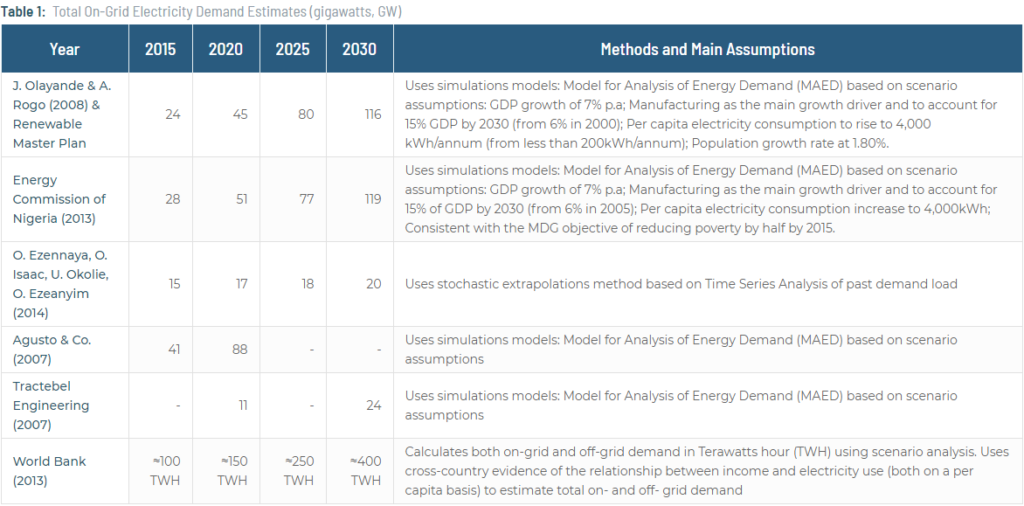
Given this, we can assume that Nigeria’s demand gap is significant, though exactly how large is disputed. The significant differences in these estimates demonstrate the difficulty, and importance, of accurate demand forecasting.

The below estimates show large variance in projections for peak power demand mainly due to differences in scenario assumptions and existing infrastructure during study periods. Projecting power demand in Nigeria is challenging due to difficulty in estimating the large amount of electricity produced by small and unregulated petrol/diesel-powered generators, and in quantifying suppressed demand. Looking at available demand estimates for 2015 (Table 1), Nigeria’s on-grid electricity demand seems to be about 4 – 12 times the total electricity distributed on the grid (at 3200 MW, or 3.2 GW). Even at optimistic capacity factors and assumptions about deliverability, Nigeria needs well over 63GW of new generation to satisfy unmet demand.5 Until then, expensive and dirty self-generation will remain pervasive.

Endnotes

  • World Bank (2019). Electric Power Consumption (kWh per capita). Retrieved from: https://data.worldbank.org/indicator/NY.GDP.MKTP.KD.ZG?locations=NG
  • IEA (2017), Energy Access Outlook: From Poverty to Prosperity, IEA.
  • Todd Moss and Gailyn Portelance. “Do African Countries Consume Less (or More) Electricity than Their Income Levels Suggest?”
  • R. Cervigni, J. Rogers, and M. Henrion (2018), Low Carbon development: Opportunities for Nigeria, The World Bank
  • GIZ (2015), The Nigerian Energy Sector An Overview with a Special Emphasis on Renewable Energy, Energy Efficiency and Rural Electrification. Nigerian Energy Support Programme (NESP)
  • Olayande, J.S & Rogo, A.T. (2008), Electricity Demand and Supply Projections for Nigeria, Abuja: Energy Commission of Nigeria
  • Sambo, A. S., 2008. Paper presented at the “National Workshop on the Participation of State Governments in the Power Sector: Matching Supply with Demand”, 29 July 2008, Ladi Kwali Hall, Sheraton Hotel and Towers, Abuja.
  • O. Ezennaya, O. Isaac, U. Okolie, O. Ezeanyim (2014), Analysis Of Nigeria‘s National Electricity Demand Forecast (2013-2030), International Journal Of Scientific & Technology Research 3(3)

This article was first published on Energy for Growth Hub

Read More

Poverty Alleviation via Education in Nigeria: Lessons from China

In Nigeria, approximately 50% of the estimated 193 million population live in poverty. In 2018, the World Poverty clock estimates that Nigeria has the highest number of people living in extreme poverty. These trends point to the need to rethink and rejig the government’s approach to poverty alleviation.

In rethinking Nigeria’s current approach, there are important lessons that could be drawn from emerging economies like China. Between 1990 and 2015, China effectively lifted 745 million out of poverty. This contributed to about 70% of the global poverty reduction over the period and the achievement has been described as the most impressive economic miracle in development history. While the roles of market reform, trade openness and state-led development initiatives in this ‘economic miracle’ are well documented, the role of education in the broader poverty alleviation strategies has been less emphasized. A new book on Poverty Alleviation in China[1] is drawing attention to the role of education in Chinese development narrative and there are many important lessons for countries like Nigeria which is facing similar developmental challenges. In this piece, we highlight four key lessons for Nigeria in order to reduce poverty via education.

First, vocational education was given priority among other levels of education in China. The elevation of the status of vocational training allowed a wider demographic of individuals (young and old) to acquire the benefits of skill development in the short-run through a flexible program. The programs ensured that the skills supplied within these communities matched local demand in order to effectively impact their experience. It also reduced the level of rural to urban migration as the campaign provided local opportunities, developed human capital within the rural areas which consequently broadened their capability. Although Nigeria has set up vocational training programs both in the formal 6-3-3 education system, as well as state governments and civil societies facilitated programs, its impact is limited. This is because the program is not widespread, lacks permeability and the programs are not standardised in delivery. Similarly, the lack of an overarching initiative focused on skill acquisition in the Nigerian education system limits its impact on poverty alleviation and also exclude some demographic groups in the development process.

Second, education policy is considered as a subset of the grander economic policy, as such China’s education policy are jointly designed and implemented by the ministries of finance and education. The synergy between the finance and the educational ministry covers standardisation of education structures across various regions as well as teacher’s training and placement programme. The understanding that education policy is directly related to economic policy is one crucial area that presents an apparatus for policy design which Nigeria can learn from. For instance, the problem of out-of-school children in the Northern Nigeria, many scholars have observed that poverty and other economic fundamentals play a role in the problem[2]. However, policy interventions to address the problem have concentrated mainly on education sector driven solution like building more schools. Predictably, most of the educational interventions to out-of-school children issues in Nigeria have failed to deliver the expected outcome. Again, China’s approach to economic planning through mainstreaming poverty alleviation programs into the education policy could help Nigeria to simultaneously tackle the educational and economic challenges.

Third, China’s intervention in reaching disadvantaged communities and vulnerable groups that are not in school employed a good mix of free education and other incentives to encourage participation. The Chinese government provides region-specific subsidies for students within disadvantaged areas as well as loan schemes to encourage longer years of education in order to effectively improve their quality of life. There is an increasing recognition in the Nigerian context too that making education free does not automatically translate to more inclusion or increase enrolment, but that additional incentive is required to encourage more participation of the disadvantage groups. Also, constraints to schooling extend beyond costs and could be driven by cultural and behavioural factors. Responding to these non-cost elements require additional interventions even when education is free. The federal and state governments recent school feeding programme is an example of balance policy mix to improve inclusion. Going forward, it is crucial to expand the interventions to region-specific incentives to improve educational performance in Nigeria.   

Fourth, it is reassuring that China with outstretched government’s presence still recognizes and ensures robust community participation in its education management. Besides allowing for supplementary training and facilities by the private sector, government-own initiatives also use local role models and organizations to secure wider buy-in from the public.The organizations and individuals were involved in campaign and awareness programme regarding education reform. In the Nigerian system where implementing reform is difficult, more involvement of communities in education policy intervention will be vital and could help restrain vested interests and better communicate reform benefits to the public. This is because the local agents understand the region-specific idiosyncrasies and factors to ensure efficient implantation and implementation of policy. In pursuing poverty alleviation in Nigeria, education system could play a significant role beyond its traditional functions of socialization and capacity and knowledge development. Education can directly work to reduce poverty through promoting inclusiveness, strengthen community engagement and using vocational education as a springboard for development. The Chinese experience offers a template which has worked to lift more than three times the estimated Nigerian population out of poverty and fortunately it only requires looking inward and building broad base local partnership.


[1] Editorial board of Poverty alleviation in China ‘Poverty-Alleviation via Education in China’,(2018), First edition

[2] Lincove, J. (2009). Determinants of schooling for boys and girls in Nigeria under a policy of free primary education. Economics of Education Review, 28(4), pp.474-484.

Read More