According to Nigeria’s Domestic and Foreign Debt Q2 2026 report by the National Bureau of Statistics (NBS), Nigeria’s public debt stock reached ₦166.79 trillion (US$120.93 billion), up from ₦159.35 trillion (US$114.95 billion) in Q1 2026, representing a quarter-on-quarter growth of 4.67%. Total external debt stood at ₦75.20 trillion, while total domestic debt was ₦91.59 trillion. Furthermore, domestic debt accounted for 54.91% of total public debt, compared with 45.09% for external debt. At the state level, Lagos recorded the highest domestic debt in Q2 2026 at ₦1.20 trillion, followed by Delta (₦369.30 billion), while Jigawa (₦1.04 billion) had the lowest, followed by Ondo (₦6.16 billion).
According to official auction notices from the Central Bank of Nigeria (CBN) for September 29, 2026, the apex bank launched a ₦2.5 trillion Open Market Operations (OMO) auction across three tenors to sterilise a ₦2.433 trillion OMO repayment maturing on 29 September 2026. This near one-for-one liquidity match occurred against a backdrop of mounting system liquidity, with commercial bank placements at the Standing Deposit Facility (SDF) expanding by 6.4% in four days to reach ₦6.278 trillion. Meanwhile, strong demand across maturities helped long-term stop rates cool to 17.29%, down from 18.99%. These matched OMO auctions help prevent excess bank reserves from pressuring the foreign exchange market or driving consumer price inflation after the MPC reset its benchmark rate to 23 %. Extending OMO maturities into mid-2027 anchors short-term money market rates and commits excess liquidity over an extended horizon.
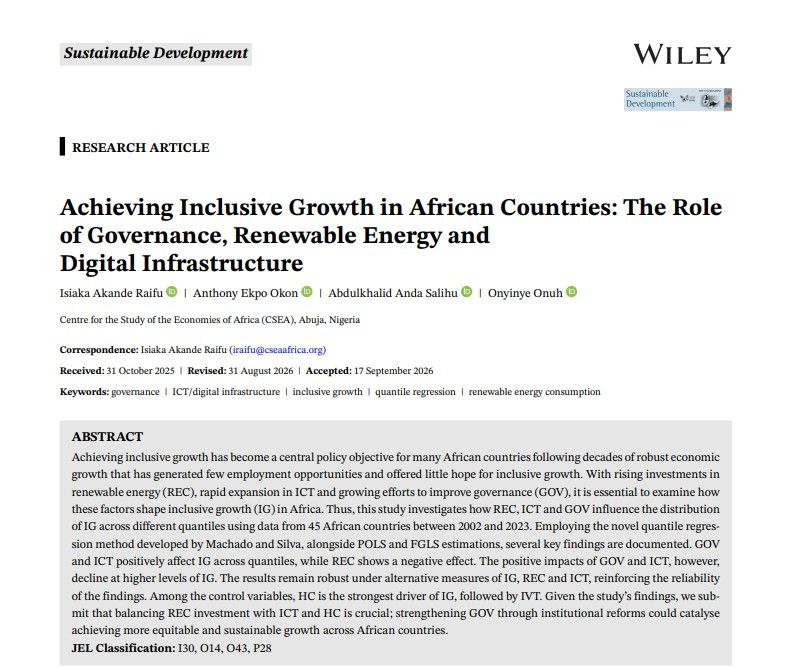
Achieving inclusive growth has become a central policy objective for many African countries following decades of robust economic growth that has generated few employment opportunities and offered little hope for inclusive growth. With rising investments in renewable energy (REC), rapid expansion in ICT and growing efforts to improve governance (GOV), it is essential to examine how these factors shape inclusive growth (IG) in Africa. Thus, this study investigates how REC, ICT and GOV influence the distribution of IG across different quantiles using data from 45 African countries between 2002 and 2023. Employing the novel quantile regression method developed by Machado and Silva, alongside POLS and FGLS estimations, several key findings are documented. GOV and ICT positively affect IG across quantiles, while REC shows a negative effect. The positive impacts of GOV and ICT, however, decline at higher levels of IG. The results remain robust under alternative measures of IG, REC and ICT, reinforcing the reliability of the findings. Among the control variables, HC is the strongest driver of IG, followed by IVT. Given the study's findings, we submit that balancing REC investment with ICT and HC is crucial; strengthening GOV through institutional reforms could catalyse achieving more equitable and sustainable growth across African countries.
Read more
This was authored by:
Isiaka Akande Raifu, Anthony Okon, Abdulkhalid Salihu, Onyinye Onuh
According to the NMDPRA August 2026 Factsheet, the Dangote Refinery recorded an average capacity utilisation of 105.21%, producing 41.94 million litres per day (ML/D) of Premium Motor Spirit (PMS), alongside substantial volumes of diesel and aviation fuel. Average domestic PMS consumption stood at 41.5 ML/D, below the 50.0 ML/D benchmark, while national PMS stock sufficiency was 22.9 days, below the required 30-day strategic threshold. In contrast, Automotive Gas Oil (AGO) had a 51.6-day stock surplus, while Liquefied Petroleum Gas (LPG) consumption increased to 4.8 Kilotonnes per day (KT/D), despite a 17.2-day stock deficit. Nationwide gas processing averaged 8.258 billion cubic feet per day (Bcf/d) across 47 plants, representing 51.02% capacity utilisation, with 0.633 Bcf/d supplied for power generation. The increase in domestic refining capacity and the substantial diesel stock buffer represent progress towards greater domestic fuel supply and stability. However, the PMS and LPG stock deficits remain important vulnerabilities, particularly because both products are critical to household and economic activity. The relatively low utilisation of gas-processing capacity also suggests scope to increase domestic gas availability, including for power generation.
In recent years, Nigeria’s cigarette excise tax structure has improved, especially through the introduction of a mixed tax structure. Since 2018, the government has introduced several tax policy changes, including adopting a mixed structure that combines specific excise taxes with existing ad valorem taxation. The most recent changes were in 2026 with the introduction of a three-year excise schedule (2026–2028) under the Fiscal Policy Measures (FPM), setting the specific excise tax at ₦6.00 per stick in 2026, with rates scheduled to increase to ₦7.00 in 2027 and ₦8.00 in 2028, while maintaining a 30% ad valorem tax on the cost of production. However, this level of taxation is still below the recommendations of both the WHO and ECOWAS. The current tax regime remains insufficient to substantially reduce cigarette affordability, curb tobacco consumption, and maximise the fiscal and public health benefits that stronger tobacco taxation can deliver.
This brief was authored by:
Clinton Essang, Boluwatife Alayande, Halimat Abdulrazaq
According to the National Bureau of Statistics' (NBS) report, Nigeria’s headline inflation rate eased slightly to 15.39% in August 2026, from 15.43% in July 2026. On a month-on-month basis, the headline inflation rate in August 2026 was 0.71%, down from 1.57% in July 2026, which is a notable deceleration of 0.86 percentage points. Food inflation stood at 19.57% year[1]on-year in August 2026, compared with 25.30% recorded in August 2025. In the month under review, the highest year-on[1]year All-Items inflation rates were recorded in Lagos (23.68%), Zamfara (22.56%), and Enugu (22.06%), while Sokoto (2.11%), Kebbi (3.72%), and Jigawa (3.81%) recorded the lowest rates. Overall, the decline in inflation indicates that, although the general price level in the economy may have continued to rise, the pace of increase has slowed. While the price of goods and services did not necessarily fall, the moderation in the rate of price increases may result in greater price stability if the momentum is sustained. A sustained deceleration in inflation can foster a more conducive environment for investment, savings, and long-term economic decision-making. However, sustaining the downward inflation trajectory to realise these benefits require addressing structural supply-side bottlenecks that continue to drive cost pressures, particularly in food production and energy costs. This can be achieved through targeted investments in agricultural productivity, rural infrastructure, and reliable, affordable power supply.
Recent evidence suggests that the Nigerian economy has entered 2026 with the weight of a hard-won stabilisation and rising structural fragility. This transition follows the Central Bank of Nigeria (CBN) implementation of several reforms since March 2023. Specifically, the CBN cleared the $7 billion backlog of verified foreign exchange obligations. Inherited in September 2023, settling the residual balance and announcing full clearance in March 2024, following an independent audit by Deloitte Consulting to verify the legitimacy of claims. The CBN also launched a banking sector recapitalisation programme in March 2024, requiring banks to meet substantially higher minimum paid-up share capital thresholds by 31 March 2026.” At the close of the programme, the Nigerian Securities and Exchange Commission (SEC) confirmed that 33 of Nigeria’s 37 banks had met the revised minimum capital requirements, with N4.65 trillion raised in aggregate.
It also allowed the naira to float under a unified, market-driven foreign exchange framework. In addition, the removal of the long-standing fuel subsidy to eliminate a structural fiscal drain also created conditions that generated substantial inflationary pressure.” Moreover, evidence indicates that the foreign exchange reserves recovered substantially, inflation began moderating after a substantial spike, and the manufacturing sector posted predominantly expansionary but uneven PMI readings throughout 2025.
However, analysis points out that Nigeria’s Central Bank now faces a dilemma that those reforms could not resolve. On the one hand, consistently raising monetary policy rates compounds and starves productive investment in real sectors already under severe structural constraints. On the other hand, cutting policy rates risks capital flight. In this light, this article argues that the interaction effects of the four unresolved structural failures in Nigeria’s financial sector, energy sector, manufacturing sector, and fiscal policy have made the monetary policy rate (MPR) a blunt and often less effective instrument.
According to the Central Bank of Nigeria’s (CBN) August 2026 Business Expectations Survey (BES) report, business confidence strengthened significantly, with the Business Confidence Index (BCI) rising to 14.8 points from 5.7 index points in July. The improvement was broad-based, with confidence increasing in industry (17.1 from 11.5), agriculture (13.9 from 3.4) and services (13.3 from 3.6). Respondents identified increased demand (25.9%), economic diversification (18.3%) and monetary policy (14.2%) as the main drivers of improved sentiment. Confidence is expected to strengthen further, reaching 23.6 points in September, 30.1 in November and 36.1 by February 2027. Despite this positive outlook, high taxation (67.8 points), insecurity (66.9 points) and high interest rates (63.5 points) remain major constraints on business activity. These challenges could limit firms’ ability to translate stronger confidence and demand expectations into investment, production and employment. The government should therefore focus on converting improved sentiment into realised economic activity. First, fiscal authorities should harmonise business[1]related taxes across government levels and eliminate overlapping levies. Second, targeted credit-guarantee and risk[1]sharing schemes should be expanded to reduce financing constraints for productive firms, particularly SMEs. Third, security agencies should prioritise agricultural zones, industrial clusters and major transport corridors to minimise disruptions to production and trade. Finally, monetary and fiscal authorities should strengthen policy coordination and communication to improve the predictability of the business environment.
According to the National Bureau of Statistics' (NBS) Foreign Trade in Goods Statistics report for Q2 2026, Nigeria's total merchandise trade stood at ₦41.44 trillion in the second quarter of 2026, representing an increase of 5.61% from the ₦39.24 trillion recorded in the corresponding quarter of 2025 and a rise of 19.13% from ₦34.79 trillion in Q1 2026. This growth was driven by a surge in export earnings alongside continued compression in imports. During Q2 2026, total exports were valued at ₦27.02 trillion, accounting for 65.20% of total merchandise trade, while imports amounted to ₦14.42 trillion (34.80% of total trade), declining by 12.55% year-on-year from ₦16.49 trillion in Q2 2025. A notable development is that non[1]crude oil exports, valued at ₦14.11 trillion, exceeded crude oil exports of ₦12.91 trillion for the first time, with non-oil products contributing ₦3.72 trillion, or 13.80%, of total exports. While the improvement in the trade surplus and the rise in non-crude oil exports are encouraging, non-oil products still account for only 13.80% of total exports, and import dependence in manufactured goods remains deeply rooted. Policy efforts should therefore focus on strengthening non-oil export performance through improved value addition and domestic production capacity, while deepening backward integration in manufacturing and expanding incentives for agro-processing and solid minerals to build a more resilient external sector.