Oil wealth comes with a caveat-depend on it excessively and be buffeted by oil market volatility. The 2014 oil price crash revealed that Nigeria did not heed this warning. The country’s expenditure forecasts are based on an assumed oil price so that the government was caught flatfooted when the crash began around June. Under duress, public officials eventually revealed how financially irresponsible governance was during the years of plenty: after a tussle with the President, State Governors shared oil profits stowed in a “rainy day” account called the Excess Crude Account (ECA) amongst themselves; they allegedly also hindered the growth of the country’s Sovereign Wealth Fund. It does not seem like those hard-won funds were spent in the public’s interest-reports detailing several state governments’ inability to fund public investments and pay public servants’ salaries have continued to arise into 2018.
It’s really quite beautiful this time of year in Gaya.
All of Kano State is truly picturesque – arguably more so than the rest of Northern Nigeria – but Gaya is especially charming….and quaint….and it is my hometown.
I enjoy spending time with Fatima – she’s my cousin and we are both fourteen. My parents don’t bring us back here to Gaya from Abuja Federal Capital Territory where we live very often, but whenever we do come, it’s quite a treat. Fatima’s lived here in the village her whole life; she’s never left, could you believe?! I always have many tales for her about city living when we visit, and she tells me stories about our village as well. I find a lot of her stories quite amazing – she once told me she has to walk 2 whole miles and back to the spring every day with her sisters, just so they can have water at home; I do so wish Daddy would let her come live with us, away from here.
Daddy and Uncle Musa – that’s Fatima’s daddy – are sitting on mats out in the courtyard; it’s really nice out there with the old shade-giving trees and the open spaces with the leaf-strewn brown earth. Mother is pacing behind them – she is trying to find reception for her iPad, and it doesn’t seem like she’s having any luck – rural areas! Fatima and I go and sit on the mat by our fathers. I am trying to teach her how to navigate mobile apps on my phone, and I’m not having a lot of luck either – this touch-screen technology is simply alien to her.
It appears Daddy and Uncle Musa are arguing.
“Shehu”, Uncle Musa sounds impatient speaking to Daddy.
“I have told you there is nothing wrong with the way I am raising my children. You may have different views, but that does not mean they are better. Don’t forget YOU were raised right here, in the exact same way.”
“Not quite”, Daddy says.
“I left the village for university, and I did it all on my own because I realized I could do so much better than here. I don’t mean to compare, but just look how differently our lives turned out Musa. I am a year younger than you are, but I have the much better life; and it’s only because I refused to follow the norm, and I pursued a Western education.”
Mother peeks over, she knows trouble is afoot. His brother’s far greater affluence was always a sore subject with Musa, and he especially disliked any comparisons of them both in that regard. My father is an Architect with a very lucrative practice you see, while my Uncle Musa is a farmer back here in the village, with limited education and a meagre livelihood.
“Well then, I suppose you believe yourself better than me because you have a university degree and I do not.”
Daddy appears to weigh his words at this point,
“That isn’t what I mean. I am only trying to say you owe your children the best life you can give them; and the best path is a good education. I am saying to look at both our lives to realize how much of a difference a good education can make.”
Mother quickly steps in; Daddy isn’t always the most pragmatic with words. She tries to cool things down a bit, sensing Uncle Musa is on the verge of responding quite angrily.
“Please pay my husband no mind Brother Musa, he is yet to learn how to talk in polite company. Speaking of your children, how are your daughters faring?”
Mother’s spoken Hausa is not very good, just like mine. We both understand the language nonetheless.
Daddy and Uncle Musa are both bemused now, but Uncle Musa has always liked Mother, in spite of his passive disapproval of her progressive lifestyle which is at odds with the far more conservative one he believes is expected of a woman.
He responds,
“My daughters are fine, thank you Aisha. By God’s grace Fatima will soon be wed, and I can only hope to have such luck with all my daughters. It’s a shame I have no sons.”
It’s Mother’s turn to be bemused,
“Do you really mean to marry Fatima off now? She is only a child.”
“Hajia...”
This is Uncle Musa’s manner of addressing Mother on occasion.
“Do not presume to tell me how to run my household. You too Shehu. It is every father’s pride for his daughter to be properly wed when she is the right age. At Fatima’s age, she may bear children, and therefore she may marry. If nature did not intend her for childbearing now, it would not have endowed her for it.”
Mother is speechless, she looks at Daddy for help.
“Musa”, Daddy begins,
“If you marry Fatima off now, she will have no real future. You condemn her to a life of servitude as solely a wife and mother...”
“As is her place”, Uncle Musa interrupts.
“We must never forget who we are. A woman’s place is as homemaker – she is mother and wife, nothing more. She is to be seen, not heard. She is to help build, and not be herself built. Why do you press me to throw money away that I barely have educating a girl – what gain is there in that? A Western education will serve her no purpose, and will keep her from finding a husband when she ought to. It will plant horrible ideas in her head of equality with men. Look at your wife for instance…”
My father starts, “Tread carefully Musa.”
“I shan’t, not anymore; not when you look for your blindness to spread to my home. Aisha thinks herself your equal, it is unspeakable. How do you expect me or anyone to think you a man, when you may not hold an opinion without her approval beforehand? You lost your way a long time ago Shehu, you with your big education and your bright and shiny ‘educated wife’. You have forgotten who you are. You may live out your folly, you and your household, but do not attempt to pull me and mine into it.”
Whenever Daddy gets really angry, he doesn’t speak. Mother told me once this was because he didn’t want to say or do the wrong things in his ire. She turns to Uncle Musa,
“Brother Musa, I respect your beliefs and your opinions as well, and I would not ever try diminish who you are with my own. My argument is in aid of my nieces – the world is far different place than what the sole perspective of a village such as this would have one believe it is. A woman may aspire to great personal success, and many have done; and it neither will remove from her femininity nor will it render her less desirable to or compatible with a man. Open your heart, and your mind Brother Musa. For love of your daughters, if for nothing else, consider the possibility of changing your stance. Shehu and I have discussed it, and we are willing to take all four of them back with us to Abuja, where we will raise them as our own and give them every opportunity to succeed. Their lives, and ultimately yours, will be much better for it I assure you.”
Uncle Musa responds slowly,
“My daughters will go to Islamic school as they have done; that is what is expected of me. It is there that they learn all that they are required to. When the time is right, God-willing they will each marry well, and from then on no longer be my property, but the property of their husbands. This is as it has been, and as it always will be. I will speak no further on the subject”
I look at my father, his expression is a combination of annoyance and sadness – I know he wants the best for his brother and his daughters, but is frustrated at his stubbornness and unhappy about what the fate of those girls might be as an outcome of it.
I look at my mother, she too looks unhappy….miserable even. I see though that her eyes still hold a glint of hope, and that she very likely has not given up. I do hope she hasn’t.
I look at Fatima, and I can’t tell how she is feeling. I truly don’t know if she feels like she may just have missed out on a promising future. I can’t tell if a proper education and a career and financial security hold as much value for her as they do for me. Maybe they don’t; maybe her life here is all she knows, and really all she wants. I feel sad for her, knowing that her understanding of her opportunities is limited – that her conditioning has rooted her values in conforming to what is expected of her.
The grown-ups begin to retire indoors; Fatima and I remain outside. We aren’t speaking; I think we are both quietly contemplating what has just transpired. I look at the courtyard, and at the leaves falling from the trees and blown across the ground by the wind. It is quite peaceful here. The Sun sets in the horizon, painting a golden haze over the courtyard.
It’s really quite beautiful this time of year in Gaya.
RESEARCH BY THE CENTRE FOR STUDY OF THE ECONOMIES OF AFRICA INTO THE DIMENSIONS AND DRIVERS FOR EXCLUSION IN QUALITY EDUCATION IN NIGERIA FOUND POVERTY, GENDER AND LOCATION OF RESIDENCE (RURAL VERSUS URBAN) TO BE THE CLEAR CRITERIA FOR EXCLUSION.
GO FURTHER…...Download the full CSEA paper Is Nigeria on Track to Achieving Quality Education for All? Drivers and ImplicationsNigeria’s economy performed poorly and witnessed a second consecutive quarter of weakened growth as real GDP slowed to a year-on-year growth rate of 1.94% in the second quarter of 20191. The rate is lower than the revised 2.1% growth rate reported for the previous quarter (2019Q1) and particularly underlines slow paced growth in the non-oil sector. While the oil sector leveraged on oil price rebounds and expanded by 6.61 percentage points to record a growth rate of 5.15% (from -1.46%), the non-oil sector slowed to 1.64%, declining from 2.47% posted in the last quarter. The trend in the non-oil sector revealed the suboptimal growth state of two major sub-sectors – agriculture and manufacturing. Agriculture subsector fell significantly from 3.17% to 1.79% while the manufacturing sector entered the negative growth rate zone (-0.13%) and contributed less to GDP QOQ (9.1%). The performance of the non-oil sectors is likely to be continually undermined by systemic issues including the lack of large-scale mechanization, inadequate backward and forward integration with local industries, and poor standardization of products. It would be beneficial for the government to create an environment that encourages private sector partnerships and public-private partnership for upscaling production, particularly in agriculture and manufacturing sectors. Regulatory agencies such as Standards Organization of Nigeria (SON) also need to deepen their efforts towards ensuring better quality and standardization of products to boost Nigeria’s domestic sales and exports.
The Federation Accounts Allocation Committee distributed a total of N769.5 billion to the three tiers of government as revenue earned in July 20193. This amount is slightly higher than the N762.6 billion disbursed as revenue earned in June4, by N6.9 billion. For the review month, the Federal, state and local governments received N299.8 billion, N190.38 billion, and N143.57 billion respectively. As 13% derivation, the oil producing states received N42.92 billion and revenue generating agencies received N92.86 billion as cost of revenue collection. Such transparency in revenue disbursement across the three tiers of government should also be reflected in the actual distribution of funds for public services, especially at state and municipal levels. This would strengthen accountability, public financial management and traceable value for tax payers Naira.
Recent reports suggest that a forex restriction on food imports into Nigeria will be implemented in the coming months1. The Apex bank had enlisted, in 2015, 41 items as invalid for foreign exchange at the Nigerian forex markets. This list is set to increase if the recent directive to ban forex for imported food items materializes. Although the key motivations behind the forex control measure include to boost local production, sustain forex stability, and conserve the foreign exchange, many underlying factors have been overlooked. Nigeria relies heavily on imported food items to meet demands of its over 180 million people, given the insufficient local food production capacity (the nation spends almost $4 billion annually to cover the food import bill2). Essentially, the current shortage in domestic food supply capacity cannot immediately replace the restricted imports. Also, the lack of structure and infrastructure for local food production sufficiency could create artificial supply gaps that are incentives to smuggling food into the country and shooting up prices and inflation. A rapid transition from smallholder farming to mechanised farming is required to stem the expected rise in food prices. While the Government promotes mechanisation through the private tractor-hiring enterprise, the programme has remained unprofitable to tractor owners as most clients are smallholder farmers. The tractor-hiring enterprise presents an entry point for international and local donor organizations active in the agriculture sector.
In view of the long-standing debate between green growth and de-growth, this analysis throws light on the dimensions of future energy use growth and its implication for development and climate concerns, in the context of the developing world.
Latest energy demand projections show that a global energy transition is underway. Based on baseline projections by the US Energy Information Administration (EIA), BP, Exxon Mobil and IEA, developing countries would have a larger share of energy use. This would be driven by changes in economic growth and structure, demography, and technological advancement. While these projection studies have varying model assumptions, they reach similar conclusions regarding energy use growth between developed and developing countries.
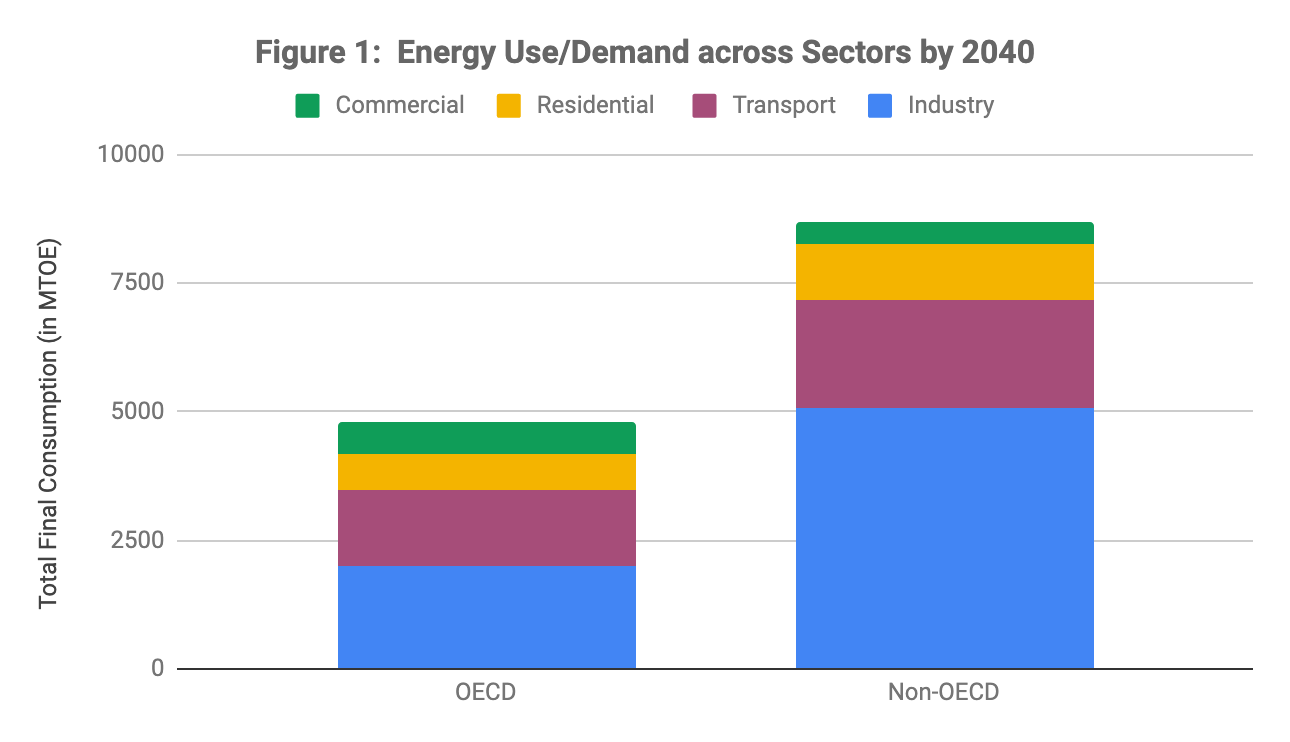
Specifically, projections indicate that global energy use is expected to rise by around one-third by 2040, most of which come from developing countries or non-member countries of the Organization for Economic Co-operation and Development (non-OECD). While energy demand slightly declines in OECD group (total: -0.3%) between 2017 and 2040, it is expected to rise significantly in non-OECD group (total: +56%) within the same period, with non-OECD Asia taking the lead. Thus, by 2040, developing countries will have around 67% of global energy use, up from 57% in 2017. China of course maintains the largest share of energy use. However, the fastest growth by far is expected to occur in India -- and to a lesser extent in Africa & other non-OECD Asia. But the slowest growth will occur in developing Europe & Eurasia, particularly, Russia.
Across sectors, industry will remain the largest contributor to overall growth in energy use for developing countries but will contribute twice as much as commercial, residential and transport sectors combined (figure 1). Strikingly, by 2040, the industrial sector of developing countries is also expected to contribute more energy than all the sectors of developed countries combined (figure 1). A key implication of the relative significance of industrial energy use is that, development efforts which narrowly targets household demand for energy may not be as effective in reducing energy poverty, improving human development, and controlling the climate impact of energy demand.
Why developing countries will consume around 67% of the world's energy by 2040.
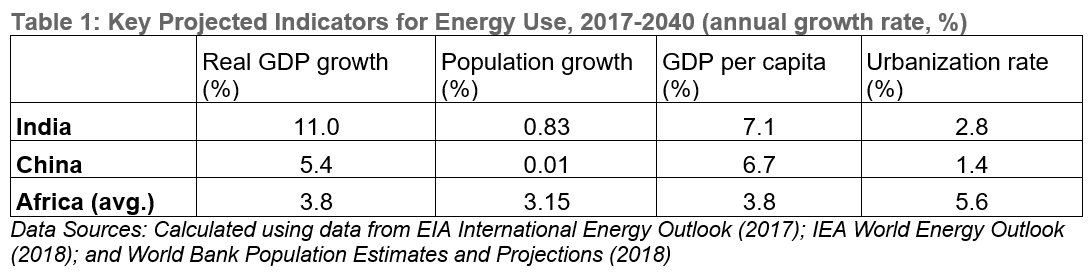
Rising energy use for the biggest users is expected to be driven by economic growth -measured by Gross Domestic Product (GDP), urbanization, and population growth. For India specifically, energy use growth will be mostly driven by expanding economic output --well above rates in China and the rest of the world. For Africa, energy use growth is expected to be mostly driven by fast growing population and urbanization –fastest rates globally (table 1).
However, for China, its current fast-growing energy use will begin to slow down around 2030s due to slower population growth and increasing transition away from energy-intensive industrial sectors towards less-energy intensive manufacturing and service sectors-- enabling it generate additional economic activity with lower energy use. This transition will be partly driven by stricter industrial standards in light of serious pollution concerns in China. This gives way for India, other developing Asia and Africa to pick up more heavy industrial production for global consumption by 2030s.
The slowest energy use growth for developing countries, however, is expected to come from developing Europe and Eurasia group, especially Russia, largely due to low population and economic growth as well as significant energy efficiency gains.

Energy intensity will decline, but not enough to stay on track with climate goals
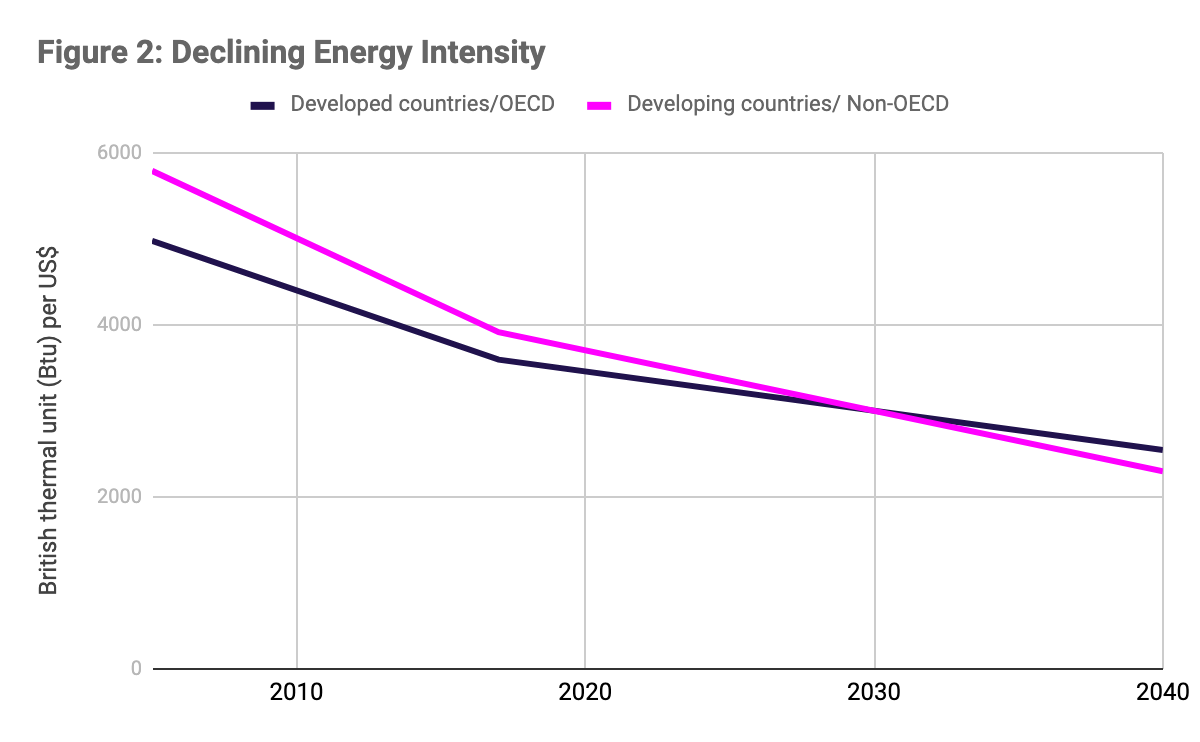
These energy demand projections also show that while overall energy use increases, global energy intensity (amount of energy used per GDP) will continue to decline in the future --from around 1% p.a. (1950-2015) to around 2% p.a (2015-2040). The decline in energy intensity will be mostly driven by the decoupling of economic growth from energy demand –which is ongoing in many developed countries. This decoupling is reflected in slower economic and population growth as well as shifts in economic structures from lower-skilled manufacturing to higher-skilled advanced manufacturing or services. Interestingly, developing countries are expected to decouple by twice the rate of developed country grouping, on average, from around 2030s (figure 2). This would come mostly from China where environmental concerns and air pollution will force the Chinese government to promote better climate-sensitive industrial policies. Although decoupling occurs at a faster rate in the developing world, overall energy intensity remains high.
However, a 2% reduction in energy intensity is not enough to put the world on the path to meeting climate goals. For such reasons, some authors like Jacobson et al. (2017) suggest pathways for reducing energy use that reflect degrowth, while others propose improvements in energy efficiency as the best solution. But recent studies suggest that the latter may not be a viable long-term solution. Particularly, Fouquet & Person (2011) and Luke et al. (2014) highlight that energy efficiency measures and technologies enable cost declines and expansion of services, which ultimately leads to higher energy use — known as the rebound effect. Therefore, they caution policymakers about depending heavily on efficiency-related emissions reduction as a climate mitigation strategy.
The key implication is that relevant actors in the international community, academia and government still need to think more carefully about other ways to reduce climate impact from energy use, beyond energy efficiency.
Is degrowth, then, a viable alternative solution for limiting energy demand and its impact on our planet? No, due to its impact on development/poverty reduction goals
One of the central messages in these projections is that the level of future energy demand will be largely determined by how fast developing economies grow, and what type of activities make up their economic growth. Given climate change concerns, it seems passively implied that degrowth –limiting the pace of economic growth – could be a viable solution for reducing future energy use. This notion may also be underpinned in the low levels of energy access targets envisioned by many development institutions, like the United Nations (UN) as part of its global development objective – as Moss & Gleave (2013) and Caine, et al. (2014) suggests. However, limiting the use of energy – a resource so essential to human progress – is not an effective alternative, if the world is interested in achieving sustainable development goals (SDGs), especially those on poverty and equitable access to energy (SDGs 1 and 7).
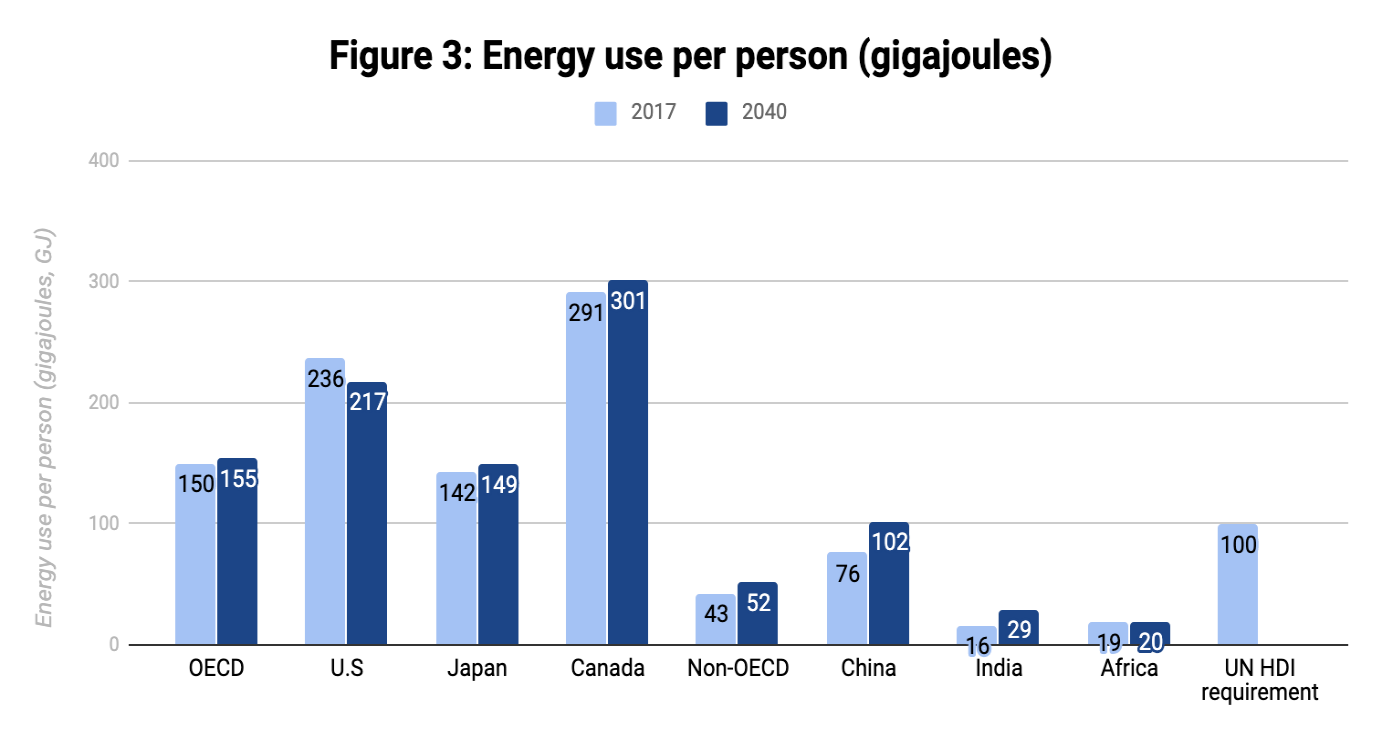
Despite energy demand growth, average energy use in many developing countries will remain below levels required for human development. The UN’s Human Development Index (HDI) suggests that increases in energy consumption up to around 100 gigajoule (GJ) per head are associated with substantial increases in human development and well-being, after which the relationship flattens out. However, many developing countries will not attain this level by 2040 (figure 3), despite fast growing energy use. Specifically, despite economic growth and prosperity of the Indian people, energy use per head increases only marginally by 2040. For Africa, its fast-growing population is expected to suppress the prosperity of its people, thus energy use per capita only rises by one unit to 20 GJ.
But interestingly, energy use per head in China (at 102 GJ) could meet UN standards for human development by 2040. Perhaps this would classify China as a developed country by 2040. It is important to note that, while China struggles environmental degradation due to the high energy use and pollution of its industries, China’s high energy use has also allowed for faster development, that will potentially transform it to a developed country by 2040. This case of China buttresses the environmental cost, yet value of high energy in driving development.

Key Takeaways
Environmental and climatic concerns are vital variables for consideration, given its immediate and long-term impact for our world. However, limiting energy demand through degrowth, especially for developing countries, would be inappropriate -- given the need for energy to drive human development and poverty reduction. Therefore, we need to think of a lower carbon and higher energy planet, bearing in mind both climate and socio-economic development goals, especially for developing countries where high energy level is required to lift people out of poverty.
Drawing on my recent grounding in the Ecomodernist ideology at The Breakthrough Institute, Any progress at advancing the twin goal (climate and poverty reduction) will require both: advanced technological innovations and piecemeal incremental policy changes to guide household and especially industry behavior. It would require unusual and equitable energy policy decisions to decrease the climate impact of energy use without reducing consumption, especially for developing countries where high energy is much needed.
The global community and developed countries will need to work with fast developing countries to minimize the environmental footprint of their industries, without minimizing production. Policies that encourage investments in initiatives that reduce emissions from industries, without constraining output, should be prioritized over household energy demand that are often in the forefront of development efforts. Carbon capture and storage for steelmaking, as well as non-emitting ways to produce cement are some good examples.
Lastly, reducing the social and political barriers to a high and clean energy transition will require relevant stakeholders to continuously spread the message of hope and possibilities that will fuel government action and human ingenuity. As advocates of energy equity emphasize, “the way we use energy will become increasingly clean not by limiting consumption but by using expanded access to energy to unleash human ingenuity”.
The importation of petroleum products into Nigeria continues to expand. In 2019Q2, imports totaled 5.61 billion litres of Premium Motor Spirit (PMS) or petrol, 1.38 billion litres of Automotive Gas Oil (AGO) or diesel, and 12.22 million litres of Household kerosene (HHK)1. Although, there were moderations in the importation of kerosene, petrol and diesel imports for the review quarter represented 15.2% and 14% QOQ increases respectively, and reflected the rising need for fuel consumption in Nigeria. While the increase in fuel imports is imperative to satisfy growing domestic demands, the path towards fuel self-sufficiency in Nigeria is becoming far-fetched. The NNPC had marked 2019 as the year for fuel independence; however, with the increasing fuel importation exacerbated by insufficient refining capacity and the lack of political will, the year 2019 may end without considerable achievement. While the recent licensing of modular refineries is a step towards meeting local demand, the full removal of subsidy will lead to cost-reflective pricing of petroleum products, thus incentivizing private investors into the upstream petroleum sector.
The 2019 Global Innovation Index (GII) depicts that out of 129 economies surveyed; Nigeria ranked 114 in terms of innovation performance1. While this position is four places up from Nigeria’s 118th position in 2018 (due to commendable performance in medical innovation), Nigeria still features as one of the lower-middle income countries whose overall innovation performance falls below expectation for the level of development. This is far below countries like Kenya, Rwanda, Mozambique, Malawi, and Madagascar who stand out for being innovation achievers. Nigeria’s weak performance may have portrayed a shifted focus to innovation quantity than to quality. This reflected in the GII measure of innovation quality as Nigeria ranked low in Research and Development, knowledge impact and diffusion, creative outputs, ICT and general infrastructure. The implication of not being an innovation-driven economy is that businesses become uncompetitive thus affecting exports and increasing vulnerability to business cycle fluctuations. As such, increasing the R&D expenditure as a share of GDP from the current 0.22%, by both private and public sectors, is an important step towards enhancing innovation.
Figures from NNPC’s latest performance report show that the corporation spent ₦206.6 billion on subsidizing fuel in two months –January and February 20194. This amount increased by over ₦190 billion, from the ₦16.2 billion spent in the previous two months – November and December 2018. Classified as under-recovery costs by the NNPC, the huge two-month spending on fuel subsidy is only partially due to increased importation of petrol during the review period. Volume of petrol imported into Nigeria rose to 3.8 billion litres in both January and February 20195, compared to the 3.4 billion litres imported in the previous two months. Most of the increase in under-recovery costs was due to low domestic crude payments in the review period, falling from ₦331.7 billion in November and December 2018 to ₦65.8 billion. Given that domestic refining capacity remains weak and the lack of political will to deregulate energy prices, substantial resources will continue to be gulped by fuel subsidy in subsequent periods. Going forward, NNPC will need to improve its domestic refining capacity to enhance its ability to meet payment obligation to the Federation Account on the 445,000 barrels/day allocated to the corporation.