


Publications

Follow via RSS

Future Energy Use in the Developing World: Implications for poverty reduction and climate goals

In view of the long-standing debate between green growth and de-growth, this analysis throws light on the dimensions of future energy use growth and its implication for development and climate concerns, in the context of the developing world.

Latest energy demand projections show that a global energy transition is underway. Based on baseline projections by the US Energy Information Administration (EIA), BP, Exxon Mobil and IEA, developing countries would have a larger share of energy use. This would be driven by changes in economic growth and structure, demography, and technological advancement. While these projection studies have varying model assumptions, they reach similar conclusions regarding energy use growth between developed and developing countries.

Specifically, projections indicate that global energy use is expected to rise by around one-third by 2040, most of which come from developing countries or non-member countries of the Organization for Economic Co-operation and Development (non-OECD). While energy demand slightly declines in OECD group (total: -0.3%) between 2017 and 2040, it is expected to rise significantly in non-OECD group (total: +56%) within the same period, with non-OECD Asia taking the lead. Thus, by 2040, developing countries will have around 67% of global energy use, up from 57% in 2017. China of course maintains the largest share of energy use. However, the fastest growth by far is expected to occur in India -- and to a lesser extent in Africa & other non-OECD Asia. But the slowest growth will occur in developing Europe & Eurasia, particularly, Russia.

Across sectors, industry will remain the largest contributor to overall growth in energy use for developing countries but will contribute twice as much as commercial, residential and transport sectors combined (figure 1). Strikingly, by 2040, the industrial sector of developing countries is also expected to contribute more energy than all the sectors of developed countries combined (figure 1). A key implication of the relative significance of industrial energy use is that, development efforts which narrowly targets household demand for energy may not be as effective in reducing energy poverty, improving human development, and controlling the climate impact of energy demand.
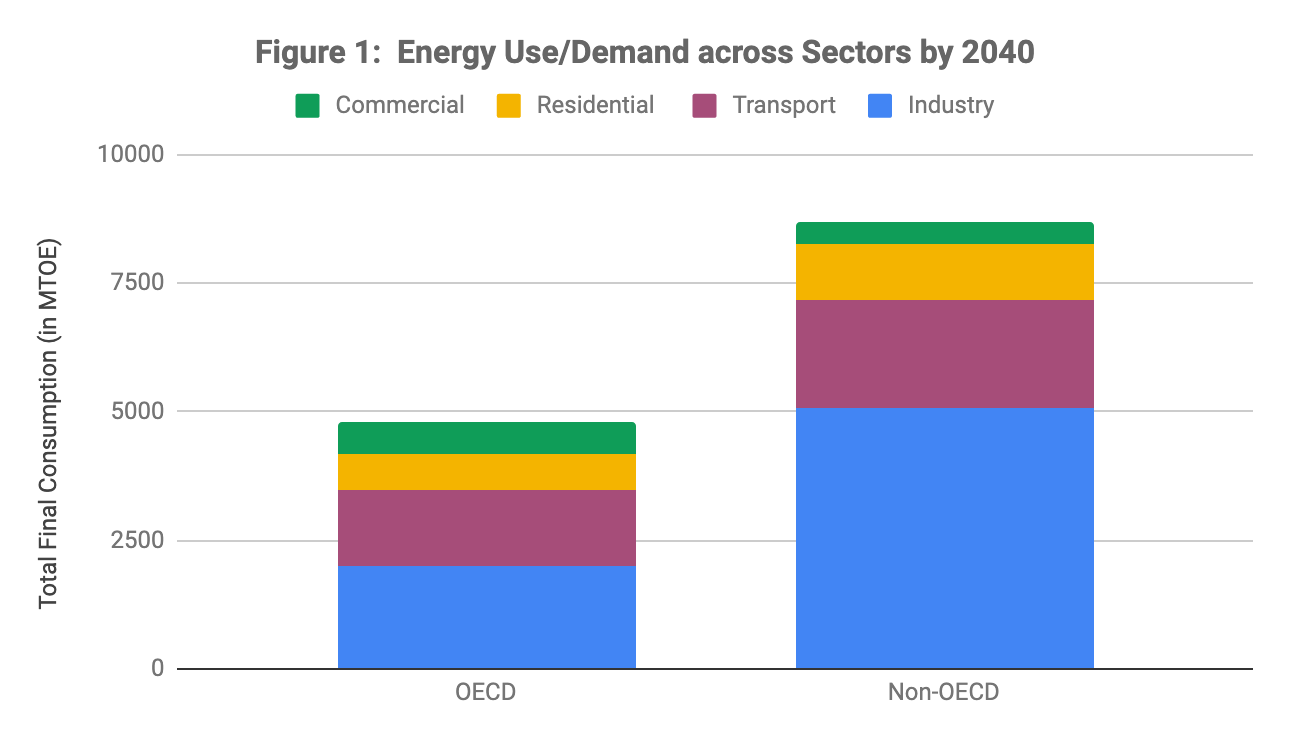
Data Source: EIA International Energy Outlook (2017)

Why developing countries will consume around 67% of the world's energy by 2040.

Rising energy use for the biggest users is expected to be driven by economic growth -measured by Gross Domestic Product (GDP), urbanization, and population growth. For India specifically, energy use growth will be mostly driven by expanding economic output --well above rates in China and the rest of the world. For Africa, energy use growth is expected to be mostly driven by fast growing population and urbanization –fastest rates globally (table 1).

However, for China, its current fast-growing energy use will begin to slow down around 2030s due to slower population growth and increasing transition away from energy-intensive industrial sectors towards less-energy intensive manufacturing and service sectors-- enabling it generate additional economic activity with lower energy use. This transition will be partly driven by stricter industrial standards in light of serious pollution concerns in China. This gives way for India, other developing Asia and Africa to pick up more heavy industrial production for global consumption by 2030s.

The slowest energy use growth for developing countries, however, is expected to come from developing Europe and Eurasia group, especially Russia, largely due to low population and economic growth as well as significant energy efficiency gains.
Energy intensity will decline, but not enough to stay on track with climate goals

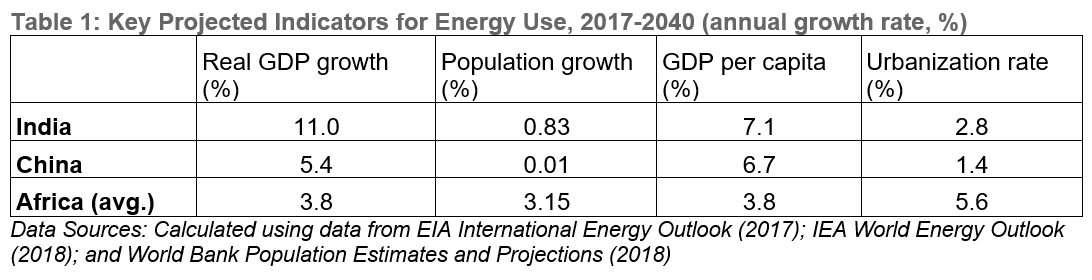
These energy demand projections also show that while overall energy use increases, global energy intensity (amount of energy used per GDP) will continue to decline in the future --from around 1% p.a. (1950-2015) to around 2% p.a (2015-2040). The decline in energy intensity will be mostly driven by the decoupling of economic growth from energy demand –which is ongoing in many developed countries. This decoupling is reflected in slower economic and population growth as well as shifts in economic structures from lower-skilled manufacturing to higher-skilled advanced manufacturing or services. Interestingly, developing countries are expected to decouple by twice the rate of developed country grouping, on average, from around 2030s (figure 2). This would come mostly from China where environmental concerns and air pollution will force the Chinese government to promote better climate-sensitive industrial policies. Although decoupling occurs at a faster rate in the developing world, overall energy intensity remains high.

However, a 2% reduction in energy intensity is not enough to put the world on the path to meeting climate goals. For such reasons, some authors like Jacobson et al. (2017) suggest pathways for reducing energy use that reflect degrowth, while others propose improvements in energy efficiency as the best solution. But recent studies suggest that the latter may not be a viable long-term solution. Particularly, Fouquet & Person (2011) and Luke et al. (2014)  highlight that energy efficiency measures and technologies enable cost declines and expansion of services, which ultimately leads to higher energy use — known as the rebound effect. Therefore, they caution policymakers about depending heavily on efficiency-related emissions reduction as a climate mitigation strategy.

The key implication is that relevant actors in the international community, academia and government still need to think more carefully about other ways to reduce climate impact from energy use, beyond energy efficiency.
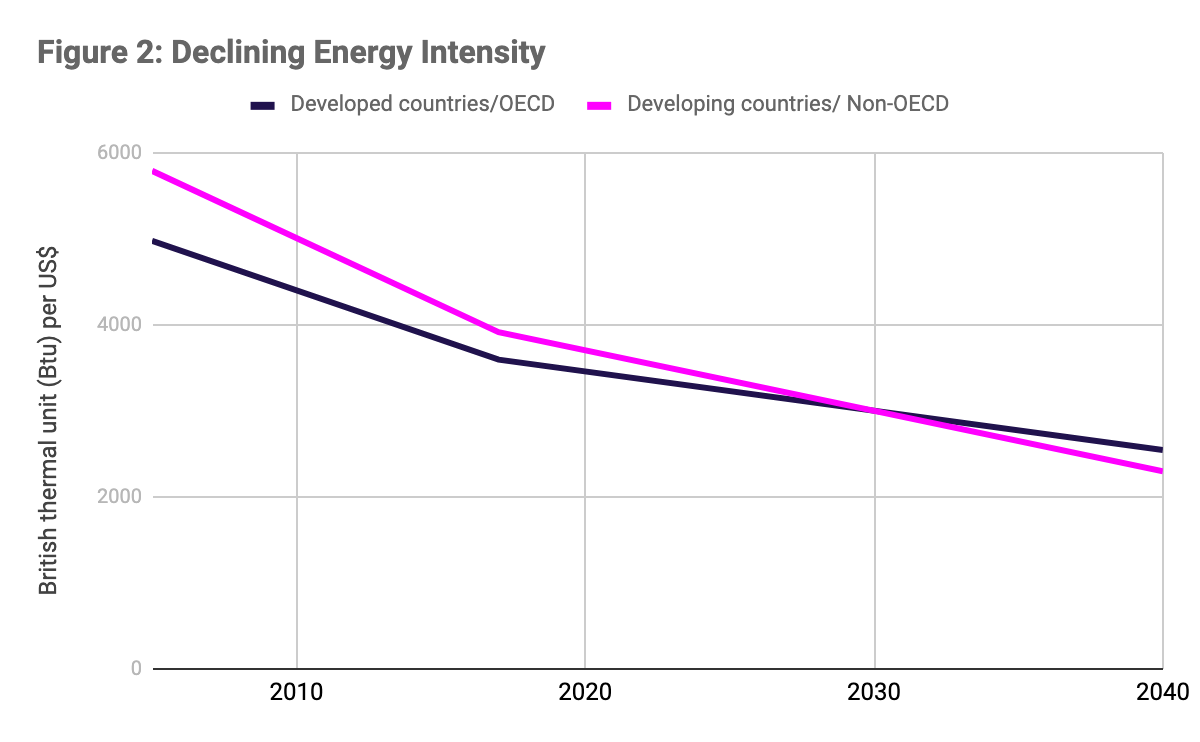
Data Sources: Calculated using data from EIA International Energy Outlook (2017); IEA World Energy Outlook (2018); and World Bank Population Estimates and Projections (2018)


Is degrowth, then, a viable alternative solution for limiting energy demand and its impact on our planet? No, due to its impact on development/poverty reduction goals

One of the central messages in these projections is that the level of future energy demand will be largely determined by how fast developing economies grow, and what type of activities make up their economic growth. Given climate change concerns, it seems passively implied that degrowth –limiting the pace of economic growth – could be a viable solution for reducing future energy use. This notion may also be underpinned in the low levels of energy access targets envisioned by many development institutions, like the United Nations (UN) as part of its global development objective – as Moss & Gleave (2013) and Caine, et al. (2014) suggests. However, limiting the use of energy – a resource so essential to human progress – is not an effective alternative, if the world is interested in achieving sustainable development goals (SDGs), especially those on poverty and equitable access to energy (SDGs 1 and 7).

Despite energy demand growth, average energy use in many developing countries will remain below levels required for human development. The UN’s Human Development Index (HDI) suggests that increases in energy consumption up to around 100 gigajoule (GJ) per head are associated with substantial increases in human development and well-being, after which the relationship flattens out. However, many developing countries will not attain this level by 2040 (figure 3), despite fast growing energy use. Specifically, despite economic growth and prosperity of the Indian people, energy use per head increases only marginally by 2040. For Africa, its fast-growing population is expected to suppress the prosperity of its people, thus energy use per capita only rises by one unit to 20 GJ.

But interestingly, energy use per head in China (at 102 GJ) could meet UN standards for human development by 2040. Perhaps this would classify China as a developed country by 2040. It is important to note that, while China struggles environmental degradation due to the high energy use and pollution of its industries, China’s high energy use has also allowed for faster development, that will potentially transform it to a developed country by 2040. This case of China buttresses the environmental cost, yet value of high energy in driving development.
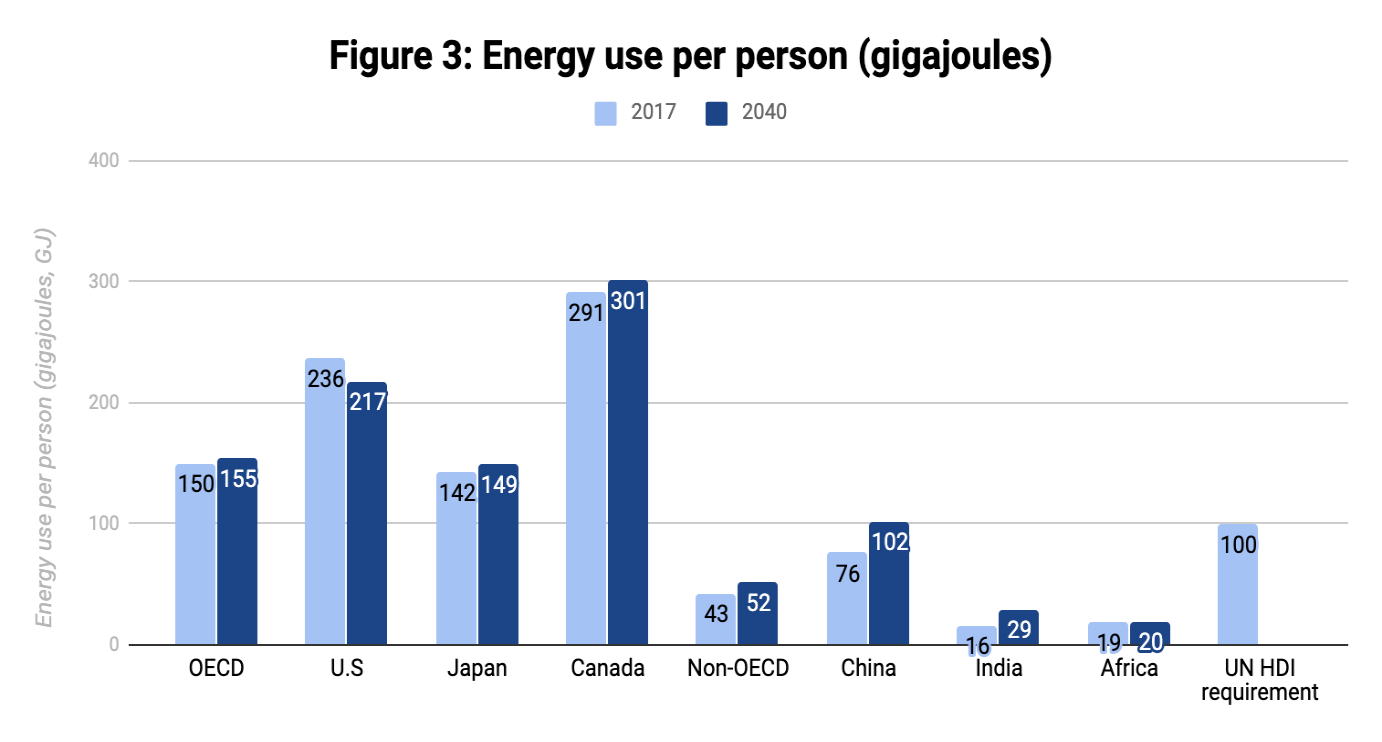
Data Sources: EIA International Energy Outlook (2017) and World Bank Population Estimates and Projections (2018)

Key Takeaways

Environmental and climatic concerns are vital variables for consideration, given its immediate and long-term impact for our world. However, limiting energy demand through degrowth, especially for developing countries, would be inappropriate -- given the need for energy to drive human development and poverty reduction. Therefore, we need to think of a lower carbon and higher energy planet, bearing in mind both climate and socio-economic development goals, especially for developing countries where high energy level is required to lift people out of poverty.

Drawing on my recent grounding in the Ecomodernist ideology at The Breakthrough Institute, Any progress at advancing the twin goal (climate and poverty reduction) will require both: advanced technological innovations and piecemeal incremental policy changes to guide household and especially industry behavior. It would require unusual and equitable energy policy decisions to decrease the climate impact of energy use without reducing consumption, especially for developing countries where high energy is much needed.

The global community and developed countries will need to work with fast developing countries to minimize the environmental footprint of their industries, without minimizing production. Policies that encourage investments in initiatives that reduce emissions from industries, without constraining output, should be prioritized over household energy demand that are often in the forefront of development efforts. Carbon capture and storage for steelmaking, as well as non-emitting ways to produce cement are some good examples.

Lastly, reducing the social and political barriers to a high and clean energy transition will require relevant stakeholders to continuously spread the message of hope and possibilities that will fuel government action and human ingenuity. As advocates of energy equity emphasize, “the way we use energy will become increasingly clean not by limiting consumption but by using expanded access to energy to unleash human ingenuity”.
Read More Download PDF

Nigeria Economic Update (Issue 32)

The importation of petroleum products into Nigeria continues to expand. In 2019Q2, imports totaled 5.61 billion litres of Premium Motor Spirit (PMS) or petrol, 1.38 billion litres of Automotive Gas Oil (AGO) or diesel, and 12.22 million litres of Household kerosene (HHK)1. Although, there were moderations in the importation of kerosene, petrol and diesel imports for the review quarter represented 15.2% and 14% QOQ increases respectively, and reflected the rising need for fuel consumption in Nigeria. While the increase in fuel imports is imperative to satisfy growing domestic demands, the path towards fuel self-sufficiency in Nigeria is becoming far-fetched. The NNPC had marked 2019 as the year for fuel independence; however, with the increasing fuel importation exacerbated by insufficient refining capacity and the lack of political will, the year 2019 may end without considerable achievement. While the recent licensing of modular refineries is a step towards meeting local demand, the full removal of subsidy will lead to cost-reflective pricing of petroleum products, thus incentivizing private investors into the upstream petroleum sector.

Read More Download PDF

Nigeria Economic Update (Issue 31)

The 2019 Global Innovation Index (GII) depicts that out of 129 economies surveyed; Nigeria ranked 114 in terms of innovation performance1. While this position is four places up from Nigeria’s 118th position in 2018 (due to commendable performance in medical innovation), Nigeria still features as one of the lower-middle income countries whose overall innovation performance falls below expectation for the level of development. This is far below countries like Kenya, Rwanda, Mozambique, Malawi, and Madagascar who stand out for being innovation achievers. Nigeria’s weak performance may have portrayed a shifted focus to innovation quantity than to quality. This reflected in the GII measure of innovation quality as Nigeria ranked low in Research and Development, knowledge impact and diffusion, creative outputs, ICT and general infrastructure. The implication of not being an innovation-driven economy is that businesses become uncompetitive thus affecting exports and increasing vulnerability to business cycle fluctuations. As such, increasing the R&D expenditure as a share of GDP from the current 0.22%, by both private and public sectors, is an important step towards enhancing innovation.

Read More Download PDF

Nigeria Economic Update (Issue 30)

Figures from NNPC’s latest performance report show that the corporation spent ₦206.6 billion on subsidizing fuel in two months –January and February 20194. This amount increased by over ₦190 billion, from the ₦16.2 billion spent in the previous two months – November and December 2018. Classified as under-recovery costs by the NNPC, the huge two-month spending on fuel subsidy is only partially due to increased importation of petrol during the review period. Volume of petrol imported into Nigeria rose to 3.8 billion litres in both January and February 20195, compared to the 3.4 billion litres imported in the previous two months. Most of the increase in under-recovery costs was due to low domestic crude payments in the review period, falling from ₦331.7 billion in November and December 2018 to ₦65.8 billion. Given that domestic refining capacity remains weak and the lack of political will to deregulate energy prices, substantial resources will continue to be gulped by fuel subsidy in subsequent periods. Going forward, NNPC will need to improve its domestic refining capacity to enhance its ability to meet payment obligation to the Federation Account on the 445,000 barrels/day allocated to the corporation.

Read More Download PDF

Nigeria Economic Update (Issue 29)

Latest report from NBS shows that the Nigeria Immigration Service (NIS) generated ₦39.06 billion in 20181 as against ₦35.72 billion it generated as local revenue in 2017- representing a growth of 9.3%. Whereas the Combined Expatriate Residence Permit and Aliens Card (CERPAC) generated the highest revenue of ₦20.4 billion, the ECOWAS/African affairs revenue section recorded the largest growth. Specifically, revenue generated from ECOWAS travel documents increased by 93.3% YOY, from ₦65.3 million in 2017 to ₦126.1 million in 2018. This huge revenue increase is due to the increased number of ECOWAS residence cards produced and ECOWAS travel certificate issued by the NIS: demand for both documents increased YOY by 25.6% and 18.4% respectively. Evidence suggests that migration drives economic activity and supports the drive for domestic resource mobilization. Nigeria can leverage its dominant position in the region to drive regional economic activities inwards to exploit these gains.
Read More Download PDF

Nigeria Economic Update (Issue 28)

Nigeria’s Micro, Small and Medium Enterprises (MSME) sector showed noteworthy growth potentials between 2013 and 2017. A total number of 4.4 million MSMEs were established within the time period, increasing the sector’s economic participation to 41.5 million MSMEs1. As an important backbone of economic growth and development, the MSMEs contribute to employment and job creation. About 18.1 million jobs were created in the time period, increasing the sector’s share of the labour force from 84% to 86.3% within the same time period. In addition, the sector’s contribution to GDP increased marginally to 49.8% in 2017. While a large MSME sector is characteristic of a growing economy, the slow/insufficient transition of MSMEs into large firms implies that the quality jobs available remains static. As such, there is a stagnation in wages paid and wage growth, which in turn deters high-skilled workers and limits the productivity growth of MSMEs. While pro-business policies are being put in place such as the recent (July 2019) CBN directive to banks to increase lending to the real sector, structural issues that hinder lending such as information asymmetries between banks and business owners will need to be addressed to encourage the implementation of these policies

Read More Download PDF

The Economics of Tobacco Control in Nigeria: Modelling the Fiscal and Health Effects of a Tobacco Excise Tax Change

The World Health Organization (WHO) emphasises that tobacco use is a significant hurdle to public health and development gains worldwide, as it imposes significant economic costs on countries both in terms of direct medical care for adults and lost productivity. Cigarette smoking and other forms of tobacco use impose a large and growing public health burden globally and in Nigeria. Globally, tobacco use is the most preventable cause of death. Statistics show that tobacco use caused 100 million deaths in the twentieth century, and if current trends continue unchecked, one billion people (about 10 million, one in six adults, per year) will die from tobacco-related causes in the twenty-first century (Blecher and Ross 2013). Nearly 80 per cent of these deaths occur in low- and middle-income countries, especially in Asia (ibid.). Presently in Nigeria, more than 17,500 deaths are recorded each year on account of tobacco-related diseases; that is about 207 men and 130 women per week (Tobacco Atlas 2015). In the past, tobacco use and tobacco control in Africa received little attention relative to other regions and health issues. This was due to the perceived low smoking prevalence in Africa in addition to the more immediate need for interventions against infectious diseases. However, the trends are quickly changing. With improving economic growth and health in Africa, the number of smokers and cigarettes smoked in the region is rising. In Nigeria, smoking prevalence is growing at an average of 4 per cent each year; from 11.3 per cent in 2000 to 17.4 per cent in 2015 (World Bank 2017). According to data from Nigeria Customs Service (NCS) and the GlobalData Plc, a total of 920 million cigarette packs were sold in Nigeria in 2015, of which 74 per cent were produced domestically.

DOWNLOAD PAPER HERE
Read More Download PDF

Nigeria Economic Update (Issue 27)

On July 7, 2019, Nigeria signed the Africa Continental Free Trade Area (AfCFTA) agreement1 – the world’s largest free trade area deal since the formation of the World Trade Organization. The AfCFTA aims to, among other cardinal objectives, boost intra-regional trade which stands in favour of Nigeria and improve its low bilateral trade with other African countries. According to the NBS, exports from Nigeria to the rest of Africa accounted for 13.2% of total exports in 20182, far below 43.9% and 27.9% to Europe and Asia respectively; also, imports from other African countries made up only 3.5% of total imports, unrivalled with 41% and 44% from Europe and Asia respectively.  By signing the AfCTA which removes the tariff on about 90% of the commodities produced within Africa, trade between Nigeria and other African countries could potentially increase to 52% by 2022. However, the extent to which Nigeria would reap the encompassing benefits of the CFTA depends strongly on the improvement in the efficiency of local firms and the development of continent-wide systems upon which trade can thrive.  To address the former, the inefficiency and opacity in border administration and the lack of connective infrastructure will need to be dealt with. Furthermore, the Nigerian government may strongly consider signing the Protocol on free movement of people, which stipulates visa-free entry for up to 30 days for African nationals and the introduction of an ‘African passport’ issued by member states, that opened up for signature in March 2018 and has been signed by 32 countries3.

Read More Download PDF

SUSTAINABILITY IMPLICATIONS OF NIGERIA’S WATER USE PATTERNS

Nigeria has significant renewable water resources; however, the current reality is that most of it is poorly utilized and managed, thus raising important sustainability questions. There are several concerns associated with the water situation in the country such as pollution, flooding, poor drainage infrastructure, etc. All these have dire water-poverty, socio-economic, health and livelihood implications for Nigerians. This discussion paper identifies the absence of a properly functioning regulatory regime in Nigeria’s Water Resources sector - with the ensuing pattern of open-access water use in the country - as a fundamental issue that needs to be addressed. It briefly maps out some specifics of the current situation within Nigeria’s Water Resources sector. Utilising a simple steady-state economic framework that shows the implications of open access use of natural resources, it goes on to explain the sustainability implications of the current water resource use-patterns in Nigeria. Drawing on the points raised, the paper concludes with a few high-level recommendations for water sustainability in Nigeria.

Read More Download PDF Download PDF