The amount of financial subsidy that Nigeria absorbs to maintain pump price at the official N145/litre has remained high. According to reports, the NNPC now pays N48.68 subsidy for a litre of petrol1, as against the N26 recorded as payments in May 20182. In total, at the daily average consumption rate of 50 million litres per day, the government currently pays N2.43 billion per day as subsidy payments. The direct and externally-influenced reason has been increasing in landing costs which rose from N171 to N193.7 – consistently above the official N145 pump price - and this has fueled the very politically-charged issue of increasing petrol pump price domestically. With the upward trend in oil price, landing costs are expected to continue rising. The complete deregulation of the downstream oil sector will allow for private investment and consequently end subsidy payments, making it available for other sectors.
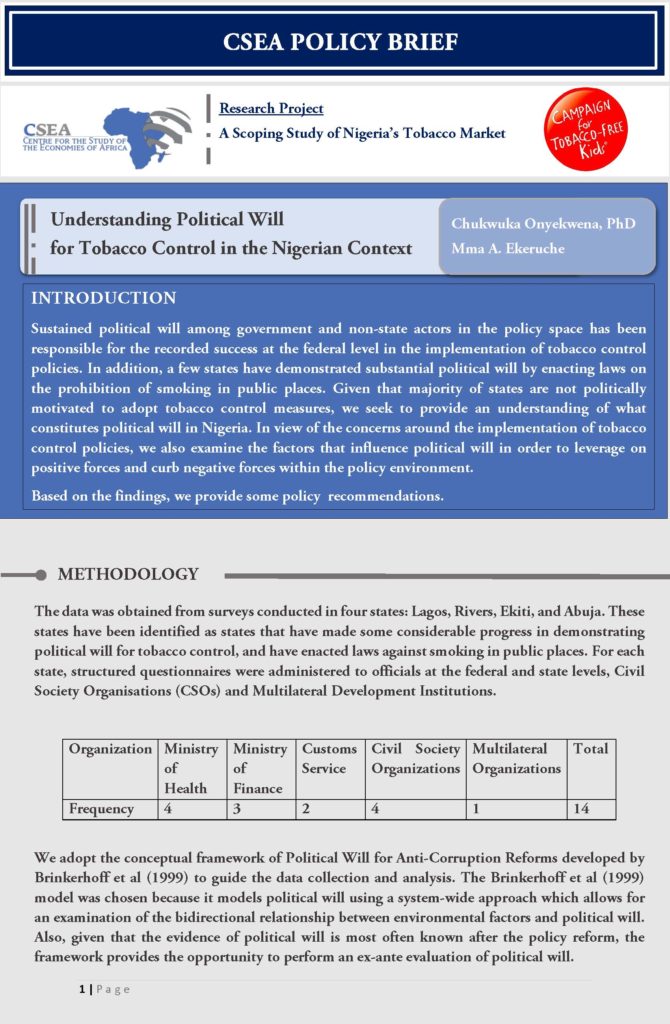
Sustained political will among government and non-state actors in the policy space has been responsible for the recorded success at the federal level in the implementation of tobacco control policies. In addition, a few states have demonstrated substantial political will by enacting laws on the prohibition of smoking in public places. Given that majority of states are not politically motivated to adopt tobacco control measures, we seek to provide an understanding of what constitutes political will in Nigeria. In view of the concerns around the implementation of tobacco control policies, we also examine the factors that influence political will in order to leverage on positive forces and curb negative forces within the policy environment.
Nigerian tobacco industry operates within an oligopolistic market structure, with BAT owning 79% of market brands, which allows for price differentiation across brands. However, price variations are also observed between the same brand both within and across regions, which suggests non-market factors could also contribute to the variability. For instance, the sale of cigarettes in sticks and the significant distance between production hubs and retail points, which generates asymmetric information, transportation cost and opportunity for arbitrage.
Tobacco use and control in Nigeria and other African countries have received little attention relative to other regions like Asia and Latin America. This is due to the perceived low smoking prevalence in Africa compared to the more immediate need for interventions against infectious diseases. However, the trends are changing quickly. Economic growth rate in Sub-Saharan Africa (SSA) nearly tripled from an average of 1.7 percent in 80s and 90s to about 4.8 percent in the 2000s and 2010s, with Nigeria growing more than five-fold from 1.2 percent to 6.7 percent within the same period (World Bank, 2018). On a similar trend, albeit of lesser magnitude, is the smoking prevalence in Nigeria which grew from 11.3 percent in 2000 to 17.4 percent in 2015 (World Bank, 2017). A combination of rising incomes, population growth, media-driven social trends, and targeted advertisement by the tobacco industry are the key drivers of the rising prevalence in SSA.
Various forms of consumer energy subsidies[1] are implemented in Nigeria. Three energy products are particularly subsidized: gasoline (Premium Motor Spirit –PMS), household kerosene (HHK), and electricity. In the case of petroleum products (PMS and HHK), government provided subsidies by paying petroleum products marketers the difference between the market rate and the government approved retail price[2]. For electricity, the government required state utility companies to charge tariffs below the costs of electricity production, then it reimbursed as part of a lump sum and by under-charging the electricity sector for the cost of natural gas[3].While petroleum (fuel) subsidy has increased, other forms of energy subsidies (such as kerosene) have relatively fallen over the years. Notably, the proposed study focuses on petroleum subsidies in Nigeria, as it weighs most heavily on the Nigerian economy and the welfare of the citizens[4].
As in the case of most energy subsidizing countries, the main rationale for energy subsidies in Nigeria is to protect consumers from the negative effects of increases in petroleum prices, while promoting industrial growth. Also, in line with most oil-exporting countries, the provision of petroleum subsidies in Nigeria is driven by socio-political reasons – the perception that cheap petrol prices are an entitlement for citizens of an oil-wealthy country. However, despite the poverty alleviation justification for providing subsidies, there is strong evidence that Nigeria’s experience with subsidies has been marred with economic, structural, and political challenges, among others.
Considered as a looming crisis, Nigeria’s unemployment rate has continued to deteriorate. Based on the new data released by the NBS unemployment rate stood at 23.1 percent in 2018Q31, up from the previous quarter’s 18.8 percent. This implies that 3.3 million people became unemployed during the quarter, increasing the total figure to 20.9 million people. About 63 percent (13.1 million) of the total unemployed Nigerians are youth who experience much higher unemployment rates (29.7 percent in 2018Q3) than the rest of the population. While many have attributed their status to the inability to find their first job, others have become unemployed due to loss of previous jobs. This implies that the gap between job creation and labour market demand is widening. Given Nigeria’s young population structure, large numbers of labour entrants are expected going forward. Going forward, the current emergence of a vibrant entrepreneurial class that cuts across agriculture, services, and tech should be supported through the provision of credit facilities and enabling infrastructure.