Publications

Follow via RSS

Nigeria Economic Update (Issue 8)

The total amount of non-performing loans (NPL) of Nigerian banks declined for the year 2018, relative to 2017. At N1.79 trillion, the stock of NPL fell by 24.2 percent from N2.36 trillion in 20171. Also, gross loans as of the end of 2018 stood at N15.35 trillion, as against N15.96 trillion as at the end of 2017. The reduction in NPL shows that debtors may have relieved more of their indebtedness in 2018 compared to 2017; this may have been complemented by the Asset Management Company of Nigeria’s (AMCON) resolve to achieve its recovery mandate against erring debtors2. AMCON is saddled with the statutory responsibility, among others, of recovering the NPL hitherto disbursed by eligible banks to their customers. The decline in non-performing loans is expected to continue as the overconcentration of banking sector loans to the unpredictable and volatile oil and gas sector has been reduced to a great length.  Monetary authorities should tighten mechanisms to ensure that commercial banks strictly adheres to the macroprudential guidelines that stipulate a 5 percent NPL benchmark.
Read More Download PDF

Managing Natural Resources for Sustainable Development

In most business schools and development economics classes around the world, Nigeria is used as a textbook case of “resource curse”. With more than USD 1 trillion earned from oil revenue since inception, the country is still ranked high in major underdevelopment indicators such as poverty, infant and maternal mortality among others. A comparative analysis of resource-rich countries, however, indicates that development outcomes hinge not strongly on the resource endowment per se, but crucially on effective management and governance of the resource.

Read More Download PDF Download PDF

Nigeria Economic Update (Issue 7)

Nigeria’s economy has shown sustained signs of recovery. Real GDP growth rate rose Year-on-Year by 2.38 percent in 2018Q4, as against 1.81 percent recorded in the preceding quarter – an increase of 0.57 percentage points.1 Non-oil sector remained the focal point for the economic expansion - growth in the sector’s activities improved to 2.7 percent from 2.3 percent and contributed approximately 93 percent to real GDP. The numbers unveil key high-performing non-oil activities during the quarter, with services manufacturing, and agriculture leading the pack. Going forward, the economy is expected to continue registering positive growth following a more stable political economy. However, inadequate credit among other factors may hinder the non-oil sector from scaling. The CBN may consider revising the banking regulations to include loan quotas for sectors with high growth and revenue-generating potential.

Read More Download PDF

Nigeria Economic Update (Issue 6)

The Nigerian economy raked in more revenue for the four quarters of 2018 fiscal year than in 2017. In the recently released economic report, the CBN reported that federally collected revenue increased by 28.4 percent to N9.44 trillion in 20181 – from N7.35 trillion in 20172. Both oil and non-oil components of federally collected revenue rose in the review year, attaining one-year peaks in 2018Q4 (N1.47 trillion) and 2018Q3(N1.14 trillion) respectively. The annual increase was most prominent in oil revenue sources, which grew significantly by 35 percent at the backdrop of 2018 improved oil price and domestic production, and accounted for N5.55 trillion of the total collected revenue. However, after statutory deductions and transfers, the federal government retained N3.96 trillion and a closer review shows that the FG expenditure pattern - at N7.36 trillion - resulted in a fiscal deficit of N3.4 trillion for the whole year 2018. Boosting non-oil sector trade and export, through infrastructure development and credit support, is critical to boosting overall government revenues to levels that match expenditure.

Read More Download PDF

Effects of 2019 Elections: Predicting the Economy’s Response in Nigeria

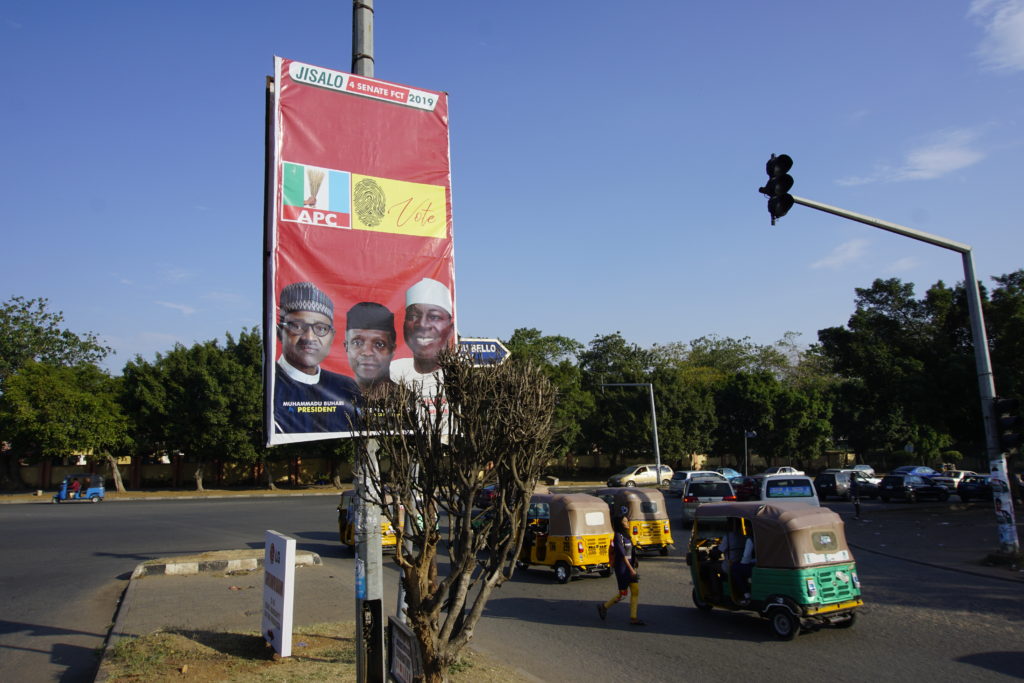
The stability of the country’s political environment is an essential element in determining and predicting the level of economic growth in a democratic economy. The traditional assumption in the political economy model is that opportunistic politicians have the tendency of manipulating economic policy around election times for political gain. The poor and largely uneducated electorate who are more likely to be susceptible to political manipulations dominate the process of electioneering in developing countries such as Nigeria. This piece analyses the changes in economic indicators caused by clearly exogenous changes resulting from the electioneering process (i.e. before, during and after the elections).

Do Election Cycles sway the Stock Market?

While it is well established that election cycles in Nigeria bring with it some level of political instability amongst and between rival parties, the dimension of this effect on the economy is unclear. In a review of stock market information, the following findings were emphasized:

  • In a research study by Osamwonyi and Omorokunma (2017) on portfolio selection in the Nigeria Stock Exchange (NSE) during elections, the analysis established that while investors strived to minimize losses and maximize gains, market friction and instability during the 2003, 2007 and 2011 election periods instigated low returns performance; and election results negatively affected the relationship between risk and return behaviour of selected companies.
  • In 2015, few months before the general elections, stock indices experienced more downtrends than uptrends and eventually culminated in an annual loss of -16.14 percent. In a similar report, the pre-2015 election year was characterized as a major-loss year for investors, a reoccurrence of a similar event in the pre-2011 election year. Investors lost about N3.23 trillion as at the end of 2014; a similar occurrence is tracked in the forthcoming 2019 elections: 2018 was marked by severe market losses.
  • In Nigeria, evidence shows that trading activities on the stock markets tend to react sensitively to past presidential election results (i.e. 2011 and 2015 elections). Particularly, the outcome of the 2011 elections saw trading activities negatively responding 2 days prior to and till 4 days after the election (Osuala et al., 2017). Overall, in both election years, electioneering activities and outcomes do affect stock market in a certain direction, depending on both the winner as well as the anticipated economic and financial policies of the new administration.
  • With respect to foreign investment in the stock market, a similar negative trend is seen with net foreign portfolio investment and All Share Index (ASI) generally dwindled towards the potential end of a presidential tenure: six months before another election is held.[1] The 2003, 2011 and 2015 elections showed the same trend and also showed a continued decline few months after the elections.


How much will the election cost the nation?

The need to win the hearts of electorates and to garner more votes via campaigns often push up government and contesting politicians’ spending in the months leading to the polls. The National Institute of Legislative Studies reports that, in 2015, more than $600 million was spent for an election that involved about 67 million voters – far more than obtainable in developed and bigger economies like Canada and the United Kingdom. The cost was not inclusive of undocumented individual costs incurred by politicians. The 2019 election is to cost about $669 million (N242 billion)[2], equivalent to the current running budget for capital projects in both health and education. In a country with over 70 percent of its populace living in poverty and an economy basked in excessive borrowings, the extensive spending is made at the expense of capital expenditure, provision of essential social infrastructure, and economic progression. The anomaly has become a norm in Nigeria and has also invalidated the cap on election campaign spending (N1 billion for presidential candidates and N200 million for governors) stated in the electoral act, 2010 as amended. Although election spending is absolutely necessary, the huge costs haunt the country post-election.

How have exchange rate, FDI, and external reserve fared during and after elections?

Presidential and general campaign periods are boom eras for the parallel foreign exchange market, and with huge dollar demands for political campaign activities, come the imminent pressure on the value of the naira. During most of the previous election periods, exchange rates were clearly seen to be adjusting to uncertainties surrounding the political environment. For the past four elections—1999, 2003, 2011, and 2015—the probability of having depreciating exchange rate was higher in the months preceding the elections, and sustained depreciation of the Naira was evident few months before, and in some cases, beyond the elections. In 2011, the exchange rate which averaged N153.98/$ six months to election rose to N157.1/$ in election month. Also, the Naira exchanged for N168.64/$ in the run-up to the 2015 election, and increased to N222.93 in election month. For the 2019 election, there are anticipated pressures on the stability of the Naira; however, the CBN is consciously dedicated to ensuring stability in the foreign exchange rate market.

In addition, foreign investors are often deterred during election periods, either in a risk-averse or risk avoidance posture. Their appetite for investments stall prior to elections and this reflects a mindset to gauge the outcome of the elections before further investment decisions are made. For example, Foreign Direction Investment (FDI) flows to Nigeria fell significantly to $73 million one month to the 2007 elections, from $460 million the previous month. Although 2007 marked a transition-government year the falling FDI trend was no different in the month leading up to both the 2011 and 2015 elections. However, there were increases in FDI some months after the stated elections - a possible signal of return of investors’ confidence – at the backdrop of a plausible die-down of political uncertainties. The electioneering period have also injected a dose of precariousness into the value of external reserves. Rather than accrete sustainably, the reserve dwindled during some of the periods and showcased a possible instability in net inflows. Before the 1999,2011 and 2015 elections, the reserves shed some dollars just prior to the election months respectively. For instance, from $8.2 billion five months to the 1999 election to $6.3 billion in the election month, and a significant fall in 2015 from $36.3 billion in the fifth month leading to the general election, to $29.4 billion as at the election month. The trends signify what seem to be capital outflows amid impact of other external factors, and alleged speculations that the reserve was used to fund election campaigns. A similar reserve downtrend is being noticed in run-up months to the 2019 election.

Conclusion

The analysis shows that the electioneering period brings with it not only uncertainty but also significant changes in economic activities. From stock markets to investors’ behaviours the election process and outcomes become determining factors to where people put their money and what they spend it on. This raises the question of what should be the economic policy focus of either the incumbent or incoming government in Nigeria. Given that Nigeria is still recovering from recession and recently ranked with high incidence of poverty, it is expected that the state of the economy should be of upmost priority to policy makers and government officials.

In our forthcoming policy brief we present the economic priorities that the new government needs to focus on. Look forward to it!

[1] http://www.adsrng.com/monthly-bulletin/

[2] https://www.thisdaylive.com/index.php/2018/10/17/finally-nassembly-approves-inecs-n242bn-election-budget/

Read More

Nigeria Economic Update (Issue 5)

States’ Internally Generated Revenue (IGR) declined in the third quarter 2018, replicating the same downward trend as seen in the previous quarter. IGR dropped to N264.38 billion in 2018Q3, compared to N279.78 billion generated in the preceding quarter – down by 5.5 percent1. The recently released IGR report by the NBS also shows that 20 states generated less revenue during the quarter (including the FCT), and only 17 states recorded growth in IGR. Reductions in Pay-As-You-Earn (PAYE) Tax, Direct Assessment, Road Taxes and revenues from Ministries, Departments and Agencies (MDAs) prompted the overall decline. In order to expand the tax base thereby improving tax revenues, a special focus should be given to harnessing the informal sector into the tax net.

Read More Download PDF

Nigeria Economic Update (Issue 4)

The monetary policy committee provided policy parameters at the first meeting for the 2019 fiscal year, held on 21st and 22nd January, 20191. As presumed, all parameters were left unchanged at their current levels: MPR at 14 percent, CRR at 22.5 percent, liquidity ratio at 30 percent, and asymmetric corridor of +200/-500 basis points around the MPR. This is the 14th consecutive time the MPC will retain all parameters, and the apex bank is justifying its stance by insisting that the economy has remained on a noteworthy track based on prevailing positive macroeconomic performances2. The committee’s optimistic outlook is likely hinged on, among other laudable achievements, the acclaimed return of foreign investors’ confidence and convergence of the foreign exchange market – the CBN has relentlessly upheld the value of the Naira despite perceptions of election risks on exchange rates. In the coming months, changes in monetary policy parameters will, however, depend on the macroeconomic performance after the elections as well as the objective to hit the CBN’s inflation target of 6 to 9 percent.

Read More Download PDF

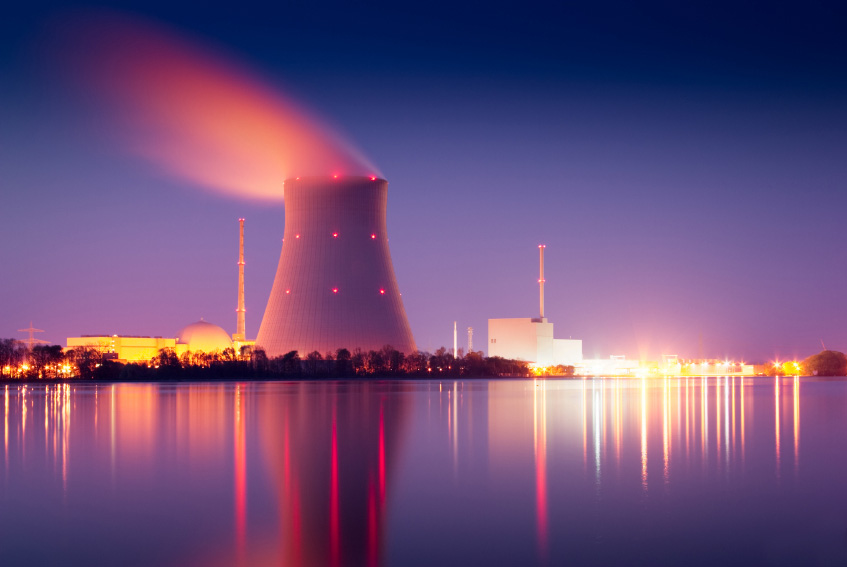
Achieving Abundant and Affordable Energy in Africa: Is there a place for nuclear power in Nigeria?

Nigeria and Russia has signed agreements to set up four nuclear power plants and a Centre for Nuclear Science and Technology in Nigeria. This piece examines the prospects of nuclear power plants to be built in Nigeria by mid-2020, with the view of objectively assessing its cost implications and feasibility.

Given Africa’s low levels of energy access, supply deficiencies and little contribution to climate change, it can be agreed that energy sources (clean or dirty) is not a question of substitutes but complements. Abundant energy that can be deployed affordably are essential for addressing energy challenges in the region. Two clean energy sources –nuclear and solar– have emerged as a revolutionary source for scaling up energy supply globally. Solar power, on one hand, has become the cheapest and fastest-growing source of electricity since 2011, on account of the surge in Chinese-manufactured silicon solar PV which cut costs by one-third. Nuclear power, on the other hand, supplies at least five times more electricity than solar power.

However, occasional symbolic fallouts around nuclear power raises concern about its suitability, especially for third world countries. The meltdown of the three reactors at Japan’s Fukushima Daiichi nuclear plant in 2011 after an earthquake and resulting tsunami is one of the two notable symbolic fallouts with nuclear. Opponent’s activism, accidents, and rising production costs have negatively affected the receptiveness and growth of nuclear power. As a result, many developed countries such as Germany, Belgium and the U.S are scaling down or exiting plans for new nuclear reactors.

Despite fallouts, confidence in nuclear power has been gradually improving due to constant development of safety technologies, including newer designs like Generation IV reactors with design features that take into account the “Fukushima Daiichi lesson”. Presently, 56 nuclear power plants are currently being constructed in the world today against 449 in operation. In Africa, the only operating nuclear plant is in South Africa, and it produces 1,860MW of power, contributing to 4% of South Africa’s power capacity. Plans to expand South Africa’s nuclear capacity is however opposed by the country’s Minister of Energy and the Treasury, on the ground of its implications for national debt. However, more African countries like Egypt, Ghana, Ethiopia, Uganda, and Zambia are establishing agreements with Russia State Atomic Energy Corporation (Rosatom) to build nuclear technologies for peaceful purposes.

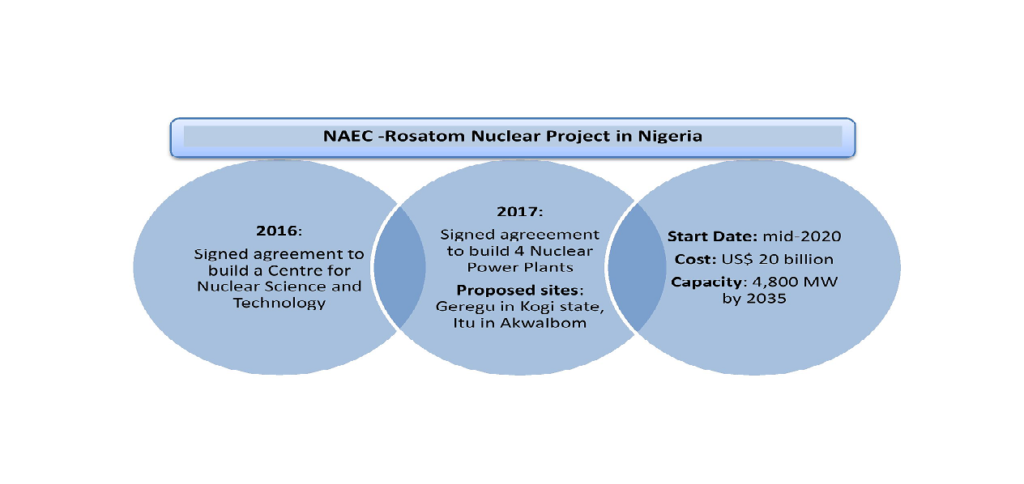
The Nigeria Atomic Energy Commission (NAEC) has also signed agreements with Rosatom, in 2017 and 2016, to set up four nuclear power plants and a Centre for Nuclear Science and Technology respectively, after a decade of developing the framework. The nuclear project, which is expected to cost about US$ 20 billion and produce 4,800 megawatts of electricity by 2035, will be initially operated by Rosatom before handover (Figure 1).

Figure 1: Details of the Nigeria-Russia Nuclear Power Agreement
 In light of the nuclear power development, two key questions call for objective analysis:
  1. What are the cost-implications of nuclear power for addressing energy deficit in Nigeria?

While nuclear power is relatively more expensive to construct, its maintenance cost is said to be low; as it can operate for about 60-80 years with very little maintenance.  As such, it is argued as being more profitable and cost-effective in delivering power in the long run, relative to other sources including gas and solar. However, the prospects of repaying loans used in the construction of the nuclear plants may be daunting for African countries.

Although information on the Nigeria-Rosatom nuclear project is scarce, analogy can be drawn from the Egypt-Rosatom agreement in which Rosatom provided a construction loan of US$ 25 billion for the 4.5 gigawatts nuclear project. The loan is projected to have an annual interest of around 3% beginning from the 10th to 13th year after the loan is made for a period of 22-28 years. At repayment, the 3% annual interest could have increased the debt by as much as 40%.

The implication is that the country receiving the nuclear plant may pay very little at onset, but the country’s fiscal space and electricity consumers could be faced with a massive burden when the repayments kick in. It is argued that most African economies may never be able to meet such debt obligations, given that the possibility of recouping funds from electricity sales is low. Furthermore, the nuclear industry is seen to have a history of cost overruns due to delays in construction, suggesting that the country receiving nuclear plant will likely face a higher-than-expected debt servicing cost. This raises concerns that future debt may position Russia to exert disproportionate influence over the affairs of the debtor country in the long-run.

The cost implications of nuclear project should be an issue of concern for Nigeria, given cost-recovery challenges presently faced by power generation companies (Gencos) mostly due to low electricity tariffs that has proven politically and structurally difficult to raise. In addition, the country’s fiscal balances remains very susceptible to oil price and production shocks so affordability might be a major concern.

  1. How feasible and safe is nuclear power in an economy characterized by inefficiencies?

Nigeria has existing nuclear facilities for other purposes except electricity generation. A case in point is the multi-billion naira Gamma Irradiation Facility within the national Nuclear Technology Centre (NTC). However, existing nuclear facilities are barely functional due to several challenges including: government’s financial constraints, non-prioritization in energy programme, corruption, and cynicism about the risks of nuclear waste and radiation on health and environment.

Despite the challenges, the prospective nuclear power project for electricity generation in Nigeria has been deemed feasible and safe by several stakeholders. Positive evaluation reports by the Inter-Ministerial Committee on the feasibility of deploying nuclear energy for electricity generation in the country, lead to the activation of the NAEC in 2006. Furthermore, reports by the International Atomic Energy Agency (IAEA), following Integrated Nuclear Infrastructure Review (INIR) missions to Nigeria, has been quite optimistic. Several missions carried out between 2015 and 2018 concluded that Nigeria’s emergency preparedness and response framework was consistent with IAEA safety standards. The review team often observe notable progress in strengthening the infrastructure for the new research reactors. In addition, a great deal of work has been done to establish appropriate legal framework and educate specialists in the NTC.

While standards seem high at onset, maintenance may be an issue especially after the project handover, given historical and current inefficiencies. For instance, Nigeria’s current thermal plants are operating below capacity due to poor maintenance and frequent disruptions to fuel (gas) flow. In addition, the country’s current installed thermal capacity is 12,500 megawatts, but in practice, it is only 3,200 megawatts.  Such inefficiencies reinforces the potential cost implications of the nuclear project.

Going forward: If nuclear plants are to be effectively operated in Nigeria, the following considerations should be incorporated in the projects’ regulatory and operational framework. These include:

  • An informed evidence-based arrangement for cost-recovery and loan repayment needs to be made.
  • Practical measures for enforcement, with penalties, need to be erected to ensure that a prospective nuclear electricity tariff/pricing schedule is followed through. This is important for safeguarding loan repayment.
  • A well-thought out plan for securing financial and human resources, needed to maintain the nuclear facilities and safeguard uranium to power the nuclear plants over the long-run, should be crafted.
  • Legal clauses that would guarantee commitment to the plan by successive government regimes should be entrenched in to the framework.
  • Continuous public awareness on the implications of nuclear power on health and environment as well as the need to maintain highest echelon of safety measures must accompany any nuclear power project in Nigeria, even decades after construction.
  • Sustainable measures to ensure that safety of the workers and residents in nuclear site locations must be guaranteed and never jeopardized.

Read More Download PDF

Nigeria Economic Update (Issue 3)

Inflation rate rose in December 2018 for the second consecutive month to 11.44 percent, 0.16 percentage points higher than the 11.28 percent recorded in November 2018.1 The rise in inflation was driven by the food component of inflation which increased to 13.56 percent from 13.30 percent within the same period. Further disaggregated data shows that the highest increments were recorded in the price of basic food items such as bread, cereals, fish, meat, potatoes, yam and other tubers. Core inflation experienced no increment from the previous month, stagnating at 9.80 percent. Seasonal demand effect is closely linked to the rise in inflation given that the holiday season is associated with a rise in the price of food items. In the coming month, we expect the inflation rate to continue on the upward trend considering the increase in election-related spending. The current monetary policy parameters should remain unchanged until a clearer picture of the effect of the election on economic indicators is known

Read More Download PDF Download PDF