Publications

Follow via RSS

Nigeria Economic Update (Issue 19)

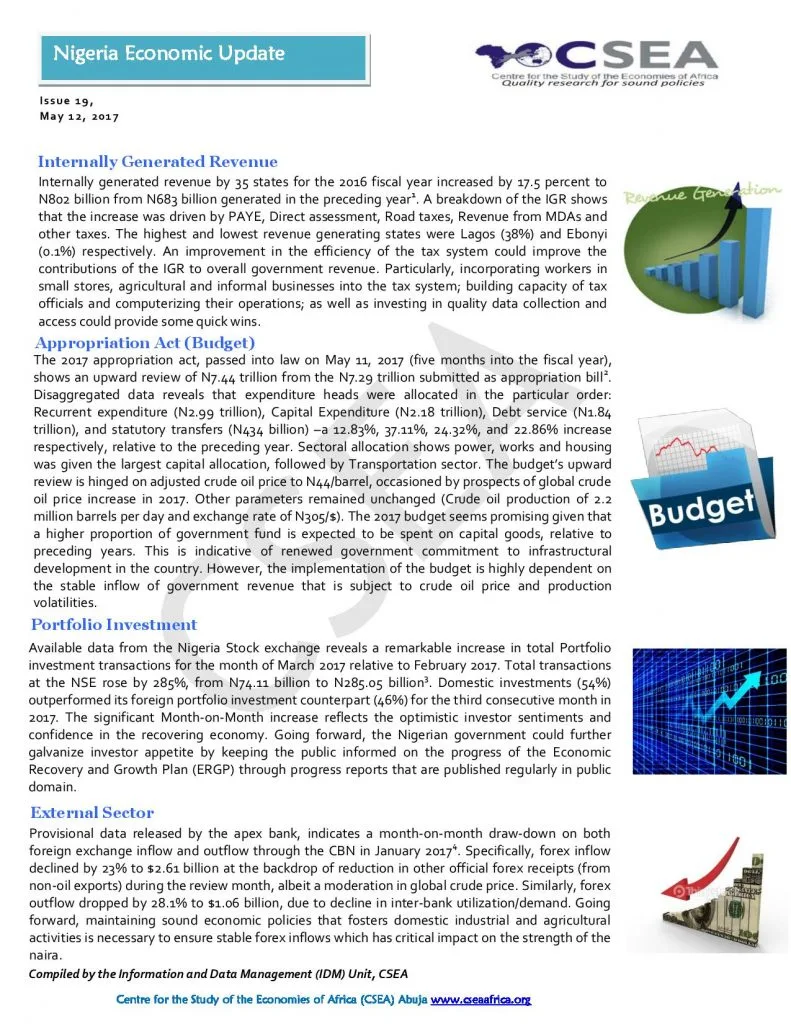
Internally generated revenue by 35 states for the 2016 fiscal year increased by 17.5 percent to N802 billion from N683 billion generated in the preceding year. A breakdown of the IGR shows that the increase was driven by PAYE, Direct assessment, Road taxes, Revenue from MDAs and other taxes. The highest and lowest revenue generating states were Lagos (38%) and Ebonyi (0.1%) respectively. An improvement in the efficiency of the tax system could improve the contributions of the IGR to overall government revenue. Particularly, incorporating workers in small stores, agricultural and informal businesses into the tax system; building capacity of tax officials and computerizing their operations; as well as investing in quality data collection and access could provide some quick wins.
Read More Download PDF

Nigeria Economic Update (Issue 18)

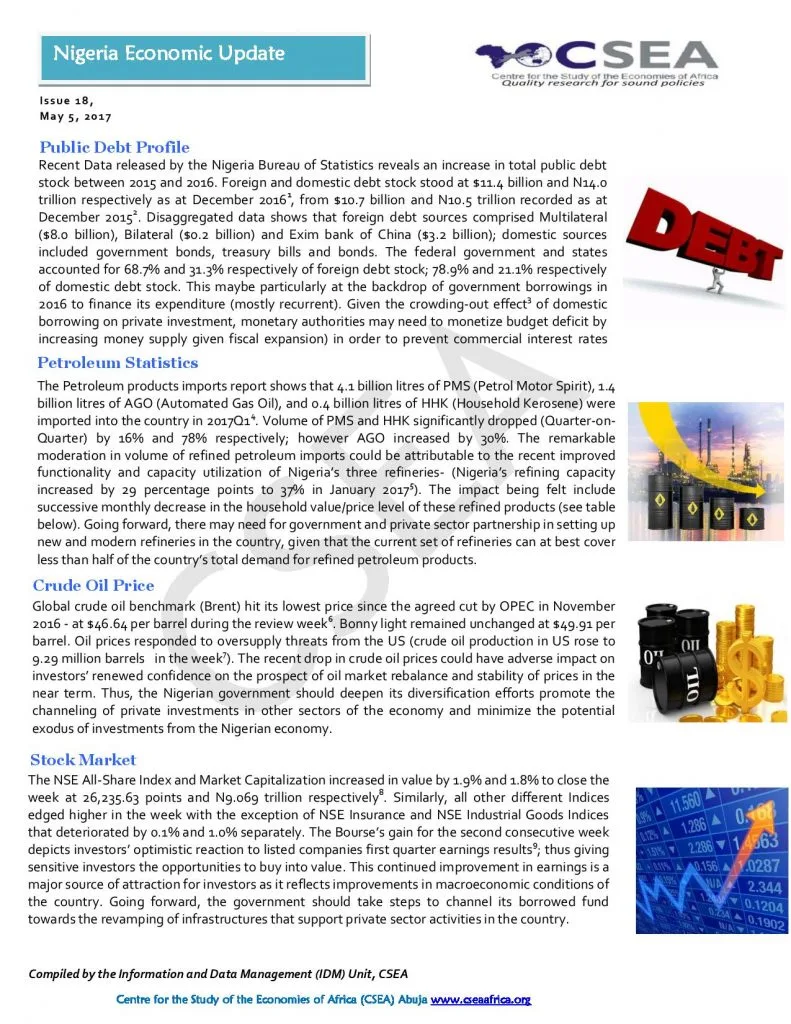
Recent Data released by the Nigeria Bureau of Statistics reveals an increase in total public debt stock between 2015 and 2016. Foreign and domestic debt stock stood at $11.4 billion and N14.0 trillion respectively as at December 2016, from $10.7 billion and N10.5 trillionrecorded as at December 2015. Disaggregated data shows that foreign debt sources comprised Multilateral ($8.0 billion), Bilateral ($0.2 billion) and Exim bank of China ($3.2 billion); domestic sources included government bonds, treasury bills and bonds. The federal government and states accounted for 68.7% and 31.3% respectively of foreign debt stock; 78.9% and 21.1% respectively of domestic debt stock. This maybe particularly at the backdrop of government borrowings in 2016 to finance its expenditure (mostly recurrent).
Read More Download PDF

Understanding The Ongoing Recession In Nigeria:A Synthesis Of The Events And Policy Options

In the second quarter of 2016, the Nigerian economy witnessed its first recession in twenty years due to the interplay of several external and internal factors. The recession has continued until date and has given rise to relentless unemployment rate and job losses, double digit and soaring inflation, currency depreciation and widening gap between parallel market and official exchange rates, amongst other adverse effect on individuals and firms in the country. Thus, there is a need to take a deeper look into the nature of the present recession as well as the impact of monetary and fiscal policy responses thus far, in order to shed light on the way forward towards tackling the recession and ensuring sustainable economic growth. This paper analyses the ongoing recession in the Nigerian economy to provide insights into the interplay of events and recommendations for policy.
Read More Download XPS

Nigeria Economic Update (Issue 17)

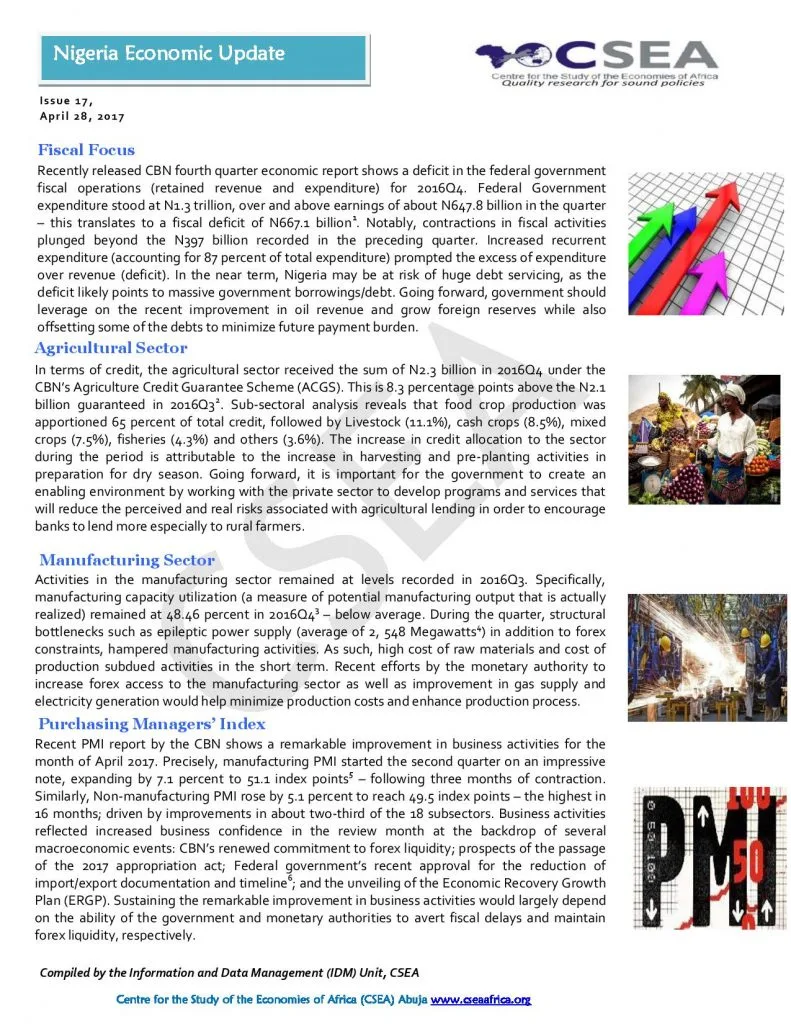
Activities in the manufacturing sector remained at levels recorded in 2016Q3. Specifically, manufacturing capacity utilization (a measure of potential manufacturing output that is actually realized) remained at 48.46 percent in 2016Q4 below average. During the quarter, structural bottlenecks such as epileptic power supply (average of 2, 548 Megawatts) in addition to forex constraints, hampered manufacturing activities. As such, high cost of raw materials and cost of production subdued activities in the short term. Recent efforts by the monetary authority to increase forex access to the manufacturing sector as well as improvement in gas supply and electricity generation would help minimize production costs and enhance production process.
Read More Download PDF

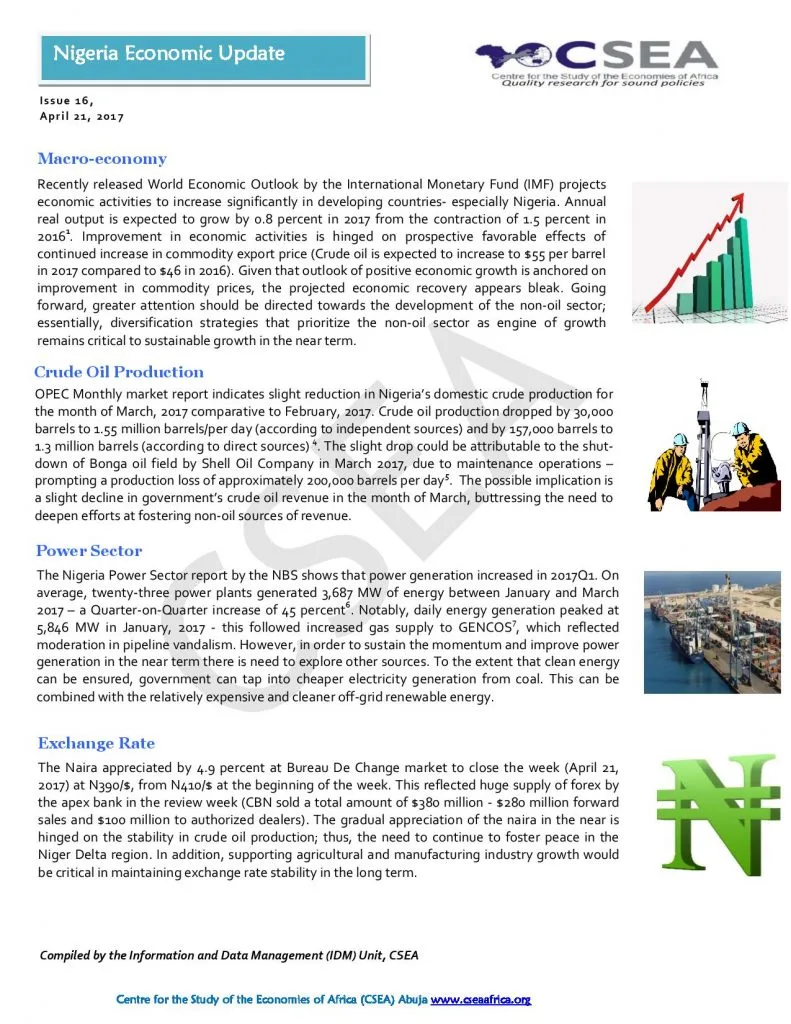
Nigeria Economic Update (Issue 16)

Recently released World Economic Outlook by the International Monetary Fund (IMF) projects economic activities to increase significantly in developing countries- especially Nigeria. Annual real output is expected to grow by 0.8 percent in 2017 from the contraction of 1.5 percent in 20161. Improvement in economic activities is hinged on prospective favorable effects of continued increase in commodity export price (Crude oil is expected to increase to $55 per barrel in 2017 compared to $46 in 2016).
Read More Download PDF

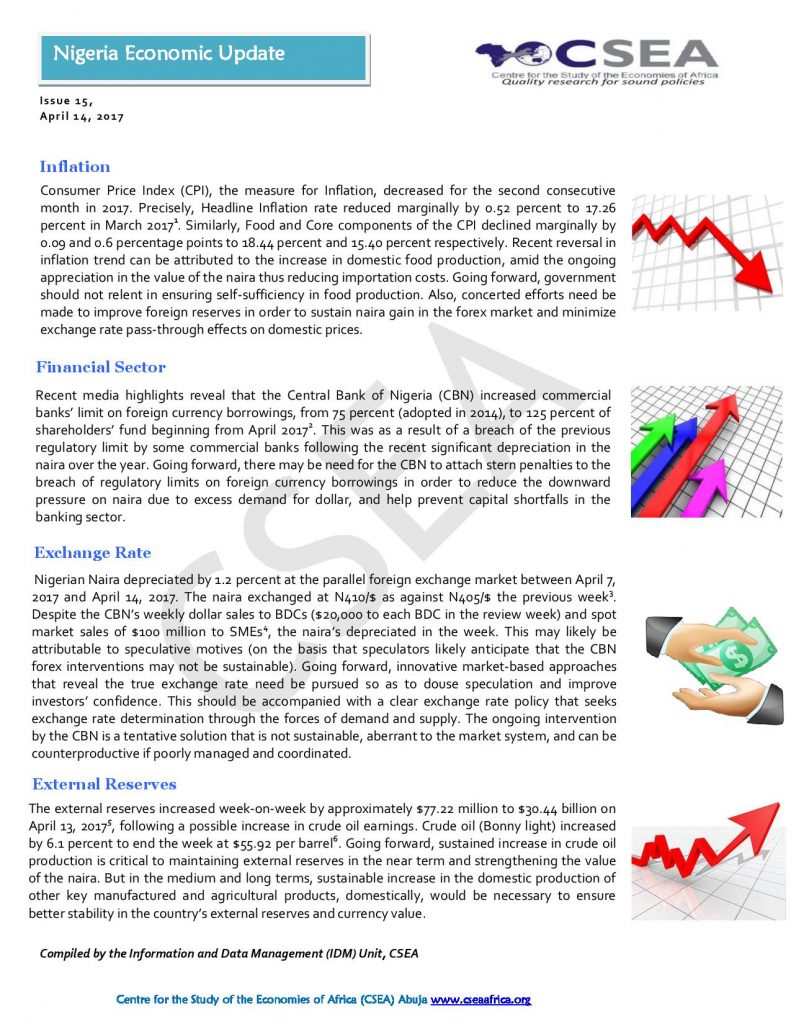
Nigeria Economic Update (Issue 15)

Nigerian Naira depreciated by 1.2 percent at the parallel foreign exchange market between April 7, 2017 and April 14, 2017. The naira exchanged at N410/$ as against N405/$ the previous week. Despite the CBNs weekly dollar sales to BDCs ($20,000 to each BDC in the review week) and spot market sales of $100 million to SMEs, the nairas depreciated in the week. This may likely be attributable to speculative motives (on the basis that speculators likely anticipate that the CBN forex interventions may not be sustainable).
Read More Download PDF

Nigeria Economic Update (Issue 14)

Recently released report by the National Bureau of Statistics indicates decline in output and contribution to GDP in the Nigeria aviation sub-sector. In real terms, output in the sub-sector decreased annually by 4.9 percent between 2015 and 2016; and declined by 13.3 percent (Year-on-Year) in 2016Q4 the largest quarterly decline in 2016. The sectoral fall in output was supply-side driven: increased cost of operations prompted cut-back on services provided by the sector as well as termination of some aviation operations. Going forward, recent improvement in forex supply in the interbank and BDC channel would enhance forex access to airline operators and facilitate smooth running of the airline industry.
Read More Download PDF

Nigeria Economic Update (Issue 13)

OPEC basket price increased (Week-on-Week) by 1.6 percent to $49.45 per barrel on March 31, 2017- the first increase recorded in three weeks. Also, Bonny light rose by 4.7 percent to $51.92 per barrel. The rise in crude oil prices reflects demand-side expansion, consequent upon a myriad of factors: slower rise in USA crude reserves, huge supply disruptions in Libya, and the prospective extension of OPEC supply cut deals in member countries. The strengthening of crude oil price amid calm in the Niger Delta oil region, presents positive outlook for the Nigerian economy. However, given the adverse implications of sole dependence on crude oil revenue, the government should avoid returning to the norm and make efforts to intensify investments in other key sectors of the economy
Read More Download PDF

Africa Economic Update (Issue 2)

Business activities in Africa slightly improved in February 2017 albeit at a slow rate. Sales Managers Index (SMI) for Africa an assessment of business condition in Pan-African Economy increased by 0.4 index points from 52.2 points in January 2017 to 52.6 points in February 2017. Sub-Saharan African countries experienced better business activities than North Africa in the review period. The two largest economies in the region, Nigeria (48.5 index points) and South Africa (49.2 Index points) registered contraction in the review period as Nigeria remained in recession while high unemployment remained a problem in South Africa. The growth in SMI recorded in the review period is driven by improvement in business confidence and sales price which outweighed the fall in other components market growth, sales output and staffing level. 
Read More Download PDF