Publications

Follow via RSS

Climate Policy and Finance: Designing an Effective Carbon Pricing System for Nigeria’s Oil and Gas Sector

Carbon pricing has been recognized not only as the most efficient economic policy instruments to internalize the social cost of emissions, but also as a major tool to generate public revenues that can be used to offset the potential adverse distributional effects of climate policy. However, in many developing countries, there is a widespread reluctance to commit to climate policy, largely due to financial constraints, a lack of public support, and concern over its regressive effects.This paper makes recommendations towards the design of an effective carbon pricing system that not only discourages air pollution but also encourages the gradual uptake of climate-friendly technologies by the private sector in Nigeria's oil and gas sector, while supporting public investment in sustainable infrastructures and projects that offset the distributional effect of the climate policy.
Read More Download PDF

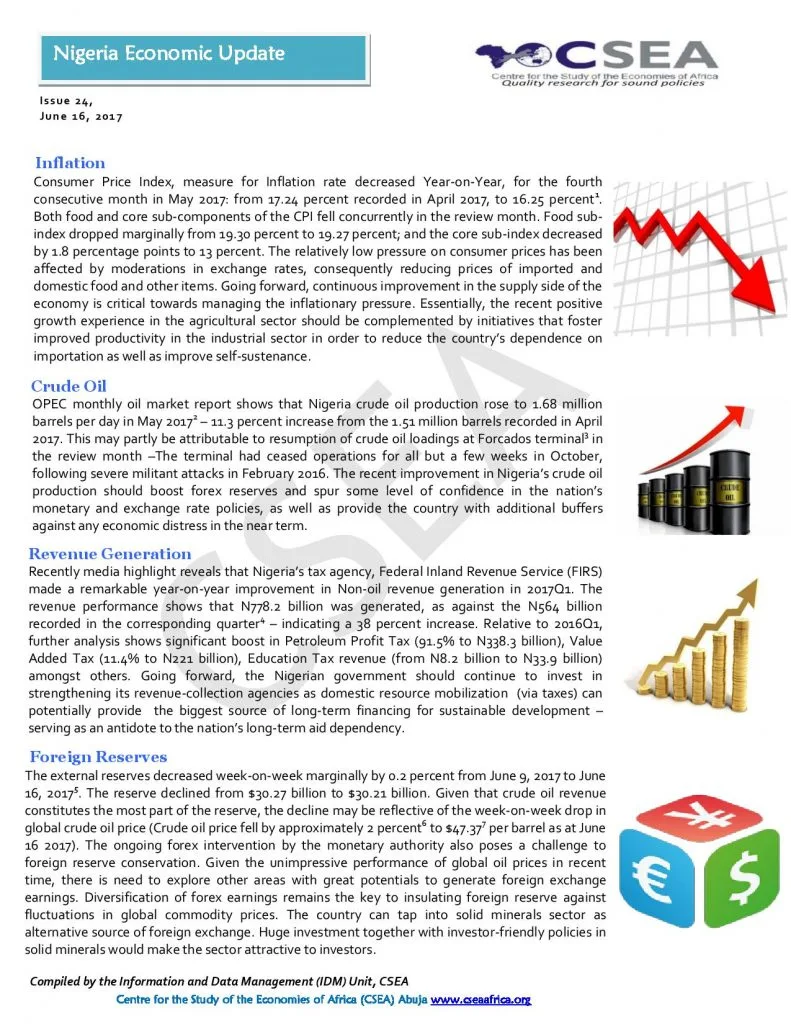
Nigeria Economic Update (Issue 24)

The external reserves decreased week-on-week marginally by 0.2 percent from June 9, 2017 to June 16, 2017. The reserve declined from $30.27 billion to $30.21 billion. Given that crude oil revenue constitutes the most part of the reserve, the decline may be reflective of the week-on-week drop in global crude oil price (Crude oil price fell by approximately 2 percent to $47.377 per barrel as at June 16 2017). The ongoing forex intervention by the monetary authority also poses a challenge to foreign reserve conservation. Given the unimpressive performance of global oil prices in recent time, there is need to explore other areas with great potentials to generate foreign exchange earnings. Diversification of forex earnings remains the key to insulating foreign reserve against fluctuations in global commodity prices. The country can tap into solid minerals sector as alternative source of foreign exchange. Huge investment together with investor-friendly policies in solid minerals would make the sector attractive to investors.
Read More Download PDF

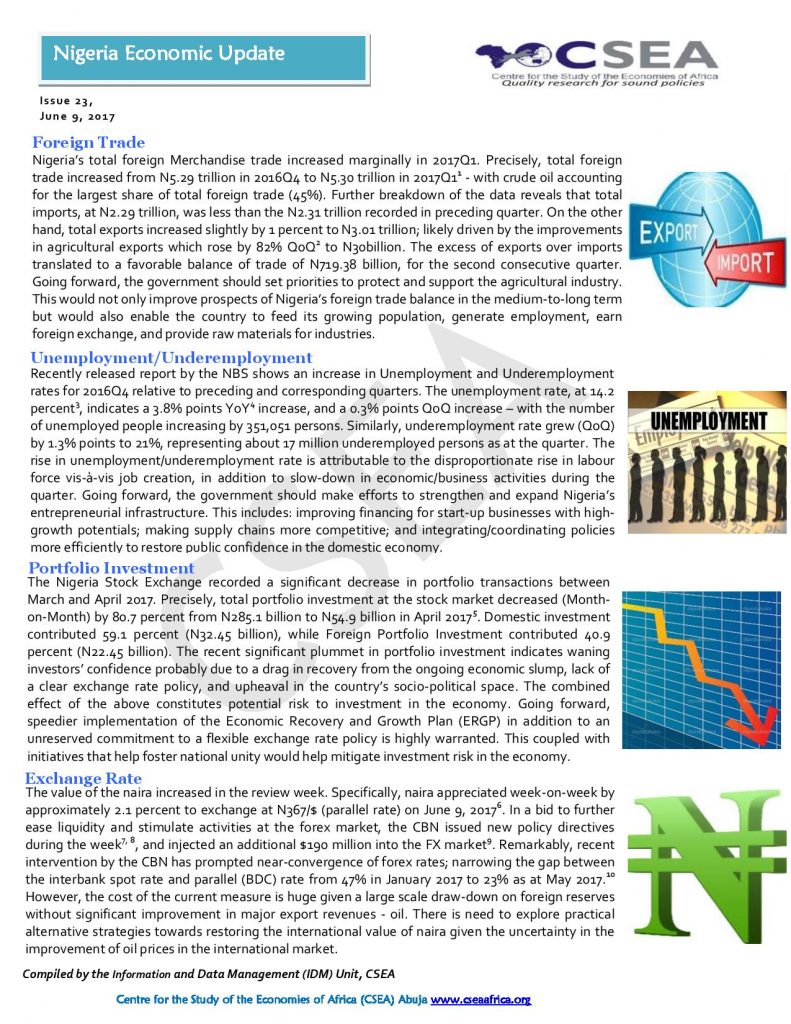
Nigeria Economic Update (Issue 23)

Recently released report by the NBS shows an increase in Unemployment and Underemployment rates for 2016Q4 relative to preceding and corresponding quarters. The unemployment rate, at 14.2 percent, indicates a 3.8% points YoY4increase, and a 0.3% points QoQ increase with the number of unemployed people increasing by 351,051 persons. Similarly, underemployment rate grew (QoQ) by 1.3% points to 21%, representing about 17 million underemployed persons as at the quarter. The rise in unemployment/underemployment rate is attributable to the disproportionate rise in labour force vis--vis job creation, in addition to slow-down in economic/business activities during the quarter. Going forward, the government should make efforts to strengthen and expand Nigerias entrepreneurial infrastructure.
Read More Download PDF

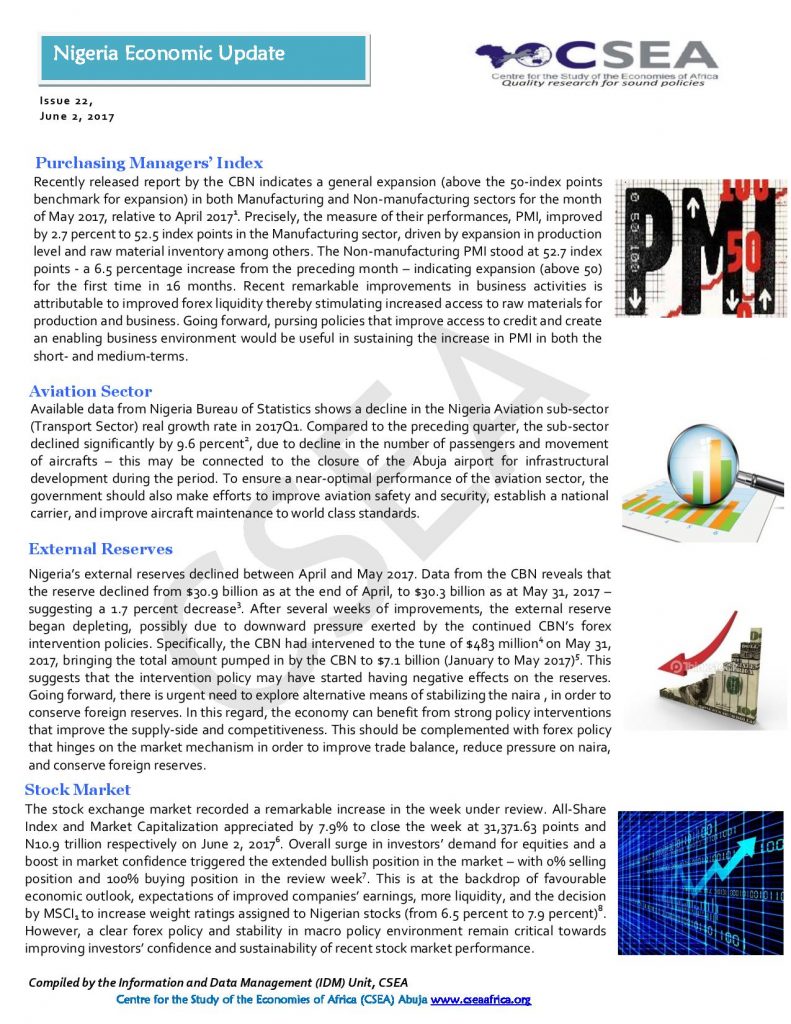
Nigeria Economic Update (Issue 22)

Available data from Nigeria Bureau of Statistics shows a decline in the Nigeria Aviation sub-sector (Transport Sector) real growth rate in 2017Q1. Compared to the preceding quarter, the sub-sector declined significantly by 9.6 percent, due to decline in the number of passengers and movement of aircrafts this may be connected to the closure of the Abuja airport for infrastructural development during the period. To ensure a near-optimal performance of the aviation sector, the government should also make efforts to improve aviation safety and security, establish a national carrier, and improve aircraft maintenance to world class standards.  
Read More Download PDF

Nigeria Economic Update (Issue 21)

Nigerias domestic crude production increased significantly in April 2017. OPECs Month-on-Month data shows a 22.6 percent increase to 1.5 million barrels per day constituting the biggest increase among oil producing group. Crude production increased at the backdrop of completion of scheduled maintenance/repairs at the Bonga oil field, implying resumption of crude production by an additional 225,000 barrels. Remarkably, Nigeria is progressively moving towards meeting daily output benchmark/target (2.2 million barrels per day). Given recent boost in domestic crude oil production, considerable effort should be made to improve the countrys refining capacity in order to reduce fuel importation and conserve foreign exchange.
Read More Download PDF

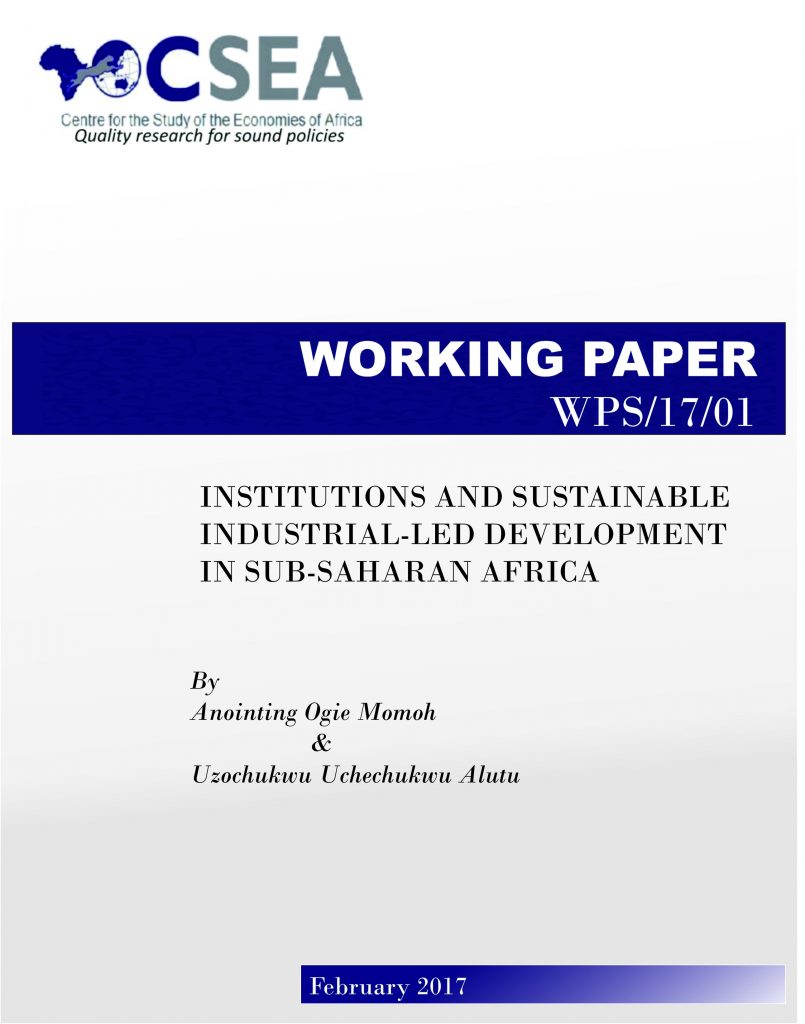
Institutions And Sustainable Industrial-led Development In Sub-Saharan Africa

In 2015, economic growth in Sub-Saharan Africa (SSA) slowed to 3.4 percent from 4.6 percent the previous year. The economic slowdown in the region was the result of an interplay of several external and domestic factors such as lower commodity prices, slowdown in the economies of major trading partners, tightening borrowing conditions, political instability and conflict, electricity shortages and other infrastructure deficiencies (World Bank, 2016). This sluggish growth trends is in contrast to the impressive growth recorded in the region, over the past decade.
Read More Download PDF

Nigeria Economic Update (Issue 20)

The Naira maintained slight appreciation against the dollar in the review week. At the parallel market, the value of the Naira appreciated week-on-week by 1.6 percent to exchange at N380/$ on May 19, 2017. In addition, inter-bank market rate appreciated slightly by 15kobo to N305.45/$. The appreciation in both segments of the market are favorable effects of the CBNs continued forex supply in the week under review (In a bid to further ease forex liquidity, the CBN pumped a total of $457.3 million on May 15, 2017).
Read More Download PDF

Africa Economic Update (Issue 4)

International Monetary Fund (IMF) revised down growth forecast for Sub-Saharan Africa by 0.2 percentage points, while retaining growth estimates for Nigeria and South Africa in 2017. Precisely, growth rate forecast for Africa was reduced from 2.8 percent in January 2017 forecast to 2.6 percent in April 2017 forecast while growth estimates were retained at 0.8 percent for both South Africa and Nigeria. In contrast, global economic growth outlook was increased by 0.4 percentage points from 3.1 percent to 3.5 percent within the same period. Growth in Sub-Saharan Africa is hampered by adverse cyclical and supply side factors, weak fiscal buffers and rising public debt amongst non-commodity exporters as well as severe drought was experienced in Eastern and Southern Africa
Read More Download PDF

Africa Economic Update (Issue 3)

Available data shows that headline inflation rates increased and remained high in most countries in the region in February 2017. Specifically, inflation rate increased in Egypt (30.2), Burundi (20.9 percent), Kenya (10.28), and Ethiopia (8.5 percent), while it eased in Nigeria (17.78 percent), Ghana (13.2 percent), South Africa (6.3 percent), and Namibia (7.8 percent). Seychelles (-0.6 percent) remained in deflation while Sudan (32.86 percent) and Tunisia (4.6 percent) had unchanged inflation rates within the review period. Increased cost of food continued to plague the region as food component of inflation remained the major driver of inflation. Drought in East Africa continues to compound price pressure in the region. Inflation rates in Burundi6, Kenya and Ethiopia increased by 8, 3.29, and 2.4 percentage points respectively, signifying the three highest price increase in the review period
Read More Download PDF