Publications

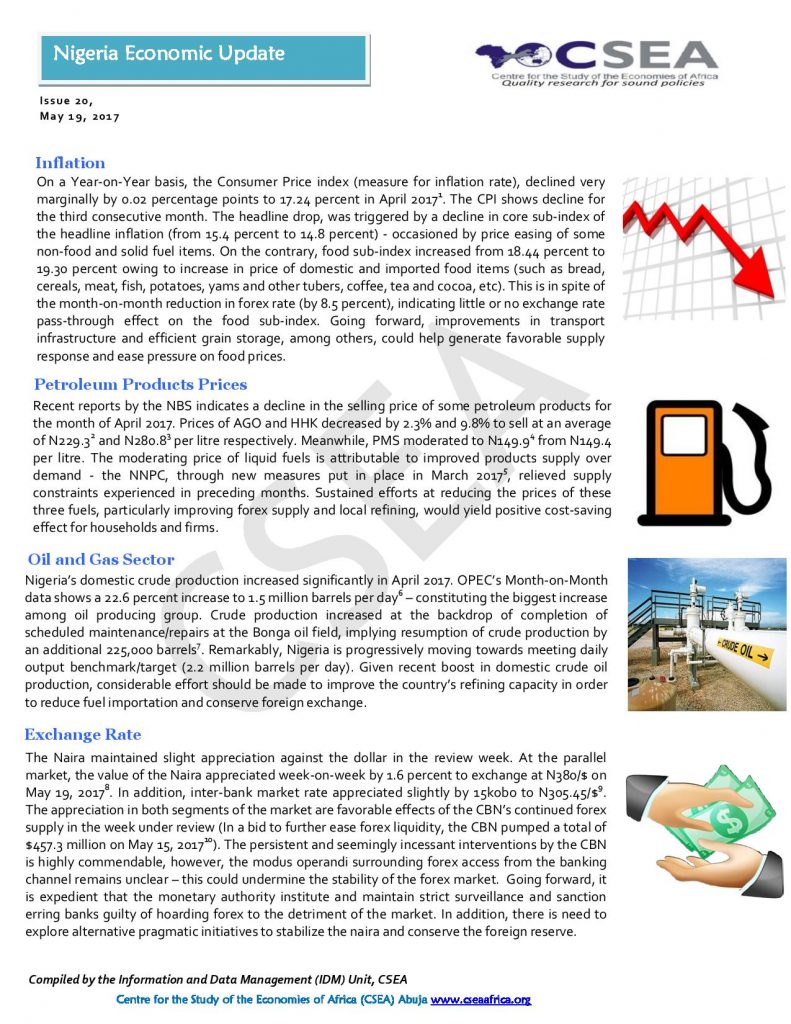
Nigeria Economic Update (Issue 20)

The Naira maintained slight appreciation against the dollar in the review week. At the parallel market, the value of the Naira appreciated week-on-week by 1.6 percent to exchange at N380/$ on May 19, 2017. In addition, inter-bank market rate appreciated slightly by 15kobo to N305.45/$. The appreciation in both segments of the market are favorable effects of the CBNs continued forex supply in the week under review (In a bid to further ease forex liquidity, the CBN pumped a total of $457.3 million on May 15, 2017).
Read More Download PDF

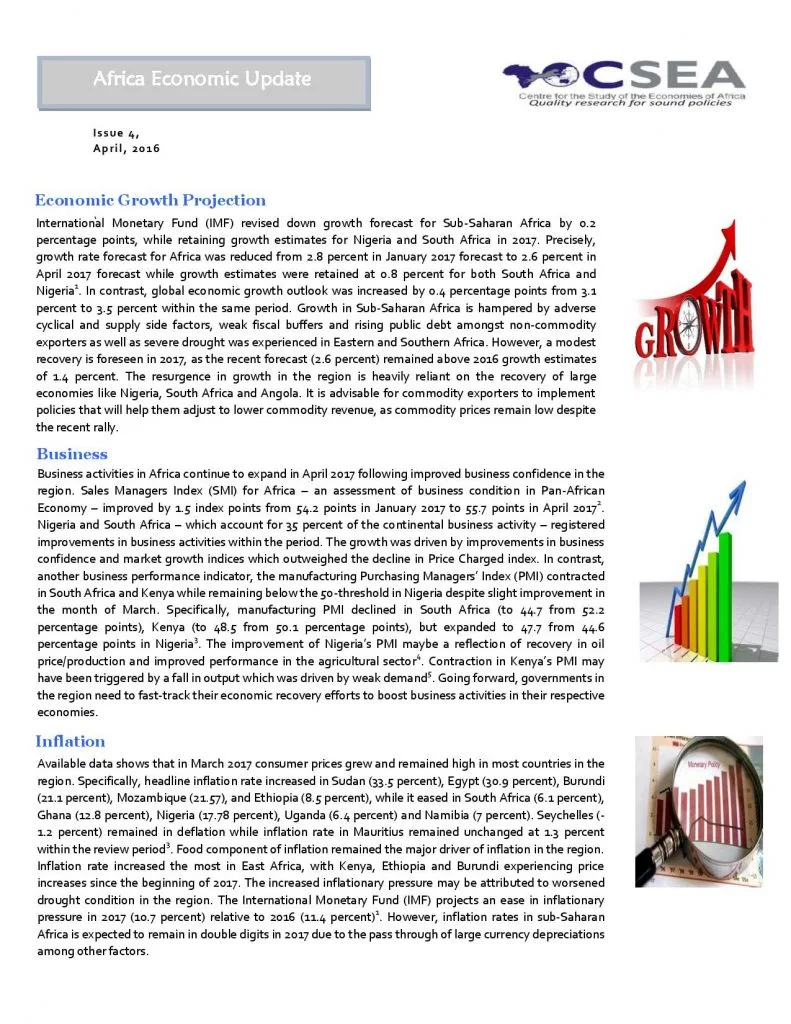
Africa Economic Update (Issue 4)

International Monetary Fund (IMF) revised down growth forecast for Sub-Saharan Africa by 0.2 percentage points, while retaining growth estimates for Nigeria and South Africa in 2017. Precisely, growth rate forecast for Africa was reduced from 2.8 percent in January 2017 forecast to 2.6 percent in April 2017 forecast while growth estimates were retained at 0.8 percent for both South Africa and Nigeria. In contrast, global economic growth outlook was increased by 0.4 percentage points from 3.1 percent to 3.5 percent within the same period. Growth in Sub-Saharan Africa is hampered by adverse cyclical and supply side factors, weak fiscal buffers and rising public debt amongst non-commodity exporters as well as severe drought was experienced in Eastern and Southern Africa
Read More Download PDF

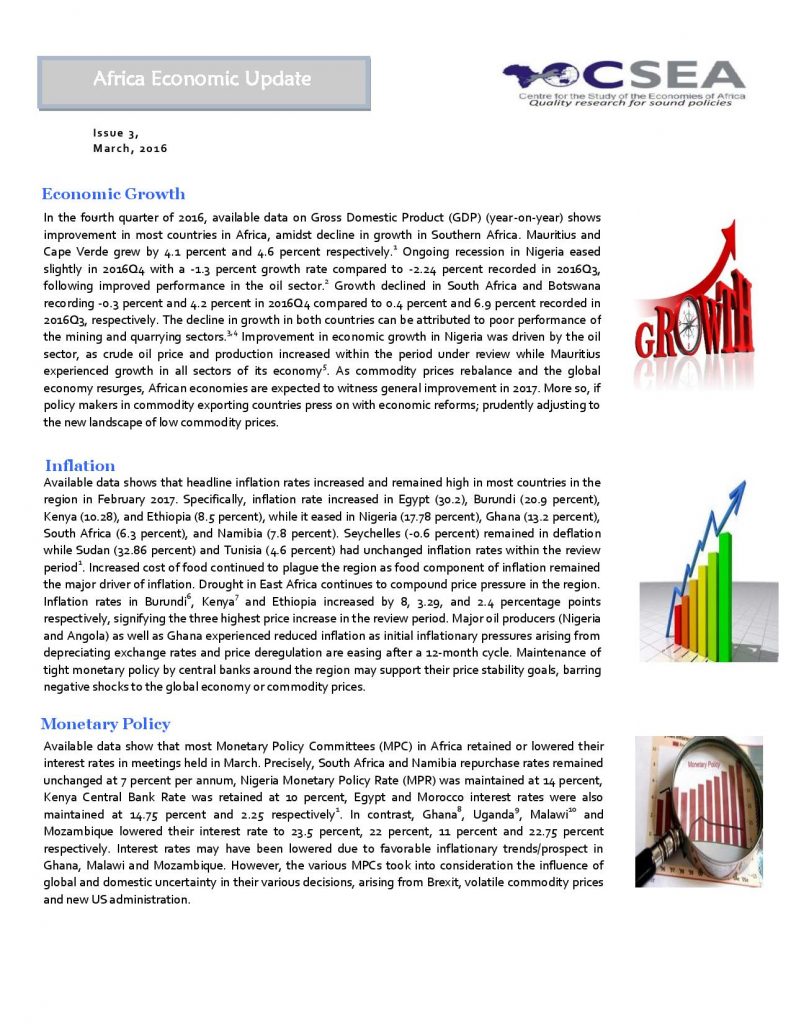
Africa Economic Update (Issue 3)

Available data shows that headline inflation rates increased and remained high in most countries in the region in February 2017. Specifically, inflation rate increased in Egypt (30.2), Burundi (20.9 percent), Kenya (10.28), and Ethiopia (8.5 percent), while it eased in Nigeria (17.78 percent), Ghana (13.2 percent), South Africa (6.3 percent), and Namibia (7.8 percent). Seychelles (-0.6 percent) remained in deflation while Sudan (32.86 percent) and Tunisia (4.6 percent) had unchanged inflation rates within the review period. Increased cost of food continued to plague the region as food component of inflation remained the major driver of inflation. Drought in East Africa continues to compound price pressure in the region. Inflation rates in Burundi6, Kenya and Ethiopia increased by 8, 3.29, and 2.4 percentage points respectively, signifying the three highest price increase in the review period
Read More Download PDF

Nigeria Economic Update (Issue 19)

Internally generated revenue by 35 states for the 2016 fiscal year increased by 17.5 percent to N802 billion from N683 billion generated in the preceding year. A breakdown of the IGR shows that the increase was driven by PAYE, Direct assessment, Road taxes, Revenue from MDAs and other taxes. The highest and lowest revenue generating states were Lagos (38%) and Ebonyi (0.1%) respectively. An improvement in the efficiency of the tax system could improve the contributions of the IGR to overall government revenue. Particularly, incorporating workers in small stores, agricultural and informal businesses into the tax system; building capacity of tax officials and computerizing their operations; as well as investing in quality data collection and access could provide some quick wins.
Read More Download PDF

Nigeria Economic Update (Issue 18)

Recent Data released by the Nigeria Bureau of Statistics reveals an increase in total public debt stock between 2015 and 2016. Foreign and domestic debt stock stood at $11.4 billion and N14.0 trillion respectively as at December 2016, from $10.7 billion and N10.5 trillionrecorded as at December 2015. Disaggregated data shows that foreign debt sources comprised Multilateral ($8.0 billion), Bilateral ($0.2 billion) and Exim bank of China ($3.2 billion); domestic sources included government bonds, treasury bills and bonds. The federal government and states accounted for 68.7% and 31.3% respectively of foreign debt stock; 78.9% and 21.1% respectively of domestic debt stock. This maybe particularly at the backdrop of government borrowings in 2016 to finance its expenditure (mostly recurrent).
Read More Download PDF

Understanding The Ongoing Recession In Nigeria:A Synthesis Of The Events And Policy Options

In the second quarter of 2016, the Nigerian economy witnessed its first recession in twenty years due to the interplay of several external and internal factors. The recession has continued until date and has given rise to relentless unemployment rate and job losses, double digit and soaring inflation, currency depreciation and widening gap between parallel market and official exchange rates, amongst other adverse effect on individuals and firms in the country. Thus, there is a need to take a deeper look into the nature of the present recession as well as the impact of monetary and fiscal policy responses thus far, in order to shed light on the way forward towards tackling the recession and ensuring sustainable economic growth. This paper analyses the ongoing recession in the Nigerian economy to provide insights into the interplay of events and recommendations for policy.
Read More Download XPS

Nigeria Economic Update (Issue 17)

Activities in the manufacturing sector remained at levels recorded in 2016Q3. Specifically, manufacturing capacity utilization (a measure of potential manufacturing output that is actually realized) remained at 48.46 percent in 2016Q4 below average. During the quarter, structural bottlenecks such as epileptic power supply (average of 2, 548 Megawatts) in addition to forex constraints, hampered manufacturing activities. As such, high cost of raw materials and cost of production subdued activities in the short term. Recent efforts by the monetary authority to increase forex access to the manufacturing sector as well as improvement in gas supply and electricity generation would help minimize production costs and enhance production process.
Read More Download PDF

Nigeria Economic Update (Issue 16)

Recently released World Economic Outlook by the International Monetary Fund (IMF) projects economic activities to increase significantly in developing countries- especially Nigeria. Annual real output is expected to grow by 0.8 percent in 2017 from the contraction of 1.5 percent in 20161. Improvement in economic activities is hinged on prospective favorable effects of continued increase in commodity export price (Crude oil is expected to increase to $55 per barrel in 2017 compared to $46 in 2016).
Read More Download PDF

Nigeria Economic Update (Issue 15)

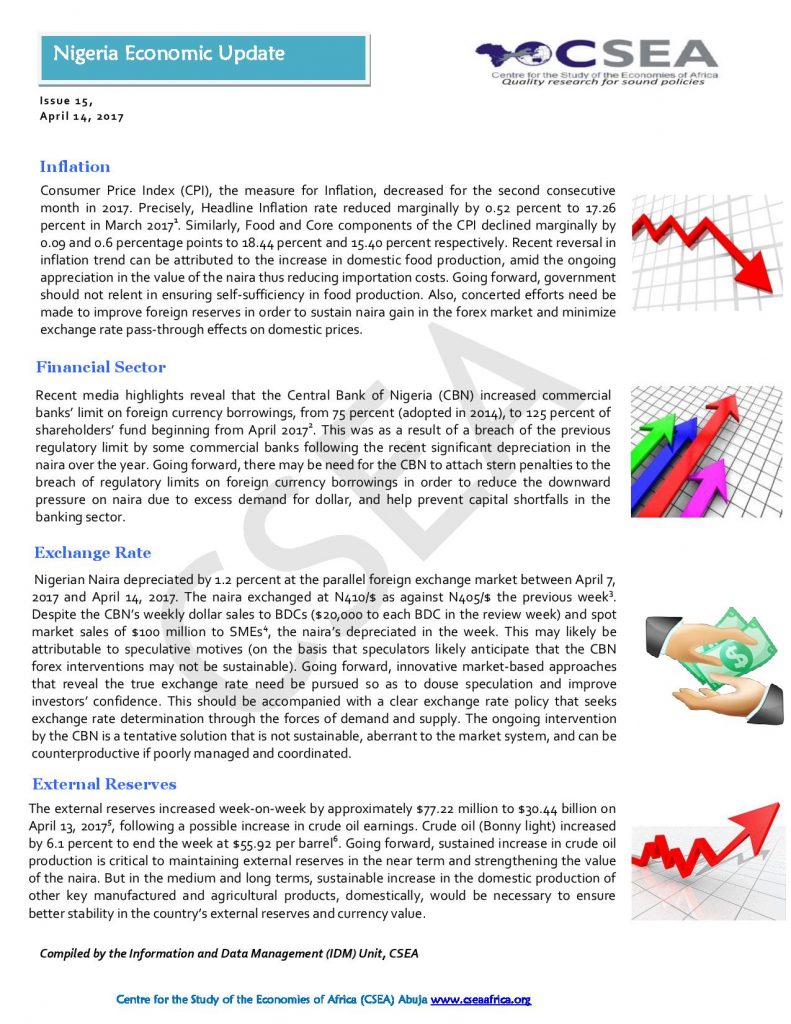
Nigerian Naira depreciated by 1.2 percent at the parallel foreign exchange market between April 7, 2017 and April 14, 2017. The naira exchanged at N410/$ as against N405/$ the previous week. Despite the CBNs weekly dollar sales to BDCs ($20,000 to each BDC in the review week) and spot market sales of $100 million to SMEs, the nairas depreciated in the week. This may likely be attributable to speculative motives (on the basis that speculators likely anticipate that the CBN forex interventions may not be sustainable).
Read More Download PDF