Publications

Follow via RSS

Africa Economic Update (Issue 6)

Available data shows that headline inflation reduced in most countries in the region in May 2017 relative to preceding months. Notably, headline inflation decreased in Nigeria (16.25 percent), Ghana (12.26 percent), Tanzania (6.1 percent), Senegal (1.8 percent), Namibia (6.3 percent) and Rwanda (11.7 percent), while it grew in South Africa (5.4 percent), Kenya (11.7 percent), Ethiopia (8.7 percent) and Uganda (7.2 percent). Cote dIvoire (-0.4 percent) recorded consumer price deflation. The decrease in consumer price in Nigeria, Tanzania and Ghana can be attributed to decreases in both food and non-food components of inflation. Regionally, all countries in Southern Africa recorded single digits inflation, however consumer price marginally increased in South Africa, for the first time in 2017 owing to spike in food prices6, and Botswana (both by 0.1 percent).
Read More Download PDF

Nigeria Economic Update (Issue 30)

Recent media highlights suggest that there is a prospective decrease in Nigerias budgetary benchmark crude oil production. Precisely, the 1.8 million barrels per day proposed at the Joint OPEC and Non-OPEC Ministerial Monitoring Committee (JMMC) meeting, is 18.2 percent lower than the budgetary production benchmark of 2.2 million barrels per day. This followed OPECs recent review to include Nigeria in the ongoing production cut agreement amid concerns of global oil market oversupply, given the constant production increase from Nigeria over the last few months.
Read More Download PDF

Nigeria Economic Update (Issue 29)

Global oil price edged upwards in the review week. International crude benchmark, Brent, rose week-on-week by 3.1 percent to $50 per barrel as at July 21, 20173 a level it had not attained since June. The remarkable gains followed demand-side progress earlier statistics from China showed increase in crude imports, indicating prospects of higher demand. This was also complimented by the huge drop in US domestic crude production (Crude reserves fell by 4.7 million barrels). If the trend is sustained, Nigeria could record further rise in its Gross Federally Collected Revenue. Nevertheless, there remains a need for Nigeria to overcome the challenge of harnessing its oil and gas resources by making strategic policy choices andensuring coordination in policy implementation to minimize macroeconomic distortions.
Read More Download PDF

Nigeria Economic Update (Issue 28)

Latest monthly economic report by the CBN reveals a decline in foreign exchange flows through the CBN. Foreign exchange inflow through the apex bank, dropped Month-on-Month by 21 percent to $2.3 billion in May 2017, occasioned by the fall in from Oil and Non-oil sources during the month.
Read More Download PDF

Nigeria Economic Update (Issue 26)

Power sector statistics indicates a huge decline in power generated in the week under review (June 23, 2017 to June 30, 2017). Power generated, attained a peak of 4,305 MW on June 23, 2017 but fell significantly by 33.1 percent to approximately average of 3,000 MW as at June 30, 2017. The huge decline is attributable to continued poor payment and inability of most GENCOs to pay for gas supply and a system collapse. Consequently, power sector lost huge prospective funds; and daily power supply reduced to 4.5 hours per day7. Going forward, improvement in energy supply is critical to domestic production, job creation, and diversification agenda of the government.
Read More Download PDF

Nigeria Economic Update (Issue 25)

Naira appreciated in the week under review. At the parallel market, naira gained 0.54 percent to exchange at N368/$ on June 23, 20175. This is at the backdrop of injections into the forex market by the CBN to the tune of $195 million at the beginning of the review week, to meet various forex demands. This is amid a slight week-on-week increase in the external reserves (by 0.1 percent to $30.23 billion). Despite the recent naira appreciation, the long-term prospects seem bleak given that the ongoing intervention that seeks to stabilize naira by depleting reserves is unsustainable.
Read More Download PDF

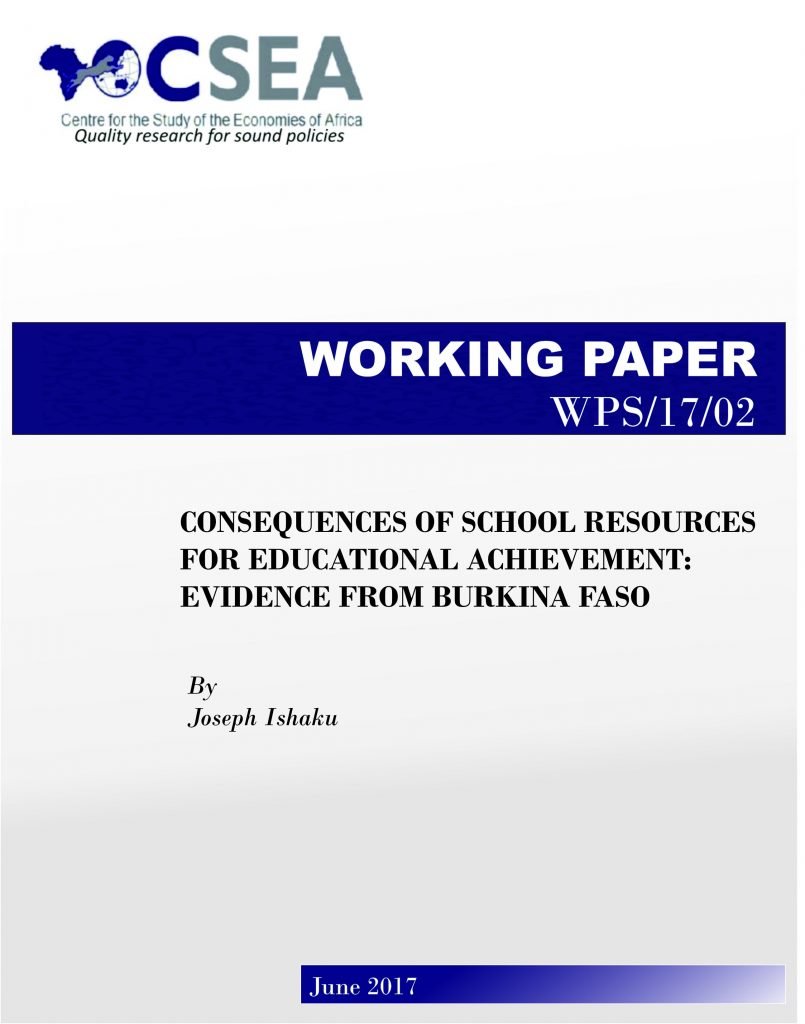
Consequences Of School Resources For Educational Achievement

This paper examines the determinants of educational achievement in a developing country context, Burkina Faso. We deviate from the extant literature by constructing an aggregate index of school quality from the observable school resources. Also, we account for school choice constraints, faced by children especially in rural areas, as it relates to the geographical inequalities in the distribution of quality schools. These treatments provide an unbiased estimates of the relevance of school resources for academic performance. The empirical approach is based on a two-stage procedure that accounts for supply constraints in school choice.
Read More Download PDF