Publications

Follow via RSS

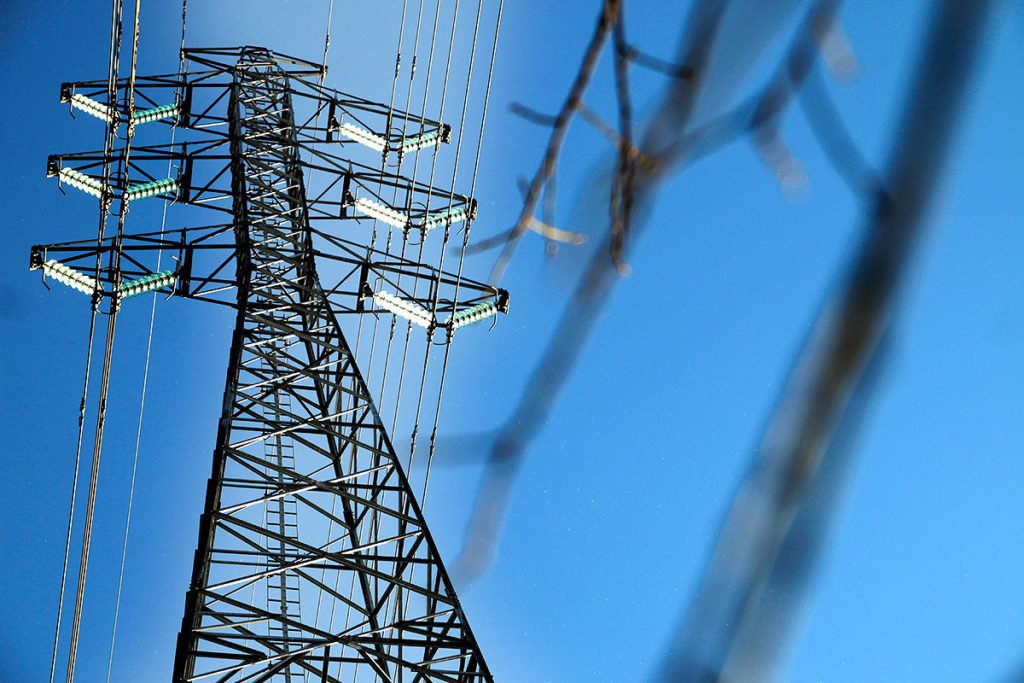
Electrification in Nigeria: Challenges and Way Forward

Although electricity has been generated in commercial quantities in Nigeria for over a century, the rate of electricity infrastructure development in the county is low and power supply remains inadequate. Prior to reforms, the central challenges of the Nigerian power sector was the vertically integrated monopoly of government in power generation, transmission and distribution. While the reforms was successful in privatizing the generation and distribution segments of the Nigerian Electricity Supply Industry (NESI), the overbearing problems in the sector persists –with privatization only changing the dimensions of the challenges.

Financing remain a major problem across all the segments of the NESI partly due to non-cost reflective tariff. Yet each segment of the NESI also faces its unique challenges. The generation segment is riffed with the problems of energy security and inefficiencies in other segments. The challenges in the transmission segment lies in the lack of modern transmission lines and equipment, gross mismanagement, poor maintenance of available infrastructure and inefficient grid design. Distribution companies face the problem of huge Aggregate Technical, Commercial, and Collection (ATC&C) losses.

In terms of electricity access, 46.09 percent of the Nigerian population remains unconnected to the national grid, representing 83.98 million people. Further, electricity demand is estimated at 24,380 MW as at 2015 compared to NESI’s available generation capacity of 7,139.6 MW. In terms of energy use, Nigeria has the lowest in the world – 80 percent below its energy use based on income levels.

In a bid to tackle aforementioned challenges, the Federal Government of Nigeria (FGN) set ambitious targets for the country’s energy mix. This should allow Nigeria exploit its potential for coal, solar, wind, biomass, as well as small and large hydroelectric power electric generation, while reducing the prevalence of self-generation, which constitute two-thirds of present energy mix. By 2020, the FGN targets to achieve up to 75 percent access to electricity by connecting 1.5 million households annually. While Nigeria’s energy mix targets are desirable, the prospect of success remain bleak on account of financial constraints, pricing policy and lack of policy coordination.

Improving electricity supply in Nigeria and addressing barriers to achieving the energy mix targets will entail: addressing payment risk, financing power sector investment, as well as improving the pricing and tariff structure, gas pricing and allocation, and market regulation.


Read More Download PDF Download PDF Download PDF

Nigeria Economic Update (Issue 40)

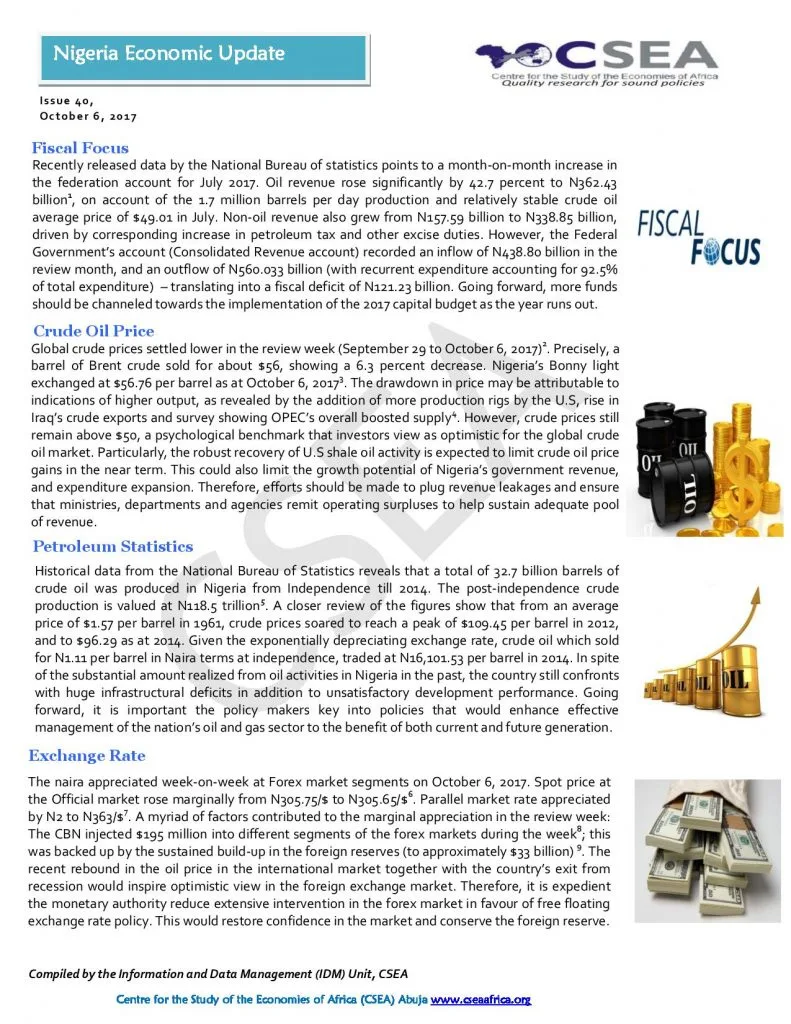
Global crude prices settled lower in the review week (September 29 to October 6, 2017). Precisely, a barrel of Brent crude sold for about $56, showing a 6.3 percent decrease. Nigerias Bonny light exchanged at $56.76 per barrel as at October 6, 2017. The draw down in price may be attributable to indications of higher output, as revealed by the addition of more production rigs by the U.S, rise in Iraqs crude exports and survey showing OPECs overall boosted supply.
Read More Download PDF

Nigeria Economic Update (Issue 39)

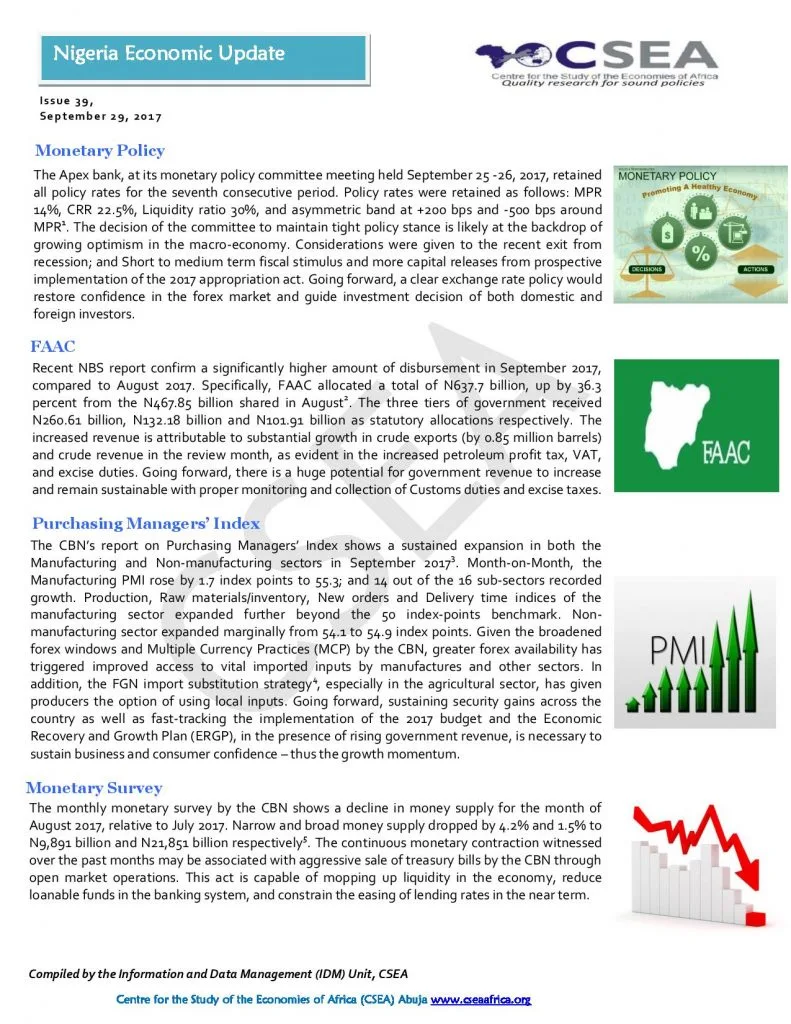
The monthly monetary survey by the CBN shows a decline in money supply for the month of August 2017, relative to July 2017. Narrow and broad money supply dropped by 4.2% and 1.5% to N9,891 billion and N21,851 billion respectively. The continuous monetary contraction witnessed over the past months may be associated with aggressive sale of treasury bills by the CBN through open market operations. This act is capable of mopping up liquidity in the economy, reduce loanable funds in the banking system, and constrain the easing of lending rates in the near term.
Read More Download PDF

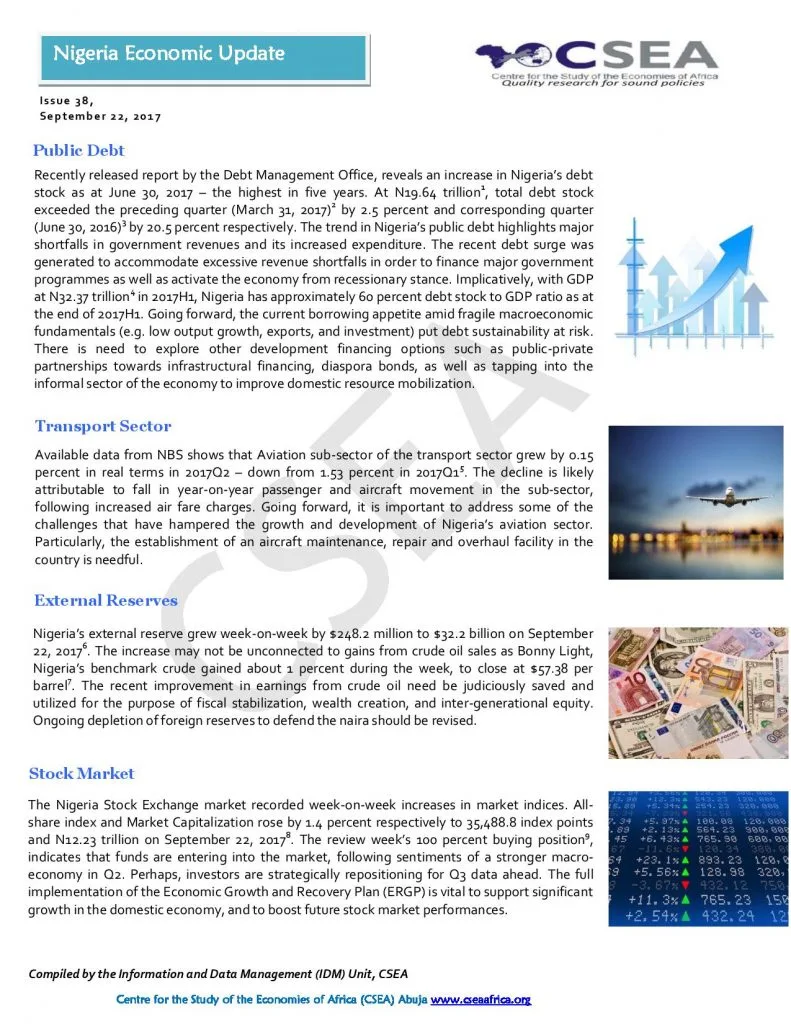
Nigeria Economic Update (Issue 38)

Available data from NBS shows that Aviation sub-sector of the transport sector grew by o.15 percent in real terms in 2017Q2 down from 1.53 percent in 2017Q15. The decline is likely attributable to fall in year-on-year passenger and aircraft movement in the sub-sector, following increased air fare charges. 
Read More Download PDF

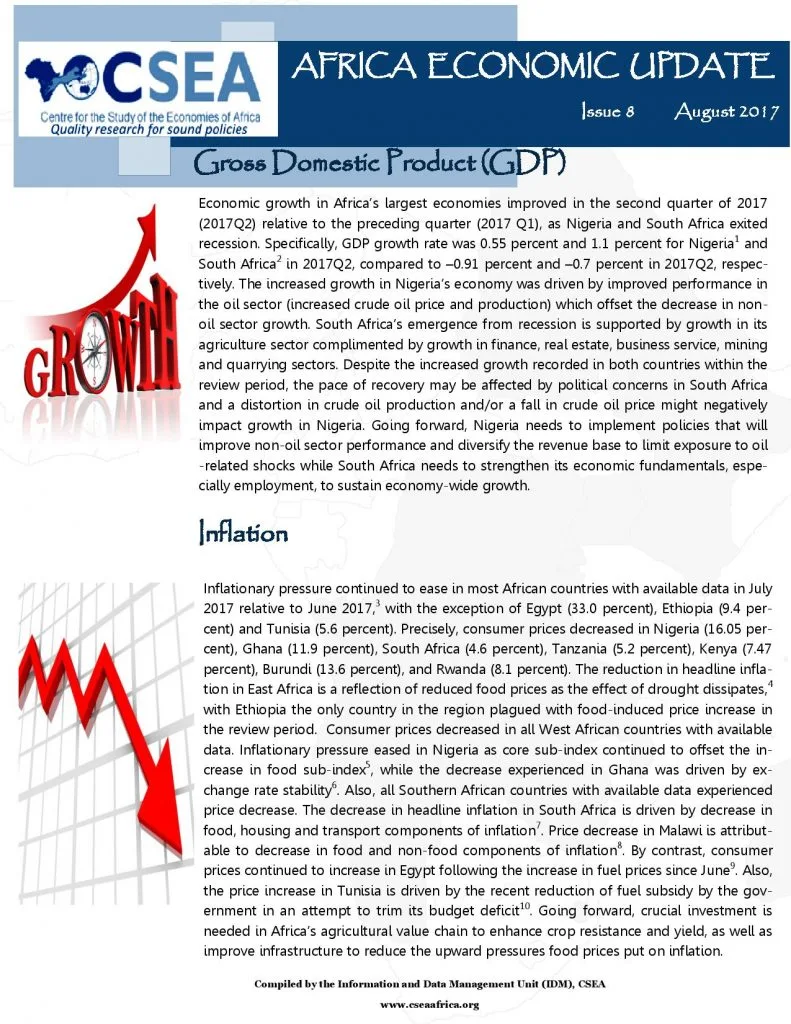
Africa Economic Update (Issue 8)

Economic growth in Africas largest economies improved in the second quarter of 2017 (2017Q2) relative to the preceding quarter (2017 Q1), as Nigeria and South Africa exited recession. Specifically, GDP growth rate was 0.55 percent and 1.1 percent for Nigeria and South Africa in 2017Q2, compared to 0.91 percent and 0.7 percent in 2017Q2, respectively. The increased growth in Nigerias economy was driven by improved performance in the oil sector (increased crude oil price and production) which offset the decrease in non-oil sector growth, while South Africas emergence from recession is supported by growth in its agriculture sector complimented by growth in finance, real estate, business service, mining and quarrying sectors.
Read More Download PDF

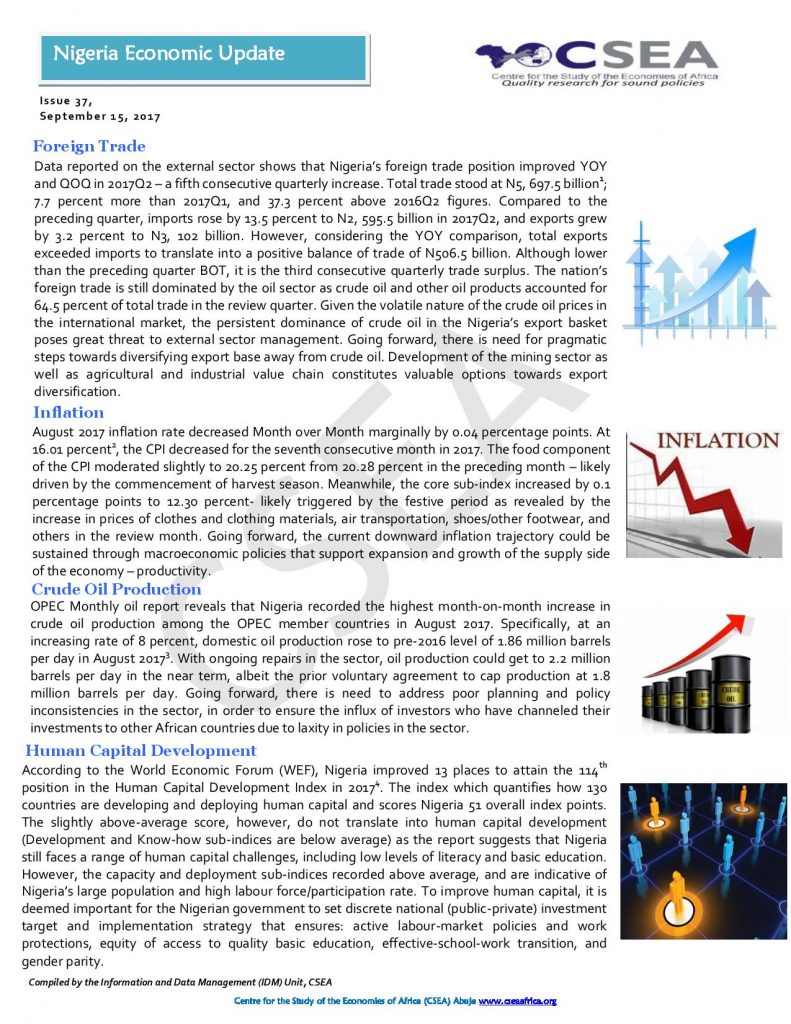
Nigeria Economic Update (Issue 37)

OPEC Monthly oil report reveals that Nigeria recorded the highest month-on-month increase in crude oil production among the OPEC member countries in August 2017. Specifically, at an increasing rate of 8 percent, domestic oil production rose to pre-2016 level of 1.86 million barrels per day in August 2017. With ongoing repairs in the sector, oil production could get to 2.2 million barrels per day in the near term, albeit the prior voluntary agreement to cap production at 1.8 million barrels per day. Going forward, there is need to address poor planning and policy inconsistencies in the sector, in order to ensure the influx of investors who have channeled their investments to other African countries due to laxity in policies in the sector.
Read More

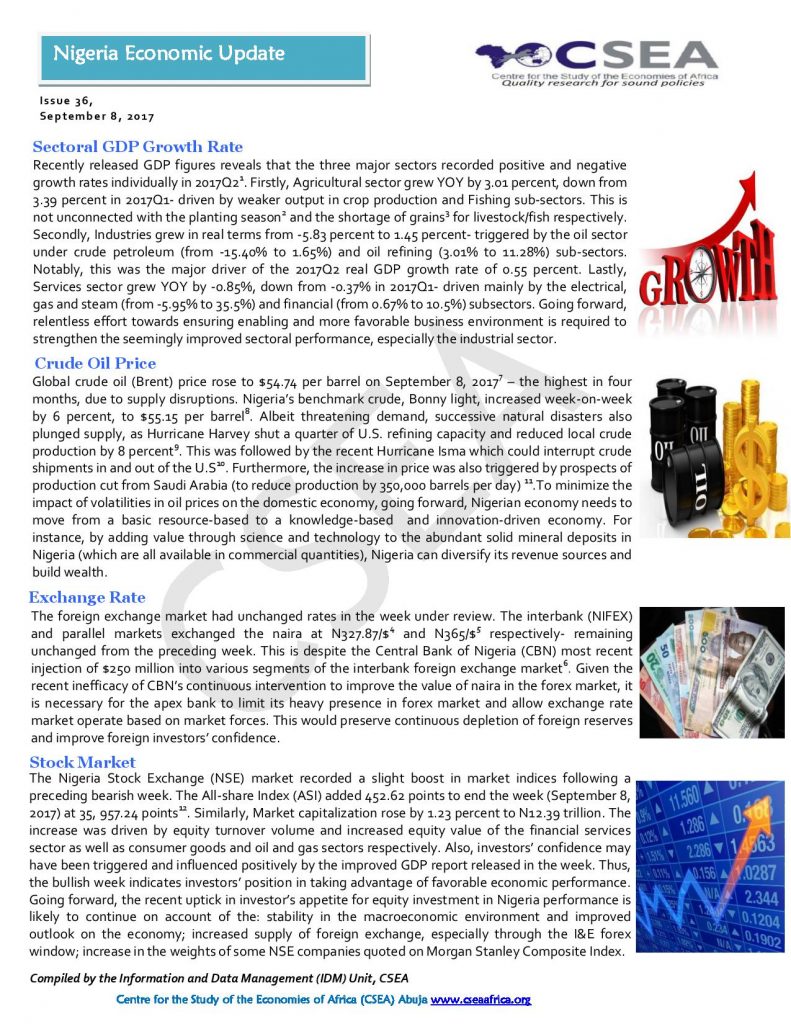
Nigeria Economic Update (Issue 36)

Recently released GDP figures reveals that the three major sectors recorded positive and negative growth rates individually in 2017Q2. Firstly, Agricultural sector grew Year on Year by 3.01 percent, down from 3.39 percent in 2017Q1- driven by weaker output in crop production and Fishing sub-sectors. This is not unconnected with the planting season and the shortage of grainsfor livestock/fish respectively.
Read More Download PDF

Nigeria Economic Review

The global economy grew by 2.7 percent in the fourth quarter of 2016 (2016Q4) relative to 2.5 percent in 2016Q3, due to rising investment and consumption demands in developed and emerging economies as well as a rise in commodity prices. However, over the entire year, global GDP growth stood at 2.6 percent in 2016, relative to the growth of 3.09 percent recorded in 2015. Notably, output grew progressively in the US over the year, while the steady growth recorded in the UK since the start of the year stalled in 2016Q4. Also, the declining growth recorded in France since 2015 took a positive turn in 2016Q4, the rest of the Eurozone witnessed a fall in output in the quarter. While emerging economies recorded mixed experiences, many Sub-Saharan African countries showed signs of recovery in the period.
Read More Download PDF

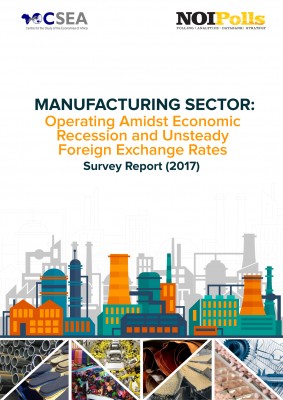
MANUFACTURING SECTOR: Operating Admist Economic Recession And Rising Foreign Exchange Rates

This 2017 Manufacturing Sector survey provides an assessment of the Nigerian manufacturing sector, highlighting the key challenges facing operators within the sector. It also examines the dynamics and major development in the manufacturing sector over the last one year. Overall, the objective of the report is to provide a snapshot of the manufacturing sector in Nigeria, which will provide a framework for policy intervention by policymakers
Read More Download PDF