Publications

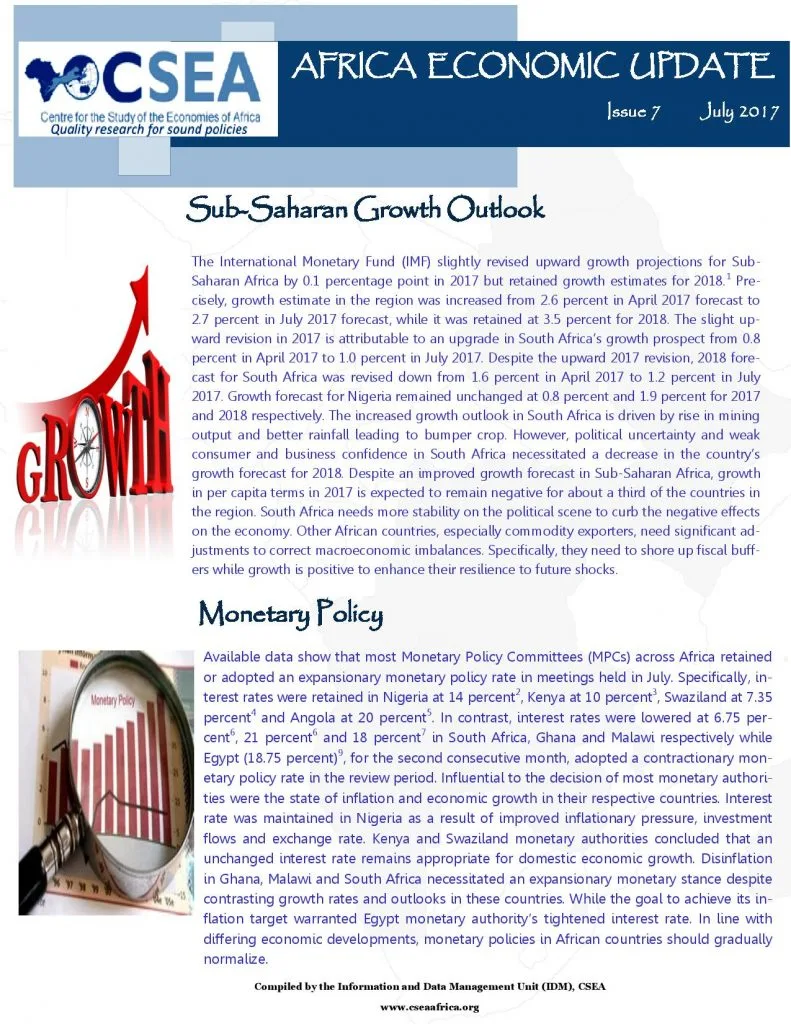
Africa Economic Update (Issue 7)

The International Monetary Fund (IMF) slightly revised upward growth projections for SubSaharan Africa by 0.1 percentage point in 2017 but retained growth estimates for 2018.1 Precisely, growth estimate in the region was increased from 2.6 percent in April 2017 forecast to 2.7 percent in July 2017 forecast, while it was retained at 3.5 percent for 2018. The slight upward revision in 2017 is attributable to an upgrade in South Africas growth prospect from 0.8 percent in April 2017 to 1.0 percent in July 2017. Despite the upward 2017 revision, 2018 forecast for South Africa was revised down from 1.6 percent in April 2017 to 1.2 percent in July 2017. Growth forecast for Nigeria remained unchanged at 0.8 percent and 1.9 percent for 2017 and 2018 respectively.
Read More Download PDF

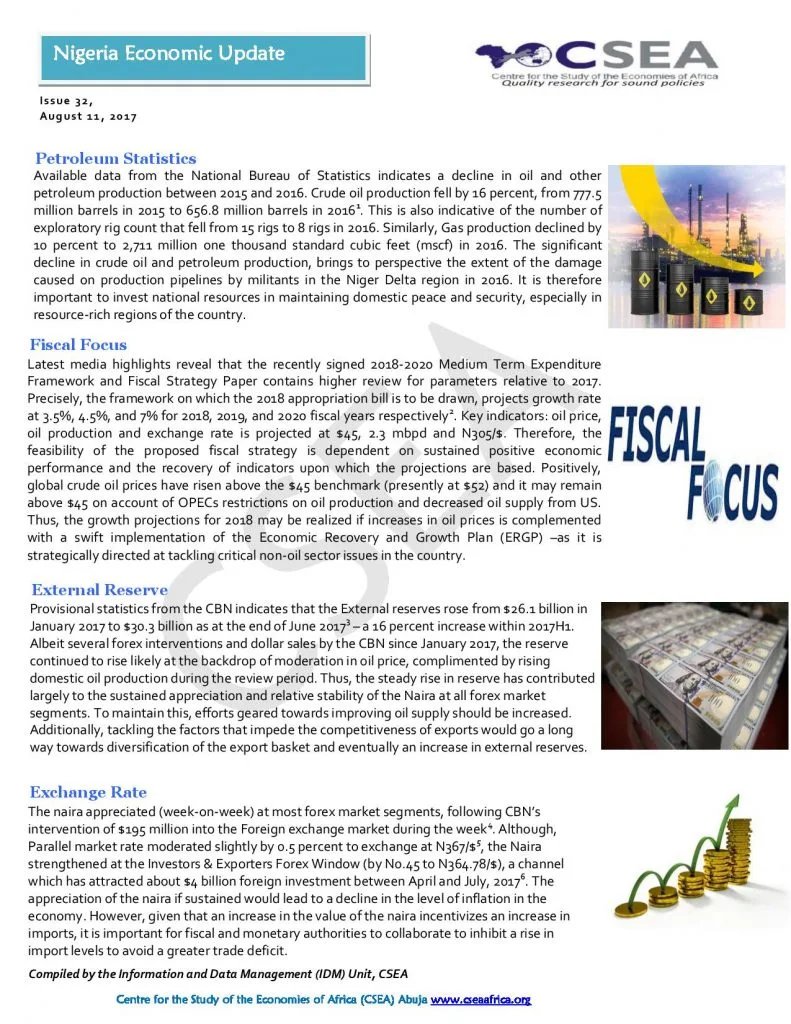
Nigeria Economic Update (Issue 32)

Available data from the National Bureau of Statistics indicates a decline in oil and other petroleum production between 2015 and 2016. Crude oil production fell by 16 percent, from 777.5 million barrels in 2015 to 656.8 million barrels in 2016. This is also indicative of the number of exploratory rig count that fell from 15 rigs to 8 rigs in 2016. Similarly, Gas production declined by 10 percent to 2,711 million one thousand standard cubic feet (mscf) in 2016. The significant decline in crude oil and petroleum production, brings to perspective the extent of the damage caused on production pipelines by militants in the Niger Delta region in 2016. It is therefore important to invest national resources in maintaining domestic peace and security, especially in resource-rich regions of the country.
Read More Download PDF

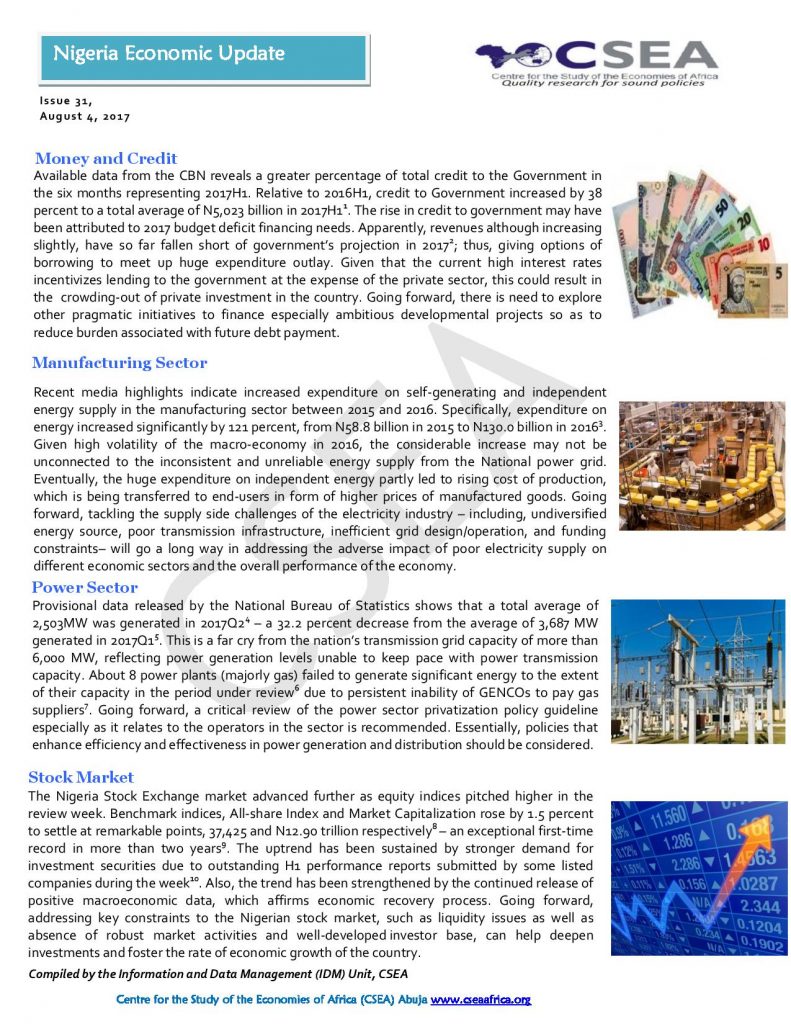
Nigeria Economic Update (Issue 31)

The Nigeria Stock Exchange market advanced further as equity indices pitched higher in the review week. Benchmark indices, All-share Index and Market Capitalization rose by 1.5 percent to settle at remarkable points, 37,425 and N12.90 trillion respectively an exceptional first-time record in more than two years. The uptrend has been sustained by stronger demand for investment securities due to outstanding H1 performance reports submitted by some listed companies during the week10.
Read More Download PDF

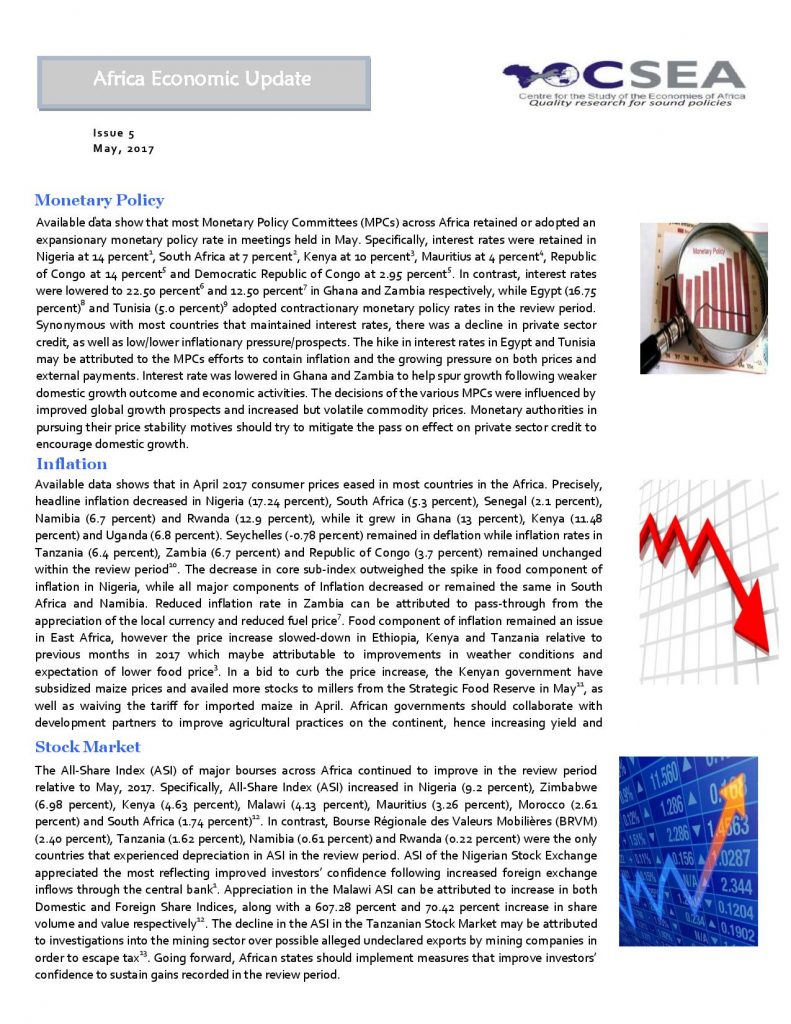
Africa Economic Update (Issue 6)

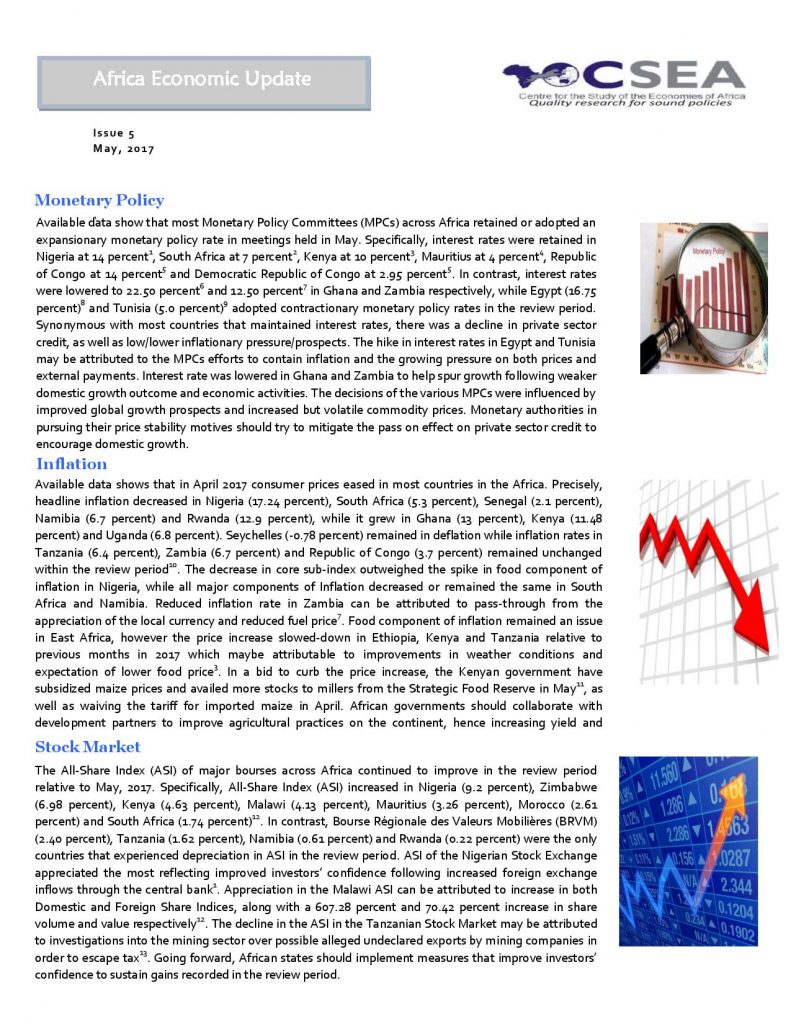
Available data shows that headline inflation reduced in most countries in the region in May 2017 relative to preceding months. Notably, headline inflation decreased in Nigeria (16.25 percent), Ghana (12.26 percent), Tanzania (6.1 percent), Senegal (1.8 percent), Namibia (6.3 percent) and Rwanda (11.7 percent), while it grew in South Africa (5.4 percent), Kenya (11.7 percent), Ethiopia (8.7 percent) and Uganda (7.2 percent). Cote dIvoire (-0.4 percent) recorded consumer price deflation. The decrease in consumer price in Nigeria, Tanzania and Ghana can be attributed to decreases in both food and non-food components of inflation. Regionally, all countries in Southern Africa recorded single digits inflation, however consumer price marginally increased in South Africa, for the first time in 2017 owing to spike in food prices6, and Botswana (both by 0.1 percent).
Read More Download PDF

Nigeria Economic Update (Issue 30)

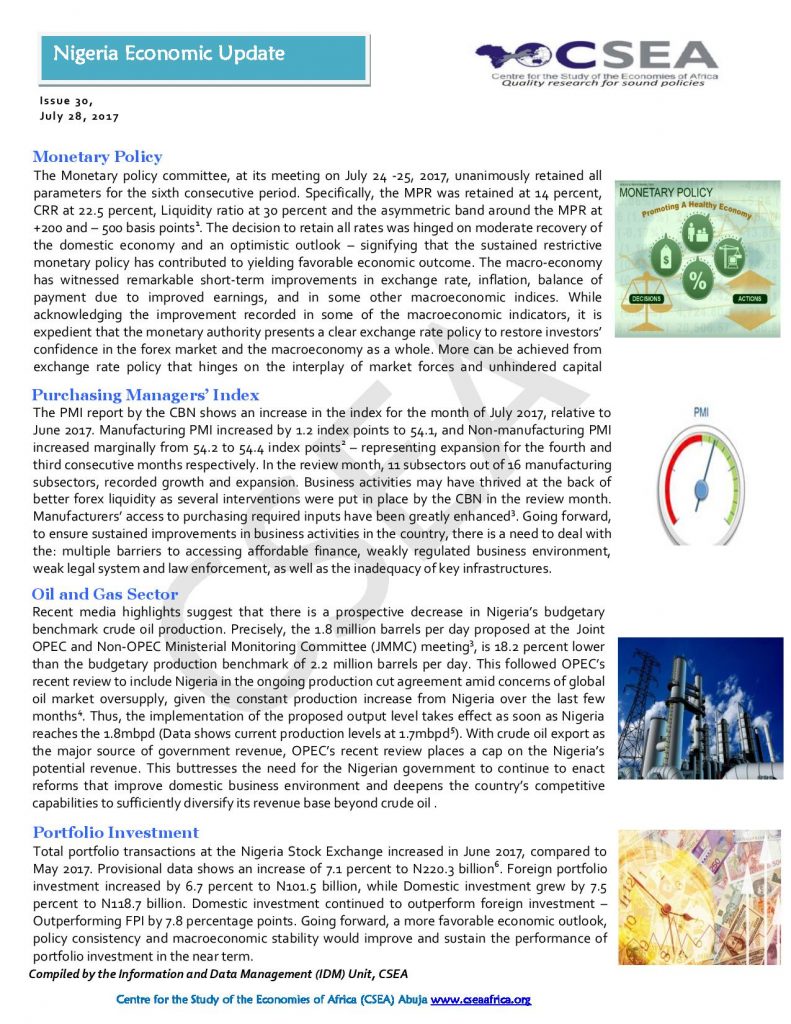
Recent media highlights suggest that there is a prospective decrease in Nigerias budgetary benchmark crude oil production. Precisely, the 1.8 million barrels per day proposed at the Joint OPEC and Non-OPEC Ministerial Monitoring Committee (JMMC) meeting, is 18.2 percent lower than the budgetary production benchmark of 2.2 million barrels per day. This followed OPECs recent review to include Nigeria in the ongoing production cut agreement amid concerns of global oil market oversupply, given the constant production increase from Nigeria over the last few months.
Read More Download PDF

Nigeria Economic Update (Issue 29)

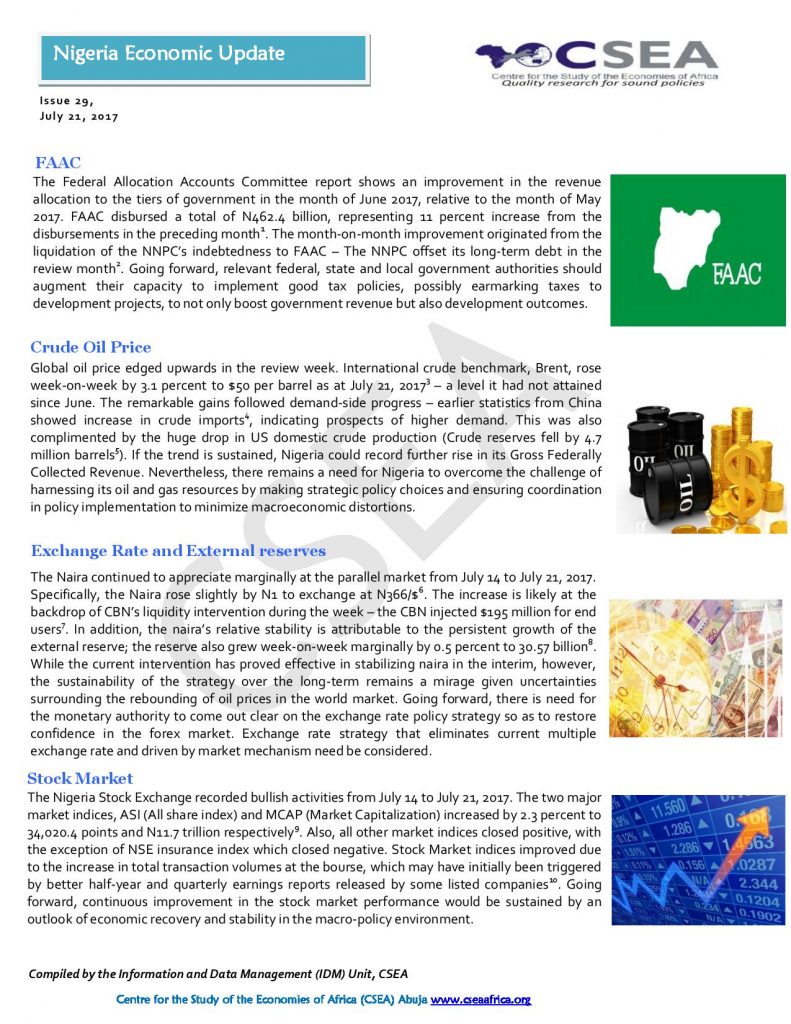
Global oil price edged upwards in the review week. International crude benchmark, Brent, rose week-on-week by 3.1 percent to $50 per barrel as at July 21, 20173 a level it had not attained since June. The remarkable gains followed demand-side progress earlier statistics from China showed increase in crude imports, indicating prospects of higher demand. This was also complimented by the huge drop in US domestic crude production (Crude reserves fell by 4.7 million barrels). If the trend is sustained, Nigeria could record further rise in its Gross Federally Collected Revenue. Nevertheless, there remains a need for Nigeria to overcome the challenge of harnessing its oil and gas resources by making strategic policy choices andensuring coordination in policy implementation to minimize macroeconomic distortions.
Read More Download PDF

Nigeria Economic Update (Issue 28)

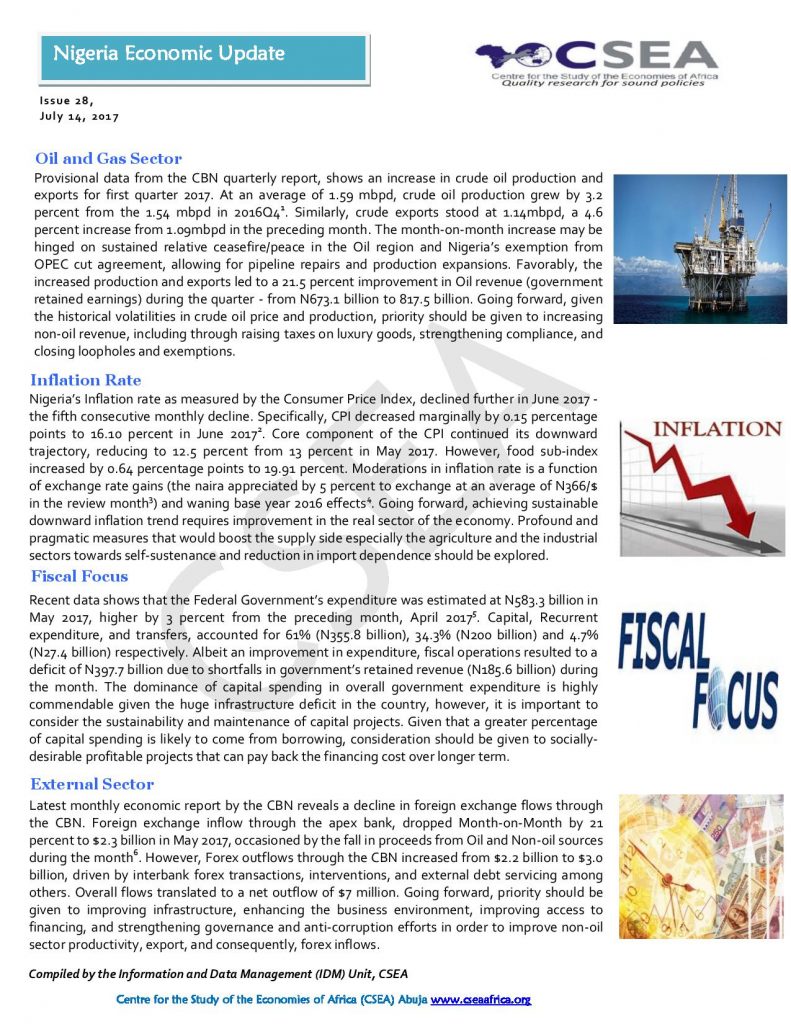
Latest monthly economic report by the CBN reveals a decline in foreign exchange flows through the CBN. Foreign exchange inflow through the apex bank, dropped Month-on-Month by 21 percent to $2.3 billion in May 2017, occasioned by the fall in from Oil and Non-oil sources during the month.
Read More Download PDF