Nigeria’s all products terms of trade (calculated as the receipts of exports as a percentage of payments for imports), indicated increases in the three months of 2018Q2. Indexed at an average of 110.8% in 2018Q21, the favourable TOT reflects improvement from an average of 99.2% in 2018Q1. A further breakdown shows that TOT indices for April, May and June stood at 100.5%, 111.1% and 109.2% respectively which implies that the value of exports exceeded imports by 0.5%, 11.1% and 9.02% in each of the months. The positive trade position is attributable to improvements in mineral, animal and vegetable products group, as reported. With renewed interest in the Agric and mineral sectors by the government and private sector, we expect an improvement in the trade position.
The 2017 budget implementation report shows a paltry average performance in 2017, compared to the projections contained in the budget. The actual oil and non-oil revenue generated were N1.1 trillion and N957 billion respectively, considerably below the projected figures of N2.1 trillion1 and N1.4 trillion. Other revenue sources brought the total revenue generated to N2.7 trillion. However, on the expenditure side, the combination of personnel expenditure and debt repayments amounted to N3.5 trillion, which exceeded total revenue by N885 billion. This implies that Nigeria borrowed to pay salaries and service debts in 2017. As long as the culture of making unrealistic budget projections continues, we expect to record low budget implementation going forward. To address the wide gap between actual and expected budget performance, better forecast of future revenue alongside making less ambitious spending plans is critical.
The recent report by United Nations Development Programme (UNDP) shows that Nigeria’s Human Development Index (HDI) value rose very marginally from 0.530 in 2016 to 0.532 in 20171. However, overall, the ranking remained unchanged at 157th position out of 189 sample countries – putting the nation in the low human development category, and below Ghana, Kenya and a few other sub-Saharan countries. The HDI criteria which are broadly inclusive of countries’ social, political and economic diversity and indicative of the quality of life, may have shown limited progress in Nigeria due to rising population2 (currently, the population stands at 190.1 million). In the population growth and absence of the political will to address the sub-optimal HDI, signalled by the historic low budget share allocated to the education and health sectors, significant improvements in the HDI is not foreseeable in the near future.
Total value of Nigeria’s merchandise trade contracted in 2018Q2. Valued at N6.6 trillion1, total trade fell quarter-on-quarter by 8.9 percent from the N7.2 trillion recorded in the previous quarter. Both exports and imports declined during the period: Exports shrunk by 4.9 percent down to N4.5 trillion and was triggered by a huge fall in solid minerals and manufacturing exports. On the other hand, imports declined from N2.5 trillion to N2.1 trillion. Further review shows that crude oil accounted for 83.5 percent of total foreign merchandise trade, and trade to GDP lowered to 22.5 percent from 25.5 percent. However, there was a recorded trade surplus during the period, valued at N2.4 trillion. Going forward, there is a need for export promotion strategies, including subsidies, tax exemptions, and special credit lines to support non-oil business growth.
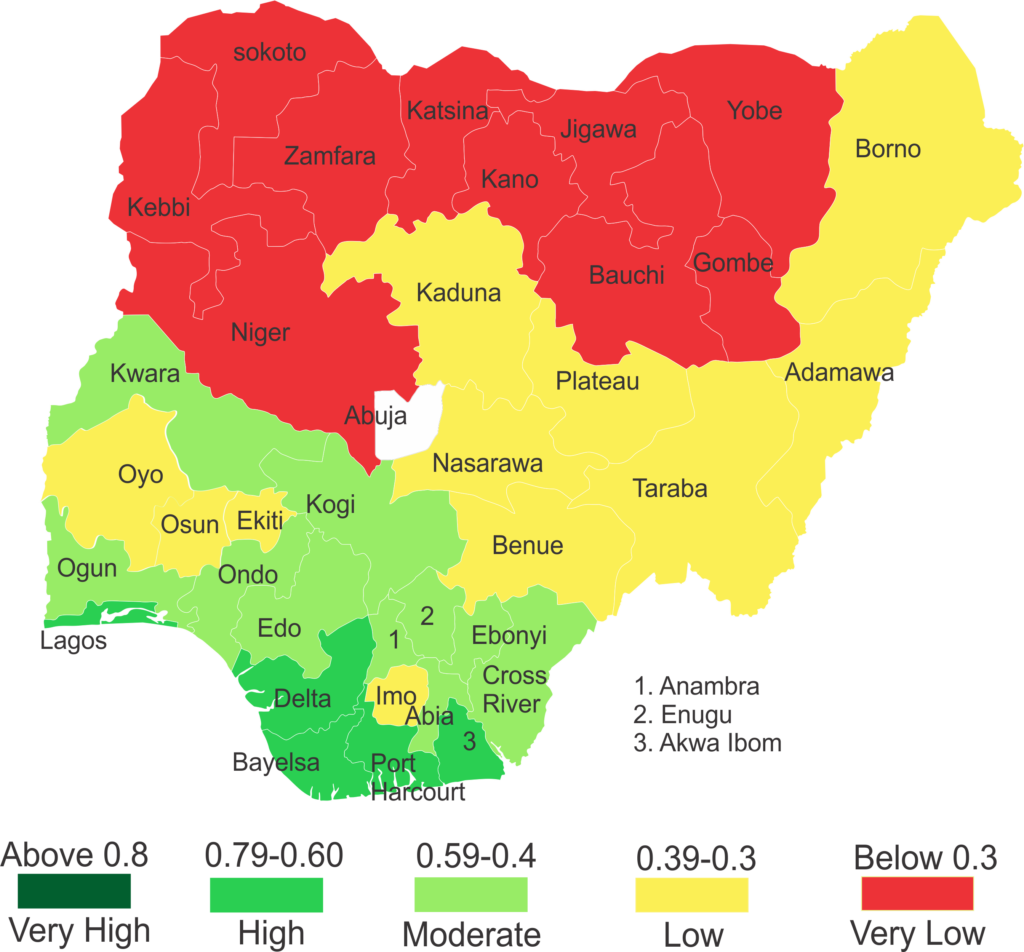
This study develops a comparable Human Development Index for subnational government in Nigeria. While built on the UNDP approach, we extend the generic framework to address challenges at the subnational level such as comparable indicator, data unavailability, and estimation technique. The result shows a wide disparity across states in their human development, with states within the southern region recording more impressive performance. We further examine the key economic and political drivers of the observed variations across the state and found fiscal sustainability and geopolitical zoning as the key determinants.
Latest data from the CBN shows that Nigeria’s external reserves fell significantly in August 2018. As at the end of July, the reserve stood at $47.11 billion; it dropped to $45.83 billion by August 23– losing as much as $1.23 billion in the month. The CBN’s continuous intervention along with affected foreign investment premised around political uncertainties, may have triggered the decline in reserves. Policy actions that relay a message of future political stability and conducive business environment amid politicking for 2019 elections is critical to sustaining short-medium term investment flows.
Total capital imported into Nigeria declined in 2018Q2, compared to 2018Q1 – the first quarterly decline since 2017Q1. At $5.5 billion in 2018Q21, capital importation dropped by 12.5 percent from the $6.3 billion recorded in the preceding quarter. The quarter-over-quarter decline may be attributable to decreases in both portfolio and other investments, which fell by 9.8 percent and 24.1 percent respectively. However, portfolio investment maintained its leading role in contributing to total capital importation, at $4.1 billion or 74.5 percent. On the flip side, FDI continues to be the least contributor since 2017Q1, and accounted for only 4.7 percent ($264.1 million) in the review quarter. The overall lower capital inflows, particularly portfolio investments, puts into perspective the recent persistent downward trend in Nigeria’s capital and money markets.