Macroeconomic Report & Economic Updates

  • Home
  • Macroeconomic Report & Economic Updates
Follow via RSS

Nigeria Economic Update (Issue 35)

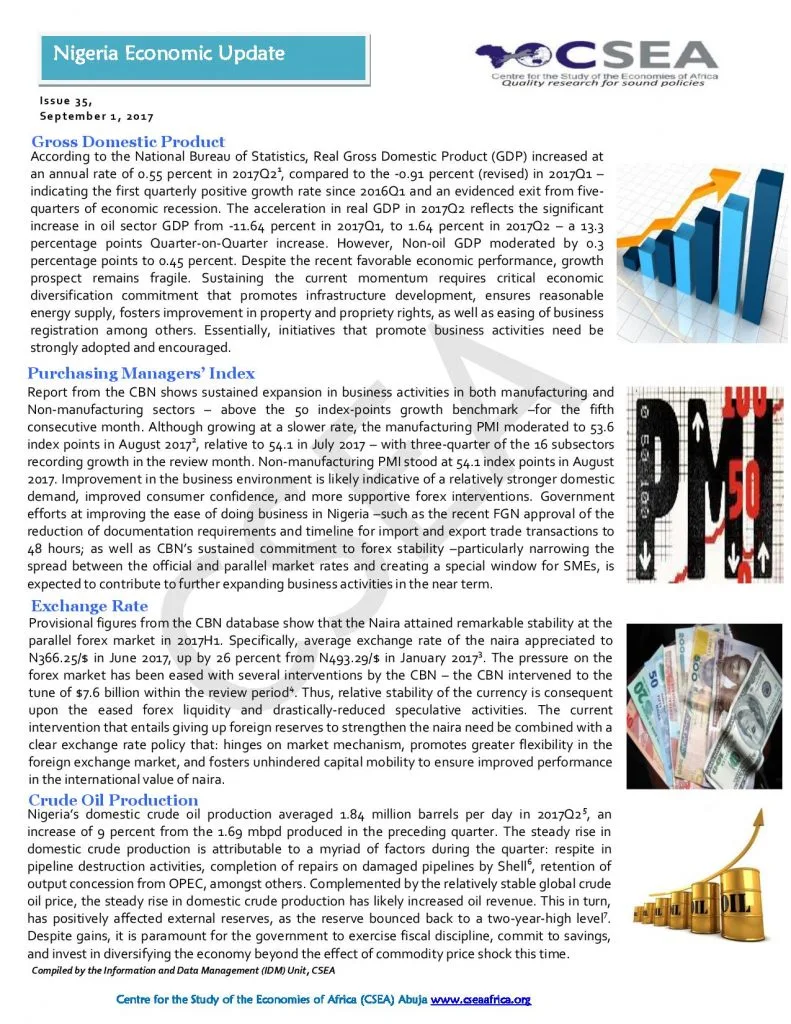
Nigeria's Real Gross Domestic Product (GDP) increased at an annual rate of 0.55 percent in 2017Q21, compared to the -0.91 percent (revised) in 2017Q1 indicating the first quarterly positive growth rate since 2016Q1 and an evidenced exit from five quarters of economic recession. The acceleration in real GDP in 2017Q2 reflects the significant increase in oil sector GDP from -11.64 percent in 2017Q1, to 1.64 percent in 2017Q2 a 13.3 percentage points Quarter-on-Quarter increase. However, Non-oil GDP moderated by 0.3 percentage points to 0.45 percent. Despite the recent favorable economic performance, growth prospect remains fragile.


Read More Download PDF

Nigeria Economic Update (Issue 34)

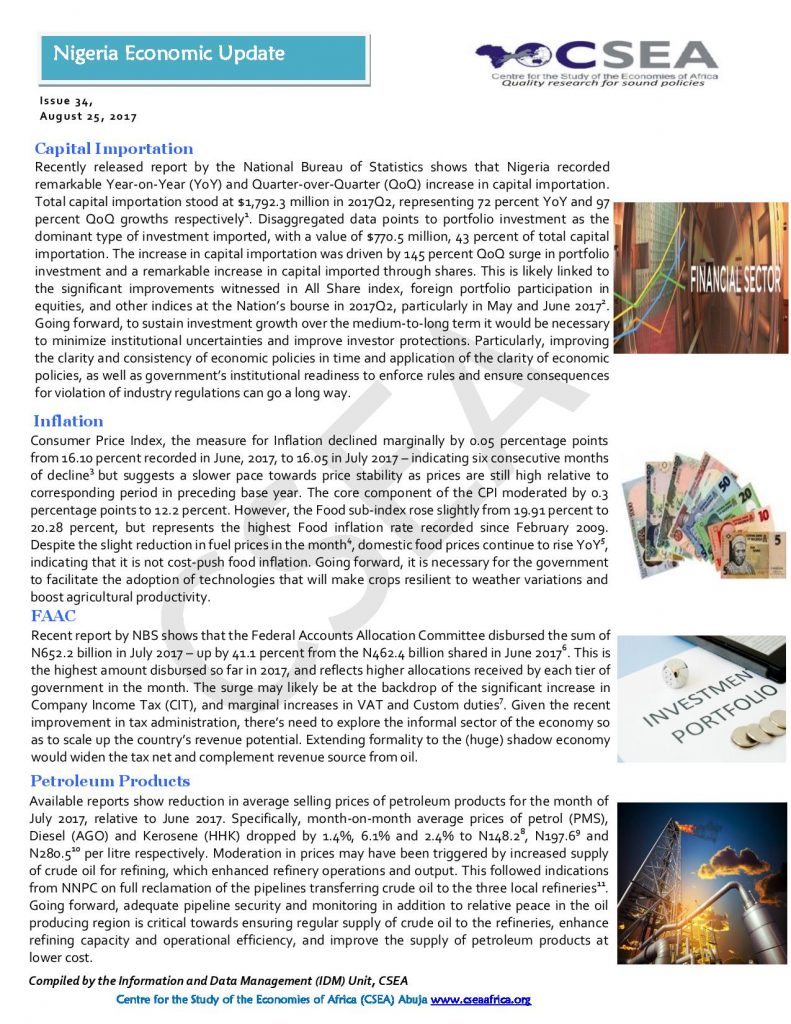
Recently released report by the National Bureau of Statistics shows that Nigeria recorded remarkable Year-on-Year (YoY) and Quarter-over-Quarter (QoQ) increase in capital importation. Total capital importation stood at $1,792.3 million in 2017Q2, representing 72 percent YoY and 97 percent QoQ growths respectively. Disaggregated data points to portfolio investment as the dominant type of investment imported, with a value of $770.5 million, 43 percent of total capital importation. The increase in capital importation was driven by 145 percent QoQ surge in portfolio investment and a remarkable increase in capital imported through shares.
Read More Download PDF

Nigeria Economic Update (Issue 33)

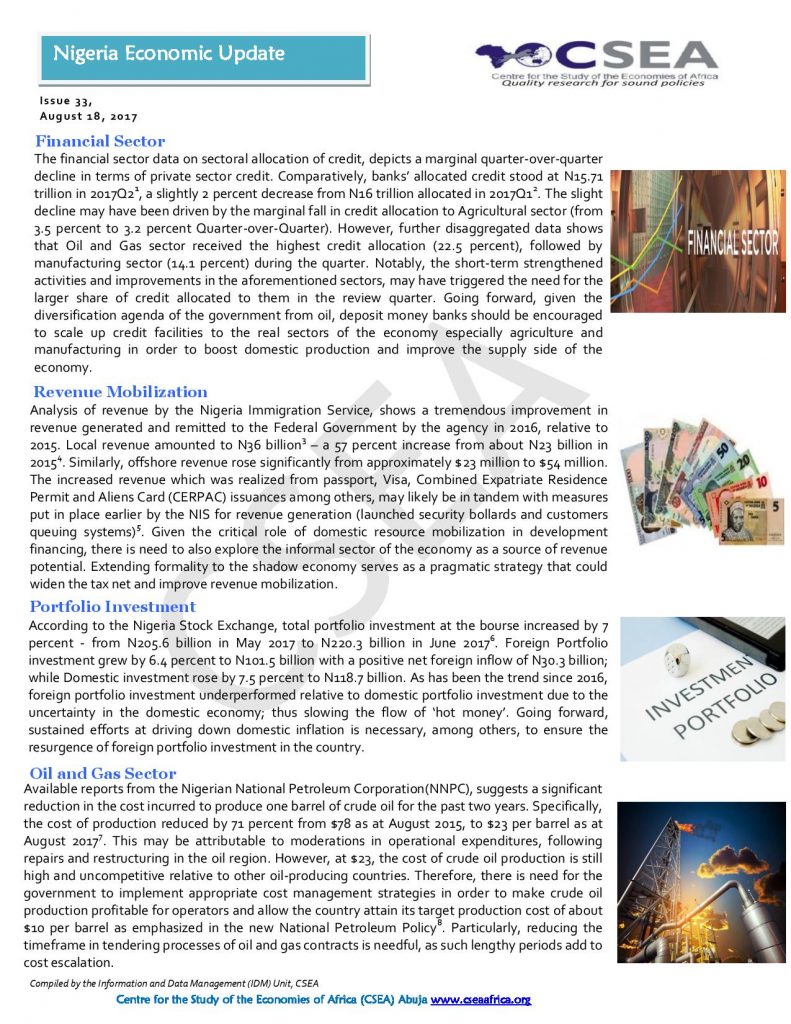
Available reports from the Nigerian National Petroleum Corporation(NNPC), suggests a significant reduction in the cost incurred to produce one barrel of crude oil for the past two years. Specifically, the cost of production reduced by 71 percent from $78 as at August 2015, to $23 per barrel as at August 2017. This may be attributable to moderations in operational expenditures, following repairs and restructuring in the oil region.
Read More Download PDF

Africa Economic Update (Issue 7)

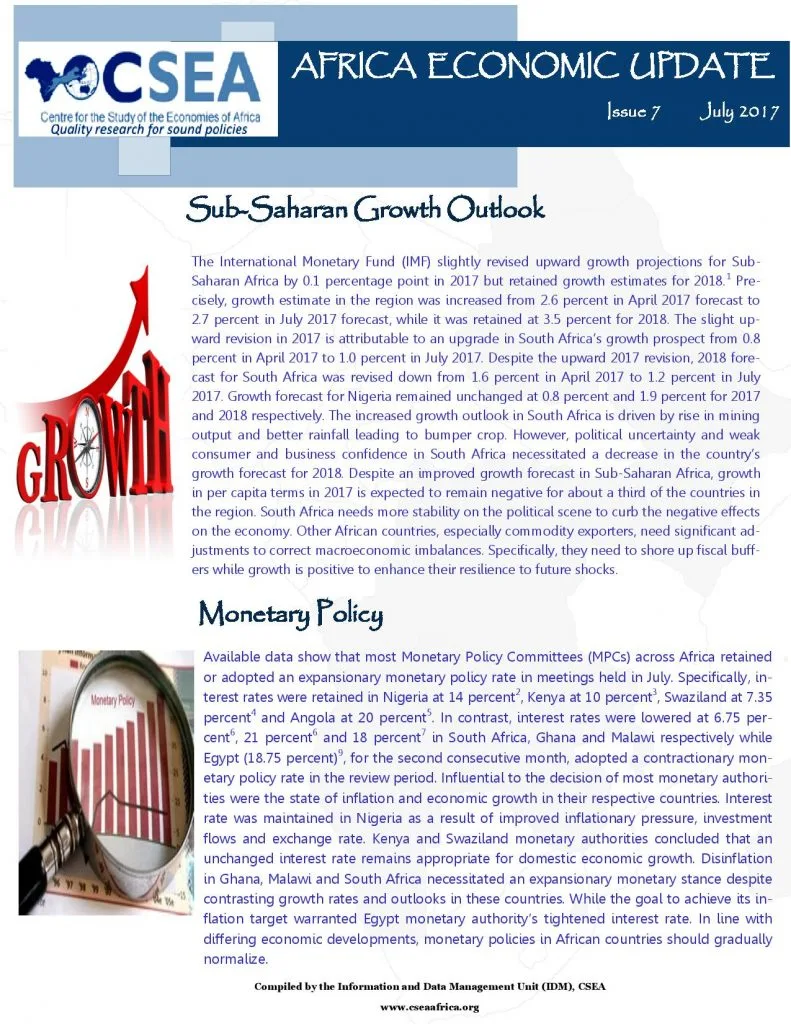
The International Monetary Fund (IMF) slightly revised upward growth projections for SubSaharan Africa by 0.1 percentage point in 2017 but retained growth estimates for 2018.1 Precisely, growth estimate in the region was increased from 2.6 percent in April 2017 forecast to 2.7 percent in July 2017 forecast, while it was retained at 3.5 percent for 2018. The slight upward revision in 2017 is attributable to an upgrade in South Africas growth prospect from 0.8 percent in April 2017 to 1.0 percent in July 2017. Despite the upward 2017 revision, 2018 forecast for South Africa was revised down from 1.6 percent in April 2017 to 1.2 percent in July 2017. Growth forecast for Nigeria remained unchanged at 0.8 percent and 1.9 percent for 2017 and 2018 respectively.
Read More Download PDF

Nigeria Economic Update (Issue 32)

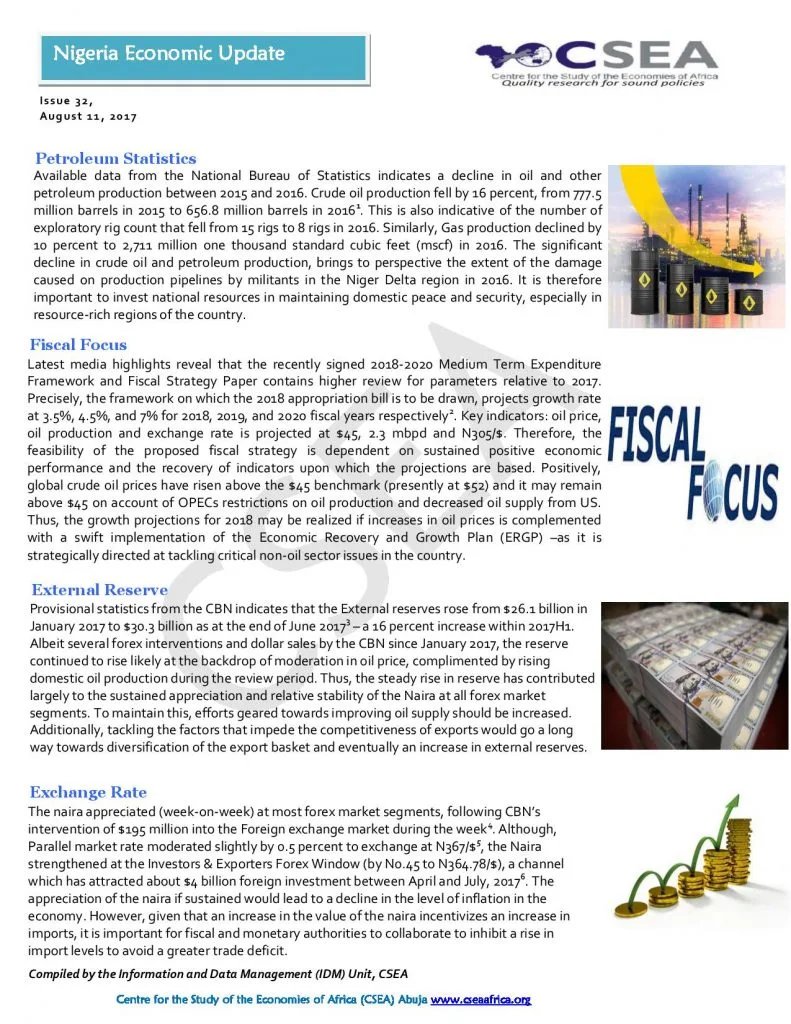
Available data from the National Bureau of Statistics indicates a decline in oil and other petroleum production between 2015 and 2016. Crude oil production fell by 16 percent, from 777.5 million barrels in 2015 to 656.8 million barrels in 2016. This is also indicative of the number of exploratory rig count that fell from 15 rigs to 8 rigs in 2016. Similarly, Gas production declined by 10 percent to 2,711 million one thousand standard cubic feet (mscf) in 2016. The significant decline in crude oil and petroleum production, brings to perspective the extent of the damage caused on production pipelines by militants in the Niger Delta region in 2016. It is therefore important to invest national resources in maintaining domestic peace and security, especially in resource-rich regions of the country.
Read More Download PDF