Macroeconomic Report & Economic Updates

  • Home
  • Macroeconomic Report & Economic Updates
Follow via RSS

Nigeria Economic Update (Issue 43)

Crude oil prices have sustained upward increases for the past few weeks in October. While upward trajectory of crude oil prices is expected to be sustained in the short term in line with OPECs production cuts deal expected to run until March 2018, it is important to note that crude oil prices would remain volatile. The Nigerian government therefore should take advantage of periods of high revenue from crude oil exports to develop other sectors (such as Agriculture, Manufacturing and Services sectors) of the economy as key exporting and revenue generation sectors, and thus minimize volatility risks
Read More Download PDF

Nigeria Economic Update (Issue 42)

Recently released survey report by the CBN shows an improvement in the availability of secured and unsecured banks credit and loans to households, corporate and small businesses in 2017Q3, and an optimistic outlook in 2017Q4. Among other indices, availability of overall secured and unsecured lending to households improved from -6.2 and -19.2 to -0.9 and -15.0 index points respectively; although still in the negative territory. Index for availability of credit to small businesses improved from -20.1 to -6.7. Lenders and respondents noted that anticipation of a brighter economic outlook, favorable liquidity positions, market share objectives and higher appetite for risk were major factors behind the increase. 
Read More Download PDF

Nigeria Economic Update (Issue 41)

Latest World Economic Outlook (WEO) report by the International Monetary Fund reveals that Nigerias economy will grow by 1.9 percent in 2018 an unchanged stance from earlier projections. However, the figure is 2.9 percentage points lower than the 4.8 percent 2018 estimated growth rate in Nigerias ERGP (Economic Recovery and Growth Plan) 2 showing a very large disparity between domestic and international growth forecasts for Nigeria. The Funds projection however seems to have taken into cognizance underlying factors that could slow growth in the medium term: faster pace of population growth relative to GDP growth3, poor policy implementation, banking system fragilities and foreign exchange market segmentation.
Read More Download PDF

Nigeria Economic Update (Issue 40)

Global crude prices settled lower in the review week (September 29 to October 6, 2017). Precisely, a barrel of Brent crude sold for about $56, showing a 6.3 percent decrease. Nigerias Bonny light exchanged at $56.76 per barrel as at October 6, 2017. The draw down in price may be attributable to indications of higher output, as revealed by the addition of more production rigs by the U.S, rise in Iraqs crude exports and survey showing OPECs overall boosted supply.
Read More Download PDF

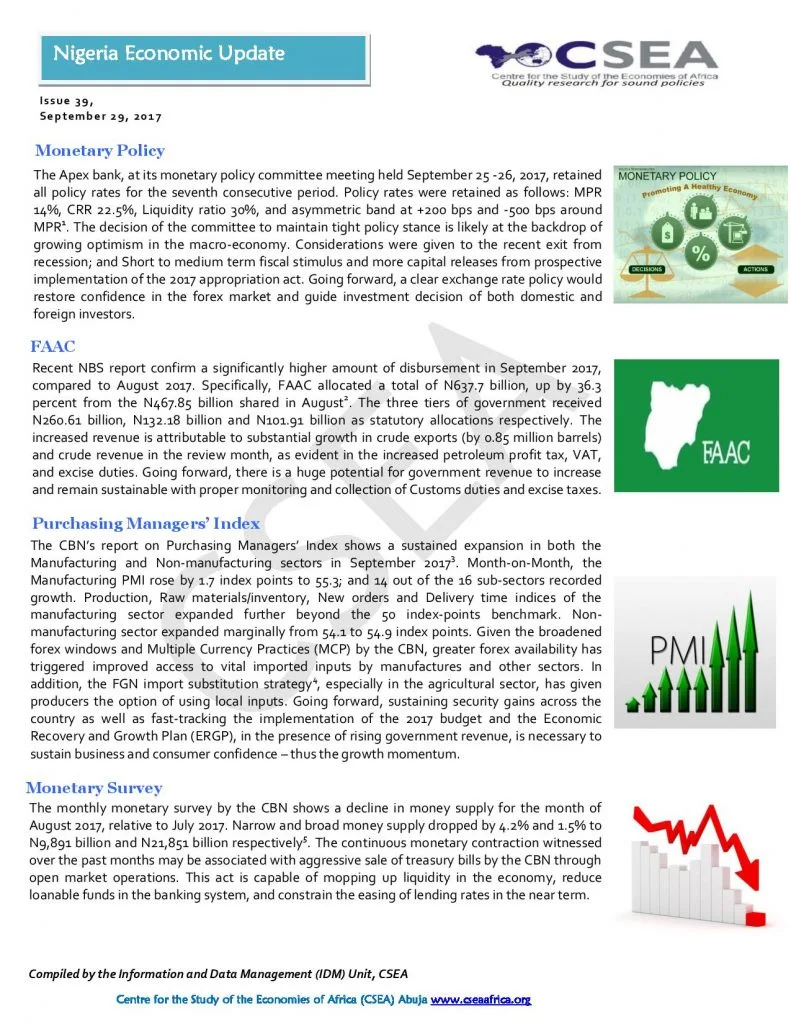
Nigeria Economic Update (Issue 39)

The monthly monetary survey by the CBN shows a decline in money supply for the month of August 2017, relative to July 2017. Narrow and broad money supply dropped by 4.2% and 1.5% to N9,891 billion and N21,851 billion respectively. The continuous monetary contraction witnessed over the past months may be associated with aggressive sale of treasury bills by the CBN through open market operations. This act is capable of mopping up liquidity in the economy, reduce loanable funds in the banking system, and constrain the easing of lending rates in the near term.
Read More Download PDF