Macroeconomic Report & Economic Updates

  • Home
  • Macroeconomic Report & Economic Updates
Follow via RSS

Nigeria Economic Update (Issue 28)

Latest monthly economic report by the CBN reveals a decline in foreign exchange flows through the CBN. Foreign exchange inflow through the apex bank, dropped Month-on-Month by 21 percent to $2.3 billion in May 2017, occasioned by the fall in from Oil and Non-oil sources during the month.
Read More Download PDF

Nigeria Economic Update (Issue 26)

Power sector statistics indicates a huge decline in power generated in the week under review (June 23, 2017 to June 30, 2017). Power generated, attained a peak of 4,305 MW on June 23, 2017 but fell significantly by 33.1 percent to approximately average of 3,000 MW as at June 30, 2017. The huge decline is attributable to continued poor payment and inability of most GENCOs to pay for gas supply and a system collapse. Consequently, power sector lost huge prospective funds; and daily power supply reduced to 4.5 hours per day7. Going forward, improvement in energy supply is critical to domestic production, job creation, and diversification agenda of the government.
Read More Download PDF

Nigeria Economic Update (Issue 25)

Naira appreciated in the week under review. At the parallel market, naira gained 0.54 percent to exchange at N368/$ on June 23, 20175. This is at the backdrop of injections into the forex market by the CBN to the tune of $195 million at the beginning of the review week, to meet various forex demands. This is amid a slight week-on-week increase in the external reserves (by 0.1 percent to $30.23 billion). Despite the recent naira appreciation, the long-term prospects seem bleak given that the ongoing intervention that seeks to stabilize naira by depleting reserves is unsustainable.
Read More Download PDF

Nigeria Economic Update (Issue 24)

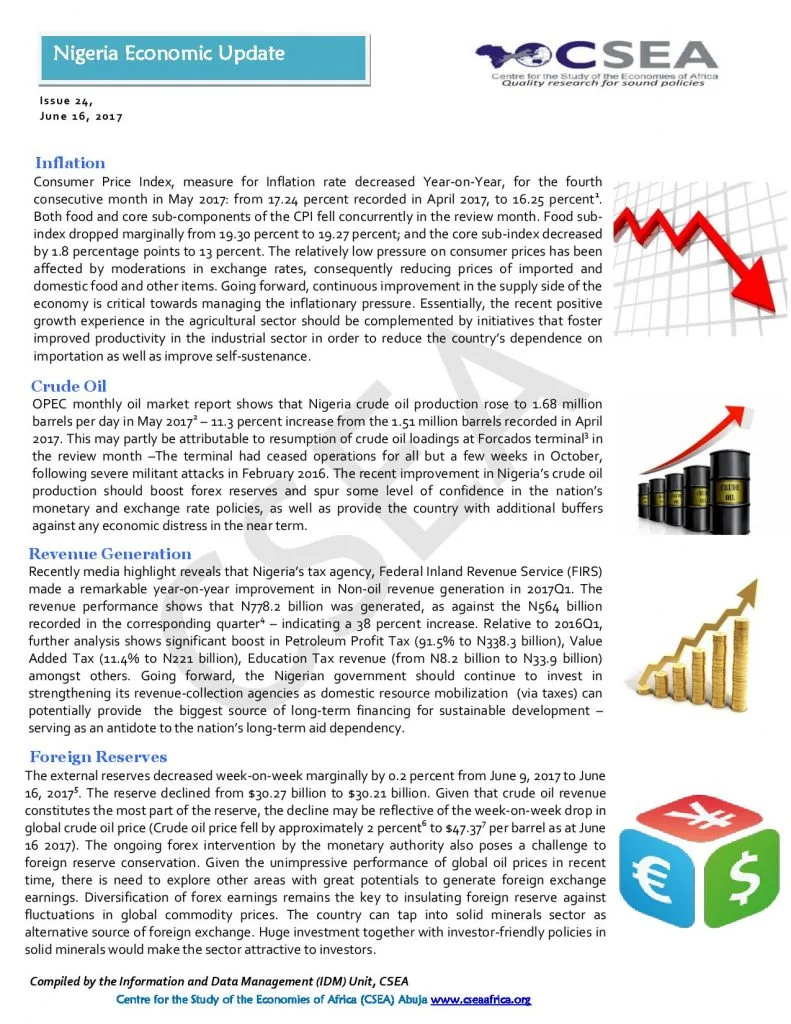
The external reserves decreased week-on-week marginally by 0.2 percent from June 9, 2017 to June 16, 2017. The reserve declined from $30.27 billion to $30.21 billion. Given that crude oil revenue constitutes the most part of the reserve, the decline may be reflective of the week-on-week drop in global crude oil price (Crude oil price fell by approximately 2 percent to $47.377 per barrel as at June 16 2017). The ongoing forex intervention by the monetary authority also poses a challenge to foreign reserve conservation. Given the unimpressive performance of global oil prices in recent time, there is need to explore other areas with great potentials to generate foreign exchange earnings. Diversification of forex earnings remains the key to insulating foreign reserve against fluctuations in global commodity prices. The country can tap into solid minerals sector as alternative source of foreign exchange. Huge investment together with investor-friendly policies in solid minerals would make the sector attractive to investors.
Read More Download PDF