Macroeconomic Report & Economic Updates

  • Home
  • Macroeconomic Report & Economic Updates
Follow via RSS

Nigeria Economic Update (Issue 48)

Data released by the National Bureau of Statistics shows that Internally Generated Revenue by states increased in 2017H1. The IGR increased from N392.1 billion in 2016H1, to N396.9 billion in 2017H1, a slight 1.2 percentage half Year-on-year growth. Also, N149.5 billion was generated in 2017Q3. Lagos state remains top in internal revenue generation, with a significant 42.3 percent share of total IGR in the review half year. The improvements in IGR may be attributable to efficient revenue collection by each reported state from the various sources of internal revenue: taxes, fines and fees, licenses, earnings & sales, rent on government property, interests and dividends, among others. 
Read More Download PDF

Nigeria Economic Update (Issue 47)

Recently released data by the Debt Management Office reveals a further increase in Nigerias debt stock as at the end of 2017Q3. Total debt stock stood at N20.37 trillion as at September 20172, increasing by 3.75 percent Quarter-over- Quarter and 20.67 percent Year-on-Year. External debts rose 2 percent to N4.69 trillion, while domestic debts (FGN and States) grew by 4.3 percent to N15.68 trillion both accounting for approximately 23 percent and 77 percent of total debt stock respectively. Obviously, Nigerias increasing debt accumulation at a rate faster than GDP growth rate, clearly exacerbates difficulties in meeting debt repayment and sustainability of debt servicing measures. The recent borrowing surge should be utilized to provide socially viable and profitable infrastructure so as to minimize the future debt burden.
Read More Download PDF

Nigeria Economic Update (Issue 46)

On a Month-on-Month basis, average growth rate of selected food prices decreased in October 2017.  Precisely, contracting by 1.24 percent in October, average growth rate fell from 0.08 percent recorded in September 2017. Notably, the contraction reflected in the food sub-index of the headline inflation for October 2017. The marginal decrease in the prices of selected food items may be in line with seasonal levels, as the harvest season reaches its peak, thus making food items relatively available at various demand levels. Going forward, investment towards the provision of better farming inputs, technology, financing, and value addition across the agricultural value chain could help improve yield output and food security all through the year. 
Read More Download PDF

Nigeria Economic Update (Issue 45)

Crude oil prices recorded increase during the review week. Global benchmark, Brent price increased from $61.42 to $63.522. Nigerias Bonny light gained 9.6 percent to trade at $64.78 per barrel. The weeks rise was at the backdrop of further prospective cuts agreement at OPECs meeting in November 2017 and political tensions and uncertainties in Saudi Arabia given that these events may likely reduce supply and support demand in the near term. Meanwhile, global crude oil market events have been favorable to Nigeria, as the price of bonny light at approximately $65 per barrel, reflects the highest in more than two years.
Read More Download PDF

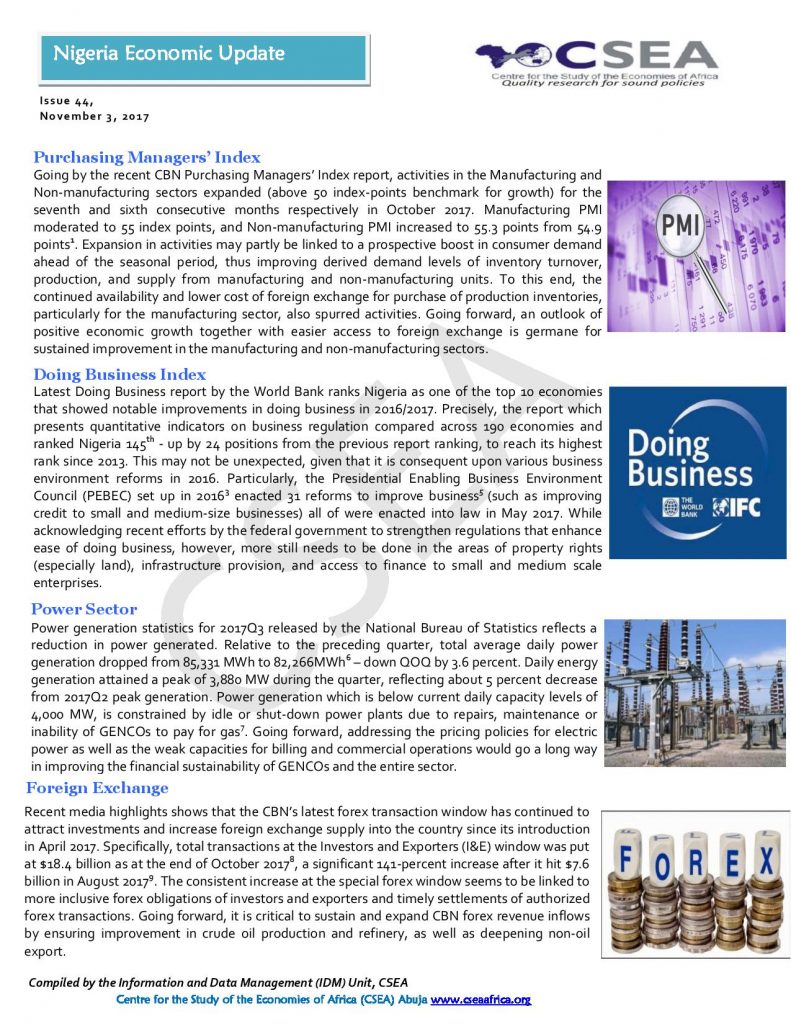
Nigeria Economic Update (Issue 44)

Latest Doing Business report by the World Bank ranks Nigeria as one of the top 10 economies that showed notable improvements in doing business in 2016/2017. Precisely, the report which presents quantitative indicators on business regulation compared across 190 economies and ranked Nigeria 145th - up by 24 positions from the previous report ranking, to reach its highest rank since 2013. This may not be unexpected, given that it is consequent upon various business environment reforms in 2016. Particularly, the Presidential Enabling Business Environment Council (PEBEC) set up in 2016 enacted 31 reforms to improve business(such as improving credit to small and medium-size businesses) all of were enacted into law in May 2017.
Read More Download PDF