Macroeconomic Report & Economic Updates

  • Home
  • Macroeconomic Report & Economic Updates
Follow via RSS

Nigeria Economic Update (Issue 2)

International rating body, Fitch, has projected higher economic growth for Nigeria in 2018. The body estimated that Nigerias economy will grow by 2.6 percent, slightly higher compared to projections from the International Monetary Fund (2.1 percent) and The World Bank (1 percent). A myriad of factors may have driven the projected increase: improved availability of forex for the non-oil sector, higher government capital expenditure capability driven by more oil revenue, and fiscal stimulus. However, the relatively strong economic growth projected by Fitch and IMF may be hampered
Read More Download PDF

Nigeria Economic Update (Issue 1)

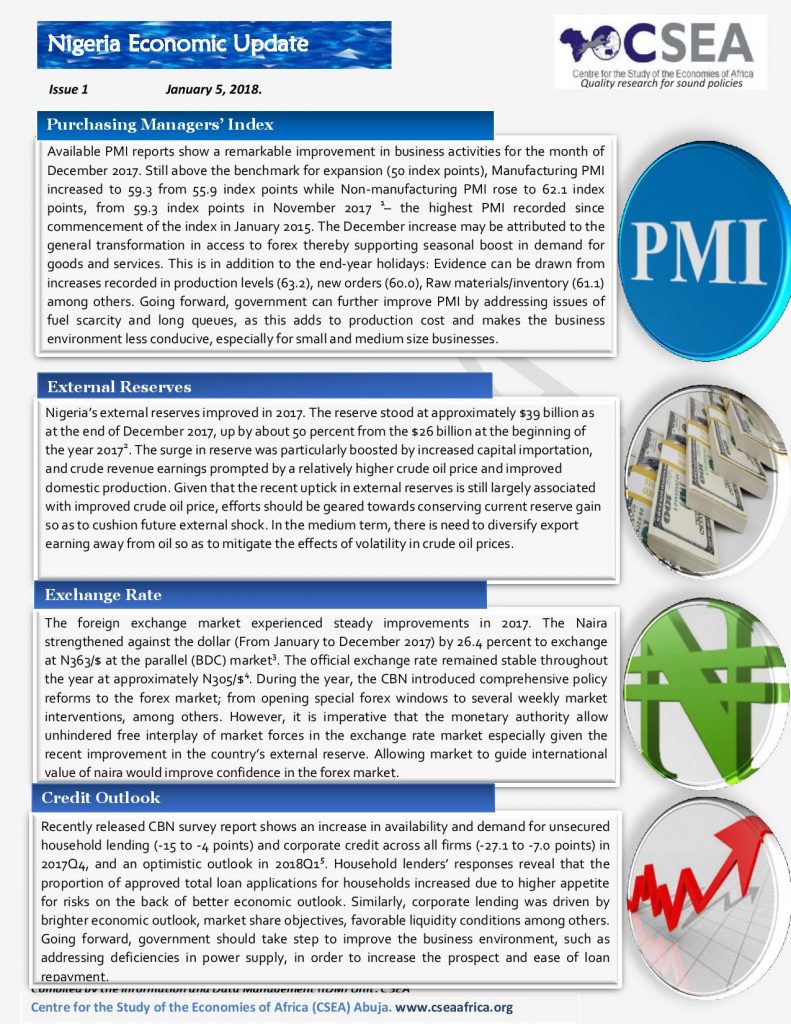
Nigerias external reserves improved in 2017. The reserve stood at approximately $39 billion as at the end of December 2017, up by about 50 percent from the $26 billion at the beginning of the year 20172. The surge in reserve was particularly boosted by increased capital importation, and crude revenue earnings prompted by a relatively higher crude oil price and improved domestic production. Given that the recent uptick in external reserves is still largely associated with improved crude oil price, efforts should be geared towards conserving current reserve gain so as to cushion future external shock. In the medium term, there is need to diversify export earning away from oil so as to mitigate the effects of volatility in crude oil prices.
Read More Download PDF

Nigeria Economic Update (Issue 51)

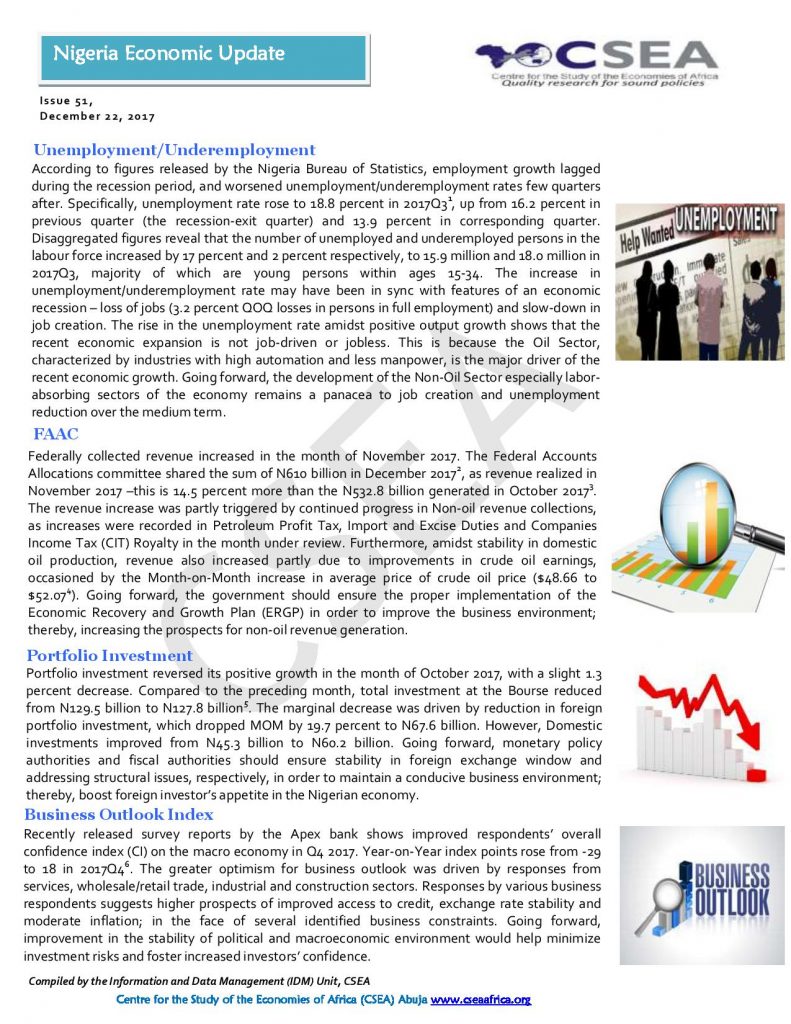
According to figures released by the Nigeria Bureau of Statistics, employment growth lagged during the recession period, and worsened unemployment/underemployment rates few quarters after. Specifically, unemployment rate rose to 18.8 percent in 2017Q31, up from 16.2 percent in previous quarter (the recession-exit quarter) and 13.9 percent in corresponding quarter. Disaggregated figures reveal that the number of unemployed and underemployed persons in the labour force increased by 17 percent and 2 percent respectively, to 15.9 million and 18.0 million in 2017Q3, majority of which are young persons within ages 15-34. 
Read More Download PDF

Nigeria Economic Update (Issue 50)

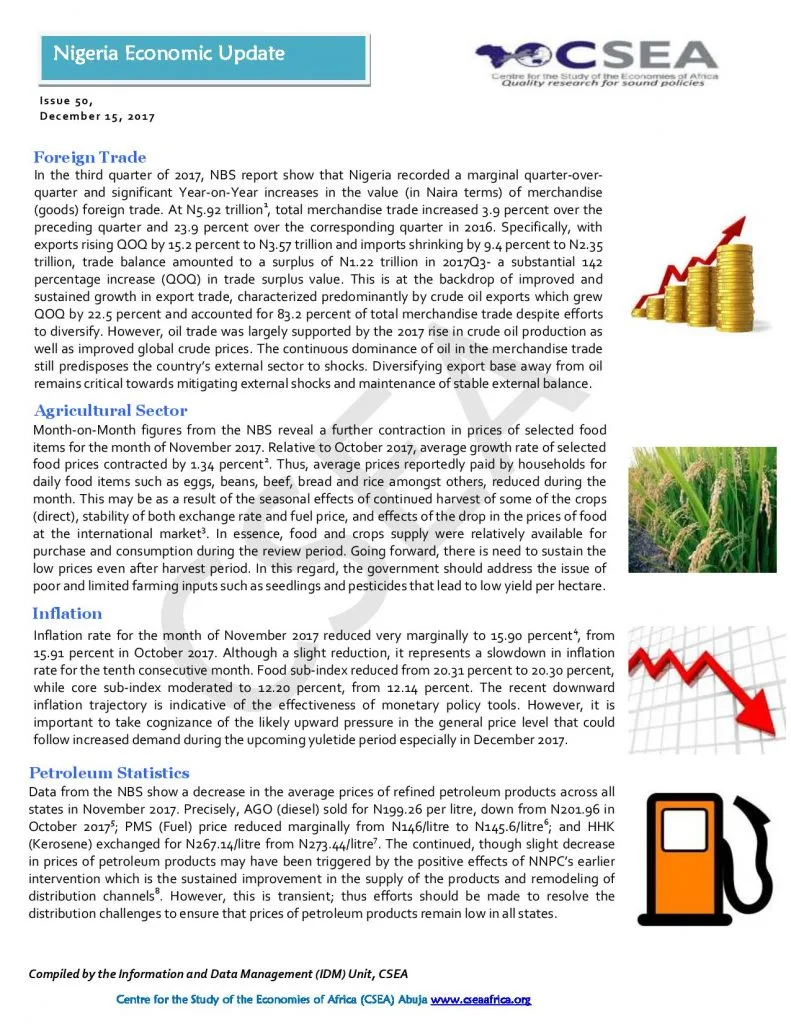
In the third quarter of 2017, NBS report show that Nigeria recorded a marginal quarter-overquarter and significant Year-on-Year increases in the value (in Naira terms) of merchandise (goods) foreign trade. At N5.92 trillion, total merchandise trade increased 3.9 percent over the preceding quarter and 23.9 percent over the corresponding quarter in 2016. Specifically, with exports rising QOQ by 15.2 percent to N3.57 trillion and imports shrinking by 9.4 percent to N2.35 trillion, trade balance amounted to a surplus of N1.22 trillion in 2017Q3- a substantial 142 percentage increase (QOQ) in trade surplus value.
Read More Download PDF

Nigeria Economic Update (Issue 49)

OPEC weekly basket price reduced from $61.14 to $60.73 per barrel (December 1 8, 2017). Similarly, Global oil benchmark crude sold for as low as $61.22 per barrel during the week, down week-on-week by 1.8 percent. Nigerias Bonny light declined slightly by approximately 1 percent to $63.534. The fall in crude prices came after a sharp rise in U.S. inventories of refined fuel, which suggested that actual demand may be weakening5 (the EIA data shows an increase of 8.5 million barrels of stored fuel). Given that crude oil revenue remains critical to Nigerias budget performance, investments aimed at improving growth and competitiveness of other key sectors is essential to minimize distortions on budgetary expenditure.
Read More Download PDF