Publications

Follow via RSS

Nigeria Economic Update (Issue 23)

A recently released CBN report indicates a weakened business outlook of -66.2 points for the month of May. The agriculture and service sectors are the worst hit, recording a decline in activity of -37.7 index point for May. According to the survey the pessimism is maintained in June as businesses expect an economic outlook of -4.22. The employment outlook is pessimistic across the construction, manufacturing, agriculture, and service sectors as employment is expected to decline by -18.5, -10.9, and -4.1 points respectively. The weakened outlook towards the macroeconomy results from limited economic activity with businesses that are import and/or export-oriented and those that are neither import nor export-oriented expressing pessimism. Considering that the factors that constrain business activity including power supply insufficiencies, access to finance and credit, high-interest rate, and insufficient demand are still present, the business outlook in the coming months is expected to continue to weaken considerably.

Read More Download PDF

The Impact of Covid-19 on Africa’s Pre-Existing Vulnerabilities

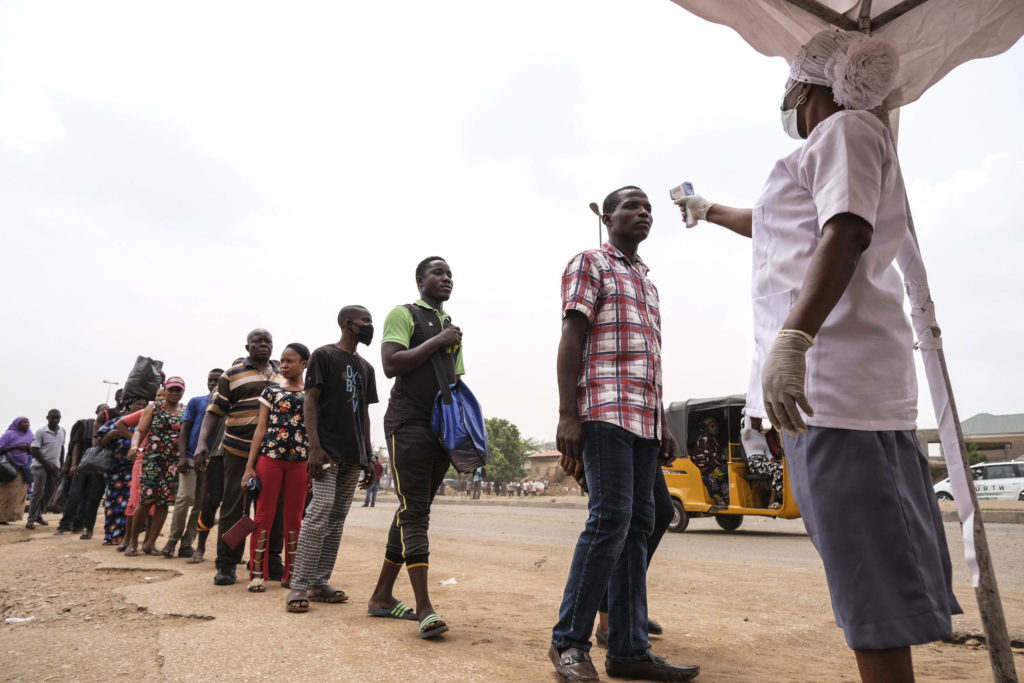
The COVID-19 pandemic has had devasting effects in many countries across the globe, affecting every aspect of humanity. The scale of the crisis was unprecedented, with both developed and developing countries under immense pressure to curtail the spread of the virus and the associated negative consequences on the economy. With the exemplary health systems in the rich world being overwhelmed by the scale of the outbreak, it became worrisome what the impact would be on low-income countries, particularly in Africa, with very weak health systems among other persistent challenges.

Most countries in Africa met the crises in a weak position. A host of pre-existing vulnerabilities signalled an impending disaster of massive scale. The region was battling with socio-economic challenges: rising debt; huge health infrastructure gaps; weak governance systems; unemployment and informality of labour; inequality and high poverty incidence, among others. But quite surprisingly, the evidence so far has shown relatively low levels of cases and fatalities, which have given rise to debates about several factors that may be driving the limited spread, albeit with limited factual backing. Some argue that the predominantly young population, higher temperatures, and previous exposure to similar diseases like malaria might be the cause(s) of the limited spread; while others contend that the official figures may be misleading, as poor testing facilities limit the number of overall tests conducted, and thus grossly underestimates the reality of the incidence of coronavirus in Africa.

Aside from the heath/mortality effects of the pandemic in Africa, the seemingly clearer effect is the impact of the social distancing and lockdown measures on the economy. While these measures were necessary to curb the spread of the virus following standard medical/epidemiological advice, the imposition of the measures in African countries had widespread negative impacts on several economies in the region. Restrictions to movement led to a general halt in economic activities, and importantly a disruption in the income of workers in the predominantly informal sector (66 percent of total employment in sub-Saharan Africa), who rely on small daily earnings. These workers in the gig economy in Africa have very limited savings to ease consumption, and thus the lockdown became a threat to their livelihoods.

In line with most countries in different regions, governments in several African countries provided a combination of fiscal, monetary and social protection responses, such as increased health and other crisis-related spending; easing of tax and duty payments for private enterprises; decrease in policy rate and lending facility rates; moratoria for COVID-19-related repayment difficulties; distribution of aid to the less privileged, among others. However, several factors have grossly limited the effectiveness of these policy responses. The first is that the spending plans of countries in SSA is only 0.26% of GDP on average, given the limited fiscal space and the high debt burden on the continent. The second is the high commodity dependence of many African countries, and the recent fall in demand for/prices of commodities have reduced their revenue-generating capacity and ability to ease tax payments. The third is the combination of high levels of informality of businesses and financial exclusion, inadequate data for the effective targeting of poor households, weak institutions and governance systems to ensure transparency and accountability in aid distribution, have all undermined the social protection responses.

The worry in Africa seems to be more about the negative effects of the disruptions/halts in economic activities and livelihoods, than the morbidity and mortality of COVID-19 itself. With the pre-existing vulnerabilities in the region, the crisis poses a genuine threat to livelihoods , and the adverse effects are expected to linger in the absence of concrete mitigation strategies. Other sources of finance such as remittances, which have increasingly become a major source of income and are used to ease household consumption for the poor, have been badly affected as the pandemic affected both the givers and the recipients. The World Bank estimates a decline of 23.1 percent in SSA as a result of COVID-19, the highest drop in history.

The situation has led to calls for global attention to supporting Africa, particularly for creditors to provide some debt relief for countries with high debt burdens, in order to create some fiscal room to tackle the pandemic. Different actors, including governments, private sectors, bilateral and multilateral organisations, International donors, civil society, among others, have come to the rescue of the continent in these perilous times. But the question remains: will Africa learn lessons from this pandemic to make conscious efforts to tackle these persistent vulnerabilities that continuously undermine their preparedness and response to outbreaks?

The pandemic can serve as a wake-up call for African governments to resolve the persistent challenges that continue to place the continent in a weak position. It is high time African governments take concrete and practical steps towards diversifying their economies to limit their exposure to commodity price shocks. The pandemic should stimulate efforts to move away from commodity dependence, particularly on oil extraction, to sectors which build and strengthen productive capacities, create jobs, and generate non-oil revenues. Governments in the region need to strengthen their public financial management by building and managing fiscal buffers to cushion the effects of commodity revenue shocks. Fiscal responsibility mechanisms should be enforced and backed by law, to limit wasteful expenditure and reckless accumulation of debt. There is need to provide incentives for businesses to formalize, as that would increase internally generated revenues, as well as improve the effectiveness of social protection initiatives, especially during periods of crisis. Governments can collaborate with development partners to strengthen data-based management systems to enhance the targeting of social safety net programs, particularly during emergency/crisis periods. Lastly, national governments and regional bodies should empower the knowledge industry to provide African solutions to the numerous African problems and challenges. Higher education, research organisations, civil society organisations, and other knowledge-oriented bodies should be adequately funded, to generate credible evidence and create awareness that will contribute to tackling future outbreaks in the region.

This article was first published by the Italian Institute for International Political Studies

Read More

Nigeria Economic Update (Issue 22)

Foreign capital imported into Nigeria increased by 53.97 percent from US$3.8 billion in the fourth quarter of 2019 to US$5.85 billion in the first quarter of 2020. This rise was largely driven by an increase in portfolio investments which grew 128.78 percent to US$4.3 billion, accounting for 73.61 percent of total capital importation. Other components such as foreign direct investment (-16.7 percent) and other investment (-19.9 percent) declined compared to the previous quarter1. The rise indicates a renewed interest from investors in local money market instruments, which had been on the decline since Q12019. This capital inflow would benefit the limited national foreign reserves. As the government shifts away from foreign debt and seeks to borrow US$4.34 billion from the domestic market, the associated increase in yields will attract foreign investors and is likely to further increase foreign portfolio investment in the coming months. However, caution should be taken as sudden increases in the FPI outflows will have a negative impact on the foreign exchange market and the overall economy.

Read More Download PDF

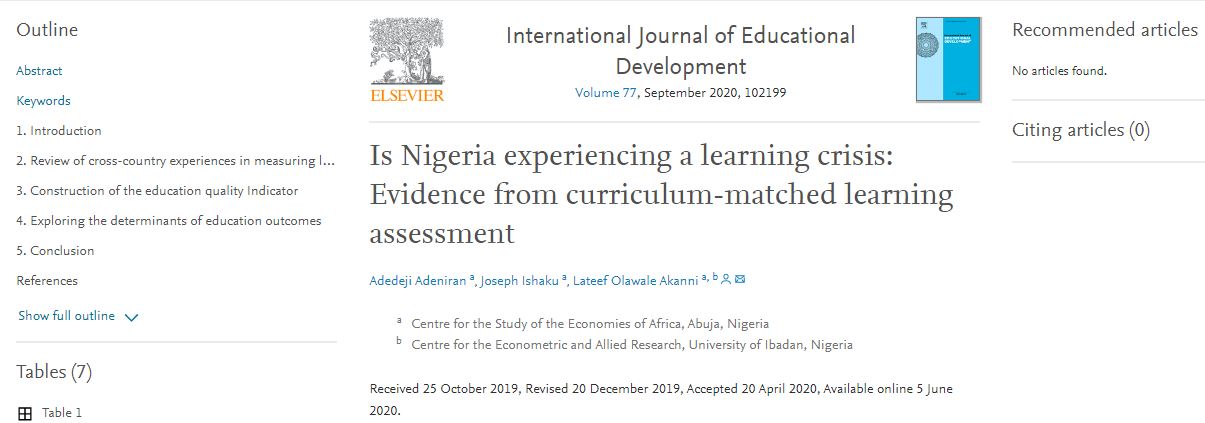
Is Nigeria experiencing a learning crisis: Evidence from curriculum-matched learning assessment

Agenda 2030 sets an ambitious target to provide inclusive and quality education for all. The first step in this quest is identifying those left behind in accessing quality education and reasons for their exclusion. However, Nigeria like many developing countries lacks data on learning assessment to measure progress on Agenda 2030 at the national and sub-national levels. In this study, we construct a measure for the quality of education by matching curriculum with literacy and numeracy assessments based on existing education survey. In addition, we examine the drivers of quality education in Nigeria based on the newly constructed learning indicator. Our findings confirm Nigerian education system is indeed facing deep learning crisis with the affected children mostly from poor households, in the rural areas, those that attend government-owned schools, and those in the northern region of the country Nigeria. The results emphasized the need for systemic change that will improve school infrastructure, teacher training and ensure more parental involvement.

Read More

Read More

Nigeria Economic Update (Issue 21)

A recently released NBS report indicated a 20.92% rise in Internally Generated Revenue (IGR) in 2019. The year on year rise saw total IGR hit ₦1.33 trillion. The rise was largely driven by revenue generated from income tax which accounted for 60.7% of IGR. Lagos state as the highest contributor with ₦398.73 billion accounted for 29.88% of total revenue generated2.  On the other hand, Taraba state was the lowest contributor with ₦53.04 billion. The improvement in tax compliance stands to make provision for state-level fiscal sustainability as well as a continued increase in total IGR. State governments can leverage on the fall in demand for oil to identify innovations and muster the political will required to expand their IGR base.

Read More Download PDF

Nigeria Economic Update (Issue 20)

According to the Central Bank of Nigeria, the primary market recorded a rise in interest rates for the first time in 3 months. The rise was recorded in the recent 13th May auction as interest rates rose to 2.5% (+35%) and 2.85% (+16%) for the 91-day and 182-day tenor respectively when compared to the preceding auction1. The rise in interest rates can be attributed to lower demand given that investors are seeking for safer assets in more stable currencies in these unprecedented times. Bearing in mind that the government aims to mobilize domestic funds following a shift in debt sourcing, this will increase the cost of borrowing for the government. In addition, considering that the interest rate on T-bills is the benchmark interest rate, the rates of other commodities including bonds and equities are expected to rise. The rise in interest rate will increase the need to save for households, thus lowering consumption and increase the cost of borrowing for firms, thus reducing investment. The overall effect will be a negative impact on economic growth.

Read More Download PDF

Learning in Nigeria's Schools: Lessons from In and Out of School Children and a Potential Pedagogical Function (A RISE PRESENTATION)

Like most developing countries, Nigeria is mobilizing national and international efforts to meet the sustainable development goal of inclusive and quality education for all. Learning profiles allow for tracking of SDG 4 and assessment of optimal policy response.

Read More Download PDF

Nigeria Economic Update (Issue 19)

The recent NBS survey found that 40.1% – 82.9 million – Nigerians are living in poverty with the national poverty line estimated at ₦137,430per year 1. As such, 4 out of 10 Nigerians spend less than ₦376 per day on both food and non-food basic needs. A further disaggregation shows that the population in rural and urban areas living in poverty are 52.1% and 18% respectively. On inequality, the report found that the national Gini coefficient was 35.1 while the coefficient for the rural and urban population are 32.8 and 31.9 respectively.  The level of inequality in Nigeria is comparable to that of in India (35.2) but significantly below countries like South Africa (62.5)2. Based on the experiences of countries that have improved the living standard of a large proportion of their population, Nigeria will need to achieve sustained and high economic growth, substantial infrastructural development, provide large-scale structured and targeted poverty alleviation programs alongside social development programs. In doing this, the government will not only provide immediate relief to the poor but will also enhance the income-generating potential of citizens and minimize the risk of falling into poverty.

Read More Download PDF

Nigeria Economic Update (Issue 18)

he International Monetary Fund (IMF) recently announced the approval of $3.4 billion emergency support to Nigeria under its Rapid Financing Instrument (RFI) facility1. This support fund comes as part of efforts to assist the nation in mitigating potential balance of payment problems as a result of both the decline in oil revenue as well as the economic effects of the COVID-19 pandemic. The IMF has approved a total of $8.3 billion to countries in the sub-Saharan region under various financing schemes in order to mitigate the impact of the pandemic2. However, the fund to Nigeria is the single largest disbursement made to any nation within the region and it is expected to provide the country with the much-needed liquidity during this critical period. On the grounds that Nigeria is taking 100% of its quota under the RFI, the government is expected to pay a concession fee totaling about 1.05% with repayment period up to 5 years. Although, this loan is not expected to completely finance the government’s spending plans or avert the imminent recession, it will serve as a cushion for revenue shortage problems.

Read More Download PDF