In
July 2019, Nigeria joined 53 other African Union member countries to endorse
the Africa Continental Free Trade Agreement (AfCFTA). The signing of this
agreement is expected to have wide reaching implications on the activities of
businesses in Nigeria. AfCFTA
was essentially designed to establish a single market for trade in goods and
services in Africa and improve intra-African trade. Some existing studies suggest that the potential
benefits of the agreement are significant for several reasons.
The International Labor Organization (ILO) recently released a report which highlights global trends of employment. The report noted that the sub-Saharan African region which is characterized by high informal employment would experience a 3.1 percent employment growth in 20205. However, this growth will be counteracted by the displacement of workers as a result of the COVID-19 pandemic. In March, the ILO noted that 38 percent of the global workforce would be displaced6 as a result of the pandemic. The high informal nature of the workforce in Nigeria, as well as limited social protection, stands to increase population vulnerability. Within Nigeria, the unemployment rate which stood at 23.1 percent in Q32018 has been steadily rising from Q12016 (10.4 percent)7. The current economic lockdown in addition to volatile global commodities markets further stands to drive the unemployment rate upward. One way to mitigate the impact is through a committed national economic diversification drive. Also, social investment and intervention programs should be strengthened and institutionalized to ameliorate the effect of poverty and unemployment on citizens.
The Federation Account Allocation Committee (FAAC) disbursed the sum of ₦647.35 billion to the federal, state and local of governments in February which is 9.6 percent lower than the ₦716.30 billion disbursed in January1,2. Disaggregated data shows the federal, state, and local governments received ₦267.39 billion, ₦176.92 billion, and ₦132.94 billion respectively. This decline comes as a result of a decline in revenue generated due to the fall in oil prices associated with the coronavirus pandemic. Relatedly, the federal government has revised the 2020 budget in order to account for a decline in oil revenue which includes a 20 percent cut in capital projects. Going forward, there would be a further decline in the federal allocation as the mainstay of the government’s revenue is hit by the pandemic. Sub-national governments should endeavor to generate substantial revenue to free them from the volatilities of oil prices. Aside from tax, the government should leverage on the pandemic by equipping locals to boost the production of domestic commodities in import-substitution sectors.
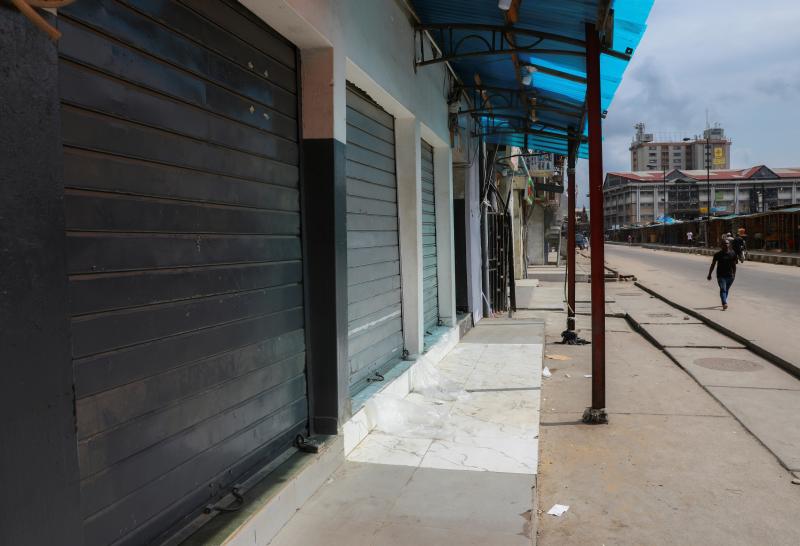
Faced with an invisible and novel enemy to fight, governments across the
globe have deliberately shut down their economies and placed cities on lockdown
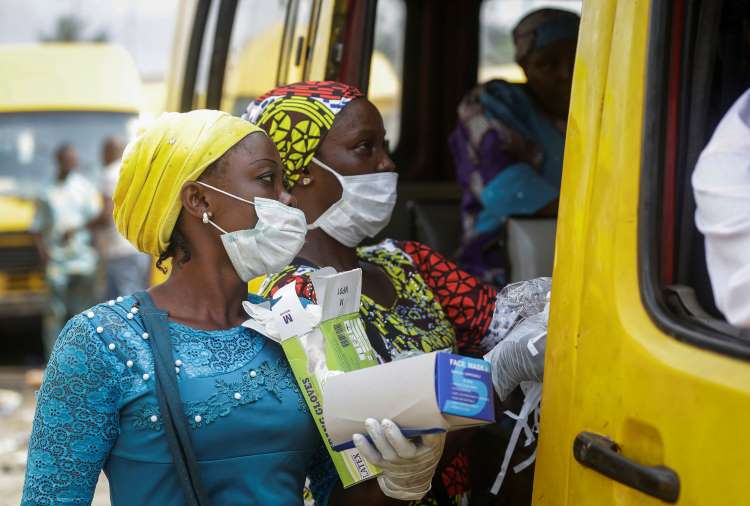
in order to stem the spread of the COVID-19 virus. In Nigeria, two states and
the federal capital territory, have so far enforced a total lockdown, while
other control measures have been implemented in other states. These mitigation
strategies, albeit necessary, have affected the livelihood of most citizens, especially
those operating in the informal sector who rely on daily incomes for survival.
The Federal Government has introduced various social protection policies to
support vulnerable groups during the COVID-19 crises. These policies are
primarily targeted towards the 2.6million households on the social registry
for the vulnerable, and an additional 1 million households are to be provided
conditional cash transfer for 2months.
The present social
registry uses a three-stage targeting process based on geographical targeting,
community-based validation, and proxy-means-testing (PMT) in order to identify
the poorest of the poor in Nigeria. With over 90 million Nigerians living in
extreme poverty, the social registry covers only about 2% of the poor, excluding
many households given the enormous financial requirement for universal social
protection. While the coronavirus lockdown will negatively affect most
Nigerians, the impact will vary markedly across groups, even amongst the poor.
There are legitimate questions about the suitability of the existing social
registry as a reference for the groups most vulnerable to the economic shocks
induced by the coronavirus lockdown.
For the COVID-19
social protection interventions to be effective in curbing severe drops in basic
consumption (largely food and housing), they need to be well targeted to those
most vulnerable to Covid-19 shocks. Those most likely to be affected by
COVID-19 lockdown measures are not necessarily the most vulnerable groups
nationwide, and are likely to be missing from the social
registry used for the Federal Government’s social protection measures.
What is known about
the current social protection registry is that it largely covers agricultural
and rural households, especially those with human capacity constraints.
However, these groups are also less likely to be negatively affected by the
economic shocks induced by the lockdown for a number of reasons: First, they
are largely isolated from the major economic centers, being primarily rural and
agricultural, hence basic livelihoods remain minimally unaffected by the
lockdown. Second, the transportation of food items is excluded from the
lockdown, which means that rural farmers may continue to get their produce to
markets. Third, and more important, most households in this group produce a
majority of what they consume, and are therefore better able to maintain basic
consumption levels during the lockdown.
In order to more effectively target groups of the poor that are most vulnerable to negative consumption shocks during the COVID-19 lockdown, we need to ask, in the most basic terms: which groups of people need to earn an income every day in order to purchase food? Put another way, poor households whose basic income and consumption patterns are more closely tied to the market would be most likely to be negatively affected by the lockdown. In this piece, we profile the characteristics of the groups that are most likely to be affected by the government lockdown and restriction of economic activities vis-à-vis those on the social registry, explain why COVID-19 social protection interventions ought to be better targeted to these groups, and suggest ways to improve poverty targeting for those affected by the coronavirus shock.
Using data from the Nigeria Demographic and Health surveys (2008 and 2013), we find that the urban poor is more likely to work in non-agricultural occupations, which often involves commuting between suburbs and satellite towns into the urban core. Here, we may think of drivers, cleaners, sales associates, and operators of micro-enterprises, etc. Incomes from these occupations that involve work in the city’s core are the most likely to be affected by the lockdown in economic activities. While most agricultural activities will slow down, the exception to food transportation, storage, and sales, means that income loss here will be minimized. Furthermore, data from the National Living Standards survey (2010) shows that 64% of the food consumed by the poor in rural areas comes from food that they produce themselves (auto-consumption), compared to just 22% for poor urban households. This implies that the urban poor is significantly more likely to experience a greater decrease in food consumption with a decrease in market income.
Overall, the data reveal that the urban poor are more likely to suffer a decline in incomes as a result of the economic lockdown introduced to control the spread of COVID-19. As a result, the urban poor is also substantially more likely to suffer a decrease in food and other consumption, because unlike rural households, they largely consume what they are able to buy from market incomes. The urban poor have their livelihoods more closely tied to the market, and with a market shutdown, they are better targets for supplementary incomes/consumption intended to alleviate the hardships induced by COVID-19. This category of the poor is largely underrepresented in the current social protection registry.
Alternative Targeting
Mechanism for the Urban Poor
The preceding discussion highlighted the inadequacy of the present
social register as the urban poor are not sufficiently captured. However, it is
difficult or impossible to rebuild or update the social registry in the midst
of the pandemic. The government will need to explore alternative targeting
mechanisms in the immediate term. One key characteristic of the urban poor is
that they mostly live in slums, which enables them to minimize rental costs in
cities. Social security targeted at the slums and other geographical locations
where the urban poor people reside will be crucial. The Government can
also leverage on the social infrastructure and local knowledge of
non-governmental organizations (NGOs) that have worked with urban poor in the
past. With proper accountability in place, non-state actors can assist in the
identification of the vulnerable households and suggest other effective ways of
reaching them. This suggests a combination of geographic targeting complemented
by community identification.
The efficacy of targeting through direct deposit into individuals’ accounts using their unique Bank Verification Number (BVN) will be weak in the present circumstances. With 36.8% of the adult population in Nigeria still financially excluded, targeting only those with a low balance in their account will exclude the most vulnerable people, who are less likely to have a bank account, and might find it more difficult to get into a bank location where they are able to withdraw cash. Further, using the banking approach also means individuals rather than households will be targeted. Without a quality system for auditing to check duplication, using BVN alone is susceptible to abuse. In some households, multiple members might be able to take advantage of the palliatives at the expense of financially excluded households.
Irrespective of the mechanism adopted by the government, it is important to emphasize that apart from food security, adequate measures are required to prevent the spread of COVID-19 among urban poor. The optimal poverty targeting for the urban poor must, therefore, incorporate social distancing at its core.
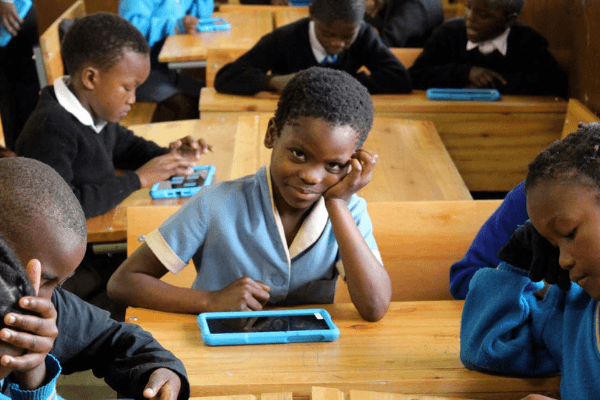
According to UNESCO, about 35.9 million primary and secondary school learners are currently out-of-school as a result of the school closures. For primary schools, this number totals approximately 25.6 million students, of which about 87 percent (23.5 million) are students enrolled in public schools. The numbers are just as stark for secondary school learners. Of the roughly 10.3 million secondary school students who are out-of-school as a result of the closures, approximately 81 percent (8.4 million) of them are public school students. In Nigeria, school opportunity is correlated to income level, and public schools differ from private schools in the populations they serve. While private schools serve learners from higher socio-economic backgrounds who are willing and able to pay more to access the better resources offered by private schools, public schools which are usually free, comprise students from lower socio-economic households and low-income areas. In instances where distance learning opportunities are available, uptake will be low from the students in the public school's category, as a result of poor infrastructure such as no electricity, or poor/no internet connectivity, etc. Opportunities to learn within the homes are also limited, given that a parent’s ability to provide education support to their children will be shaped by their own level of educational attainment, general literacy level, and other commitments. Given the significant relationship between educational attainment and income level, and the correlation between parentals income level and school choice, we can infer that the literacy level of parents in public schools in Nigeria might be lower than their private school counterparts. In instances where the parents are educated, investing the time in training their children during this time might be a luxury. For Nigeria, the reality is simple - while the school closures are necessary to curtail the spread of the COVID-19 virus until the ban on movement is lifted and schools are reopened, the majority of students will not be learning.
The manufacturing sector PMI declined from 58.3 points
to 51.1 points between February and March 20201. The slowdown was triggered by
reduced growth in 7 subsectors including electrical equipment, chemical and
pharmaceutical products, primary metals and non-metallic mineral products.
Similarly, the non-manufacturing PMI index declined to 49.2 percent, falling
below the 50 percent threshold for the first time in over 2 years1. The overall
contraction is due to the depression in global economic activity which has led
to a reduction in new orders, inventory and consequently employment levels
across the manufacturing and non-manufacturing sectors. In the coming months,
the reduced activity across both sectors is expected to continue as a result of
the decline in global demand for exports and the reduction in local
consumption. In the meantime, some manufacturers can switch to producing
essential commodities that are required to tackle the pandemic. In addition,
the cash transfers by the government should be distributed to manufacturing and
non-manufacturing workers that would be laid off or furloughed as a result of
the pandemic.
Between January and February, Nigeria’s external
reserves declined from US$37.2 billion to $35.5 billion, its lowest in over 2
years1. Although the reserve level remains above the $30 billion benchmark set
by the Central Bank of Nigeria (CBN)2, the reserves have depleted considerably
by 2.03% month-on-month. Since the beginning of the year, external reserves
have steadily declined, falling by a total of $2.38 billion in 2020. The recent
decline stems from a fall in crude oil prices occasioned by a slowdown in
global economic activities following the Corona virus outbreak. Perhaps in
reaction to the declining external reserves, CBN has decided to suspend the
multiple exchange window policy which was hitherto used to determine the value
of the Naira. The decision to collapse the multiple window rates is a step in
the right direction as this will forestall some inherent demerits in using
different rates which include currency roundtripping, non-reflective production
costs, rent-seeking and corruption.
With 1.39 million coronavirus cases and 79,382
deaths globally, the world continues to battle the COVID-19
pandemic. Even before the outbreak, the outlook for the world economy—and
especially developing countries like Nigeria—was fragile, as global GDP growth
was estimated to be only 2.5 percent in 2020. While many developing countries
have recorded relatively fewer cases—Nigeria currently has 238 confirmed cases and 5 deaths as of
this writing—the weak capacity of health care systems in these countries is
likely to exacerbate the pandemic and its impact on their economies.
THE IMPACT ON THE NIGERIAN ECONOMY
Before the pandemic, the Nigerian government had been grappling
with weak recovery from the 2014 oil price shock, with GDP growth tapering
around 2.3 percent in 2019. In February, the IMF revised the 2020 GDP growth rate from 2.5
percent to 2 percent, as a result of relatively low oil prices and limited
fiscal space. Relatedly, the country’s debt profile has been a source of
concern for policymakers and development practitioners as the most recent
estimate puts the debt service-to-revenue ratio at 60 percent, which is likely
to worsen amid the steep decline in revenue associated with falling oil prices.
These constraining factors will aggravate the economic impact of the COVID-19
outbreak and make it more difficult for the government to weather the crisis.
AGGREGATE DEMAND WILL FALL, BUT
GOVERNMENT EXPENDITURE WILL RISE
In
Nigeria, efforts were already being made to bolster aggregate demand through
increased government spending and tax cuts for businesses. The public budget increased
from 8.83 trillion naira ($24.53 billion) in 2019 to 10.59 trillion naira
($29.42 billion) in 2020, representing 11 percent of the national GDP, while
small businesses have been exempted from company income tax, and the tax rate
for medium-sized businesses has been revised downwards from 30 to 20 percent.
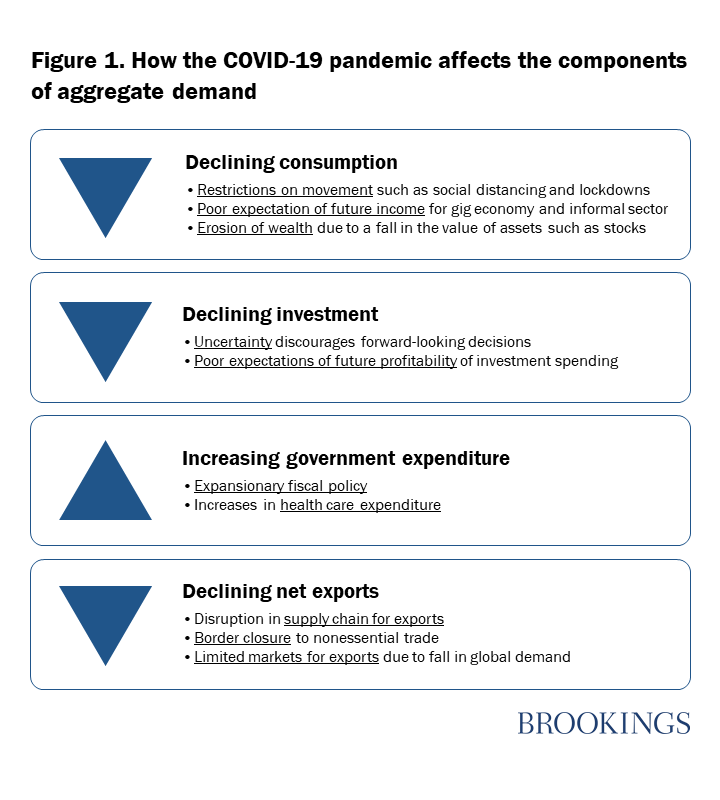
Unfortunately, the COVID-19 crisis is causing all components of aggregate
demand, except for government purchases, to fall (Figure 1).
The fall in household consumption in
Nigeria will stem from 1) partial (or full) restrictions on movement, thus
causing consumers to spend primarily on essential goods and services; 2) low
expectations of future income, particularly by workers in the gig economy that
are engaged on a short-term/contract basis, as well as the working poor in the
informal economy; and 3) the erosion of wealth and expected wealth as a result
of the decline in assets such as stocks and home equity. The federal government
has imposed a lockdown in Lagos and Ogun states as well as Abuja (which have
the highest number of coronavirus cases combined). Subnational governments have
quickly followed suit by imposing lockdowns in their states. Nigeria has a
burgeoning gig economy as well as a large informal sector, which
contributes 65 percent of its economic output. Movement
restrictions have not only reduced the consumption of nonessential commodities
in general, but have affected the income-generating capacity of these groups,
thus reducing their consumption expenditure.
Investments by firms will be impeded largely
due to the uncertainties that come with the pandemic-limited knowledge about
the duration of the outbreak, the effectiveness of policy measures, and the
reaction of economic agents to these measures—as well as negative investor
sentiments, which are causing turbulence in capital markets around the world.
Indeed, the crisis has led to a massive decline in stock prices, as the
Nigerian Stock Exchange records its worst performance since the 2008 financial
crisis, which has eroded the wealth of investors. Taking into consideration the
uncertainty that is associated with the pandemic and the negative profit
outlook on possible investment projects, firms are likely to hold off on
long-term investment decisions.
On the other hand, government purchases will
increase as governments, which typically can afford to run
budget deficits, utilize fiscal stimulus measures to counteract the fall in
consumer spending. However, for governments that are commodity dependent, the fall in the global demand for commodities stemming
from the pandemic will significantly increase their fiscal deficits. In
Nigeria’s case, the price of Brent crude was just over $26 a barrel on April 2,
whereas Nigeria’s budget assumes a price of $57 per barrel and would still have
run on a 2.18 trillion naira ($6.05 billion) deficit. Similarly, with oil
accounting for 90 percent of Nigeria’s exports, the decline in the demand for
oil and oil prices will adversely affect the volume and value of net exports.
Indeed, the steep decline in oil prices associated with the pandemic has
necessitated that the Nigerian government cut planned expenditure. In fact, on
March 18, the minister of finance announced a 1.5 trillion naira ($4.17
billion) cut in nonessential capital spending.
The restrictions on movement of people and border closures
foreshadow a decline in exports. Already,
countries around the world have closed their borders to nonessential traffic,
and global supply chains for exports have been disrupted. Although the exports
of countries that devalue their currency due to the fall in the price of
commodities (like Nigeria), will become more affordable, the limited markets
for nonessential goods and services nullifies the envisaged positive effect on
net exports.
WHAT ARE THE POLICY RESPONSES BY THE
NIGERIAN GOVERNMENT?
Already,
the Central Bank of Nigeria (CBN) has arranged a fiscal stimulus package,
including a 50 billion naira ($138.89 million) credit facility to households
and small and medium enterprises most affected by the pandemic, a 100 billion
naira ($277.78 million) loan to the health sector, and a 1 trillion naira
($2.78 billion) to the manufacturing sector. In addition, the interest rates on
all CBN interventions have been revised downwards from 9 to 5 percent, and a
one-year moratorium on CBN intervention facilities has been introduced,
effective March 1.
With
oil being Nigeria’s major source of foreign exchange, amid the steep decline in
oil prices, the official exchange rate has been adjusted from 306 to 360 naira.
The exchange rate under the investors and exporters (I&E) window has also
been adjusted from 360 to 380 naira in order to unify the exchange rates across
the I&E window, Bureau de Change, and retail and wholesale windows.
Furthermore, the government has introduced import duty waivers for
pharmaceutical companies and increased efforts toward ensuring that they
receive forex.
WHAT OTHER POLICY RESPONSES CAN BE
IMPLEMENTED?
Given
the size and scope of the economic impact of the pandemic, there is the need to
implement other recovery strategies to stimulate demand. Thus, we recommend the
following fiscal and monetary policy measures:
Although there is a cash transfer program in place, the federal
government should improve efforts towards enhancing the efficiency and
effectiveness of the distributive mechanisms to reach households that are
worst-hit by the pandemic.
The
Federal Inland Revenue Service (FIRS) as well as State Inland Revenue Services
(SIRS) should waive payments on personal and corporate income tax for the
second quarter of 2020, considering that the shock has affected the income and
profits of households and businesses.
The
CBN’s decision to increase the cash reserve ratio (CRR) from 22.5 percent to
27.5 percent in January 2020 should be revisited to provide liquidity for banks
so that banks can, in turn, create credit to the private sector.
FIRS
and SIRS should delay tax collection for the worse-hit sectors including
tourism, the airline industry, and hoteliers in order to enable them recover
from the steep decline in demand.
To
provide additional liquidity in the forex market, the CBN should establish a
swap facility with the U.S. Federal Reserve and/or the People’s Bank of China,
as was done in 2018, to provide dollar and yen liquidity to financial
institutions, investors, and exporters. This move would ease up forex shortage
in the financial market and economy.
While the naira has been adjusted as a result of the forex
shortage, it is important that the CBN maintains exchange rate stability by
deploying external reserves in order to avoid investors selling off
naira-denominated assets.
The COVID-19 pandemic is a wake-up call to policymakers as the unusual and unprecedented nature of the crisis has made it impossible for citizens to rely on foreign health care services and more difficult to solicit for international support given the competing demand for medical supplies and equipment. A more integrated response spanning several sectors—including the health, finance, and trade sectors—is required to address structural issues that make the country less resilient to shocks and limit its range of policy responses. In the long term, tougher decisions need to be made, including but not limited to diversifying the country’s revenue base away from oil exports and improving investments in the health care sector in ensuring that the economy is able to recover quickly from difficult conditions in the future.
The Global Health Hazards and Economic Impacts of COVID-19
In December 2019, a cluster of pneumonia cases from an unknown virus surfaced in Wuhan, China. Based on initial laboratory findings, the disease named Coronavirus disease 2019 (abbreviated as COVID-19), was described as an infectious disease that is caused by severe acute respiratory syndrome coronavirus 2. The COVID-19 outbreak has since spread to about 196 countries and territories in every continent and one international conveyance across the globe. While there are ongoing efforts to curtail the spread of infection which is almost entirely driven by human-to-human transmission, it has accounted for over 400,000 confirmed cases with over 18,000 deaths[1].
Beyond the tragic health hazards and human consequences of the COVID-19 pandemic, the economic uncertainties, and disruptions that have resulted come at a significant cost to the global economy. The United Nations Trade and Development Agency (UNCTAD) put the cost of the outbreak at about US$2 trillion in 2020. Most central banks, finance ministries and independent economic experts around the world have taken solace in the prediction that the impacts might be sharp but short-lived, and economic activities would return to normal thereafter. This line of thought mirrors the thinking of the events that shaped the 2007 global financial crisis. However, it is quite instructive to note that the 2007 crisis which emanated from the United States’ subprime mortgage crisis was mainly an economic phenomenon, with its fallout spreading across many regions of the world. When compared to COVID-19, the 2007 crisis could be described as minor and manageable. The tumultuous events that COVID-19 had spread across the globe cut across every facet of human existence and the consequences may linger beyond the second half of 2020.
The slowdown in the global economy and lockdown in some countries, such as Italy, Spain and most Eurozone economies and beyond, as a result, COVID-19 has also taken its toll on the global demand for oil. The decline in oil demand is estimated to surpass the loss of nearly 1 million barrels per day during the 2007-08 recession. This is also coming at a time when two key players in the global oil industry – Russia and the OPEC cartel – are at loggerheads on the decision to cut output. The unequivocal oil price war started between these two global oil market giants may have more dire consequences on the oil price that has started to dive. .
Sector-specific implications and impacts could vary. For example, the impacts on the global aviation and tourism sectors are a result of the implications of the pandemic on global travel. As discretionary spending by consumers continues to decline, cruise companies, hotels, and hospitality are facing declining demand and patronage. For example, in Hungary alone, about 40 to 50% of hotel reservations have been canceled. Also, the pandemic is placing up to 8 million jobs in the leisure and hospitality sector at risk, with travel crashes and cancellations expected to continue. Moody’s Analytics, a rating agency, stated that more than half of the jobs in the United States which is about 80 million may be in jeopardy.
The virus is also taking its toll on health facilities and infrastructures across the globe. Italy is currently the largest affected country with a number of deaths surpassing China, since the outbreak of coronavirus. Across northern Italy, the virus has pushed the country’s National Health Service to a breaking point, emphasizing the test that other countries, especially developing and low-income countries, might face in their approach to contain the virus spread. Most hospitals and health facilities that could not handle the hazards are resulting to operating below their capacity by taking a few regular health-related cases or shutting down. What could be more devastating is the fact that the economic pains that accompanied the virus might not go away soon as envisaged.
The conventional policy measures currently being taken such as reducing interest rates and costs of borrowing, tax cuts and tax holidays are quite remarkable. However, these conventional policy measures are quite potent when there are demand shocks. There are limitations to the successes that can be recorded when demand shocks are combined with supply shocks. It is already apparent from the emergence of the current crisis that there are implications on the economy from both the demand and supply sides. Some of the demand factors include social distancing with consumers staying at home, limitations in spending and declining consumptions. On the supply side, factories are shutting down or cutting down production and output, while in other instances, staff work from home to limit physical contact.
The decision to close educational institutions and schools around the globe in an attempt to contain the pandemic has also led to a soaring number of children, youth and adults not attending schools. According to UNESCO Monitoring report on COVID-19 educational disruption and response, the impact of school closures in the over 100 countries that have implemented the decisions around the world has impacted over half of the global students’ population. These educational disruptions are being escalated particularly for the most vulnerable members of society.
Bracing up for COVID-19 consequences on the Nigerian economy
For most developing economies, the odds of sliding into a downturn are gradually expected as the global coronavirus outbreak puts severe pressure on the economy. For Nigeria, the country is still sluggishly grappling with recovery from the 2016 economic recession which was a fall out of global oil price crash and insufficient foreign exchange earnings to meet imports. In the spirit of economic recovery and growth sustainability, the Nigerian federal budget for the 2020 fiscal year was prepared with significant revenue expectations but with contestable realizations. The approved budget had projected revenue collections at N8.24 Trillion, an increase of about 20% from 2019 figure. The revenue assumptions are premised on increased global oil demand and stable market with oil price benchmark and oil output respectively at $57 per barrel and 2.18 Million Barrels Per Day.
The emergence of COVID-19 and its increasing incidence in Nigeria has called for drastic review and changes in the earlier revenue expectations and fiscal projections. Compared to events that led to recession in 2016, the current state of the global economy poses more difficulties ahead as the oil price is currently below US$30 with projections that it will dip further going by the price war among key players in the industry. Unfortunately, the nation has grossly underachieved in setting aside sufficient buffers for rainy days such as it faces in the coming days. In addressing these daunting economic challenges, the current considerations to revise the budget downward is inevitable. However, certain considerations that are expected in the review must not be left out. The assumptions and benchmarks must be based on realizable thresholds and estimates to ensure optimum budget performance, especially on the non-oil revenue components.
Furthermore, cutting expenditures must be done such that the already excluded group and vulnerable are not left to bear the brunt of the economic contraction. The economic and growth recovery program which has the aim of increasing social inclusion by creating jobs and providing support for the poorest and most vulnerable members of society through investments in social programs and providing social amenities will no doubt suffers some setbacks. Besides, the downward review of the budget and contractions in public spending could be devastating on poverty and unemployment. The last unemployment report released by the National Bureau of Statistics (NBS) ranks Nigeria 21st among 181 countries with an unemployment rate of about 23.1%. The country has also been rated as the poverty capital of the world with an estimated 87 million people living on less than $2 a day threshold.
The decision to cut the retail price of gasoline under a price modulation arrangement is a welcome development. The cut is expected to curb rising inflation, especially food price inflation which will mainly benefit the poor. However, rather than the price capping regime introduced, by which it is expected of the Petroleum Products Price Regulation Agency (PPPRA) to constantly issues monthly guide on appropriate pricing regime. It is expected that the government will use this opportunity to completely deregulate the petroleum industry in line with existing suggestions and reports. In the event that the global economy becomes healthier and crude oil prices increases, the government might return to the under-recovery of the oil price shortfall by the Nigerian National Petroleum Corporation (NNPC). A policy that annually costs the government huge revenue and recurring losses to the NNPC.
Basically, the Nigerian government essentially must lead economic diversification drive. It is one practicable way to saddle through the current economic uncertainties and instabilities. What the consequences of COVID-19 pandemic should further offer the Nigerian economic managers and policymakers, is that the one-tracked, monolithic reliance on oil is failing. Diversification priorities to alternative sectors such as agriculture, solid minerals, manufacturing and services sectors, should be further intensified.
[1] These figures were recorded as a 24th March, 2020.



 English
 Arab
Arab
 Deutsch
 Português
 China
China