Data released by the National Bureau of Statistics revealed a decline in total disbursements from the Federation Account in 2020. The Federation Account Allocation Committee (FAAC) disbursed N4.79 trillion1 to the federal and state governments in 2020, whereas, a total sum of N5.4 trillion was disbursed in the preceding year 2019, representing a 13% decline. Further disaggregation shows that the federal and state governments received N2.49 trillion and N2.3 trillion respectively in the period under review. Delta and Akwa-Ibom states were the biggest beneficiaries, receiving the highest allocations of N186.83 billion and N146.27 billion respectively, while Osun and Cross River states received the least allocations of N30.63 billion and N32.89 billion respectively. The overall decrease in disbursements is an indication of a dip in total revenue sourced during the year. The COVID-19 pandemic negatively affected global oil sales, which is the country’s main source of revenue. This therefore calls for increased commitment and intervention programs to diversify the economy, and reduce the country’s vulnerability to oil price shocks. Domestic revenue mobilization efforts also need to be intensified.
The COVID-19 pandemic has had a debilitating effect on the Nigerian economy. Specifically, the combination of lockdown measures and the global slowdown of economic activities led to the contraction of Nigeria's GDP by 6.1% in the second quarter of 2020, thus inducing the country's second recession within five years . Nevertheless, it is noteworthy that the pandemic occurred amid prevailing economic vulnerabilities.
This policy brief examines the pre-existing economic vulnerabilities, evaluates the Nigerian government's responses to the pandemic with regards to achieving a green and more diversified economy, and develops a new agenda and strategies for sustainable growth and economic transformation.
The International Monetary Fund (IMF) projects that Nigeria’s fiscal balance is estimated to increase considerably. More specifically, general government deficit is projected to widen from 4.8 to 5.9 percent of GDP between 2019 and 2020.1 Also, public debt is projected to increase substantially to 34 percent of GDP in 2020 from 29.1 percent in 2019. The increase in government general deficit can be attributed to sharp revenue declines occasioned by the pandemic. Although revenue could increase given the increase in the Value Added Tax (VAT) rate from 5 to 7.5 percent in 2020, and expenditure savings from the removal of power sector and fuel subsidies, the concurrent increase in expenditure related to COVID-19 emergency support will drive the widening fiscal deficit. However, as domestic activities recover to pre-COVID levels and spending on household and businesses vulnerable to the pandemic tapers down, the fiscal deficit is projected to narrow in 2021.
Based on the recently released Corruption Perception Index (CPI) 1, Nigeria is still perceived to be among the most corrupt nations, with a ranking of 149 out of the 180 countries assessed – a higher ranking is indicative of higher corruption. The CPI is based on a scale of 0 to 100; with zero representing extreme corruption and 100 indicating least level of corruption. Nigeria’s CPI score reduced slightly from 26 in 2019 to 25 in 20202, while its ranking worsened, falling from 146 to 149. The increase in perceived corruption may be partly attributable to the reports by civil society organisations on the hoarding and mis-management of COVID-19 palliatives and related supplies. It is therefore imperative that anti-corruption policies are enforced to boost the public trust; as this can affect domestic and foreign direct investments.
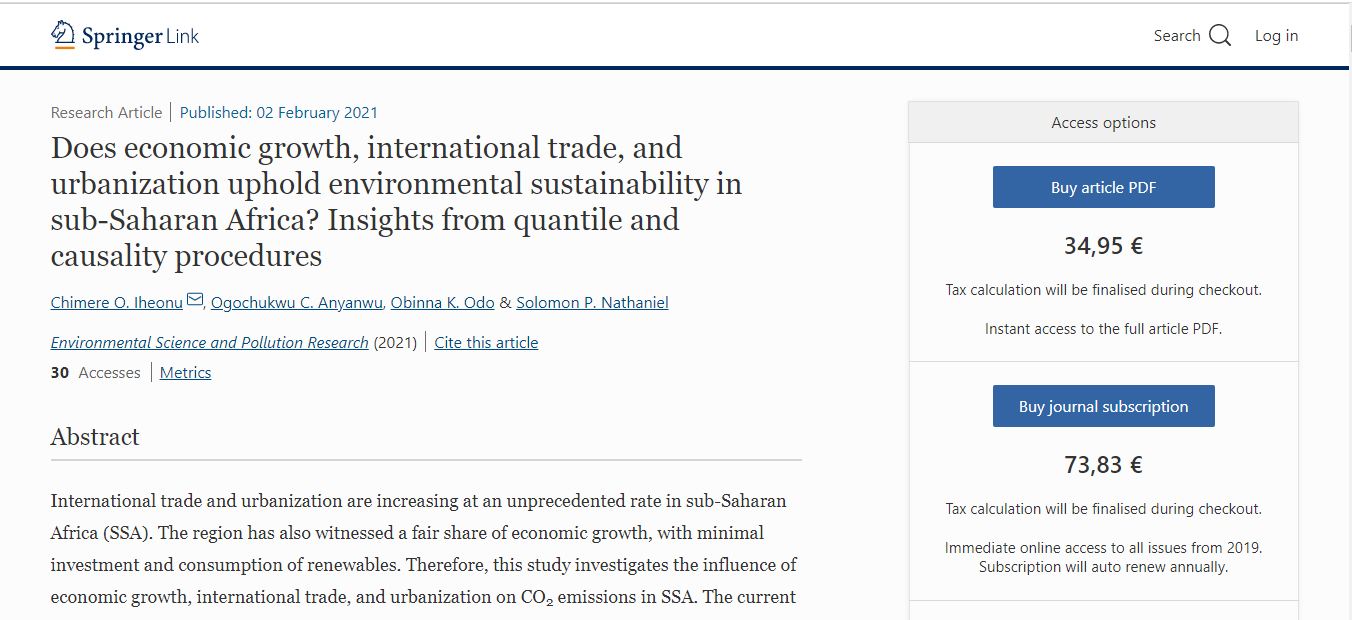
International trade and urbanization are increasing at an unprecedented rate in sub-Saharan Africa (SSA). The region has also witnessed a fair share of economic growth, with minimal investment and consumption of renewables. Therefore, this study investigates the influence of economic growth, international trade, and urbanization on CO2 emissions in SSA. The current study enriches the existing literature by employing the panel quantile regression analysis to account for existing levels of CO2 emissions in the region. Empirical findings reveal that GDP increases CO2 emissions across quantiles, especially in countries where the existing level of CO2 emissions is low. International trade improves environmental sustainability in countries where the existing levels of CO2 emissions are at their lowest and highest levels but exacts a reversed impact on CO2 emissions at the median. Further findings suggest that urbanization increases CO2 emissions across the observed quantiles with a more pronounced effect in countries where the existing levels of CO2 emissions are at its lowest level. The study also reveals a bi-directional causality between economic growth, international trade, urbanization, and the emissions of CO2. The limitations of the study and possible direction for future research have been highlighted. Policy directions are discussed.
Data from the National Bureau of Statistics (NBS) shows an overall increase in tax revenues for 2020. Total revenue generated from Value Added Tax (VAT)1 and Company Income Tax (CIT)2 stood at approximately N2.94trillion, representing a 5% increase from N2.81trillion reported in prior year. However, although the net revenue showed growth, only VAT receipts increased year-on-year by 29%, whereas, CIT revenue decreased by 13%. The professional services sector was the biggest contributor to both VAT and CIT receipts, while mining and textile/garment industry generated the least VAT and CIT revenues respectively. Considering the economic circumstances during 2020, the slight growth in tax revenues is a positive indicator. It is important for tax policymakers to continue monitoring the effectiveness and impact of ongoing tax reforms on the economy.
According to data from the National Bureau of Statistics (NBS), a 0.28% month-on-month increase in the average price of Automotive Gas Oil (diesel) was recorded as the price in December 2020 increased to N224.37 from N223.74 in November 20201. Similarly, the average price for the refilling of a 5kg cylinder for Liquefied Petroleum Gas (Cooking Gas) has increased by 0.12% month-on-month to N1949.75 in December 2020 from N1947.47 in the previous month2. The results were similar regarding the refilling of a 12.5kg cylinder with a 1.75% month-on-month increase. Contrarily, the average price paid by consumers for premium motor spirit (petrol) decreased month-on-month by -0.94% to N165.70 from N167.27 in the previous month3. Overall, in month of December 2020, gas prices rose most likely as a result of rising crude oil prices in the international market. Low-income households are less likely to be affected given that their consumption of these products is relatively lower than middle- and high-income households. However, the general decline in income due to the effect of the COVID-19 pandemic makes the increment nonetheless an economic burden.
While the African Continental Free Trade Area (AfCFTA) provides opportunities for regional financial sector development, it also poses a real test for the continent’s financial system. The ability of Africa’s financial sector to perform the crucial function of facilitating economic growth and integration, at the required scale to support the capacity of small firms to benefit from the single African market remains shaky. In terms of opportunities, the elimination of inhibitive regulations under the AfCFTA is expected to ease cross border trade, enable capital and information flow, attract greater foreign and intra-continental investments, potentially increase capital funds, and provide a much larger customer base for financial institutions to serve. This potential new market base includes traditionally excluded micro, small and medium enterprises (MSMEs) that constitute a large share of the African economy. MSMEs are expected to be a major catalyst for increasing intra African trade and shared economic growth. However, the constraint to MSME financing is a major threat to the success of the AfCFTA as effective economic integration and development depend on easily accessible and affordable capital. This brief therefore advocates for urgent implementation of harmonised financial sector policy reforms across the continent to eliminate these funding constraints, and allow for a more supportive business environment.
Click link below to download full brief
Discussions are underway between the Nigerian National Petroleum Corporation (NNPC) and a range of foreign and Nigerian trading houses with the NNPC aiming to raise $1 billion oil prepayment towards the revamping of the Port Harcourt refinery.¹ The funds acquired are expected to be repaid through the delivery of refined products over a span of seven years. In 2019, the refineries of Nigeria lost approximately N167 billion ($439.47 million) leading to the shutting down of the refineries in April 2020 for rehabilitation. If the project is successful, Nigeria’s fuel import bill will be reduced. Additionally, it would be the country’s second oil-backed financing since the onset of the COVID-19 pandemic. Currently, a key financing source is the African Export-Import (Afrexim) Bank. Some foreign banks have stated their aversions to participating or contributing to the project due to their consideration of Nigeria as a high-risk country and low credit availability. The use of sales of refined products to finance the rehabilitation of the refinery provides the appropriate incentive for successfully completing the project. However, the use of public-private partnerships in managing the refinery should be considered in order to enhance efficiency and effectiveness.