Publications

Follow via RSS

Nigeria Economic Update (Issue 11)

The Central Bank of Nigeria (CBN) has taken steps to ensure financial stability amid the COVID-19 pandemic. The steps include a reduction of interest rates for all CBN interventions from 9% to 5%, the creation of a N50 billion credit facility for households and SMEs impacted by the pandemic, and N100 billion in credit support to the healthcare industry3. Other policy actions were aimed at maintaining funding levels within deposit money banks in order to sustain lending capacity to the private sector. Overall, the CBN has committed over N1 trillion to support all critical sectors, which could help buffer the effect of a global recession4. While the fiscal stimulus package is in line with global best practice, it is critical to ensure that these interventions are not exploited. For instance, prospective beneficiaries may misconstrue these loans as grants; or may be unable to repay the loans leading to an enormous bad debt burden on the government. In addition, the extent to which these loans will reach certain businesses affected by the stay-at-home policy such as food vendors and artisans is debatable. However, MSMEs can utilize these interventions to boost local manufacturing and achieve import substitution in these industries.

Read More Download PDF

Nigeria Economic Update (Issue 11)

Foreign capital imported to Nigeria declined by 32% from US$5.6 billion to US$3.8 billion between Q3 and Q4 2019, indicating a decline for the third consecutive quarter1. The decline during the period was driven by a fall in two components of foreign capital imports as portfolio investment and other investment declined by 37.7% and 30.5% respectively, while foreign direct investment increased by 24.5%. In 2019, the United Kingdom, the United States, and South Africa emerged as the top-three countries importing the highest capital while Lagos and Abuja remain the top destinations within the country. By sector, banking (31.92%), financing (26.18%) and shares (22.24%) emerge as the top sectors. Despite the decline in capital imports between Q3 and Q4 2019, there has been a 42.7% increase in the total value of capital imported between 2018 and 2019. Taking into consideration the impact of the COVID-19 pandemic on the global economy due to the decline in demand and widespread uncertainty, a further decline in foreign capital inflows is expected going forward.

Read More Download PDF

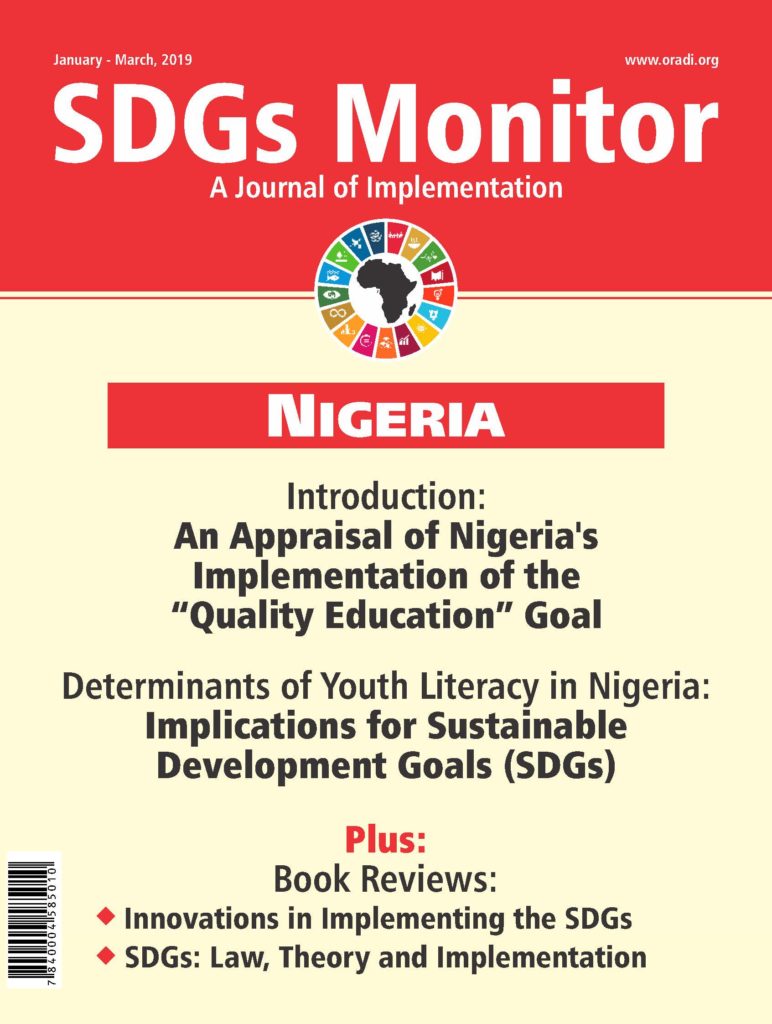
SDG Monitor: A Journal of Implementation- An Appraisal of Nigeria’s Implementation of the Quality Education Goal

Among the 17 SDGs for transforming the world by 2030, SDG 4, which emphasizes “Quality Education”, ranks high, and for obvious reasons. Basically, SDG 4 encourages all UN-member countries, including Nigeria, to ensure inclusive and equitable quality education, and promote lifelong learning opportunities for all – through the Education 2030 Framework for Action (FFA).
The role of education in the march towards development for any nation cannot be overemphasized. There is a nexus between quality education and national development. A country which is able to achieve quality education will in turn, make progress in other areas of development. Succinctly put, quality education is key to the attainment of sustainable development because as Adeyanju (2010) notes, no development can occur at all without education

Read More Download PDF

Nigeria Economic Update (Issue 10)

In its worst performance since the 2008 financial crisis, the NSE All-Share Index and market capitalization depreciated by 13.49% to close the week at 22,733.35 basis points and N11.847 trillion respectively1. The decline in the market index is underpinned by the Saudi Arabia-Russia oil price war following Russia’s failure to cut oil supplies as well as the coronavirus pandemic. The NSE Banking Index, NSE Consumer Goods Index, and NSE Premium Index were among the worst hit as they fell by 26.2%, 21.7% and 16.1% respectively. Due to the high global connectivity and the dampened demand in developed countries as a result of the pandemic, the downslide in the Nigerian market is similar to ongoing trends in the markets of other African countries, Asia, Europe and North America; and is expected to continue until the risk factors are addressed. While the uncertainty has caused many investors to sell off risky securities such as stock, investors should rather take advantage of the low stock prices to increase their investments as the bearish trend in the market is driven by temporary risk factors and not a fall in companies’ fundamentals.

Read More Download PDF

Nigeria Economic Update (Issue 9)

The Nigerian Stock Exchange All Share Index and market capitalisation declined by 4.28% to close the week at 26,216.46 and N13.658 trillion respectively4. This rise was primarily driven by the Financial Services industry, particularly Guaranty Trust Bank Plc, United Bank for Africa Plc, and Zenith Bank Plc, which comprised 82% of the total trade volume valued at N17.2 billion. Despite this, the top six price gainers were mostly non-financial services firms including May & Baker Nigeria, Ekocorp, Neimeth International Pharmaceuticals, BUA Cement, and Ardova Plc. As the equities prices continue to drop, the dividend yields will remain attractive not only to local investors but also to global portfolio managers which will drive improvements in market activities.

Read More Download PDF

Nigeria Economic Update (Issue 8)

The National Bureau of Statistics (NBS) has reported that the GDP growth rate in Q42019 is 2.55% which is relatively higher than Q32019 GDP growth rate at 2.28% and remains the highest quarter on quarter growth since the 2016 recession1. This cumulates to an annual growth rate of 2.27% for 2019. Furthermore, the aggregate GDP for Q42019 stood at N39.5 trillion compared to the aggregate GDP of Q32019 at N37.8 trillion and the corresponding quarter in 2018 at N35.2 trillion. While the non-oil sector shrunk year on year by 0.44%, it contributed 92.68% to Q42019 GDP which is significantly higher than the oil sector’s contribution at 8.78%. As the price of Brent crude oil falls below the US$57 per barrel benchmark in the 2020 budget, this threatens the realism of the budget, thus leading to a slowdown in economic activities. In order to achieve sustainable and significant economic growth, the country’s revenue base should be de-linked from oil, and recurrent expenditure in the form of cost of governance should be cut down. This will allow for the increased revenue to be diverted to key sectors including manufacturing and mining sectors.

Read More Download PDF

Nigeria Economic Update (Issue 7)

The total stock of money in circulation declined at the end of January, falling by 7.9% month-on month from N2.4 trillion in December1. Although the current stock of currency in circulation is 5% higher than the corresponding year, the decline in currency-in-circulation stands to reduce the current levels of inflation2. This potential impact is in line with the expected outcome of the newly increased Cash Reserve Ratio (CRR) from 22.5% to 27.5% which aims to address monetary-driven inflation. The reduction in currency in circulation amid the increase in CRR, which in itself may constrain banks’ ability to create money through lending, may further increase interest rate and cost of doing business. However, the Central Bank of Nigeria’s stance on increasing the loan to deposit ratio from 60% to 65%, which hitherto has recorded some successes in increasing credit to private sector, may continue to further push market interest rates downwards or at least tame the negative impact of increased CRR.

Read More Download PDF

Addressing the Challenges of Urbanization in Africa

Africa is the world’s least urbanized continent, and yet the rate at which its cities are expanding is growing faster than no other worldwide – at an average of 3.5 percent per year. This growth of urbanization does, however, vary across the continent, ranging from the already heavily urbanized North Africa (47.8 percent) to the least urbanized Sub-Saharan Africa (32.8 percent).The aggregate rate of urbanization on the continent is projected to grow from 40 percent in 2015 to 56 percent in 2050.
The enormous speed at which Africa’s cities are growing is linked to other key development trends, most prominently accelerating economic and population growth, increasing migration from rural to urban areas, and the youth bulge. It is strongly driven by Africans’ perceptions that cities – in contrast to the continent’s rural areas – offer an abundance of livelihood opportunities, including employment and income-generating opportunities, food security, and access to finance, education and social capital as well as social protection.

Read More

Read More Download PDF

2019 BENCHMARKING EXERCISE REPORT

The 2019 Benchmarking Exercise Report (BER) is produced by the Nigerian Natural Resource Charter (NNRC) in partnership with a consortium of Think Tanks and Civil Society Organisations (CSOs) comprising the Centre for the Study of the Economies of Africa (CSEA), Centre for Public Policy Alternatives (CPPA), We the People: Centre for Social Studies and Development (CSSD),Centre for Social Justice (CSJ), and Social Action (SA).
The 2019 edition is the fourth in a series of BERs produced by the NNRC carried out to provide an assessment of the governance of Nigeria’s petroleum wealth. Three previous exercises were conducted and published in 2012, 2014, and 2017 respectively. The BER uses the NRC framework developed by a diverse set of internationally renowned experts on natural resource management to conduct detailed and contextual assessments of the country’s oil and gas industry. It analyses the governance of petroleum wealth in Nigeria and identifies crucial changes that have taken place in the sector since the last benchmarking exercise was conducted.

Read More Download PDF