Macroeconomic Report & Economic Updates

  • Home
  • Macroeconomic Report & Economic Updates

Nigeria Economic Update (Issue 7)

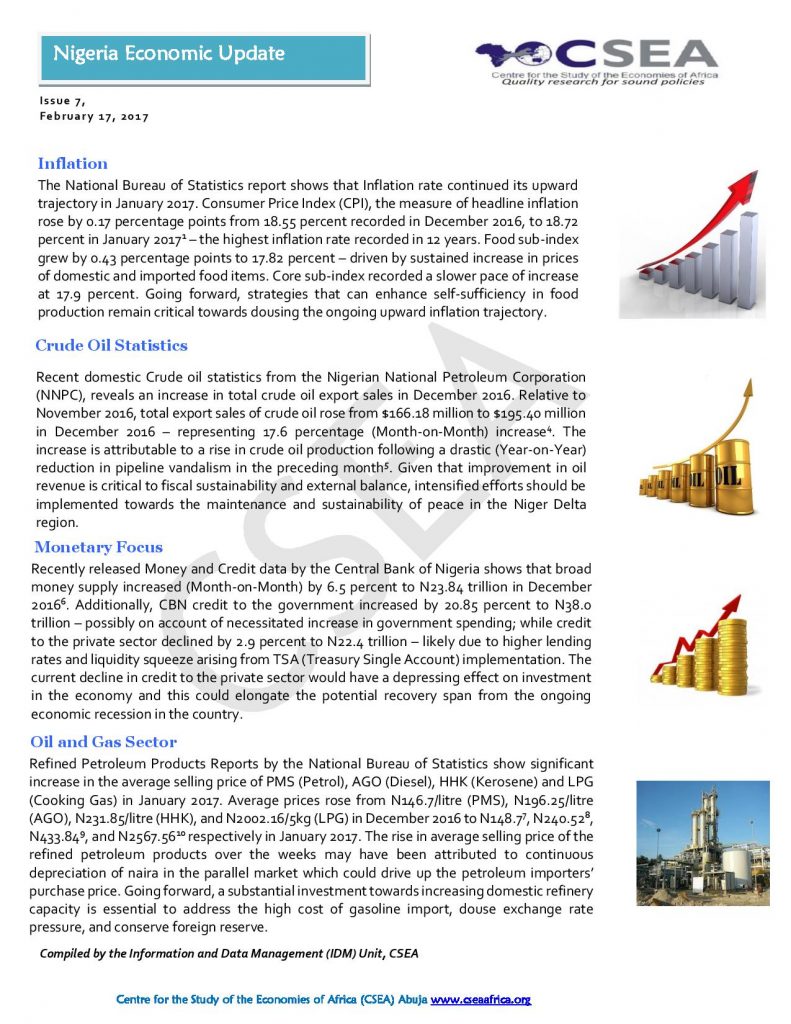
Recent domestic Crude oil statistics from the Nigerian National Petroleum Corporation (NNPC), reveals an increase in total crude oil export sales in December 2016. Relative to November 2016, total export sales of crude oil rose from $166.18 million to $195.40 million in December 2016 representing 17.6 percentage (Month-on-Month) increase. The increase is attributable to a rise in crude oil production following a drastic (Year-on-Year) reduction in pipeline vandalism in the preceding month. Given that improvement in oil revenue is critical to fiscal sustainability and external balance, intensified efforts should be implemented towards the maintenance and sustainability of peace in the Niger Delta Region.
Read More Download PDF

Nigeria Economic Update (Issue 6)

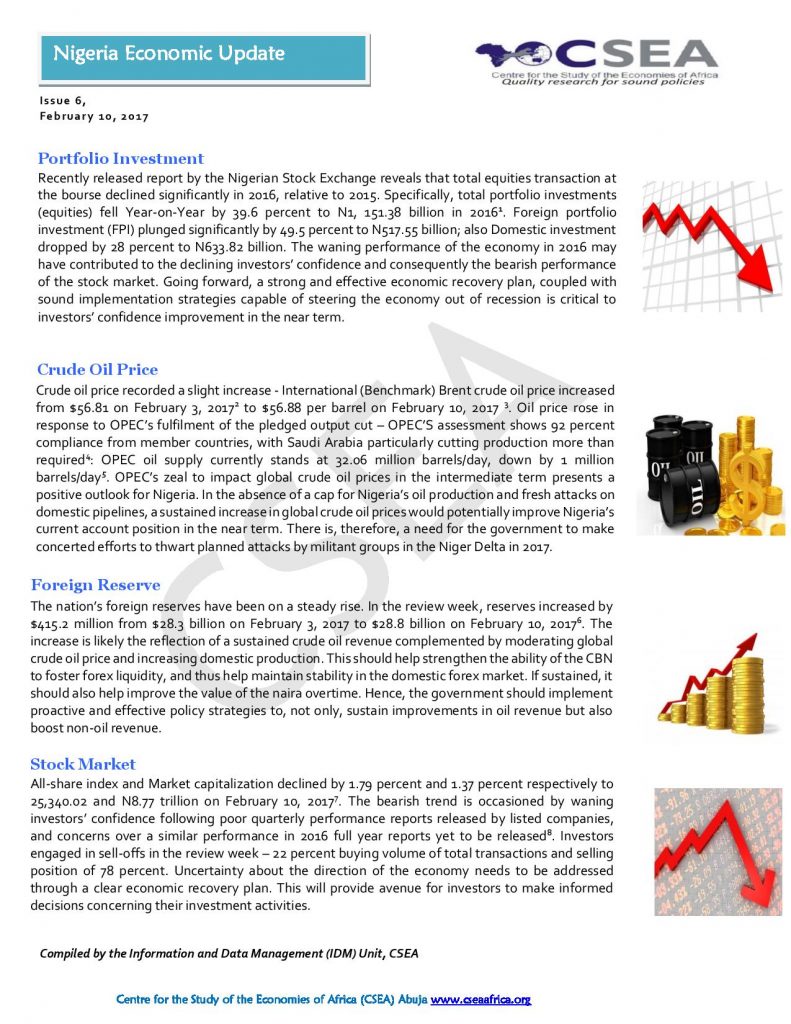
The nations foreign reserves have been on a steady rise. In the review week, reserves increased by $415.2 million from $28.3 billion on February 3, 2017 to $28.8 billion on February 10, 2017. The increase is likely the reflection of a sustained crude oil revenue complemented by moderating global crude oil price and increasing domestic production. This should help strengthen the ability of the CBN to foster forex liquidity, and thus help maintain stability in the domestic forex market. If sustained, it should also help improve the value of the naira overtime. Hence, the government should implement proactive and effective policy strategies to, not only, sustain improvements in oil revenue but also boost non-oil revenue.
Read More Download PDF

Nigeria Economic Update (Issue 5)

The Naira continued to depreciate in the review week. At the parallel market, naira exchanged for N498/$ on January 27, 2017 and N500/$ on February 3, 2017. Despite the weekly sales of forex to BDCs and the significant improvements in the external reserves, the naira has continued to lose value to other currencies. The pressure on the naira has been triggered by escalating scarcity of forex in the spot market, likely due to forex hoarding. However, in the preceding week, the CBN sold $660 million in forwards contract in an attempt to manage liquidity and stabilize the naira. In the face of growing speculation in the parallel market, the monetary authority should institute mechanisms that would discourage excessive forex hoarding among licensed BDC operators. An initiative that monitors transaction dealings in the parallel market would go a long way in detecting erring BDC operators.
Read More Download PDF

Nigeria Economic Update (Issue 4)

Recently released power sector report by the National Bureau of Statistics records a total average energy generation of 2,548GWH by 25 power stations, from October 2016 to December 2016. Daily Energy generation, attained the 2016Q4 highest level of 3,859.6MW in October 2016, and a lowest level of 2522MW in the same month. On the average, current daily energy generated which is below 3,000MW, prompts system malfunctions. Thus, the irregular power generation and supply experienced in recent times is attributable to shortage of gas owing to non-functional major pipelines, in addition to the inability of GENCOs to make payments for the available gas supply. Given the recent challenges to power supply, efforts should be geared towards the diversification of electricity generation. Government should consider investment in renewable as well as coal energy to complement gas power supply.
Read More Download PDF

Nigeria Economic Review

Global economic growth remained fairly stable in 2016Q3 with baseline projections for global growth at 3.1 percent and 2.4 percent by International Monetary Fund (IMF) and the World Bank respectively. Growth in developed countries was moderate but unevenly distributed: while the U.S and the UK showed improvements, growth in other economies remained tepid. Among emerging countries, India witnessed higher growth while growth in China remained constant but the Chinese Yuan continued to appreciate. Given that India is Nigerias major crude oil importer, improving economic conditions in India may translate into rising demand for Nigerias crude oil. However, the continuous appreciation of the Yuan poses significant inflationary threat in Nigeria given the high level of imports from China. Subdued global demand, weak trade, uncertainties in commodity prices and consequences of the Brexit were the key constraining factors to growth over the period. In addition, growth in Sub-Saharan African countries remained generally slow on the account of low commodity price, political turmoil, and inconsistent government policies.
Read More Download PDF