Macroeconomic Report & Economic Updates

  • Home
  • Macroeconomic Report & Economic Updates

Nigeria Economic Update (Issue 10)

Nigerias external reserve rose to its 19-month high in the week under review (March 3, 2017 to March 10, 2017). Precisely, the reserve improved by a daily average-percentage-increase of 0.21 percent, from $29.79 billion on March 3, 2017 to $30.04 billion on March 10, 2017  the highest level since August 2015. The rising reserve at the backdrop of steady revenue from improved domestic crude oil production/prices and forex inflows from rising exports, has reduced pressure on the Naira the naira has witnessed marginal but steady appreciation. While the recent improvement in oil revenue is a welcome development, concerted efforts need be made to develop the Non-oil sector so as to mitigate future oil revenue shocks.  
Read More Download PDF

Nigeria Economic Update (Issue 11)

Recently released report by the National Bureau of Statistics (NBS) indicates price increase of selected food items for the month of February 2017, relative to January 2017. Specifically, prices of the selected 24 food items ranged from N47.42 N1, 812 in January to N42.90 N1, 955.10 in February 2017. Average price of all selected items increased month-on-month by 2.7 percent to N540.05. Non-seasonal agriculture factors such as rising cost of crop production, imported products, and transportation continue to drive domestic food prices higher as domestic food supply contracts. This is also reflective of the high food inflation rate in February (18.53 percent) relative to 17.82 percent recorded in January 2017. Strengthening Nigerias crude oil production, supporting local agricultural production, and improving forex policies to straighten the naira remain critical in improving food supply and reducing inflation.
Read More Download PDF

Nigeria Economic Update (Issue 9)

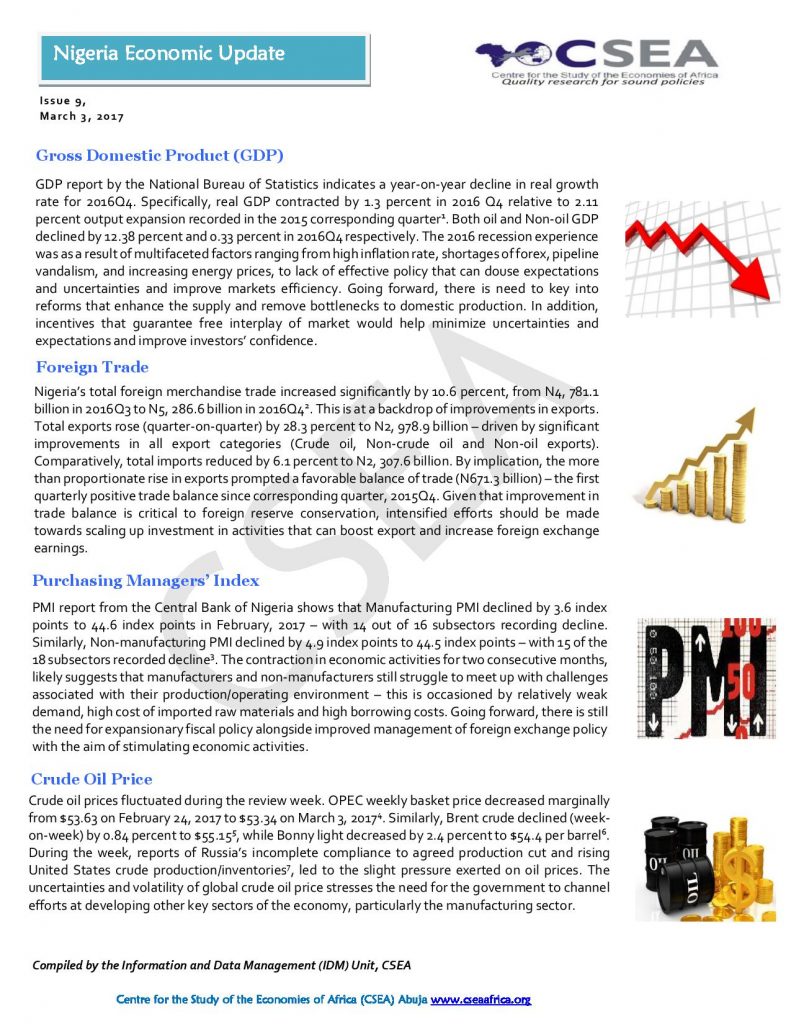
Crude oil prices fluctuated during the review week. OPEC weekly basket price decreased marginally from $53.63 on February 24, 2017 to $53.34 on March 3, 2017. Similarly, Brent crude declined (week-on-week) by 0.84 percent to $55.15, while Bonny light decreased by 2.4 percent to $54.4 per barrel. During the week, reports of Russias incomplete compliance to agreed production cut and rising United States crude production/inventories, led to the slight pressure exerted on oil prices. The uncertainties and volatility of global crude oil price stresses the need for the government to channel efforts at developing other key sectors of the economy, particularly the manufacturing sector.
Read More Download PDF

Nigeria Economic Update (Issue 8)

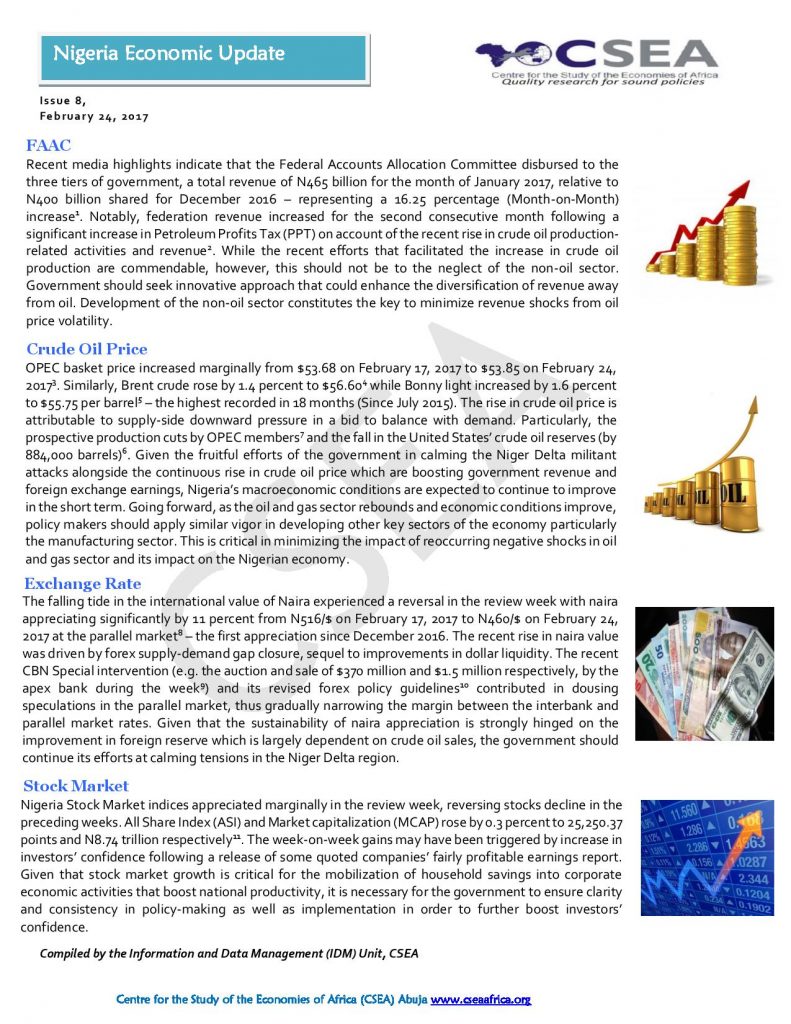
The falling tide in the international value of Naira experienced a reversal in the review week with naira appreciating significantly by 11 percent from N516/$ on February 17, 2017 to N460/$ on February 24, 2017 at the parallel market the first appreciation since December 2016. The recent rise in naira value was driven by forex supply-demand gap closure, sequel to improvements in dollar liquidity. The recent CBN Special intervention (e.g. the auction and sale of $370 million and $1.5 million respectively, by the apex bank during the week) and its revised forex policy guidelinescontributed in dousing speculations in the parallel market, thus gradually narrowing the margin between the interbank and parallel market rates. Given that the sustainability of naira appreciation is strongly hinged on the improvement in foreign reserve which is largely dependent on crude oil sales, the government should continue its efforts at calming tensions in the Niger Delta region.
Read More Download PDF

Africa Economic Update (Issue 1)

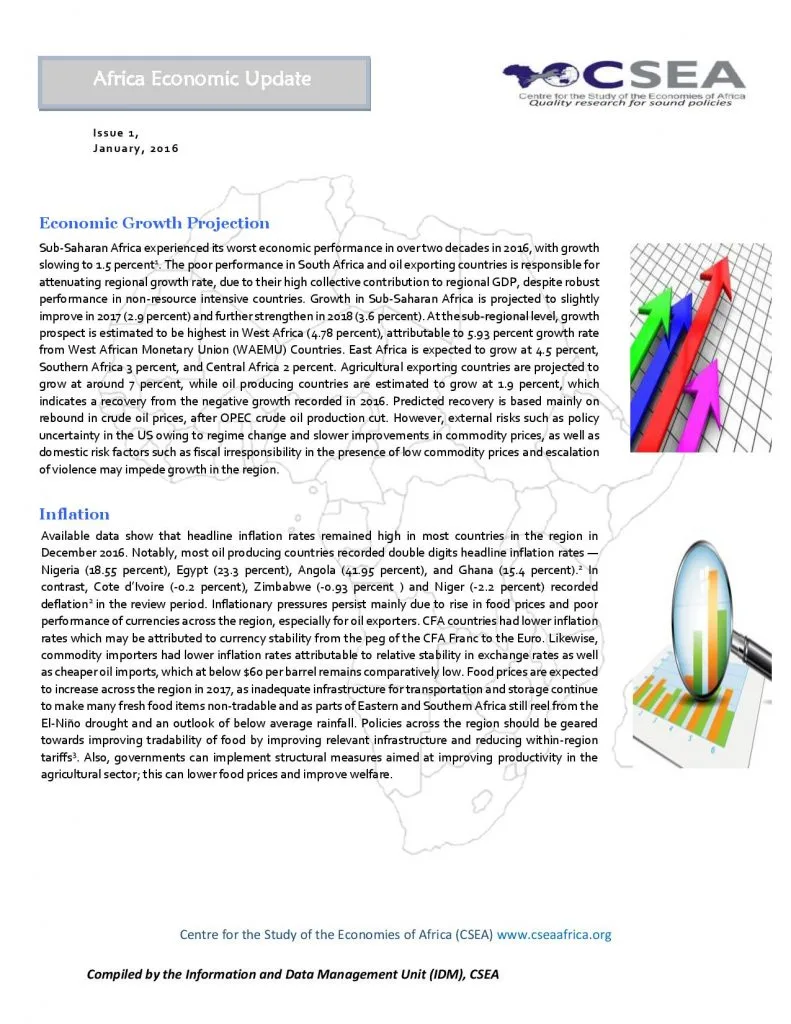
Sub-Saharan Africa experienced its worst economic performance in over two decades in 2016, with growth slowing to 1.5 percent. The poor performance in South Africa and oil exporting countries is responsible for attenuating regional growth rate, due to their high collective contribution to regional GDP, despite robust performance in non-resource intensive countries. Growth in Sub-Saharan Africa is projected to slightly improve in 2017 (2.9 percent) and further strengthen in 2018 (3.6 percent). At the sub-regional level, growth prospect is estimated to be highest in West Africa (4.78 percent), attributable to 5.93 percent growth rate from West African Monetary Union (WAEMU) Countries. East Africa is expected to grow at 4.5 percent, Southern Africa 3 percent, and Central Africa 2 percent. Agricultural exporting countries are projected to grow at around 7 percent, while oil producing countries are estimated to grow at 1.9 percent, which indicates a recovery from the negative growth recorded in 2016.
Read More Download PDF