Macroeconomic Report & Economic Updates

  • Home
  • Macroeconomic Report & Economic Updates

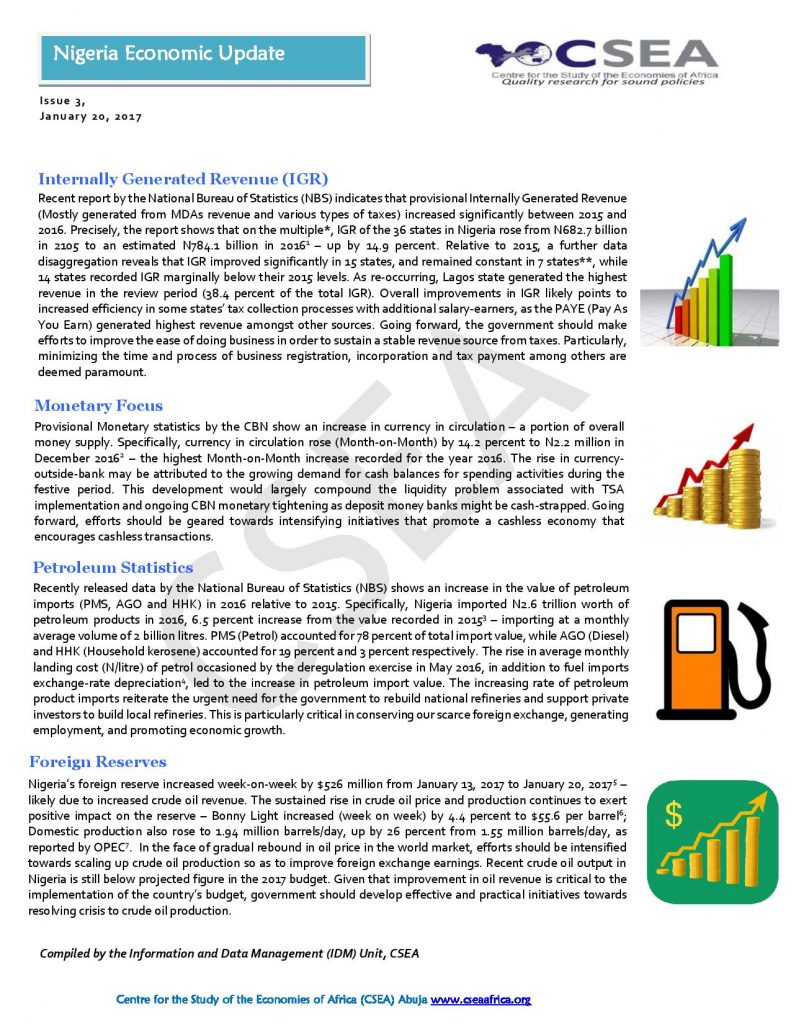
Nigeria Economic Update (Issue 3)

Provisional Monetary statistics by the CBN show an increase in currency in circulation a portion of overall money supply. Specifically, currency in circulation rose (Month-on-Month) by 14.2 percent to N2.2 million in December 2016  the highest Month-on-Month increase recorded for the year 2016. The rise in currency- outside-bank may be attributed to the growing demand for cash balances for spending activities during the festive period. This development would largely compound the liquidity problem associated with TSA implementation and ongoing CBN monetary tightening as deposit money banks might be cash-strapped. Going forward, efforts should be geared towards intensifying initiatives that promote a cashless economy that encourages cashless transactions.
Read More Download PDF

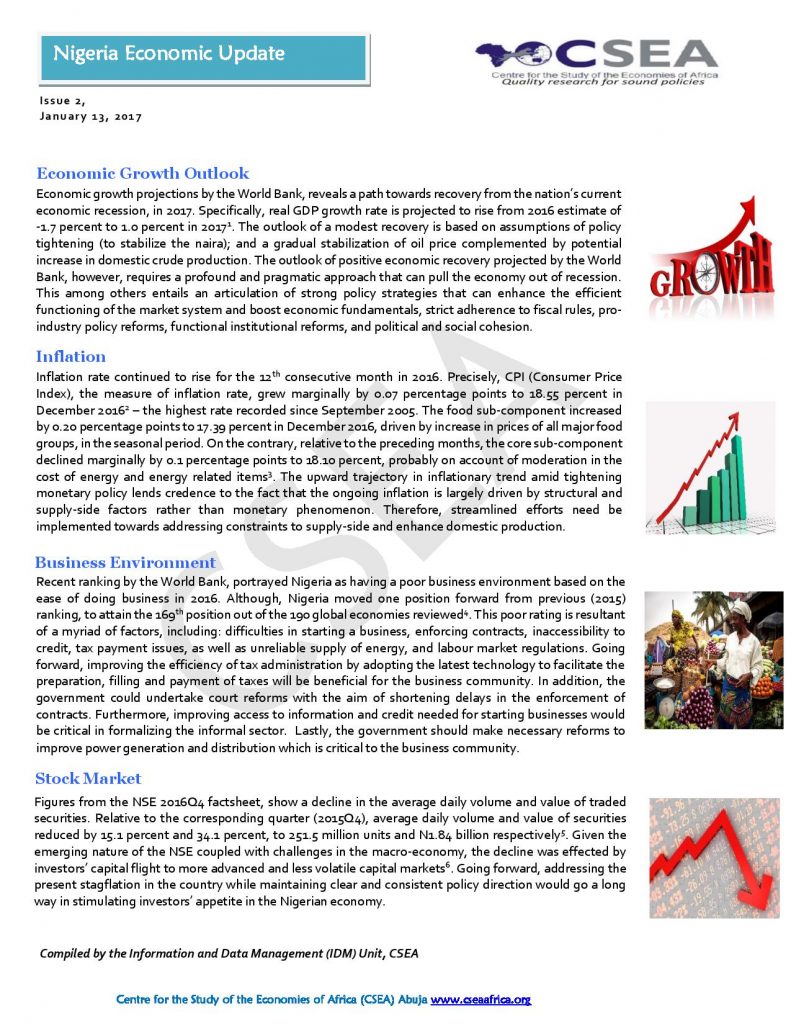
Nigeria Economic Update (Issue 2)

Recent ranking by the World Bank, portrayed Nigeria as having a poor business environment based on the ease of doing business in 2016. Although, Nigeria moved one position forward from previous (2015) ranking, to attain the 169th position out of the 190 global economies reviewed4. This poor rating is resultant of a myriad of factors, including: difficulties in starting a business, enforcing contracts, inaccessibility to credit, tax payment issues, as well as unreliable supply of energy, and labour market regulations. Going forward, improving the efficiency of tax administration by adopting the latest technology to facilitate the preparation, filling and payment of taxes will be beneficial for the business community.
Read More Download PDF

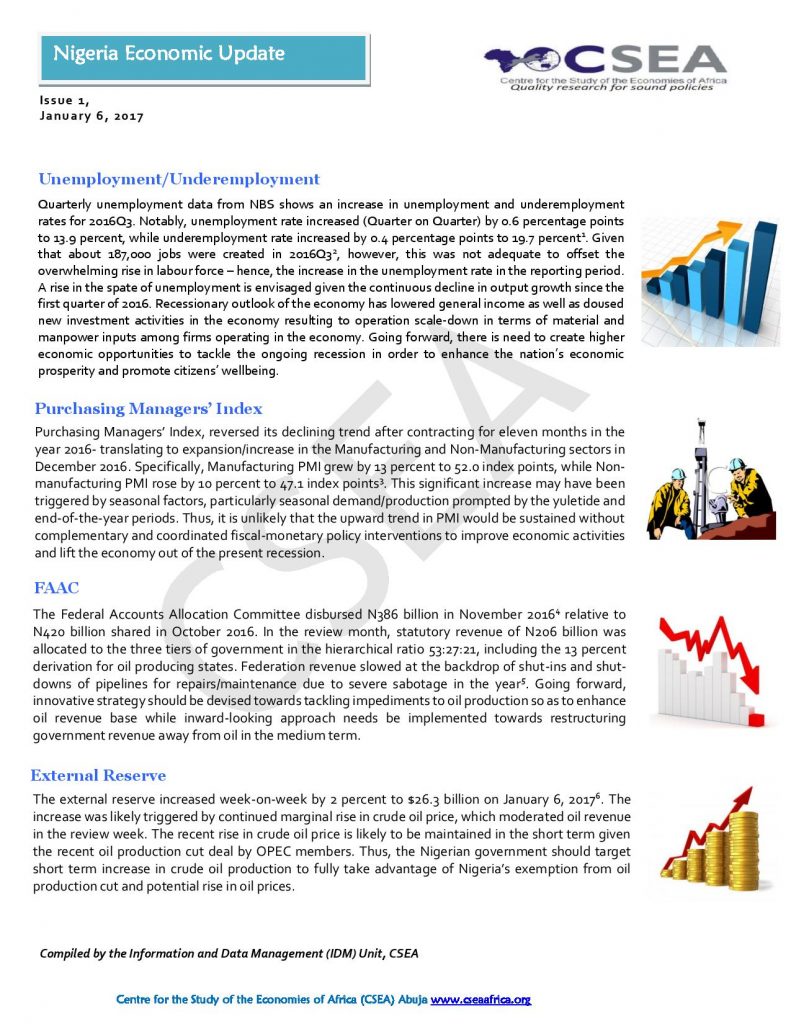
Nigeria Economic Update (Issue 1)

The external reserve increased week-on-week by 2 percent to $26.3 billion on January 6, 2017. The increase was likely triggered by continued marginal rise in crude oil price, which moderated oil revenue in the review week. The recent rise in crude oil price is likely to be maintained in the short term given the recent oil production cut deal by OPEC members. Thus, the Nigerian government should target short term increase in crude oil production to fully take advantage of Nigerias exemption from oil production cut and potential rise in oil prices.
Read More Download PDF

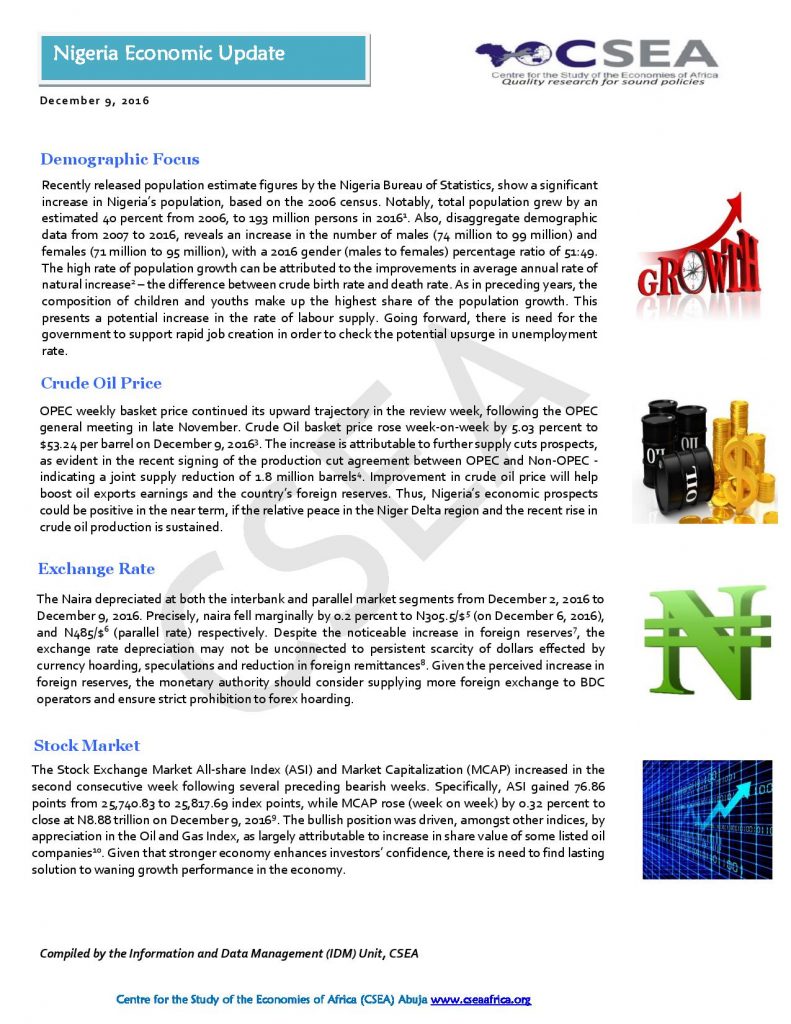
Nigeria Economic Update (Issue 52)

Recently released population estimate figures by the Nigeria Bureau of Statistics, show a significant increase in Nigerias population, based on the 2006 census. Notably, total population grew by an estimated 40 percent from 2006, to 193 million persons in 2016. Also, disaggregate demographic data from 2007 to 2016, reveals an increase in the number of males (74 million to 99 million) and females (71 million to 95 million), with a 2016 gender (males to females) percentage ratio of 51:49. The high rate of population growth can be attributed to the improvements in average annual rate of natural increase the difference between crude birth rate and death rate. As in preceding years, the composition of children and youths make up the highest share of the population growth. This presents a potential increase in the rate of labour supply. Going forward, there is need for the government to support rapid job creation in order to check the potential upsurge in unemployment rate.
Read More Download PDF

Nigeria Economic Update (Issue 51)

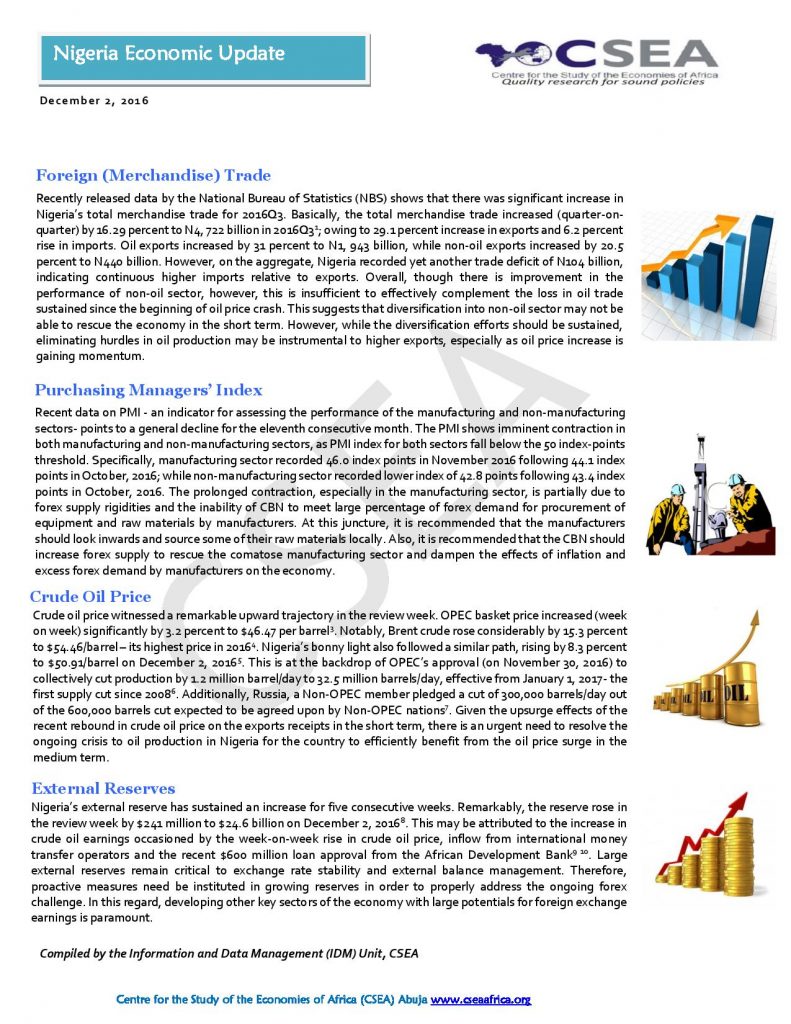
Recently released data by the National Bureau of Statistics (NBS) shows that there was significant increase in Nigerias total merchandise trade for 2016Q3. Basically, the total merchandise trade increased (quarter-on-quarter) by 16.29 percent to N4, 722 billion in 2016Q3;owing to 29.1 percent increase in exports and 6.2 percent rise in imports. Oil exports increased by 31 percent to N1, 943 billion, while non-oil exports increased by 20.5 percent to N440 billion. However, on the aggregate, Nigeria recorded yet another trade deficit of N104 billion, indicating continuous higher imports relative to exports. Overall, though there is improvement in the performance of non-oil sector, however, this is insufficient to effectively complement the loss in oil trade sustained since the beginning of oil price crash. This suggests that diversification into non-oil sector may not be able to rescue the economy in the short term. However, while the diversification efforts should be sustained, eliminating hurdles in oil production may be instrumental to higher exports, especially as oil price increase is gaining momentum.
Read More Download PDF