Publications

Brazil’s President Visit to Nigeria and Implications for the BRICS

The visit culminated in the signing of a Memorandum of Understanding (MoU) and the setting up of the Nigeria-Brazil Bi-national Commission with the aim of boosting trade and economic activities between the two countries
Read More

Nigeria Economic Update (Issue 5)

Recently released media highlights show that Nigeria has dropped in terms of macroeconomic indicator rankings in 2018. With a headline index of 2.77, Nigeria is ranked 158th globally out of 181 countries five places lower than the previous year rankings. Indicators suggest that Nigeria is presently behind 28 other African countries, and just ahead of only 4 West African countries (Mauritania, Togo, Niger and Guinea Bissau). 
Read More Download PDF

Nigeria Economic Update (Issue 8)

Global benchmark crude, Brent, sold for $66.43 per barrel, a little above 3.4 percent from the $64. 3 per barrel in the preceding week. Nigeria’s Bonny light exchanged for $65.71 per barrel. Global Crude supply levels have been constrained by a dip in Libya’s production, following the shutdown of the El Feel oilfield in Libya, which produces 70,000 bpd. This is complemented by the continued compliance by OPEC member countries to curb production levels, thus rebalancing the global crude oil market and gradually driving prices upwards.  
Read More Download PDF

Nigeria Economic Update (Issue 4)

Recently released labour force report by the NBS shows a quarter-over-quarter increase in Nigerias working age and labour force population. Working population rose from 110.29 million in 2017Q2, to 111.13 million persons in 2017Q32. The working age population in 2017Q3 constituted 85.08 million persons in the labour force (an increase from 83.94 million), of which 40 percent were either unemployed or underemployed.  Thus, total employed persons in the quarter reached 69.1 million.
Read More Download PDF

Nigeria Economic Update (Issue 3)

Recently released inflation rate report by the NBS shows a further decline in consumer price index in December 2017. At 15.37 percent, the CPI was 0.53 percentage points lower than the 15.90 percent recorded in November 2017. The food sub-index decreased to 19.42 percent from 20.21 percent, indicating reduced pressure on food prices in the review period. Core sub-index fell slightly to 12.1 percent from 12.21 percent in the preceding month. Going forward, the ability of the Central Bank of Nigeria (CBN) to control inflation in 2018 may be hampered by monetary injections by the government and politicians towards budgetary expenditure and election campaigns, respectively.
Read More Download PDF

Nigeria Economic Update (Issue 2)

International rating body, Fitch, has projected higher economic growth for Nigeria in 2018. The body estimated that Nigerias economy will grow by 2.6 percent, slightly higher compared to projections from the International Monetary Fund (2.1 percent) and The World Bank (1 percent). A myriad of factors may have driven the projected increase: improved availability of forex for the non-oil sector, higher government capital expenditure capability driven by more oil revenue, and fiscal stimulus. However, the relatively strong economic growth projected by Fitch and IMF may be hampered
Read More Download PDF

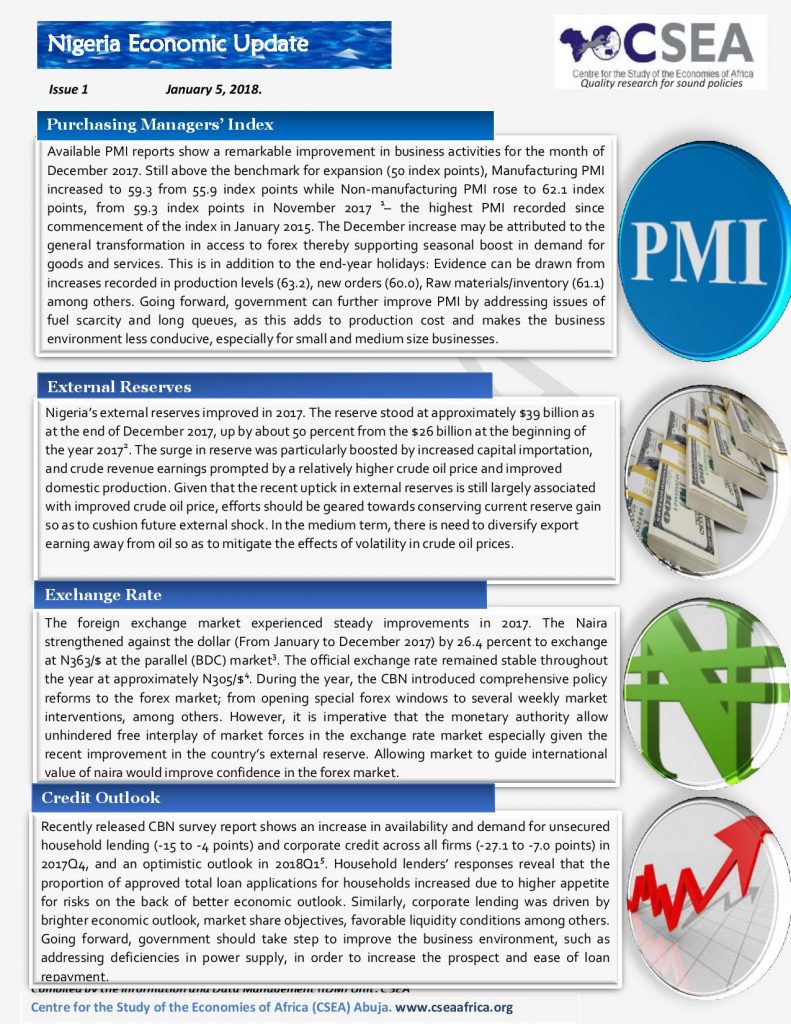
Nigeria Economic Update (Issue 1)

Nigerias external reserves improved in 2017. The reserve stood at approximately $39 billion as at the end of December 2017, up by about 50 percent from the $26 billion at the beginning of the year 20172. The surge in reserve was particularly boosted by increased capital importation, and crude revenue earnings prompted by a relatively higher crude oil price and improved domestic production. Given that the recent uptick in external reserves is still largely associated with improved crude oil price, efforts should be geared towards conserving current reserve gain so as to cushion future external shock. In the medium term, there is need to diversify export earning away from oil so as to mitigate the effects of volatility in crude oil prices.
Read More Download PDF

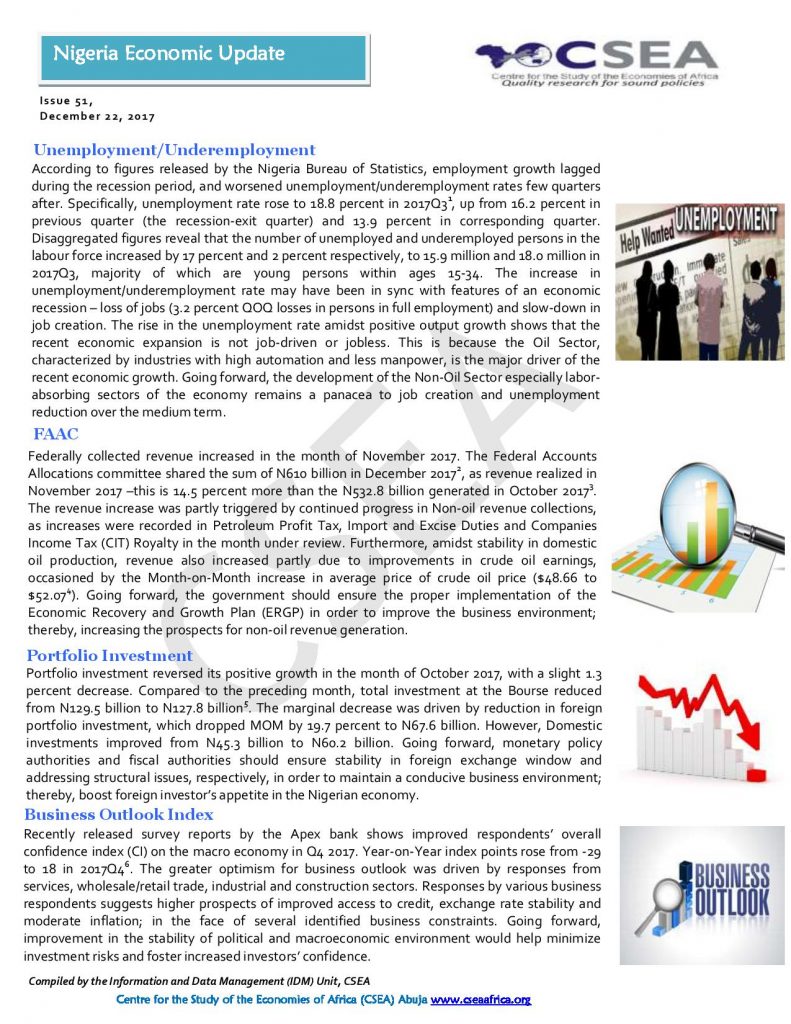
Nigeria Economic Update (Issue 51)

According to figures released by the Nigeria Bureau of Statistics, employment growth lagged during the recession period, and worsened unemployment/underemployment rates few quarters after. Specifically, unemployment rate rose to 18.8 percent in 2017Q31, up from 16.2 percent in previous quarter (the recession-exit quarter) and 13.9 percent in corresponding quarter. Disaggregated figures reveal that the number of unemployed and underemployed persons in the labour force increased by 17 percent and 2 percent respectively, to 15.9 million and 18.0 million in 2017Q3, majority of which are young persons within ages 15-34. 
Read More Download PDF

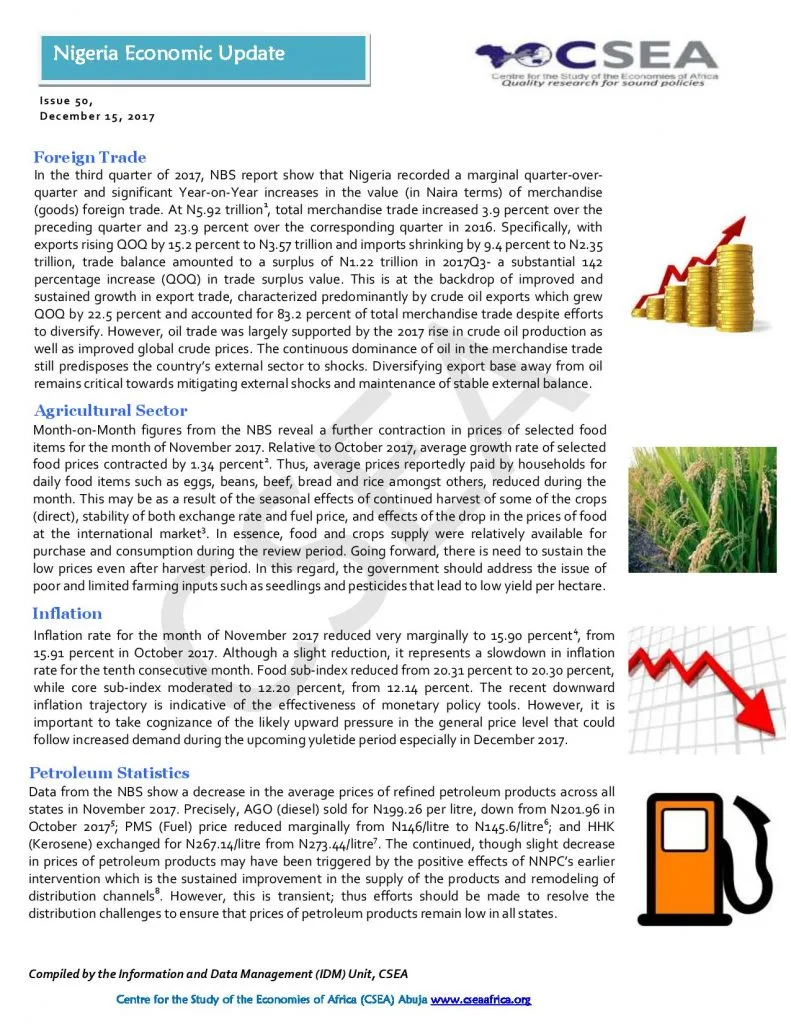
Nigeria Economic Update (Issue 50)

In the third quarter of 2017, NBS report show that Nigeria recorded a marginal quarter-overquarter and significant Year-on-Year increases in the value (in Naira terms) of merchandise (goods) foreign trade. At N5.92 trillion, total merchandise trade increased 3.9 percent over the preceding quarter and 23.9 percent over the corresponding quarter in 2016. Specifically, with exports rising QOQ by 15.2 percent to N3.57 trillion and imports shrinking by 9.4 percent to N2.35 trillion, trade balance amounted to a surplus of N1.22 trillion in 2017Q3- a substantial 142 percentage increase (QOQ) in trade surplus value.
Read More Download PDF