The Nigerian Exchange (NGX) weekly report for January 16, 2026, showed that the NGX All-Share Index (ASI) rose by 2.36%, closing at 166,129.50 points, while market capitalisation increased by 2.48% to ₦106.354 trillion. The gain signifies strong market activity and increased participation in equities and exchange-traded products. Furthermore, investors traded a total of 4.607 billion shares, valued at ₦130.636 billion, across 263,439 deals in the week under review, up from 4.164 billion shares worth ₦94.026 billion in 248,254 deals recorded in the preceding week. The financial services sector led the activity chart, accounting for 3.126 billion shares valued at ₦47.2 billion across 94,186 deals, contributing 67.8% to the total equity turnover volume and 36.2% to the total equity turnover value. The services sector followed with 353.4 million shares worth ₦5.1 billion in 17,764 deals, while the ICT sector came third with 277.3 million shares valued at ₦18.0 billion across 28,525 deals. The rise in equities indicates that investors are regaining confidence in the market, likely driven by expectations of stable economic conditions and strong corporate earnings. To build on the positive market momentum, policymakers should ensure well communicated monetary and fiscal policies, enhance transparency in corporate reporting, and strengthen investor protection measures. Proactive steps in these areas will help sustain market confidence, encourage broader participation, and attract long-term capital to the equity market.
Nigeria's GDP growth in 2025 shows a clear upward trend, rising from 3.13% in Ql to 4.23% in Q2, before moderating to 3.98% in Q3, which is 0.12 percentage points higher than Q3 2024.This sustained growth was driven mainly by the non-oil sector, which accounted for over 96% of real output, with sector wide gains in agriculture, industry, and services. This growth rate aligns IMF's October 2025 upward revision of Nigeria's GDP growth forecast to 3.9% in 2025 and 4.2°k in 2026, supported by improved oil production, stronger investor confidence, and a more supportive fiscal stance. However, persistent inflation and structural bottlenecks in the power, transport and security sectors highlight the need for diversification into manufacturing, agriculture and digital services, alongside macroeconomic and regulatory reforms to sustain economic recovery.
The study explores the Tourism-led-growth Hypothesis (TLGH) with a focus on spiritual tourism and economic growth in Saudi Arabia. Using the Generalised Method of Moments (GMM) for 28 years of annual data, we evaluated the impact of religious tourism on economic growth in the presence of structural breaks. Our analysis yielded promising results; thus, we make 4 important contributions to the literature. First, we establish the presence of a positive relationship between spiritual tourism and economic growth across all our models. Second, we discover that domestic pilgrimage in Saudi Arabia is a modest contributor to economic growth compared with international pilgrimage. Third, we demonstrate the importance of a structural break in modelling the relationship between the two major variables, spiritual tourism and economic growth. Finally, we show that capital formation in Saudi Arabia’s economy is largely from foreign pilgrims. The findings of our study have remarkable significance for both investors and policy makers within and outside Saudi Arabia.
According to the National Bureau of Statistics (NBS), the Federation Account Allocation Committee (FAAC) disbursed a total of ₦2.93 trillion to the three tiers of government in November 2025 from the total revenue generated in October 2025. This comprised ₦2.16 trillion from the Statutory Account, ₦49.87 billion from Electronic Money Transfer Levy (EMTL), and ₦719.83 billion from Value Added Tax (VAT). Of the total allocation, the federal government received ₦758.41 billion, state governments ₦689.12 billion, and local governments ₦505.80 billion, while ₦141.39 billion was distributed to oil-producing states from the 13% derivation fund. These allocations reveal that effective revenue mobilisation and timely disbursement are essential for sustaining public service delivery. However, boosting internal revenue mobilisation is very crucial at the subnational level to reduce dependence on FAAC, as most states are largely dependent on FAAC. Thus, there is a need to create an enabling environment for businesses in states to attract investment, which will translate to more tax revenue mobilised at the state and local government levels. To consolidate the current gains in revenue mobilisation, policymakers should strengthen revenue collection efficiency through the digitalisation of tax processes, enhance transparency, and expand non-oil revenue sources. Ensuring there is improved fiscal planning will help stabilise both national and subnational finances, which will support development initiatives across the federation.
Data from the Nigerian Foreign Exchange Market (NFEM), published by the Central Bank of Nigeria (CBN), showed that the naira appreciated by 7.4% in 2025.
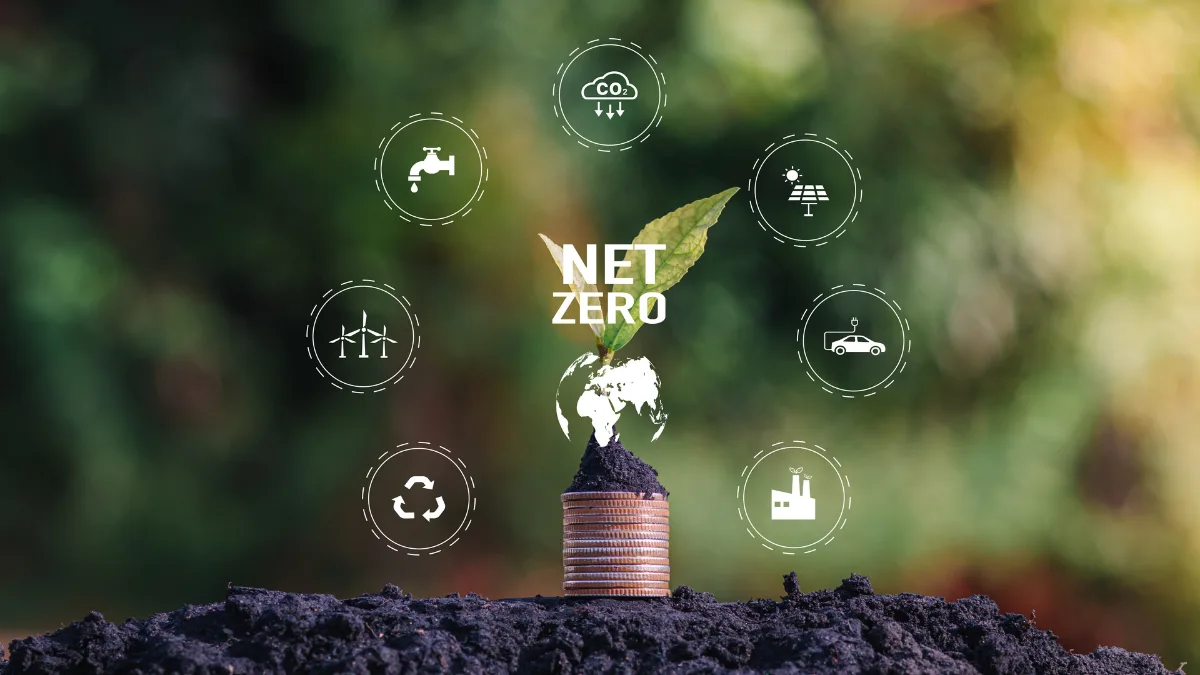
A compelling global consensus has formed around achieving Net-Zero emissions as the indispensable framework for collective climate action. This framework, which aims to balance greenhouse gases emitted with those removed from the atmosphere, is grounded in the Paris Agreement's objective of limiting global temperature rise to well below 2°C. It provides a common language and a set of quantifiable targets that shape national policy, international finance, and corporate strategy. The urgency for this framework is clear: between 1990 and 2023, annual energy-related CO₂ emissions surged from 20.5 to 37.3 gigatonnes, with the global per capita average standing at 4.67 tonnes in 2023.
Author: Ezra Ihezie
In Nigeria’s secondary schools, students are typically grouped into one of three subject streams: Science and Technology (Sciences), Humanities (Arts), or Business Studies (Social Sciences). This grouping is typically done at the start of senior secondary school. The system is intended to align students’ education with their intended career paths, ensuring they take subjects required for national examinations, such as the West African Senior School Certificate Examination (WASSCE) and the Unified Tertiary Matriculation Examination (UTME). However, this well-intentioned structure can inadvertently narrow learning opportunities. A prominent example is that students placed in the Social Sciences stream who hope to study Economics at university are often unable to take Further Mathematics, a course where calculus, a fundamental skill for advanced Economics, is first introduced. This results in a likely gap in mathematical preparedness that scholars have called “the mathematics problem”. This challenge is not unique to Nigeria; many Economics students worldwide report being unprepared for the level of mathematical rigour required in their programmes. Evidence from the Economics Network Student Survey in Scotland, for instance, revealed that over 80% of students found their Economics degree involved far more mathematics than they had anticipated. Globally, studies have shown that a robust mathematical background acquired during secondary school is a crucial predictor of academic success and retention for students pursuing Economics at university. For instance, a study in Spain found that students from the Technological stream, which offers Advanced Mathematics, including more extensive math concepts and geometry modules, outperformed their peers from the Social Sciences stream at university, despite being the recommended stream for Economics Business students in secondary school. Similarly, research at the Erasmus School of Economics in the Netherlands demonstrated that science-preparatory students with strong math foundations achieved higher first-year credit attainment (45% vs. 30%) and lower dropout rates (under 25% vs. 45%) compared to non-science students. Collectively, these studies emphasise the essential role of advanced mathematics instruction at the secondary level in enhancing students’ academic outcomes in university Economics programs.
Authors: Obiageli (Oby) Ekwunwa, Adejo Moses Adejo, Chinecherem Jacinta Orji
Can the Chinese economy still be driven by exports in the face of global shocks? This research question is explored in this brief study. Economists and public policy analysts widely asserted that China’s economic growth and development were built on a strong foundation of the export-oriented manufacturing sector (Johnston, 2024). Precisely, China embarked on the mission of export-led growth in the 1980s, marked by a series of economic reforms such as trade liberalisation (particularly joining the World Trade Organization [WTO] in 2001), the reindustrialisation process around 2004 and the processing of export goods (Yao, 2014). However, concerns have emerged about whether the Chinese economy can continue to rely on exports as its primary driver in the years ahead. Roubini (2024) argues that China’s export-led growth model has broken down. He provides a reason for this development. He notes that after three decades of robust economic expansion, during which the economy grew at an average annual rate of 10%, China’s growth has slowed significantly. Currently, the growth rate hovers around 5% and the International Monetary Fund projects that it could decline further to approximately 3.4% by 2028 [1]. Roubini attributes this economic outlook to structural, rather than cyclical problems. These include an ageing population, a collapsed real estate bubble, massive overhangs of private and public debt and a marked shift away from market-oriented reforms back to state capitalism.
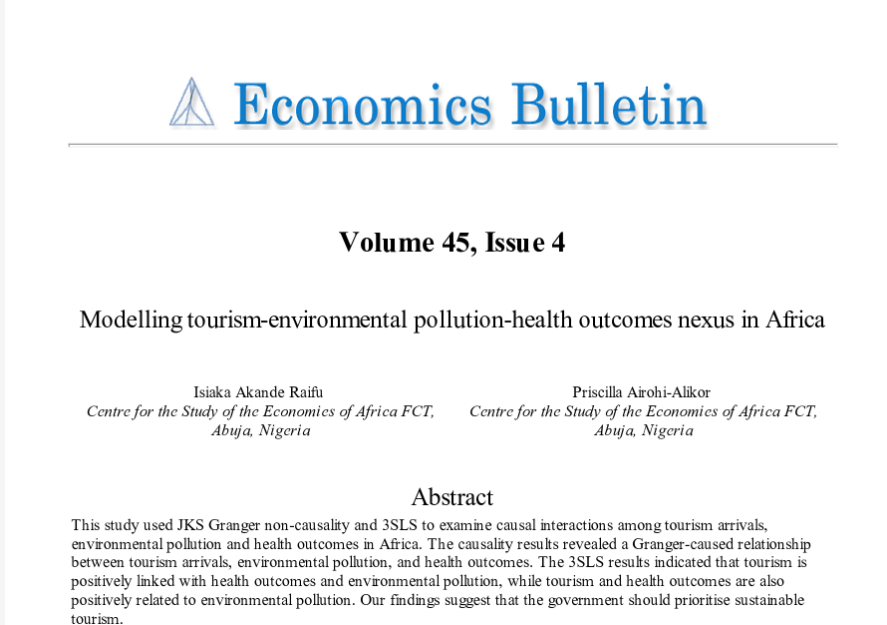
This study used JKS Granger non-causality and 3SLS to examine causal interactions among tourism arrivals, environmental pollution and health outcomes in Africa. The causality results revealed a Granger-caused relationship between tourism arrivals, environmental pollution, and health outcomes. The 3SLS results indicated that tourism is positively linked with health outcomes and environmental pollution, while tourism and health outcomes are also positively related to environmental pollution. Our findings suggest that the government should prioritise sustainable tourism.