Publications

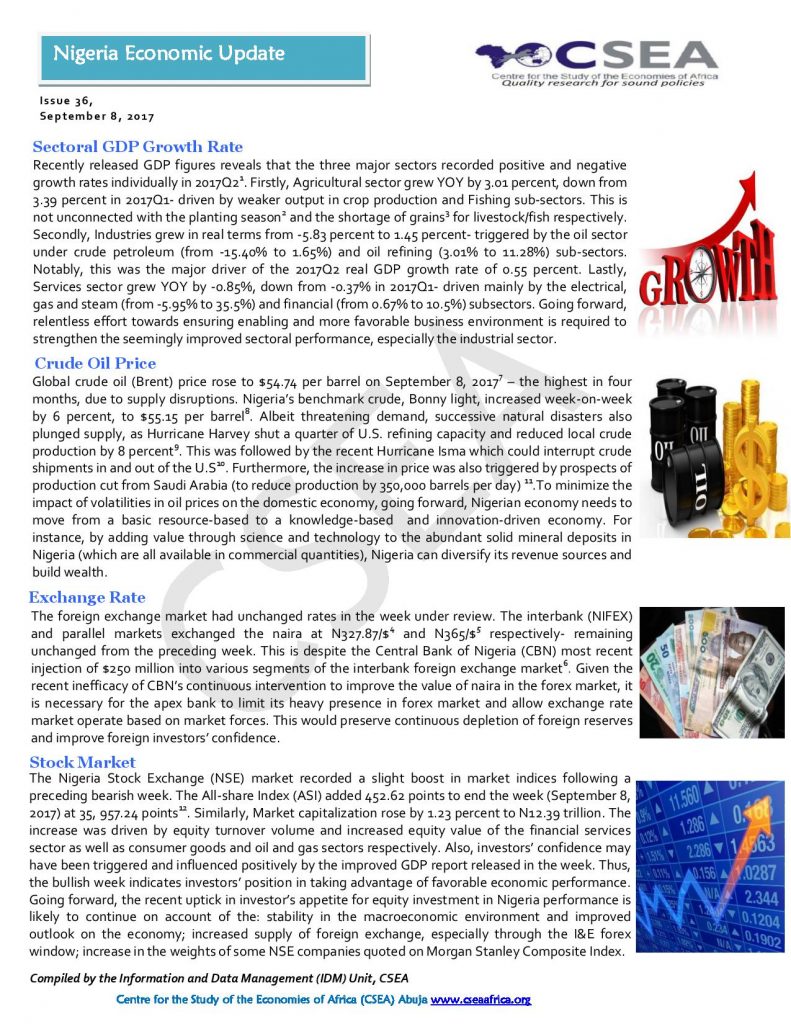
Nigeria Economic Update (Issue 36)

Recently released GDP figures reveals that the three major sectors recorded positive and negative growth rates individually in 2017Q2. Firstly, Agricultural sector grew Year on Year by 3.01 percent, down from 3.39 percent in 2017Q1- driven by weaker output in crop production and Fishing sub-sectors. This is not unconnected with the planting season and the shortage of grainsfor livestock/fish respectively.
Read More Download PDF

Nigeria Economic Review

The global economy grew by 2.7 percent in the fourth quarter of 2016 (2016Q4) relative to 2.5 percent in 2016Q3, due to rising investment and consumption demands in developed and emerging economies as well as a rise in commodity prices. However, over the entire year, global GDP growth stood at 2.6 percent in 2016, relative to the growth of 3.09 percent recorded in 2015. Notably, output grew progressively in the US over the year, while the steady growth recorded in the UK since the start of the year stalled in 2016Q4. Also, the declining growth recorded in France since 2015 took a positive turn in 2016Q4, the rest of the Eurozone witnessed a fall in output in the quarter. While emerging economies recorded mixed experiences, many Sub-Saharan African countries showed signs of recovery in the period.
Read More Download PDF

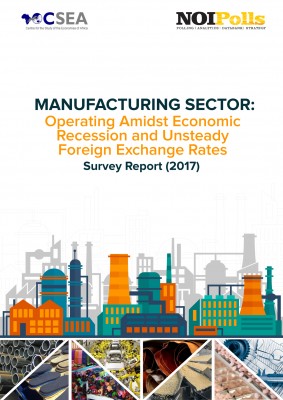
MANUFACTURING SECTOR: Operating Admist Economic Recession And Rising Foreign Exchange Rates

This 2017 Manufacturing Sector survey provides an assessment of the Nigerian manufacturing sector, highlighting the key challenges facing operators within the sector. It also examines the dynamics and major development in the manufacturing sector over the last one year. Overall, the objective of the report is to provide a snapshot of the manufacturing sector in Nigeria, which will provide a framework for policy intervention by policymakers
Read More Download PDF

Nigeria Is Out Of Recession But Not Out Of The Woods Yet

The good news coming out of Nigeria is that the economy has finally exited its worst recession in 29 years. After five quarters of negative growth, the economy grew by 0.55% in the second quarter of 2017
Read More

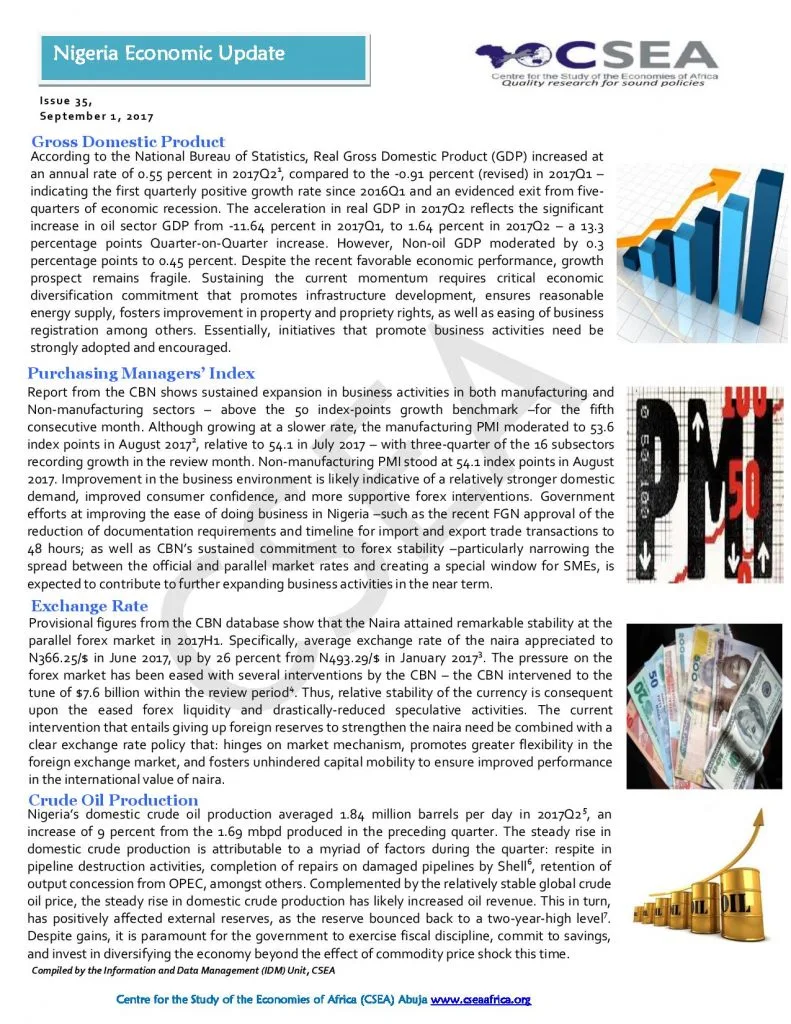
Nigeria Economic Update (Issue 35)

Nigeria's Real Gross Domestic Product (GDP) increased at an annual rate of 0.55 percent in 2017Q21, compared to the -0.91 percent (revised) in 2017Q1 indicating the first quarterly positive growth rate since 2016Q1 and an evidenced exit from five quarters of economic recession. The acceleration in real GDP in 2017Q2 reflects the significant increase in oil sector GDP from -11.64 percent in 2017Q1, to 1.64 percent in 2017Q2 a 13.3 percentage points Quarter-on-Quarter increase. However, Non-oil GDP moderated by 0.3 percentage points to 0.45 percent. Despite the recent favorable economic performance, growth prospect remains fragile.


Read More Download PDF

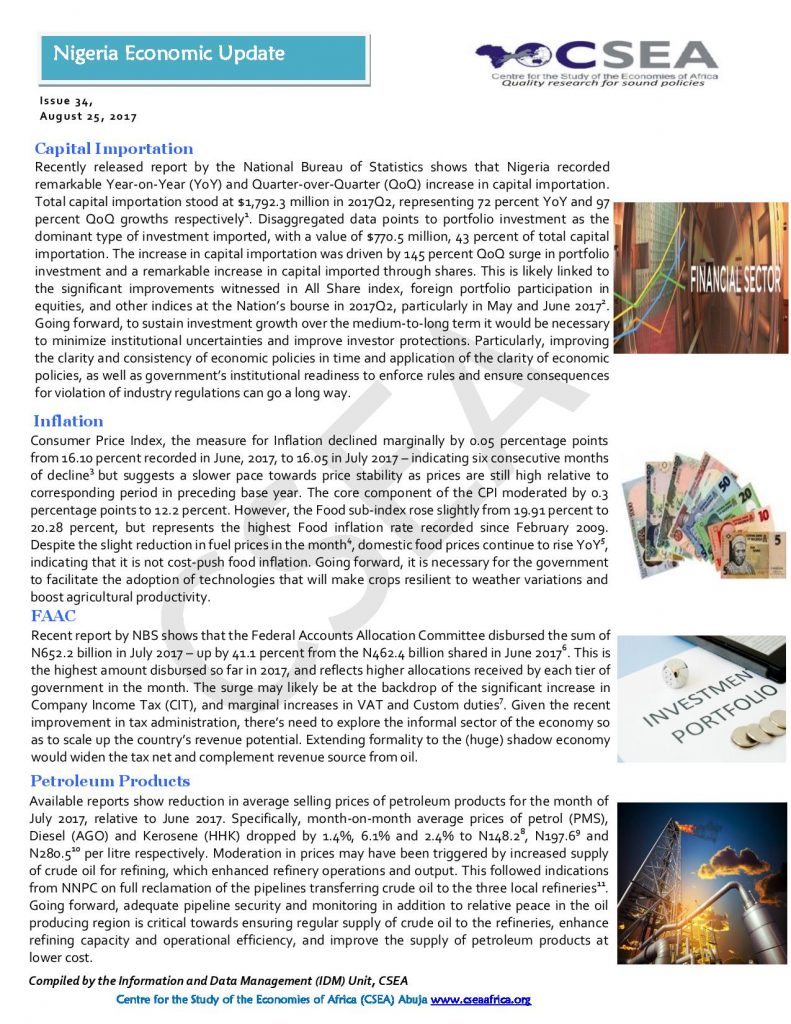
Nigeria Economic Update (Issue 34)

Recently released report by the National Bureau of Statistics shows that Nigeria recorded remarkable Year-on-Year (YoY) and Quarter-over-Quarter (QoQ) increase in capital importation. Total capital importation stood at $1,792.3 million in 2017Q2, representing 72 percent YoY and 97 percent QoQ growths respectively. Disaggregated data points to portfolio investment as the dominant type of investment imported, with a value of $770.5 million, 43 percent of total capital importation. The increase in capital importation was driven by 145 percent QoQ surge in portfolio investment and a remarkable increase in capital imported through shares.
Read More Download PDF

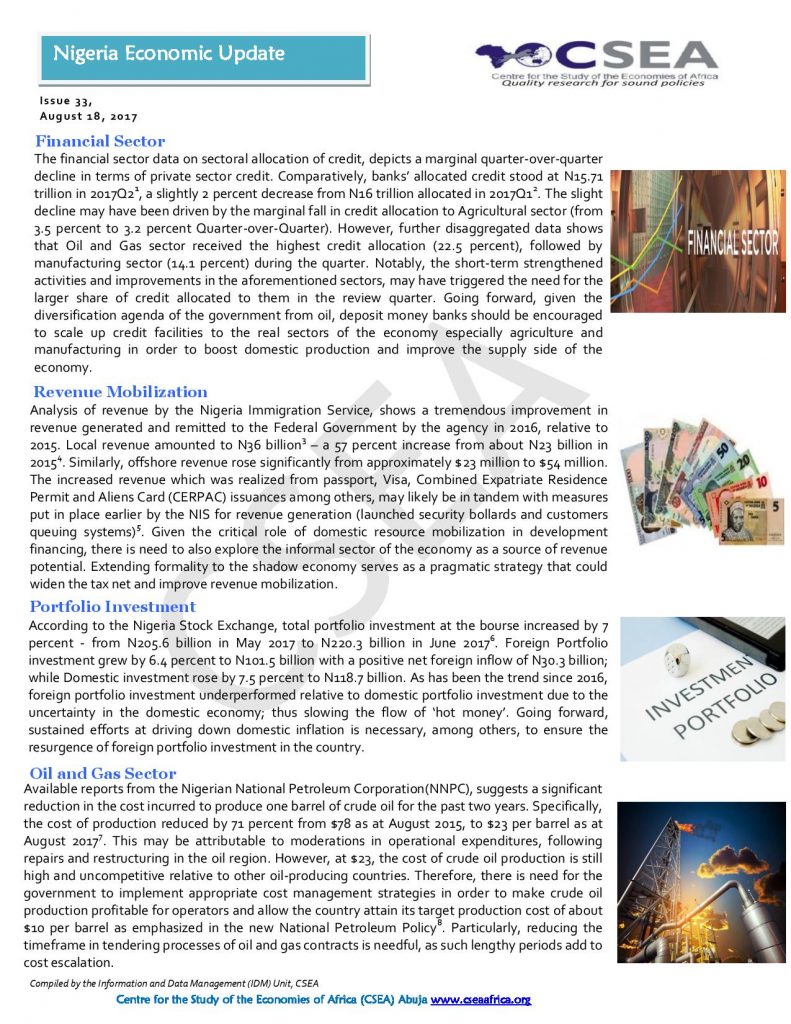
Nigeria Economic Update (Issue 33)

Available reports from the Nigerian National Petroleum Corporation(NNPC), suggests a significant reduction in the cost incurred to produce one barrel of crude oil for the past two years. Specifically, the cost of production reduced by 71 percent from $78 as at August 2015, to $23 per barrel as at August 2017. This may be attributable to moderations in operational expenditures, following repairs and restructuring in the oil region.
Read More Download PDF

CSEA ANNUAL REPORT

CSEA has continued in its tradition of providing rigorous and relevant evidence-based research that is used to inform policies in Nigeria. To provide timely and relevant evidence-based research on Nigeria‟s economy, the Centre established the Information and Data Management Unit (IDM). The main objective of this Unit is to collate qualitative and quantitative data and provide periodic analysis on Nigeria‟s economy. The unit consists of a Research Associate, Research Assistants and Communications officer. The team produces a weekly update of recent happenings in the economy under CSEA‟s thematic research areas.

Read More Download PDF Download PDF

An Analysis Of The Nigerian Economic Growth And Recovery Plan

This Paper examines the response of the Nigerian government to the ongoing recession in the domestic economy, particularly in the context of the recently released Economic Recovery and Growth Plan (ERGP) for 2017-2020. It also provides an analysis of key questions regarding the suitability, achievability, and prospect of the ERGP. The second section of the brief runs through the state of the Nigerian economy with a focus on the cause and drivers of the ongoing recession. The third section reviews the objectives, implementation strategy, and expected outcomes of the ERGP over the medium-term. The fourth section weighs on the potentials of the ERGP by analyzing some pertinent questions: Is the proposed recovery plan and policies well-targeted to address prevailing economic crises in Nigerian economy? 
Read More Download PDF