Publications

Follow via RSS

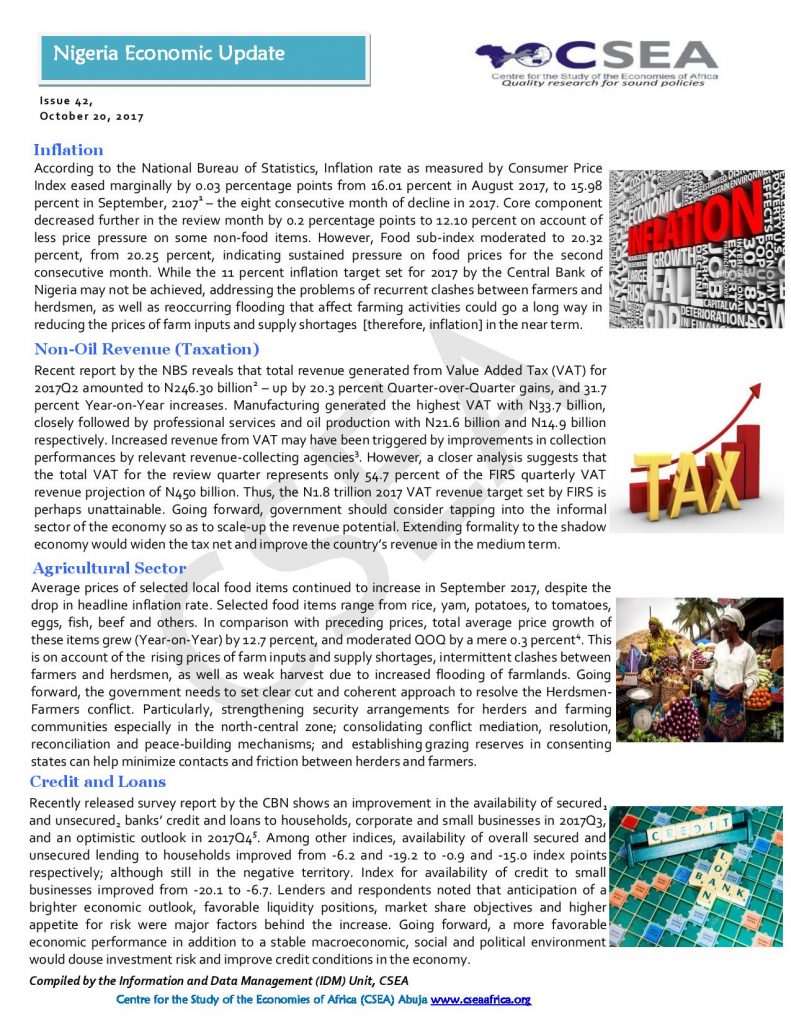
Nigeria Economic Update (Issue 42)

Recently released survey report by the CBN shows an improvement in the availability of secured and unsecured banks credit and loans to households, corporate and small businesses in 2017Q3, and an optimistic outlook in 2017Q4. Among other indices, availability of overall secured and unsecured lending to households improved from -6.2 and -19.2 to -0.9 and -15.0 index points respectively; although still in the negative territory. Index for availability of credit to small businesses improved from -20.1 to -6.7. Lenders and respondents noted that anticipation of a brighter economic outlook, favorable liquidity positions, market share objectives and higher appetite for risk were major factors behind the increase. 
Read More Download PDF

CSEA ANNUAL REPORT

As Nigeria is currently witnessing an economic and fiscal crisis, the need for evidence-based and timely research to guide policymakers in making informed decisions have become ever more useful.  CSEA,  as  a  leading  think  tank in  Africa, with proximity to policymakers in the capital city of  Abuja,  is  increasingly  repositioning  itself  to track and   analyse   key   developments   in   the Nigerian economy, and provide actionable recommendations. Thus the centre has strengthened its organizational structure, research capacity and quality, as well as its dissemination strategy to ensure that policy-relevant research is continuously channeled into the policy space

Read More Download PDF Download PDF

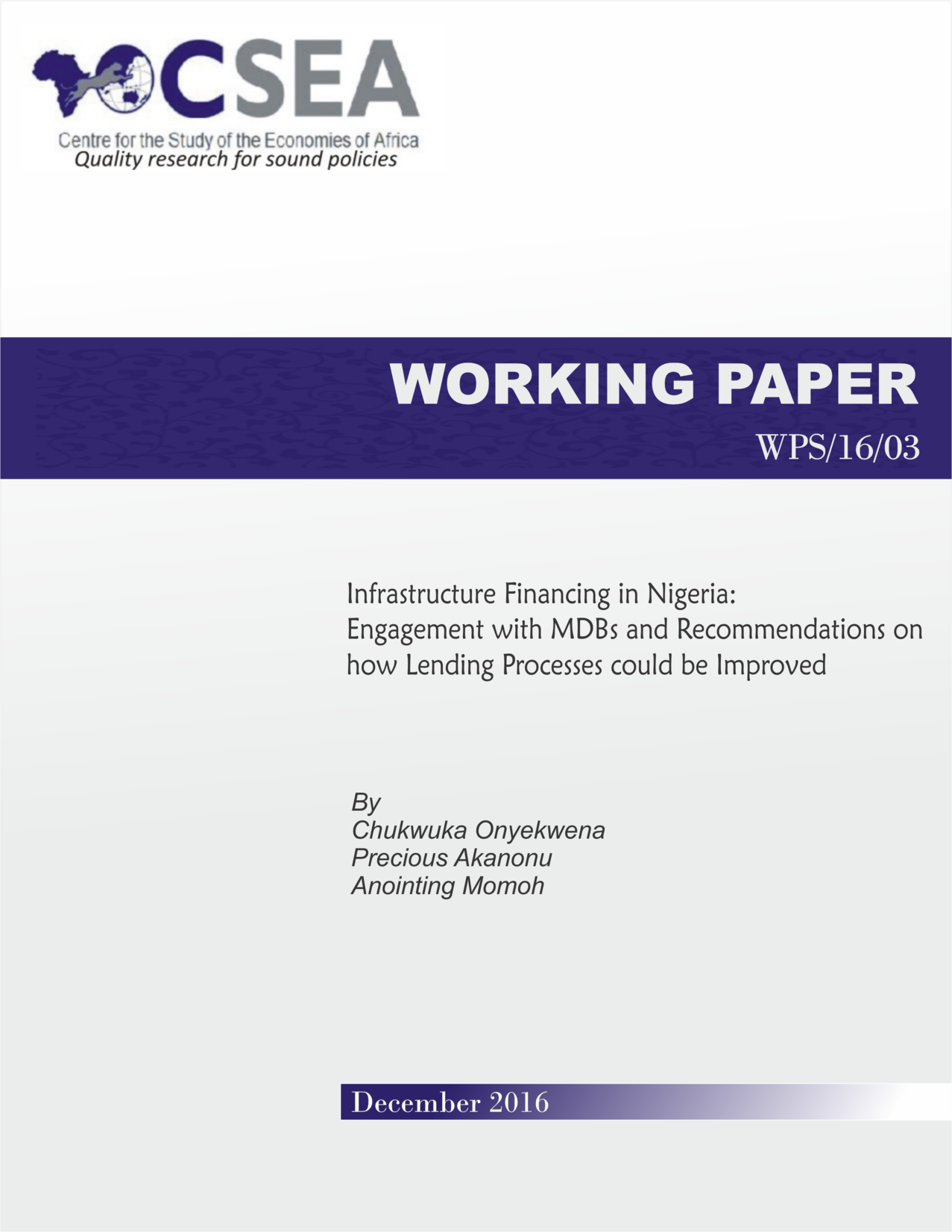
Infrastructure Financing In Nigeria:

Similar to most sub-Saharan African (SSA) countries, Nigeria has a huge infrastructure deficit which considerably limits efforts towards achieving inclusive growth, sustainable development, and poverty reduction. With infrastructure stock estimated at 20-25 per cent of Gross Domestic Product (GDP), Nigerias infrastructure stock is still significantly lower than the recommended international benchmark of 70 per cent of GDP. The 2014 National Integrated Infrastructure Master Plan (NIMP) estimates that a total of US$ 3 trillion of investments, or US$100 billion annually, is required over the next 30 years to bridge Nigerias infrastructure gap. In particular, the Plan estimates that Nigeria will have to spend an annual average of US$ 33 billion infrastructure investments for the period 2014 -2018. This means that Nigeria will have to more than double its spending on infrastructure from the current 2-3 per cent of GDP to around 7 per cent to make appreciable progress in infrastructure development over the next three decades.
Read More Download PDF

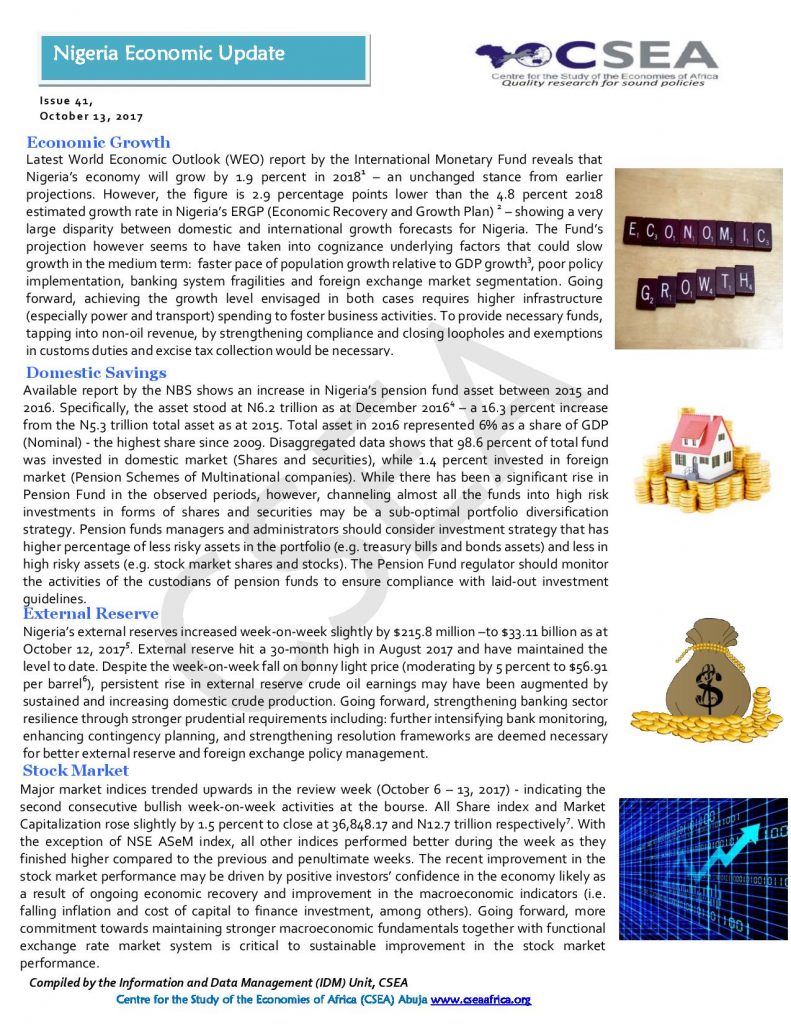
Nigeria Economic Update (Issue 41)

Latest World Economic Outlook (WEO) report by the International Monetary Fund reveals that Nigerias economy will grow by 1.9 percent in 2018 an unchanged stance from earlier projections. However, the figure is 2.9 percentage points lower than the 4.8 percent 2018 estimated growth rate in Nigerias ERGP (Economic Recovery and Growth Plan) 2 showing a very large disparity between domestic and international growth forecasts for Nigeria. The Funds projection however seems to have taken into cognizance underlying factors that could slow growth in the medium term: faster pace of population growth relative to GDP growth3, poor policy implementation, banking system fragilities and foreign exchange market segmentation.
Read More Download PDF

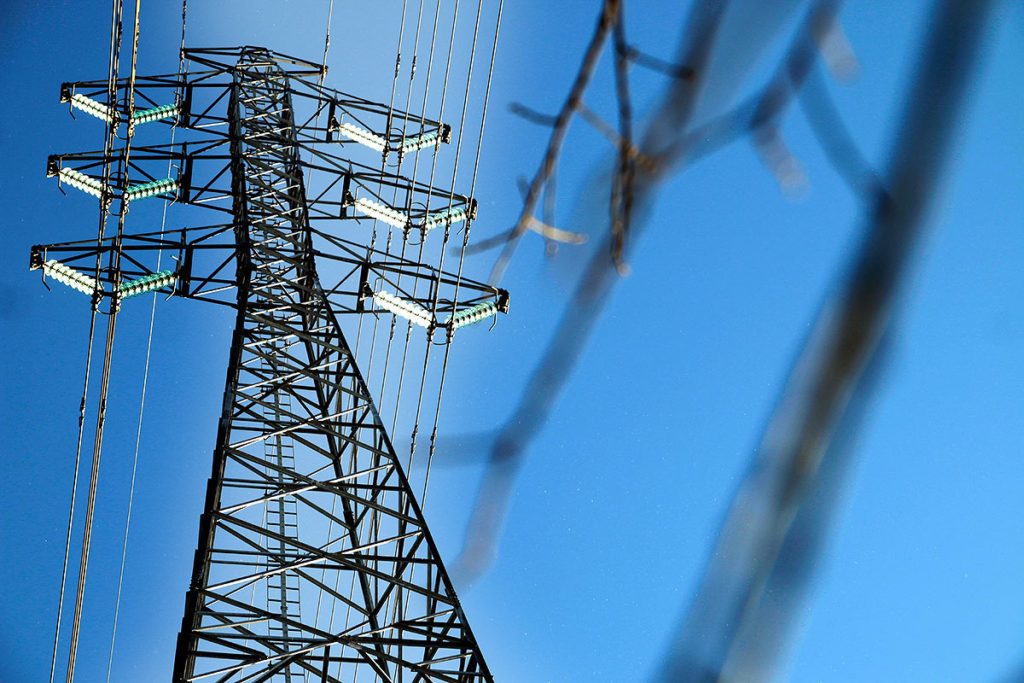
Electrification in Nigeria: Challenges and Way Forward

Although electricity has been generated in commercial quantities in Nigeria for over a century, the rate of electricity infrastructure development in the county is low and power supply remains inadequate. Prior to reforms, the central challenges of the Nigerian power sector was the vertically integrated monopoly of government in power generation, transmission and distribution. While the reforms was successful in privatizing the generation and distribution segments of the Nigerian Electricity Supply Industry (NESI), the overbearing problems in the sector persists –with privatization only changing the dimensions of the challenges.

Financing remain a major problem across all the segments of the NESI partly due to non-cost reflective tariff. Yet each segment of the NESI also faces its unique challenges. The generation segment is riffed with the problems of energy security and inefficiencies in other segments. The challenges in the transmission segment lies in the lack of modern transmission lines and equipment, gross mismanagement, poor maintenance of available infrastructure and inefficient grid design. Distribution companies face the problem of huge Aggregate Technical, Commercial, and Collection (ATC&C) losses.

In terms of electricity access, 46.09 percent of the Nigerian population remains unconnected to the national grid, representing 83.98 million people. Further, electricity demand is estimated at 24,380 MW as at 2015 compared to NESI’s available generation capacity of 7,139.6 MW. In terms of energy use, Nigeria has the lowest in the world – 80 percent below its energy use based on income levels.

In a bid to tackle aforementioned challenges, the Federal Government of Nigeria (FGN) set ambitious targets for the country’s energy mix. This should allow Nigeria exploit its potential for coal, solar, wind, biomass, as well as small and large hydroelectric power electric generation, while reducing the prevalence of self-generation, which constitute two-thirds of present energy mix. By 2020, the FGN targets to achieve up to 75 percent access to electricity by connecting 1.5 million households annually. While Nigeria’s energy mix targets are desirable, the prospect of success remain bleak on account of financial constraints, pricing policy and lack of policy coordination.

Improving electricity supply in Nigeria and addressing barriers to achieving the energy mix targets will entail: addressing payment risk, financing power sector investment, as well as improving the pricing and tariff structure, gas pricing and allocation, and market regulation.


Read More Download PDF Download PDF Download PDF

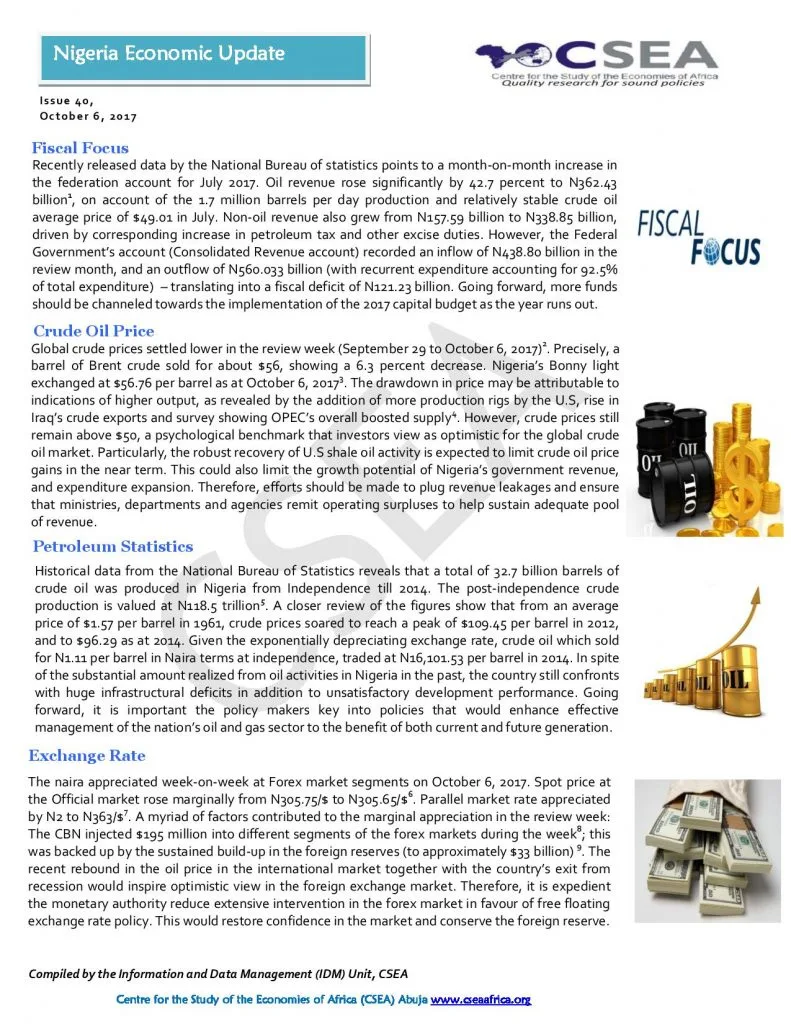
Nigeria Economic Update (Issue 40)

Global crude prices settled lower in the review week (September 29 to October 6, 2017). Precisely, a barrel of Brent crude sold for about $56, showing a 6.3 percent decrease. Nigerias Bonny light exchanged at $56.76 per barrel as at October 6, 2017. The draw down in price may be attributable to indications of higher output, as revealed by the addition of more production rigs by the U.S, rise in Iraqs crude exports and survey showing OPECs overall boosted supply.
Read More Download PDF

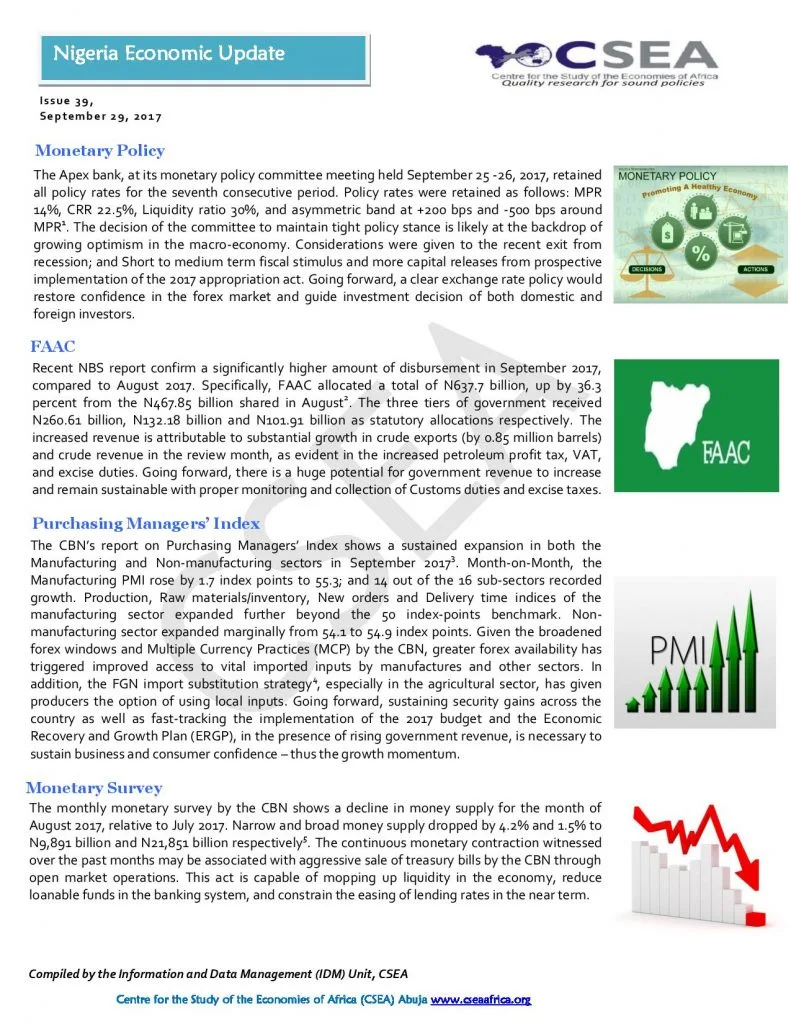
Nigeria Economic Update (Issue 39)

The monthly monetary survey by the CBN shows a decline in money supply for the month of August 2017, relative to July 2017. Narrow and broad money supply dropped by 4.2% and 1.5% to N9,891 billion and N21,851 billion respectively. The continuous monetary contraction witnessed over the past months may be associated with aggressive sale of treasury bills by the CBN through open market operations. This act is capable of mopping up liquidity in the economy, reduce loanable funds in the banking system, and constrain the easing of lending rates in the near term.
Read More Download PDF

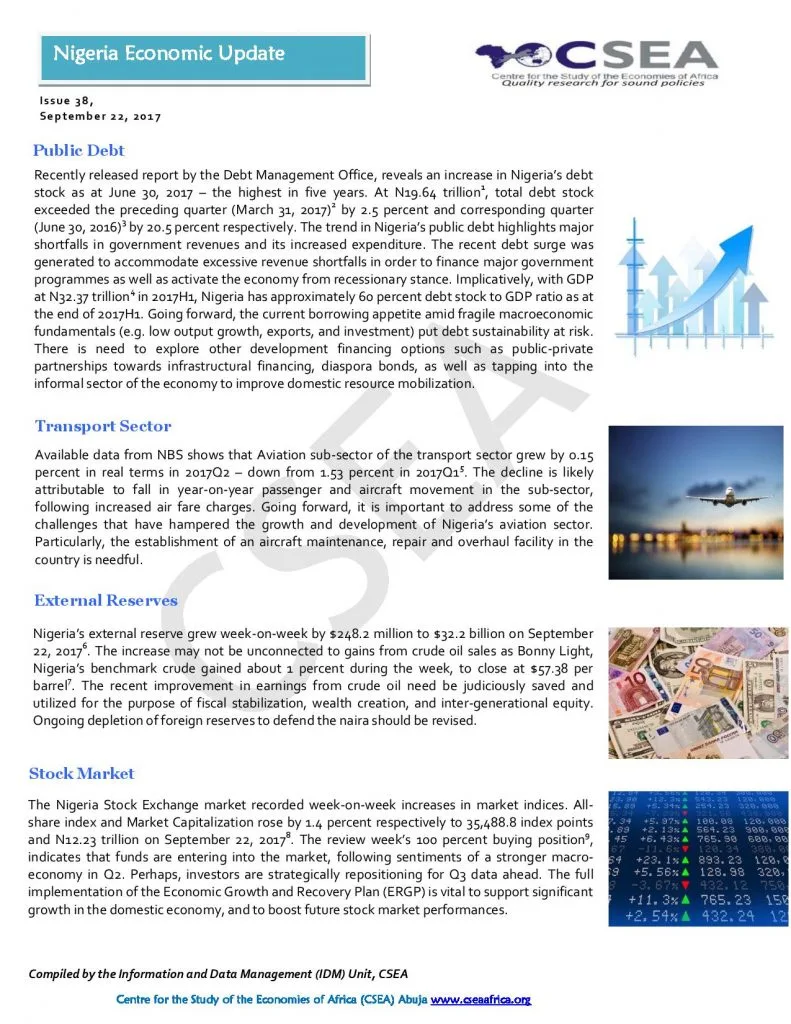
Nigeria Economic Update (Issue 38)

Available data from NBS shows that Aviation sub-sector of the transport sector grew by o.15 percent in real terms in 2017Q2 down from 1.53 percent in 2017Q15. The decline is likely attributable to fall in year-on-year passenger and aircraft movement in the sub-sector, following increased air fare charges. 
Read More Download PDF

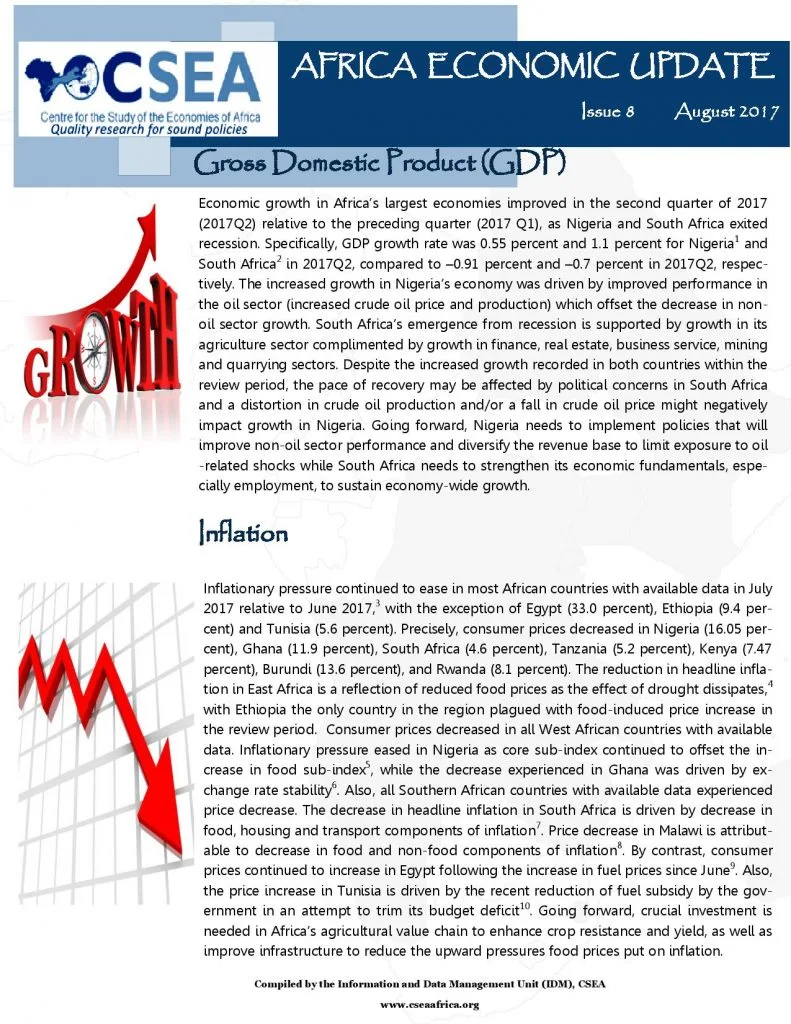
Africa Economic Update (Issue 8)

Economic growth in Africas largest economies improved in the second quarter of 2017 (2017Q2) relative to the preceding quarter (2017 Q1), as Nigeria and South Africa exited recession. Specifically, GDP growth rate was 0.55 percent and 1.1 percent for Nigeria and South Africa in 2017Q2, compared to 0.91 percent and 0.7 percent in 2017Q2, respectively. The increased growth in Nigerias economy was driven by improved performance in the oil sector (increased crude oil price and production) which offset the decrease in non-oil sector growth, while South Africas emergence from recession is supported by growth in its agriculture sector complimented by growth in finance, real estate, business service, mining and quarrying sectors.
Read More Download PDF