

Publications

Follow via RSS

Fiscal Transparency - Nigeria Continues to Slide in Open Budget Index

Overview
The International Budget Partnership (IBP), on January 23, 2013, released the results of the Open Budget Index (OBI) for 2012 in which about 100 countries were surveyed. The OBI measures the state of budget transparency, participation, and oversight in the budget process. In the outcome of the survey, Nigeria’s overall score was only 16 out of a maximum 100, a lower score when compared with the previous years. Specifically, and as shown in Figure 1, Nigeria’s score has been consistently on the decline from 20 in 2006 to 19 in 2008 and then to 18 in 2010 while dropping further to 16 in 2012. This implies that there are still challenges with respect to fiscal transparency and consolidation in Nigeria despite the passage of the Fiscal Responsibility Act (FRA). Therefore, the inability of Nigeria to improve its performance in the OBI means that the government is seen to be providing the public with little information on the budget.  

Figure 1: Nigeria’s Open Budget Index Scores 2006 – 2012

" alt="" width="510" height="230" />

Source: Open Budget Index 2013   In arriving at the respective scores for each of the surveyed countries, the IBP requires the publication of eight documents on the budget. In the case of Nigeria, six of the required eight documents were produced as shown in Table 1. The documents that were provided by the Nigerian fiscal authorities include pre-budget statement, the executive’s budget proposal, enacted budget, in-year budget report and year-end budget report. The documents that were produced but not made available to the general public are mid-year budget review and audit report. However, the citizens budget which aims to provide a ‘nontechnical’ report to the public is reportedly not made available. While most of the documents were made public, the scanty nature of the information provided, coupled with the production of two of the documents for internal use and ‘nonproduction’ of the citizens’ budget, resulted in the relatively low score of Nigeria in the OBI. On a positive note however, the survey noted the improvement of Nigeria’s oversight institutions in the budget process. Specifically, the legislative strength as well as the supreme audit institutions’ strength was accorded a ‘strong’ status even though public engagement was regarded as weak.   Table 1: The Key Budget Documents

Description of Document

Status

Pre-Budget Statement: Provides information that links government policies and budgets and typically sets forth the broad parameters that will define the budget proposal that is presented to the legislature.

Published

Executive’s Budget Proposal: Presents the government plans to raise revenues through taxes and other sources and spend these monies to support its priorities, thus transforming policy goals into action.

Published

Enacted Budget: The legal instrument authorizing the executive to raise revenues, make expenditures, and incur debt.

Published

Citizens Budget: A nontechnical presentation to enable broad public understanding of a government’s plans for raising revenues and spending public funds in order to achieve policy goals.

Not Produced

In-Year Reports: Periodic (monthly or quarterly) measures of the trends in actual revenues, expenditures, and debt, which allow for comparisons with the budget figures and adjustments.

Published

Mid-Year Review: An overview of the budget’s effects at the midpoint of a budget year and discusses any changes in economic assumptions that affect approved budget policies.

Produced for internal use

Year-End Report: Information comparing the actual budget execution relative to the Enacted Budget

Published

Audit Report: Independent evaluation of the government’s accounts by the country’s supreme audit institution. It typically assesses whether the executive has raised revenues and spent monies in line with the authorized budget, and whether the government’s accounts of its revenues and expenses are accurate and provide a reliable picture of the fiscal situation.

Produced for internal use

Source: Open Budget Index 2013   In relative terms, Nigeria’s OBI 2012 score of 16 in 2012 is well below the average score of 43 for all the 100 countries surveyed. Also, the score is lower than those of some African countries such as Ghana, Kenya and Angola, all of which attained 50, 49 and 28 scores, respectively. Similarly, when compared with the BRICS (Brazil, Russia, India, China and South Africa)Download File" name="_ftnref1">[1], it is clear that Nigeria’s score is much lower, with the exception of China, as shown in Figure 2. The BRICS are distinguished by the large and fast growing economies and Nigeria has been touted to be in this league in the near future.  

Figure 2: Nigeria’s OBI Vs Selected Countries

" alt="" width="506" height="245" />

                                           Source: Open Budget Index 2013  
Policy Implications and limitations of the Index
The OBI has thrown light on the need for the Nigerian government to do more in terms of improving the transparency of the budget process. In other words, the continuous decline in Nigeria’s score since 2006 shows that there are still ambiguities in the process even though progress is being recorded in some areas. The oversight activities of the legislature are a case in point. However, the OBI survey has some limitations. First, it is observed from the report that the Nigerian government does not produce or publish a ‘nontechnical’ report called the ‘Citizens Budget’. Second, the report also notes that the mid-year budget review is only produced for internal use (see highlighted sections in Table 1). Conversely however, the Budget Office of the Federation has a publication on its website called ‘A Citizens Guide to the Federal Budget’Download File" name="_ftnref1">[2] while it also produces for public consumption detailed quarterly reviews of the budget.Download File" name="_ftnref1">[3] For these reasons, better scores in these two areas should increase Nigeria’s overall score though not significant in relative terms. In conclusion, apart from the website/internet channel, the Nigerian fiscal authorities may want to devise other means by which budget documents are made public (for example through town hall meetings) given that the number of internet users in the country is estimated at only 46.2million or 28.8% of the total population.
 
Download File" name="_ftn1">[1] The BRICS according to Goldman Sachs
Read More

Brazil’s President Visit to Nigeria and Implications for the BRICS

The visit culminated in the signing of a Memorandum of Understanding (MoU) and the setting up of the Nigeria-Brazil Bi-national Commission with the aim of boosting trade and economic activities between the two countries
Read More

Nigeria Economic Update (Issue 5)

Recently released media highlights show that Nigeria has dropped in terms of macroeconomic indicator rankings in 2018. With a headline index of 2.77, Nigeria is ranked 158th globally out of 181 countries five places lower than the previous year rankings. Indicators suggest that Nigeria is presently behind 28 other African countries, and just ahead of only 4 West African countries (Mauritania, Togo, Niger and Guinea Bissau). 
Read More Download PDF

Nigeria Economic Update (Issue 8)

Global benchmark crude, Brent, sold for $66.43 per barrel, a little above 3.4 percent from the $64. 3 per barrel in the preceding week. Nigeria’s Bonny light exchanged for $65.71 per barrel. Global Crude supply levels have been constrained by a dip in Libya’s production, following the shutdown of the El Feel oilfield in Libya, which produces 70,000 bpd. This is complemented by the continued compliance by OPEC member countries to curb production levels, thus rebalancing the global crude oil market and gradually driving prices upwards.  
Read More Download PDF

Nigeria Economic Update (Issue 4)

Recently released labour force report by the NBS shows a quarter-over-quarter increase in Nigerias working age and labour force population. Working population rose from 110.29 million in 2017Q2, to 111.13 million persons in 2017Q32. The working age population in 2017Q3 constituted 85.08 million persons in the labour force (an increase from 83.94 million), of which 40 percent were either unemployed or underemployed.  Thus, total employed persons in the quarter reached 69.1 million.
Read More Download PDF

Nigeria Economic Update (Issue 3)

Recently released inflation rate report by the NBS shows a further decline in consumer price index in December 2017. At 15.37 percent, the CPI was 0.53 percentage points lower than the 15.90 percent recorded in November 2017. The food sub-index decreased to 19.42 percent from 20.21 percent, indicating reduced pressure on food prices in the review period. Core sub-index fell slightly to 12.1 percent from 12.21 percent in the preceding month. Going forward, the ability of the Central Bank of Nigeria (CBN) to control inflation in 2018 may be hampered by monetary injections by the government and politicians towards budgetary expenditure and election campaigns, respectively.
Read More Download PDF

Nigeria Economic Update (Issue 2)

International rating body, Fitch, has projected higher economic growth for Nigeria in 2018. The body estimated that Nigerias economy will grow by 2.6 percent, slightly higher compared to projections from the International Monetary Fund (2.1 percent) and The World Bank (1 percent). A myriad of factors may have driven the projected increase: improved availability of forex for the non-oil sector, higher government capital expenditure capability driven by more oil revenue, and fiscal stimulus. However, the relatively strong economic growth projected by Fitch and IMF may be hampered
Read More Download PDF

Nigeria Economic Update (Issue 1)

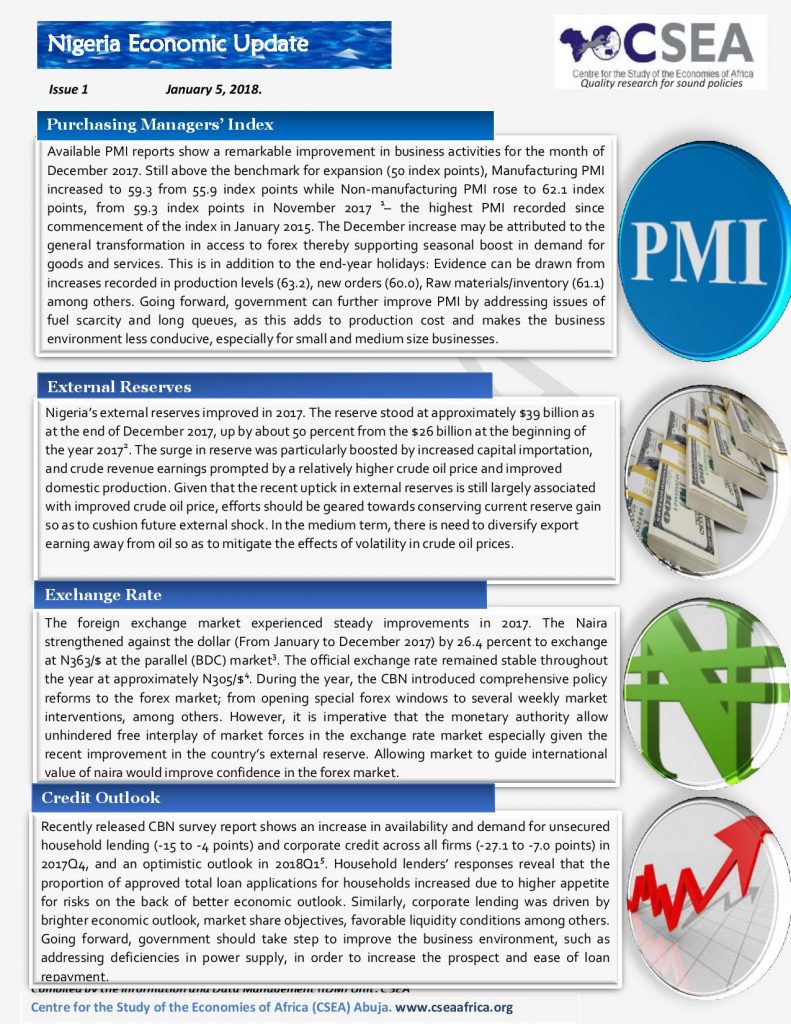
Nigerias external reserves improved in 2017. The reserve stood at approximately $39 billion as at the end of December 2017, up by about 50 percent from the $26 billion at the beginning of the year 20172. The surge in reserve was particularly boosted by increased capital importation, and crude revenue earnings prompted by a relatively higher crude oil price and improved domestic production. Given that the recent uptick in external reserves is still largely associated with improved crude oil price, efforts should be geared towards conserving current reserve gain so as to cushion future external shock. In the medium term, there is need to diversify export earning away from oil so as to mitigate the effects of volatility in crude oil prices.
Read More Download PDF

Nigeria Economic Update (Issue 51)

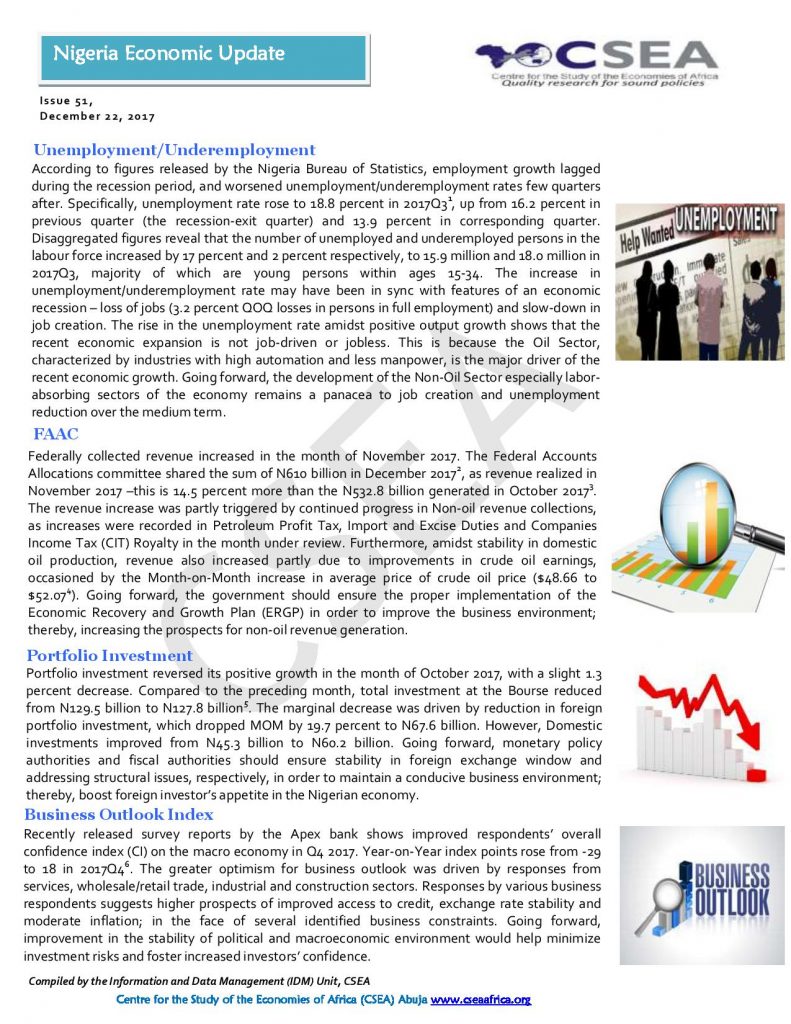
According to figures released by the Nigeria Bureau of Statistics, employment growth lagged during the recession period, and worsened unemployment/underemployment rates few quarters after. Specifically, unemployment rate rose to 18.8 percent in 2017Q31, up from 16.2 percent in previous quarter (the recession-exit quarter) and 13.9 percent in corresponding quarter. Disaggregated figures reveal that the number of unemployed and underemployed persons in the labour force increased by 17 percent and 2 percent respectively, to 15.9 million and 18.0 million in 2017Q3, majority of which are young persons within ages 15-34. 
Read More Download PDF