Publications

Nigeria Economic Update, Issue 50

In November 2025, the National Bureau of Statistics reported a gradual easing of annual price pressures alongside continued short-term increases in consumer prices. The Consumer Price Index (CPI) rose to 130.5, up from 128.9 in October, indicating a sustained increase in the general price level of goods and services purchased by households. Nonetheless, headline inflation moderated to 14.45%, down from 16.05% in the preceding month, reflecting a slowdown in year-on-year inflation. Compared with November 2024, headline inflation was 20.15%, a significant improvement largely driven by base effects following the rebasing of the CPI. Despite this moderation in annual terms, month-on-month inflation increased to 1.22% from 0.93% in October, signalling that underlying inflationary pressures persist. This suggests that households continue to experience rising costs in the short term, particularly for essential goods and services, even as broader inflation indicators show signs of improvement. The divergence between easing year-on-year inflation and rising month-on-month inflation highlights the need for continued policy vigilance. While inflationary conditions have improved relative to the previous year, achieving durable price stability will require addressing structural constraints such as food supply disruptions, energy costs, and distribution inefficiencies, alongside sustained macroeconomic discipline.

Read More Download PDF

Nigeria Economic Update, Issue 49

The Organisation of the Petroleum Exporting Countries’ (OPEC) November Monthly Oil Market report indicated that Nigeria’s average daily crude oil production (based on direct communication) for October 2025 increased by 0.8% (11,000 bpd), rising from 1.390 million barrels per day in September to 1.401 million bpd in October 2025. Despite this modest increase, production remained 6.6% below Nigeria’s OPEC quota of 1.5 million bpd and 31.9% below its target of 2.06 million bpd. These gaps indicate that Nigeria continues to face challenges in fully restoring crude oil production, despite recent investments and government-led efforts in the upstream sector. Falling short of its OPEC quota puts pressure on foreign exchange earnings, given that the sales of crude oil remain the country’s primary revenue source. However, the slight increase in output indicates a cautious yet promising recovery, which could enhance fiscal conditions if the momentum is sustained. To build on this progress, Nigeria should focus on repairing and upgrading critical oil infrastructure, securing production sites against vandalism and oil theft, and attracting consistent investment to boost output and move closer to its production targets. ECONOMIC SNAPSHOT + Quarterly Indicators

Read More Download PDF

Nigeria Economic Update, Issue 48

According to the Central Bank of Nigeria’s Purchasing Managers’ Index (PMI) report, Nigeria’s Composite PMI increased from 55.4 points in October 2025 to 56.4 points in November 2025. This increase marks twelve consecutive months of expansion, representing the strongest indication of private- sector growth so far in 2025. In the month under review, the industry sector PMI stood at 54.2 index points, while the service sector PMI rose to 56.8 points, up from the 55.6 points recorded in the previous month. Similarly, the agricultural sector expanded for the sixteenth consecutive month, standing at 58.2 index points, an increase from the 55.7 index points recorded in October 2025. The rise in private-sector activity was driven by higher production and increasing demand, signalling a broad-based strengthening of economic activity across all sectors. This positive trend also suggests that the increasing demand is likely to stimulate further production, raise employment levels, improve household incomes, and strengthen overall consumer confidence. However, this expansion carries potential inflationary risks and may affect affordability and broader economic stability. To mitigate these risks, efforts should be made to support small and medium-sized enterprises by providing access to affordable credit and capacity- building programmes. Furthermore, given the significant growth recorded in the agricultural sector, the government should invest in agricultural technology and improve value chains to enhance productivity and export capacity.

Read More Download PDF

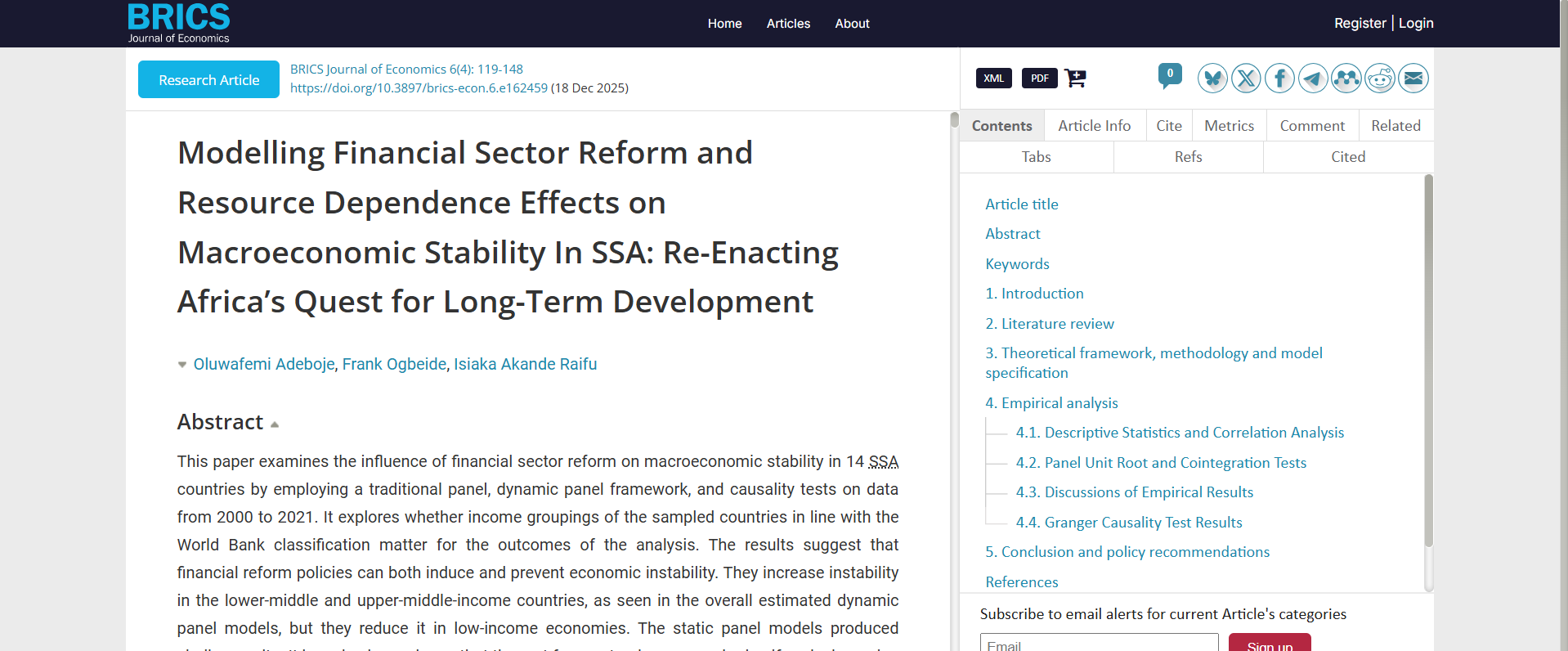
Modelling Financial Sector Reform and Resource Dependence Effects on Macroeconomic Stability In SSA: Re-Enacting Africa’s Quest for Long-Term Development

This paper examines the influence of financial sector reform on macroeconomic stability in 14 SSA countries by employing a traditional panel, dynamic panel framework, and causality tests on data from 2000 to 2021. It explores whether income groupings of the sampled countries in line with the World Bank classification matter for the outcomes of the analysis. The results suggest that financial reform policies can both induce and prevent economic instability. They increase instability in the lower-middle and upper-middle-income countries, as seen in the overall estimated dynamic panel models, but they reduce it in low-income economies. The static panel models produced similar results. It has also been shown that the rent from natural resources had uniformly damaging effects on the macroeconomic stability of all income groups in SSA, effectively confirming the “resource curse” thesis. Yet, the findings of the panel as a whole contradicted this, suggesting that revenue from natural resources can effectively play a role in stabilizing macroeconomic conditions. The results also suggest the existence of what can be called “a human capital-misery trap”, in which higher human capital development can lead to macroeconomic instability. Inflation was found to have a detrimental effect, and the impact of government interventions appeared to be mixed. This paper emphasizes the need for robust financial reforms and comprehensive policy measures in Sub-Saharan Africa (SSA), aiming to enhance the effectiveness, competitiveness, and stability of the financial sector and the broader economic landscape, which will require prudent management of natural resources.

Read More

Read More

Nigeria Economic Update, Issue 47

The Central Bank of Nigeria (CBN's) 303rd Monetary Policy Committee (MPC) meeting, convened on November 24-25, 2025, opted to hold the Monetary Policy Rate (MPR) steady at 27.0% while adjusting the Standing Facility corridor to +50/ 450 basis points. The Cash Reserve Requirement (CRR) was maintained across the board: Deposit Money Banks at 45.0%, Merchant Banks at 16.0%, and the non-TSA public sector at 75.0%. The Liquidity Ratio was retained at 30.0%. The Committee considered the sustained deceleration in headline inflation (year-on-year) over seven consecutive months, reaching 16.05% in October 2025. This decline was attributed to factors such as sustained monetary policy tightening, stable exchange rates, increased capital inflows, surplus current account balance, better food supply, and stability in the price of Premium Motor Spirit (PMS). To sustain these positive trends, the CBN should intensify efforts to enhance the efficiency of foreign exchange market interventions by leveraging digital tracking and forecasting tools (using Machine Learning and Artificial Intelligence infrastructure) to anticipate volatility and respond promptly. It is also necessary to boost agricultural output through the release of large quantities of fertiliser to the Ministry of Agriculture and collaboration with state governments to improve security in farming regions and sustain agricultural activities. Furthermore, there is a need to expand social intervention programmes to shield vulnerable populations from the effects of inflation

Read More Download PDF

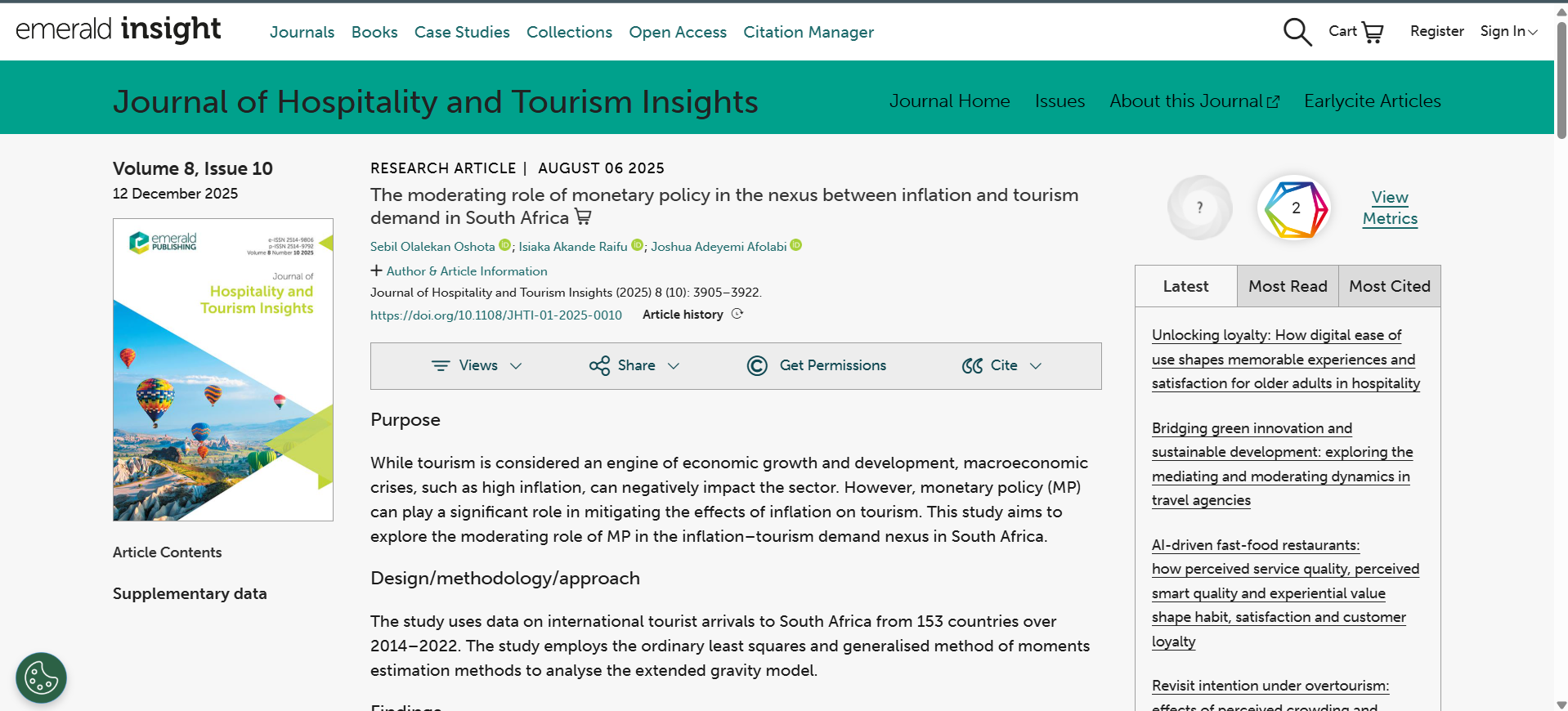
The moderating role of monetary policy in the nexus between inflation and tourism demand in South Africa

While tourism is considered an engine of economic growth and development, macroeconomic crises, such as high inflation, can negatively impact the sector. However, monetary policy (MP) can play a significant role in mitigating the effects of inflation on tourism. This study aims to explore the moderating role of MP in the inflation–tourism demand nexus in South Africa.

Read More

Read More

Nigeria Economic Update, Issue 46

According to the Organisation of Petroleum Exporting Countries (OPEC) Monthly Oil Market report for November 2025, Nigeria’s crude oil production increased marginally to 1.4 million barrels per day (mb/d) in October 2025, representing a 0.8% rise from the 1.3 mb/d recorded in September 2025. Despite this slight increase, production remained below the country’s oil production quota of 1.5 mb/d, marking the third consecutive month that Nigeria failed to meet its target. Concurrently, the price of Nigeria’s Bonny Light fell from $69.44 per barrel in September to $65.53 per barrel in October 2025, a decrease of $3.91 per barrel. The continued inability to meet production quotas reflects operational inefficiencies and persistent challenges, including pipeline vandalism.The decline in crude oil prices in October 2025 was driven by increased global oil supply, which exceeded demand by 500,000 barrels per day. Lower oil prices combined with production shortfalls have direct implications for government revenues from oil exports, creating macroeconomic uncertainty and putting pressure on exchange rate stability. To address production shortages, the government should strengthen infrastructure and security measures to prevent vandalism and operational disruptions. Investment in downstream activities, such as gas commercialisation, could help reduce dependence on crude oil export revenue. Additionally, efforts to diversify the economy should be intensified to mitigate exposure to global oil market shocks, which is significantly shaped by numerous global factors.

Read More Download PDF

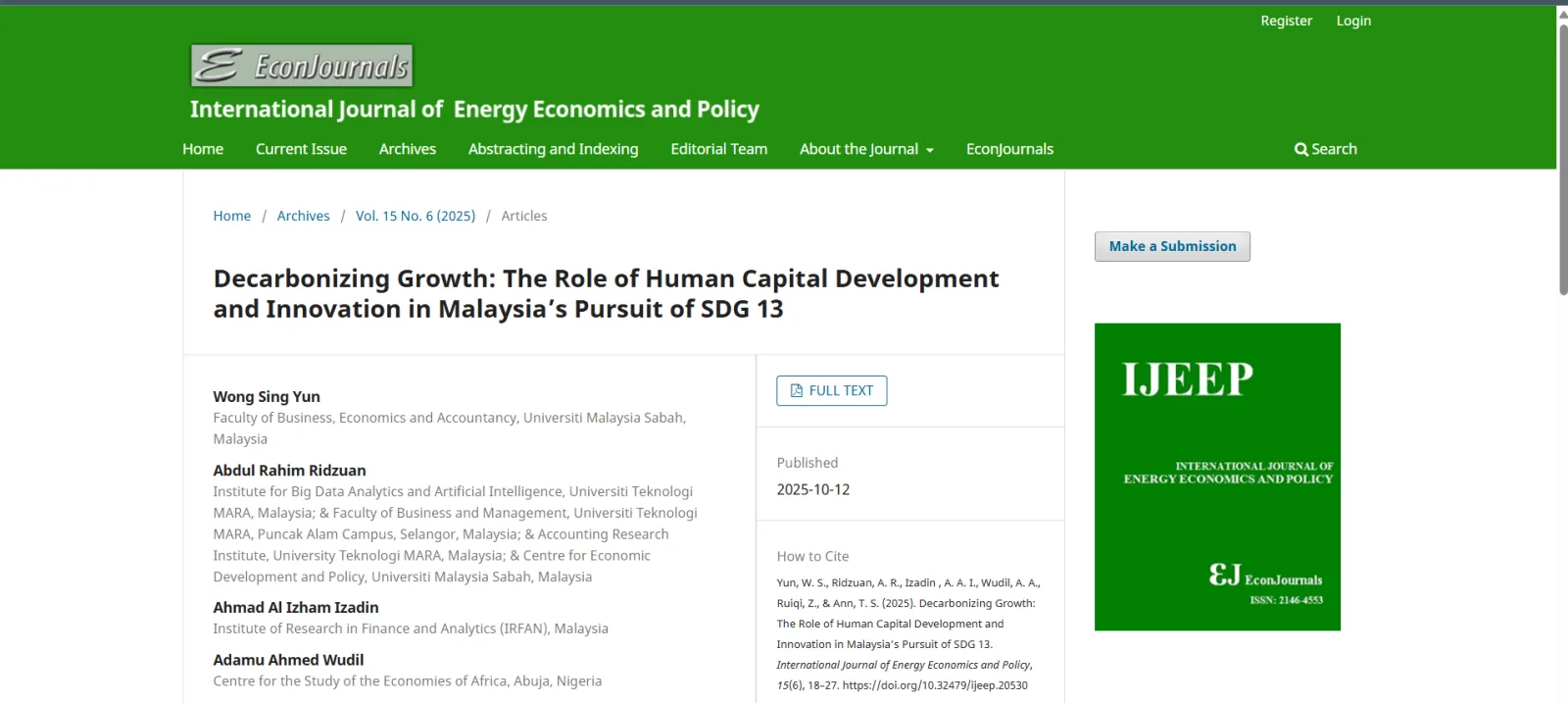
Decarbonizing Growth: The Role of Human Capital Development and Innovation in Malaysia’s Pursuit of SDG 13

This study investigates the impact of human capital development and technological innovation on environmental sustainability in Malaysia, as part of the Malaysian commitment to Sustainable Development Goal 13 (Climate Action). Using Autoregressive Distributed Lag (ARDL) model and time series data covering the period 1990-2022, the analysis explores the dynamic relationship between CO2 emissions and major macroeconomic variables, namely economic growth, energy consumption, technological innovation, trade openness, foreign direct investment (FDI), quality of governance, education, and GINI coefficient. The empirical findings reveals that technological innovation and human capital development significantly contribute to long-run decline in CO2 emission, hence emphasis their role in ensuring a sustainable low-carbon economy. On the other hand, FDI correlates with higher emissions, which gives relevance to pollution haven hypothesis in the Malaysian case. The study emphasis the need to invest in green technology, incorporate sustainability in the education system and tightening environmental standards in the foreign investments. Such policy steps are necessary to ensure that economic progress is no longer linked to environmental degradation and accelerate Malaysia’s transition towards a climate-resilient future.

Read More

Read More

Nigeria Economic Update, Issue 45

Data from the Central Bank of Nigeria (CBN) revealed that Nigeria’s gross external reserves rose to $43.32 billion as of November 6, 2025, the highest level recorded in six years. This marks a 1.83% month-onmonth increase from $42.54 billion on October 6, 2025, and a 5.87% rise from $40.92 billion on January 6, 2025. The recent build-up in reserves is largely attributed to the successful issuance of the Federal Government’s $2.3 billion Eurobond, which injected fresh liquidity into the economy and strengthened Nigeria’s external position. Beyond the Eurobond inflow, other contributory factors may include modest improvements in oil export earnings, tighter monetary policy measures, and a gradual recovery in foreign investment sentiment. The steady accumulation of reserves is a positive signal for the economy, reflecting improved external liquidity, a stronger ability to meet foreign obligations, and enhanced investor confidence in Nigeria’s macroeconomic management. Higher reserves also serve as a buffer against external shocks, helping to stabilise the exchange rate and reduce vulnerability to global financial volatility. To sustain this momentum, the government should diversify external inflows, deepen non-oil export capacity, improve diaspora remittance channels, and strengthen foreign investment inflows to ensure that reserve growth is built on sustainable, longterm drivers rather than temporary inflows.

Read More Download PDF