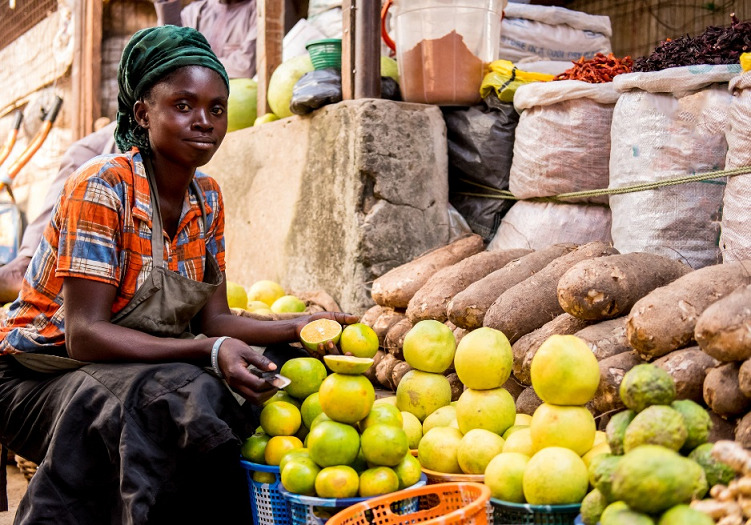
Over the years, the Nigerian government has deployed development financing initiatives to boost food production through increased access to finance for farmers and other small businesses in the sector. While progress may have been made in some areas, the country is still at a critical juncture, as access to food and its affordability remain a major problem for a large part of the population. This brief aims to examine how the government’s financing policies to improve food production have fared, given the prevailing economic conditions in the country. The focus is particularly on such financing programmes as administered by the Central Bank of Nigeria (CBN). It will highlight progress with these financing programmes and discuss other challenges to food production, which are possible drivers of the rising food inflation in the country.
The Central Bank of Nigeria (CBN) announced a new policy on cash withdrawals on 6th December 2022.2 According to the policy, the maximum weekly withdrawal over the counter is set at N100,000 for individuals and N500,000 for organizations. Any withdrawal above these limits shall attract processing charges of 5 percent and 10 percent, respectively. In addition, withdrawals using Automated Teller Machines (ATM) and Point of Sale (PoS) terminals are set at N20,000 daily. The policy is scheduled to take effect from 9th January 2023. The policy aims to achieve several objectives, including fostering financial inclusion through electronic payments, increasing government revenue generation by making individuals and businesses visible to tax authorities, and improving the tracking of illicit transactions like ransom paid to kidnappers. Due to the country’s low internet penetration, the policy will likely disrupt economic activities, especially in rural areas where digital banking products are still in the infant stage, and transactions are mainly done through cash. For the policy to achieve its intended purpose, universal internet penetration is crucial. Also, the government might need to partner with banks and other financial institutions to expand the coverage of their digital financial products.
According to the Food Prices Watch by the National Bureau of Statistics (NBS), the average price of some selected food items in the country rose in October 2022.1 The report showed that the average price of a 500g loaf of sliced bread rose year-on-year by 36.7% to N523.2 in October 2022. Also, 1kg of rice (local, sold loose) had an average price increase of 17.5% to N487.5 year-on-year in October 2022. Similarly, the average cost of 1 kg of beans increased by 18% to N564.7. In addition, the cost of a tuber of yam increased by 30.9% from N313.1 in October 2021 to N409.86 in October 2022. Food shortages, which occur due to several factors, including insecurity, flooding, and cultivation of low-yield seedlings, contribute to rising food costs. Rising food prices reduce the standard of living of millions of people in the country, as it reduces the purchasing power of people and makes basic meals less affordable. As shown in the recently launched Multidimensional poverty report, millions of Nigerians are poor and are experiencing food deprivation. Consequently, the government needs to prioritise interventions that would solve the problem of food shortages. The interventions might be in different forms, including the construction of irrigation systems, provision of fertilisers and improved seedlings, and strengthening security in agricultural farming areas. These interventions, if well executed, are expected to increase food production, and lower the rate of food price increases.
This report examines the potential for industries without smokestacks (IWOSS) in creating large-scale job opportunities in Nigeria, particularly for the young and female population subgroups. With the emergence of technology and shifts in the global economy, the relevance of some industries in economic development have increased. These industries are codified as IWOSS. IWOSS are sectors with higher labor productivity relative to traditional agriculture, and they are also tradable (Bhorat et al. 2020; Heitzig et al. forthcoming). These sectors include agro-processing, financial and business services, information and communications technology (ICT), tourism, formal trade, and transport. The emerging role of IWOSS is particularly important as evidence indicate This report examines the potential for industries without smokestacks (IWOSS) in creating large-scale job opportunities in Nigeria, particularly for the young and female population subgroups. With the emergence of technology and shifts in the global economy, the relevance of some industries in economic development have increased. These industries are codified as IWOSS. IWOSS are sectors with higher labor productivity relative to traditional agriculture, and they are also tradable (Bhorat et al. 2020; Heitzig et al. forthcoming). These sectors include agro-processing, financial and business services, information and communications technology (ICT), tourism, formal trade, and transport. The emerging role of IWOSS is particularly important as evidence indicates that the employment crisis and poor performance of manufacturing have become major concerns in Nigeria.
The study addresses the following questions: (i) What is the employment situation in Nigeria? (ii) What is the pattern of sector growth vis-a-vis performance of IWOSS and non-IWOSS sectors in Nigeria? (iii) What is the potential growth and labor demand of IWOSS sectors? The methods employed include an evaluation of sectors’ performance in terms of growth and wage employment, analyses of present and future levels of employment and productivity, and the use of a value-chain approach to assess employment creation potential and significant constraints. These approaches are complemented with a survey conducted between February and September of 2022 with firms selected from three IWOSS sectors.
The latest monthly oil market report (MOMR) of the Organisation of Petroleum Exporting Countries (OPEC) indicates that Nigeria’s crude oil production increased from 938 thousand barrels per day (tb/d) in September to 1,014 tb/d in October 2022.1 The increase is coming a few weeks after the federal government launched full-blown combat against oil theft in the country. The government discovered some illegal oil pipelines and terminals during the combat exercise. The development indicates that sustained efforts to prevent oil theft would increase oil production. With the inauguration of the $3 billion Kolmani Integrated Development Project along the fields of Gombe and Bauchi state in the North-East during the week, oil production level is anticipated to rise slightly by 50,000 in the upcoming months. Despite the improvement recorded in October, the oil production level is much lower than the 1.63 million barrels per day benchmarked in the 2022 budget. The crude oil production recorded in the period under review indicates that the actualisation of 1.6 million barrels per day anticipated in the 2023 budget would require significant inflows of investment in replacing ageing infrastructure and modern ones, as well as tight security to curtail oil theft.
The National Bureau of Statistics, in its latest National Multidimensional Poverty Index Report, shows that 62.9 percent of Nigerians are multi-dimensionally poor, which translates to 132.93 million Nigerians.3 The Multidimensional Poverty Index provides a multivariate form of poverty assessment based on fifteen indicators that describe deprivations across health, education, living standards, work, nutrition, and shocks. The statistics suggest that about two-thirds of Nigerians are deprived of health care, education, food security, and decent employment. The MPI is higher in rural areas than in urban areas. The MPI in rural areas is 72 percent, and 42 percent in urban areas. At the geopolitical zone level, North East has the highest MPI with 76.5 percent, followed by North West with 75.8 percent. South West has the lowest MPI, which stood at 40 percent. The MPI in South-South is 62.6 percent, 49 percent in South East, and 66.3 percent in North Central. At the state level, Ondo state has the lowest MPI, 27.2 percent, followed by Lagos state with 29.4 percent and Abia state with 29.8 percent. Sokoto has the highest MPI, with 90.5 percent. The geographical disparity in the MPI poverty level indicates that targeted developmental interventions are required to uplift millions of Nigerians out of multidimensional poverty.
Total revenue and income generation by the rail sector dipped significantly in Q2 2022, according to the latest rail transport statistics published by the National Bureau of Statistics (NBS). The report shows that aggregate revenue generated by the sector dropped by over 200 percent. It decreased from about N2.2 billion in Q1 2022 to about N734.5 million in Q2 2022. The decline in revenue was primarily due to the sharp fall in the total revenues generated from passengers, which fell from N2.2 billion to N598.7 million. Also, the total number of passengers over the same period reduced to 422,393 from 953,099. The decline in the number of passengers is due to the shutdown of the Abuja-Kaduna railway line in March 2022. The shutdown was due to the kidnapping of over 50 passengers. To revert low patronage and income generated, the security of the railway is essential. Hence, the government must resolve the ongoing insecurity issues that have reduced patronage, negatively impacting the sector’s income and capacity to repay the credit facility provided to revive the train stations. While the government is preparing to reopen the Abuja-Kaduna railway, there is a need for concerted efforts targeted at strengthening the security architecture. Otherwise, passenger patronage will remain low after reopening the rail line.
Food prices in Nigeria experienced a further increase in September 2022, according to the Selected Food Prices Watch Report for September 2022, published by the National Bureau of Statistics (NBS).2 The report highlighted the change in prices of some selected food items. For example, the average price of 1kg of Tomato on a year-on-year (YoY) basis increased by 30.06 percent, from N342.25 recorded in September 2021 to N445.12 in September 2022 and on a month-on-month (MoM) basis, 1kg of tomato increased by 3.29 percent to N445.12 in September 2022 from N430.93 recorded in August 2022. Also, the average price of 1kg of rice (local, sold loose) rose on a YoY basis by 14.98 percent from N410.01 recorded in September 2021 to N471.42 in September 2022, and on a MoM basis, the average price increased by 3.82 percent. Also, the average price of 1kg of beans (brown, sold loose) increased on a YoY basis by 13.14 percent from N492.13 recorded in September 2021 to N556.81, and on a MoM basis, 1kg of beans rose by 2.05 percent from N545.61 in August 2022. Tomato, rice, and beans are major food items consumed daily in Nigeria. Food is a necessity, and a must-have for every household, implying that the increase in food prices leaves many households worse off. The rising prices can be attributed to disruptions in food supply occasioned by insecurity and recent floods in most parts of the country. Hence, there is a need to support farmers by addressing the problem of insecurity and flooding as well as providing them with improved seedlings to boost food production and reduce the extent of increase in food prices in the country.
According to the 2022 global hunger index (GHI) report, Nigeria ranked 103rd out of 121 countries, suggesting Nigeria's weak and fragile food system.3 The GHI is a tool for measuring and tracking hunger at global, regional, and national levels. It is calculated based on the values of four component indicators – undernourishment, child wasting, child stunting, and child mortality. Nigeria's index score in the 2022 report is 27.3, which is more than five times the score of Belarus, which is the country with the lowest hunger level. Conflicts and climatic disasters have hampered food production in Nigeria, causing shortages that have progressively raised food prices and general inflation rates. The current flood disaster in Nigeria also affects food and agricultural production in several (food-producing) states. As a result, food production is likely to reduce in 2023 and could result in a shortage of food supplies, higher food and general inflation rates, and a more profound hunger crisis in the nation. There is a need for the government to intensify support to farmers whose farmland had been affected by the current flood, as well as scale up the introduction of modern agricultural inputs to increase productivity and boost production levels. There is an urgent need to increase investment in climate mitigation and adaptation by both the private sector and the government. This call is necessary to reduce the occurrence of climate-induced disasters like floods and their effects on the nation's food security