


Publications

Follow via RSS

Nigeria: The Resource Conundrum

This paper examines in great detail the impact of the Russia-Ukraine war on the Nigerian economy for the purpose of informing experts and non-experts alongside providing recommendations to the government. Specifically, it evaluates the trade, monetary, fiscal and macroeconomic conditions of the economy since the war began, as well as debt vulnerabilities, whilst discussing the official response so far, and seeking to forge a path for the government and its international partners.

Nigeria’s monetary and fiscal conditions have deteriorated since the war began. As a major oil producer, one could expect that Nigeria would benefit, without nuance, from higher energy prices. This has not been the case: declining oil production at a time when oil prices led to less of an export boost than expected. Moreover, the rise in the global price of food and fertilisers has translated to higher input costs for households and firms. Meanwhile, spending on oil imports and other merchandise imports, as well as various services (for instance, medical payments and tuition fees) are significant enough to have increased the demand for foreign exchange, consuming most of the increase in income associated with being an oil-exporter and causing a depreciation of the naira.

On monetary policy, the CBN’s financing of the government deficit has also created a weakness that has questioned its independence and made the naira increasingly vulnerable to speculation. Put together, tolerating these domestic economic weaknesses has contributed to the depreciation of the naira, which is not completely reflected in the official foreign exchange market. With stagnation in non-oil revenues and continuous increase in public spending, the government has had to increasingly turn to debt to finance its development needs. The IMF classified Nigeria’s debt as sustainable but points out that threats exist over the medium run, due to the high ratio of interest payments to public revenue.

The analysis presented in the paper shows that war will have a positive impact on real income at the macro level. Considering the increase in prices experienced in the first half of 2022, real income at the macro level is expected to increase by 3.6% in 2022 while multi-year simulations find that real income will increase by 3.9% in 2023 and 2024, as Nigeria gains from being a net exporter of fuel and natural gas and loses on the basis that it is a net importer of food commodities such as wheat.

However, the results at the household level are quite different: the ultra-poor households are worst hit by the war – food expenses are taking a higher share of their income. Further analysis shows that all households experience a decline in average real income (welfare gains are negative). But the lowest quintile households suffer the most from higher expenditure, (3.3% relative to 1.4% for the top quintile) while they experience a decline in average real income (-0.4%).

This publication was first published by the Finance for Development Lab. Click to read more here
Read More

Nigeria Economic Update (Issue 4)

The International Monetary Fund (IMF), has in its January World Economic Outlook improved its projection for Nigeria’s 2023 economic growth rate to 3.2 per cent, representing 0.2 percentage points increase from the 3.0 per cent earlier projected in its October 2022 World Economic Outlook. The IMF based its reviewed growth on improved security measures in the oil sector in the country.

Read More Download PDF

Nigeria Economic Update (Issue 3)

On Thursday, January 26th, 2023, the Central Bank of Nigeria (CBN) officially unveiled its national domestic card scheme in a session co-hosted by the Nigerian Inter-Bank Settlement System (NBSS). The domestic card scheme, which is named AfriGo, is part of the apex bank’s strategies towards advancing cashless payments and deepening financial inclusion in the country. 

Read More Download PDF

Nigeria Economic Update (Issue 2)

According to data from the Nigeria Inter-Bank Settlement System (NIBSS), cashless transactions in Nigeria increased by 42.05 percent to reach N395.47 trillion in 2022. The data revealed that Nigerians spent more through cashless forms of payment, which was N117.07 trillion more than the N278.39 trillion total cashless transactions processed in 2021. The N395.47 trillion processed in 2022 was composed of transactions made on the Instant Payment System and Point of Sales terminals, the channels where cashless transactions are recorded on the NIBSS.

Read More Download DOCX Download PDF

Nigeria Economic Update (Issue 1)

According to the World Bank’s latest Nigeria Development Update published in December 2022, with the title “Nigeria’s Choice”, the country’s gross domestic product (GDP) is expected to grow by 2.9 percent in the year 2023, less than the 3.1 percent for 2022. Although expected to be slightly faster than the growth of the population, this growth rate, according to the update, is still below pre-2015 levels, those of oil-producing countries (4.8 percent), and the average for Sub-Saharan Africa (3.6 percent). Services, trade, construction, and oil production are expected to lead to growth in 2023.

Read More Download PDF

Socioeconomic costs of tobacco use and caregivers burden: implications for comprehensive tobacco control

Tobacco use kills primary and secondary smokers. While 7 million primary smokers die annually from tobacco use, more than 1.2 million non-smokers also die annually from being exposed to second-hand smoke[1]. Tobacco contains many cancer-causing toxins that harm every organ of the body. Smoking tobacco introduces nicotine and other chemicals, including numerous carcinogens, into the lungs, blood and organs, which causes coronary and non-coronary heart diseases; cerebrovascular disease; chronic obstructive pulmonary disease (COPD); pneumonia and cancers[2]. 

Most diseases caused by tobacco smoking cannot be managed by smokers alone. They require treatment by specialized healthcare providers such as a cardiologist, lung specialist, an oncologist and an informal caregiver. Social support from patients’ informal caregivers is indispensable during and after treatment.

The informal caregiver is defined as a care provider that bears the burden of assisting the patient with physical, psychological and emotional support from the time of diagnosis, during the treatment period, and after treatment[3]. While caregiving may impact positively on the patient, it could also impact negatively on the caregiver who endures the physical, psychological, and emotional costs of care. The caregiver burden may lead to anxiety, depression and impaired quality of life. Although evidence on the health and economic burden of primary smokers has been widely documented, only a few attempts have evaluated the ‘caregiver burden’. In the present study, we assessed the types of burden perceived by informal caregivers and the factors associated with the caregiving burden.


Read More Download PDF Download PDF Download PDF

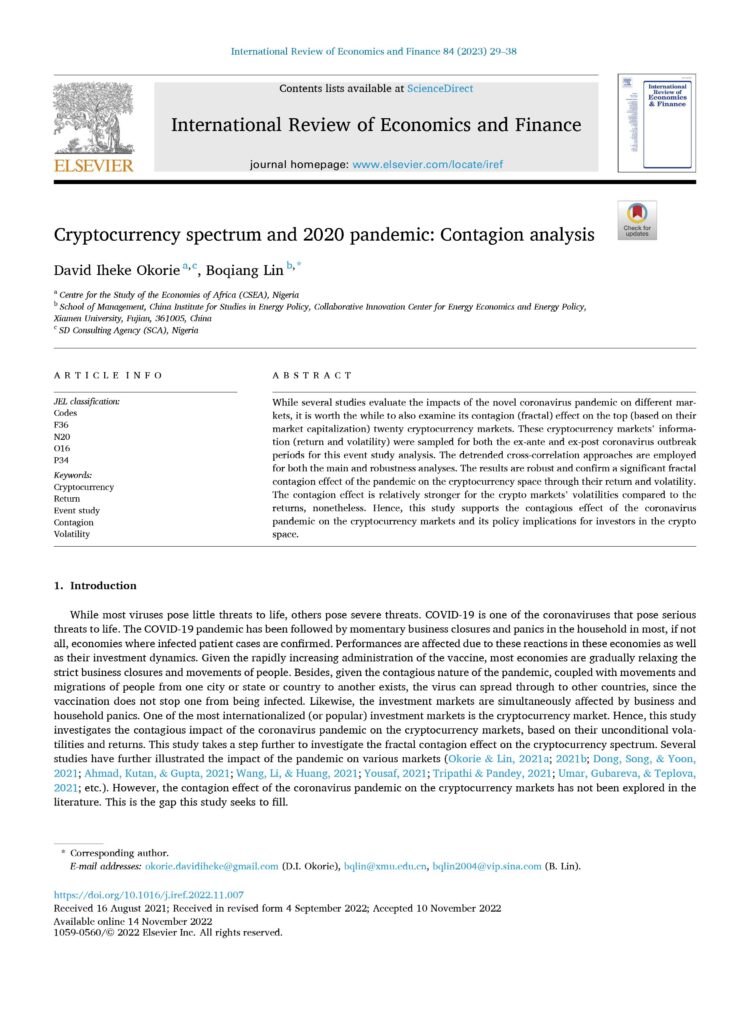
Cryptocurrency spectrum and 2020 pandemic: Contagion analysis

While several studies evaluate the impacts of the novel coronavirus pandemic on different markets, it is worth the while to also examine its contagion (fractal) effect on the top (based on their market capitalization) twenty cryptocurrency markets. These cryptocurrency markets’ information (return and volatility) were sampled for both the ex-ante and ex-post coronavirus outbreak periods for this event study analysis. The detrended cross-correlation approaches are employed for both the main and robustness analyses. The results are robust and confirm a significant fractal contagion effect of the pandemic on the cryptocurrency space through their return and volatility. The contagion effect is relatively stronger for the crypto markets’ volatilities compared to the returns, nonetheless. Hence, this study supports the contagious effect of the coronavirus pandemic on the cryptocurrency markets and its policy implications for investors in the crypto space.

Read More

Read More Download PDF

Attaining Sustainable Development Goals (SDGs): New Evidence on Foreign aid and the “Bundling” of Domestic Revenue Mobilization in Sub-Saharan Africa

With the global sustainable development goals, it has become imperative for developing countries, especially sub-Saharan African countries, to think inward on ways to increase domestically mobilized revenue. The recovery of the global economy within the last few years has increased foreign assistance inflow into African countries. However, the direction of its impact on domestic mobilized revenue is unclear. This study revisited the relationship between foreign aid and domestic mobilized revenues for 32 sub-Saharan African countries using a more recent and novel dataset on tax revenue.

Read More

Read More

Nigeria Economic Update (Issue 50)

Data from the Nigeria Inter-Bank Settlement Systems (NIBSS) shows that transactions performed electronically through the NIBSS Instant Payment platform (NIP) in Nigeria grew to N38.9 trillion in November 2022, which is 12.7 percent higher than the N34.5 trillion recorded in October 20222. On a year-on-year (YoY) basis, the N38.9 trillion value of e-payments increased 50 percent from the N25.9 trillion recorded in November 2021. The growth in e-payment transactions is partly due to the cashless policy of the Central Bank of Nigeria (CBN) and the aftermath effect of COVID-19 on the payment system. COVID-19 made firms introduce online payment into their payment system since people were ordering their products online. As a result, many Nigerians are adopting e-payment channels for payment. The withdrawal limit policy, which will take effect from January 2023, is expected to increase the use of electronic transactions across the country. However, high cybercrimes continue to undermine the effectiveness of the CBN cashless policy. Hence, the CBN and other financial intermediaries involved should focus on strengthening cybersecurity in the country to ensure the safety of funds of individuals and corporate entities.

Read More Download PDF