Policy Brief & Alerts

  • Home
  • Policy Brief & Alerts
Follow via RSS

Understanding The Ongoing Recession In Nigeria:A Synthesis Of The Events And Policy Options

In the second quarter of 2016, the Nigerian economy witnessed its first recession in twenty years due to the interplay of several external and internal factors. The recession has continued until date and has given rise to relentless unemployment rate and job losses, double digit and soaring inflation, currency depreciation and widening gap between parallel market and official exchange rates, amongst other adverse effect on individuals and firms in the country. Thus, there is a need to take a deeper look into the nature of the present recession as well as the impact of monetary and fiscal policy responses thus far, in order to shed light on the way forward towards tackling the recession and ensuring sustainable economic growth. This paper analyses the ongoing recession in the Nigerian economy to provide insights into the interplay of events and recommendations for policy.
Read More Download XPS

The Chinese Model Of Infrastructure Development In Africa

Infrastructural development is a key step in providing a competitive business environment for African economies. It provides the backbone for poverty reduction strategies and programmes designed to improve the livelihood of the poor. Africa is in dire need of infrastructural development. The absence of quality infrastructure in the continent holds back per capita economic growth by 2 percentage points each year and depresses firm productivity by as much as 40 percent (Escribano et al., 2008 and Kelly, 2012). Estimates suggest that around USD 90 billion is required to close Africas infrastructure gap annually until 2020 (AICD, 2010).
Read More Download PDF

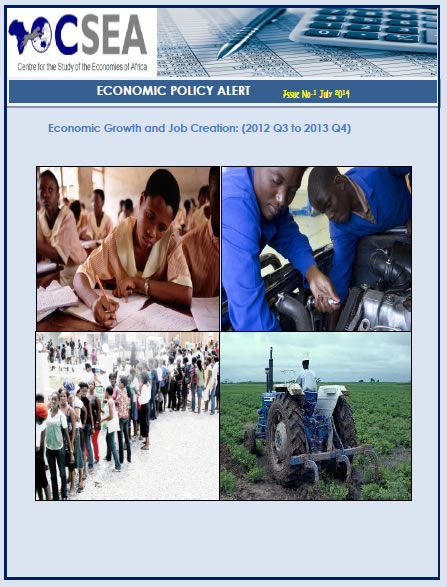
Economic Growth And Job Creation (2012 Q3 To 2013 Q4)

This report examines the pattern of economic growth and employment generation in Nigeria based on quarterly data. It also analyzes the quality of job creation, dynamics of output and employment and establishes the link or absence thereof between economic growth and labor demand.
Read More Download PDF

Increasing Female School Enrollment In Nigeria: Some Policy Options

This brief examines two policy alternatives which government can adopt in order to increase the enrollment of girls in the primary school and also help eliminate gender disparity in Nigerian schools: Provide free primary education with Stipends or provide free primary education with Transportation.
Read More Download PDF

Increasing Measles Immunization Coverage In Borno State Nigeria: Some Policy Options

This brief examines two measles immunization programs for children of age 9-23 months in an effort to boost measles immunization coverage in Borno State: free immunization against measles with media awareness campaign and free immunization against measles with house to house campaign.
Read More Download PDF