Introduction
In recent years, three members have chosen to leave the Organisation of the Petroleum Exporting Countries (OPEC), each concluding that quota-based supply restraint had come into conflict with its own national priorities. After nearly 60 years of membership, Qatar exited OPEC on 1 January 2019 to develop and increase its liquefied natural gas production (the resource in which its comparative advantage lay) from 77 million tonnes per year to 110 million tonnes, rather than remain a small player in an oil cartel.[1]
Angola left OPEC on 1 January 2024, arguing it gained little from remaining in the organisation and that its proposals were having no effect, particularly after objecting to the OPEC+ decision to assign it a production quota of 1.11 million barrels per day (bpd), below the 1.18 million bpd it had proposed. Following its departure, Angola stated it would pursue increased oil production, counter natural decline, and stabilise output rather than remain bound by OPEC production targets.[2]
Most consequentially, the United Arab Emirates formally exited OPEC and the wider OPEC+ alliance on May 1st, 2026, ending a membership held since 1967. The underlying tension was one of capacity against allocation: Emirati crude capacity had reached roughly 4.85 million barrels per day against an OPEC+ allocation of about 3.45 million bpd. More broadly, UAE policymakers appear to have judged that low-cost producers should increase exports while global demand remains strong before electrification, renewable energy growth, climate policies, and shifting consumption trends erode future demand growth.[3]
The three exits differ in detail: Qatar turned from oil to gas, Angola sought to reverse a long decline in output, and the UAE wanted to use capacity it had already built. What they share is a judgement that the quota had come into conflict with their national priorities. Nigeria’s position echoes each of them in part. Like Angola, it is a producer recovering from years of falling output, and official NUPRC figures show that crude production met or slightly exceeded the 1.5 million bpd quota in several months of 2026.
Like the UAE, it has produced far above that level in the past and faces the same prospect of weaker demand growth after 2030. Like Qatar, it is redirecting its energy strategy, with refining capacity expanding rapidly. Nigeria is not identical to any of them, but their experience raises a fair question: does quota-bound membership still serve Nigeria’s economic interests?
This brief contrasts the economic rationale for Nigeria’s 1971 accession with its 2026 realities and asks whether a planned, sequenced departure would better serve its long-term developmental and energy-security interests.
In recent years, Nigeria’s cigarette excise tax structure has improved, especially through the introduction of a mixed tax structure. Since 2018, the government has introduced several tax policy changes, including adopting a mixed structure that combines specific excise taxes with existing ad valorem taxation. The most recent changes were in 2026 with the introduction of a three-year excise schedule (2026–2028) under the Fiscal Policy Measures (FPM), setting the specific excise tax at ₦6.00 per stick in 2026, with rates scheduled to increase to ₦7.00 in 2027 and ₦8.00 in 2028, while maintaining a 30% ad valorem tax on the cost of production. However, this level of taxation is still below the recommendations of both the WHO and ECOWAS. The current tax regime remains insufficient to substantially reduce cigarette affordability, curb tobacco consumption, and maximise the fiscal and public health benefits that stronger tobacco taxation can deliver.
This brief was authored by:
Clinton Essang, Boluwatife Alayande, Halimat Abdulrazaq
Recent evidence suggests that the Nigerian economy has entered 2026 with the weight of a hard-won stabilisation and rising structural fragility. This transition follows the Central Bank of Nigeria (CBN) implementation of several reforms since March 2023. Specifically, the CBN cleared the $7 billion backlog of verified foreign exchange obligations. Inherited in September 2023, settling the residual balance and announcing full clearance in March 2024, following an independent audit by Deloitte Consulting to verify the legitimacy of claims. The CBN also launched a banking sector recapitalisation programme in March 2024, requiring banks to meet substantially higher minimum paid-up share capital thresholds by 31 March 2026.” At the close of the programme, the Nigerian Securities and Exchange Commission (SEC) confirmed that 33 of Nigeria’s 37 banks had met the revised minimum capital requirements, with N4.65 trillion raised in aggregate.
It also allowed the naira to float under a unified, market-driven foreign exchange framework. In addition, the removal of the long-standing fuel subsidy to eliminate a structural fiscal drain also created conditions that generated substantial inflationary pressure.” Moreover, evidence indicates that the foreign exchange reserves recovered substantially, inflation began moderating after a substantial spike, and the manufacturing sector posted predominantly expansionary but uneven PMI readings throughout 2025.
However, analysis points out that Nigeria’s Central Bank now faces a dilemma that those reforms could not resolve. On the one hand, consistently raising monetary policy rates compounds and starves productive investment in real sectors already under severe structural constraints. On the other hand, cutting policy rates risks capital flight. In this light, this article argues that the interaction effects of the four unresolved structural failures in Nigeria’s financial sector, energy sector, manufacturing sector, and fiscal policy have made the monetary policy rate (MPR) a blunt and often less effective instrument.
The African Continental Free Trade Area (AfCFTA), Africa's landmark regional trade agreement, has the potential to expand intra-African trade and create new economic opportunities, including for women traders. However, achieving these gains requires more than reducing tariffs. Women traders continue to face persistent barriers to participation, including limited access to information, weak institutional support, and concerns about the safety and governance of digital trade systems. This policy brief draws on findings from a randomised survey experiment involving 586 women traders in Lagos and Abuja, Nigeria. The study examined whether providing information about the AfCFTA, with and without additional messaging on data governance and digital privacy, influenced women's trust in digital trade systems and willingness to engage in cross-border trade. The findings show that AfCFTA information increased women's confidence in digital trade systems but did not increase their willingness to trade. When information on data governance and digital privacy was added, both digital trust and willingness to trade declined. These findings suggest that awareness alone is insufficient to increase women's participation in AfCFTA-enabled trade. Strengthening data governance, building trust in digital trade infrastructure, and ensuring gender-responsive institutional protections are essential for inclusive AfCFTA implementation.
This brief was authored by:
Evans Osabuohien, Professor of Economics at Covenant University, Ota
and Thelma Obiakor, Research Fellow at CSEA.
Summary
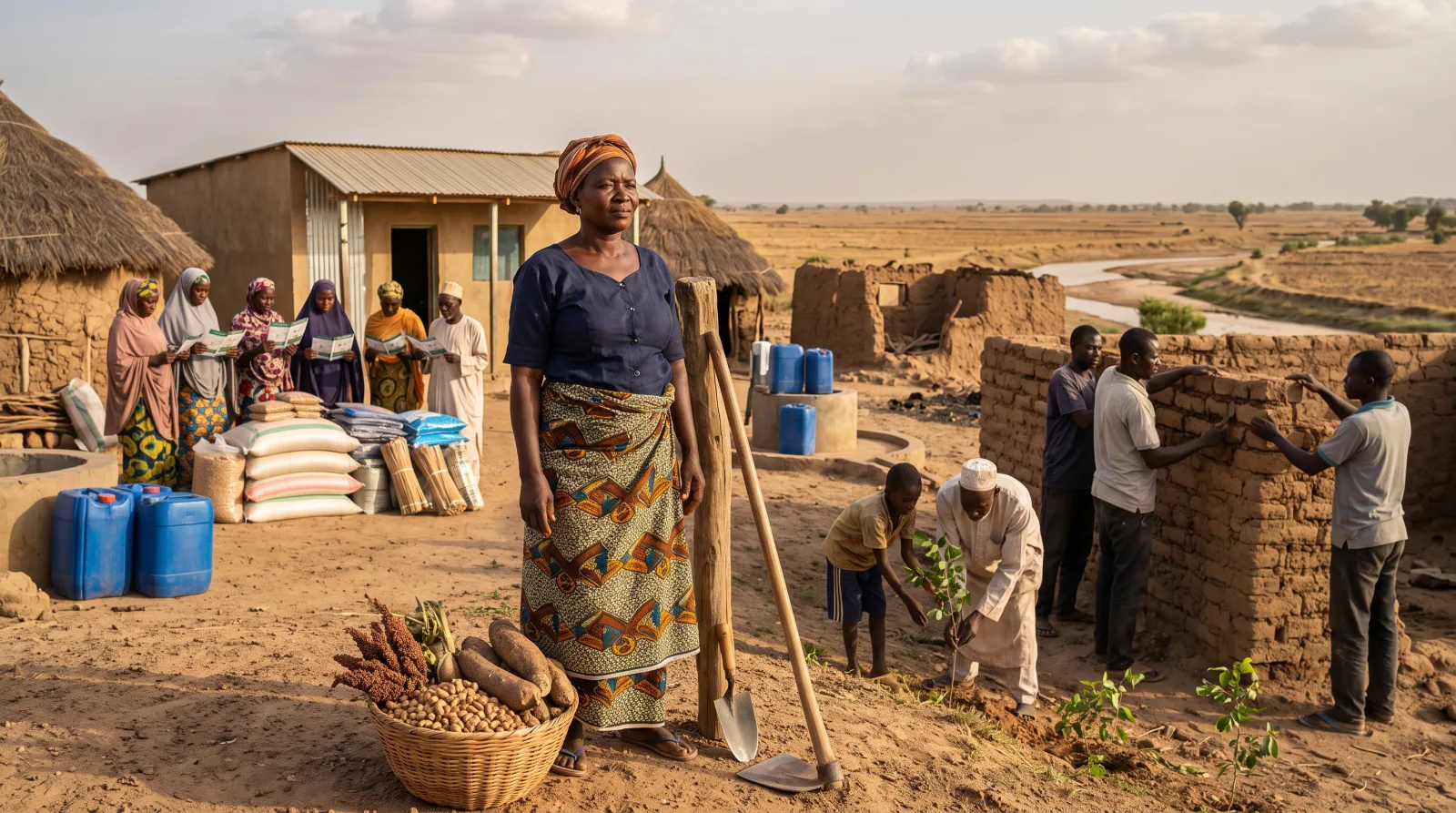
Northern Nigeria faces a growing resilience deficit as climate shocks, conflict, and economic instability converge, exposing households to repeated crises that erode livelihoods and deepen poverty. Despite existing policies on disaster management, social protection, and climate adaptation, responses remain largely reactive, focusing on relief rather than strengthening households’ ability to anticipate, absorb, and recover from shocks. Drawing on recent research, this policy brief argues for an integrated resilience system linking early warning, anticipatory action, adaptive social protection, and livelihood recovery. Lessons from sub-Saharan Africa highlight the importance of coordinated institutions, predictable financing, and shock-responsive systems to build lasting resilience.
Key messages
1. Northern Nigeria is increasingly exposed to overlapping climate hazards, conflict and economic shocks that repeatedly erode household assets, livelihoods and resilience.
2. Current disaster risk management and social protection systems remain largely reactive, with limited coverage, delayed financing and weak coordination, reducing their effectiveness in protecting vulnerable households before shocks occur.
3. Nigeria requires an integrated resilience system that links early warning, pre-arranged financing, adaptive social protection and timely livelihood recovery.
4. Strengthening resilience will require scaling up anticipatory action, expanding adaptive social protection, integrating livelihood recovery into existing programmes, and adopting conflict-sensitive climate responses supported by stronger institutional coordination and more predictable financing.
5. Greater political commitment, stronger coordination and sustained financing are also needed to transform systems into a coherent, shock-responsive resilience architecture.
This study, first published HERE, was developed by the Chronic Poverty Advisory Network, represented institutionally by the Centre for the Study of the Economies of Africa and the Institute of Development Studies.
The authors are grateful to the FCDO, particularly the Data and Evidence to end Extreme Poverty (DEEP) programme, for financial support. DEEP is funded by the UK government’s Foreign, Commonwealth & Development Office (FCDO) through its Global Research and Technology Development portfolio. The author’s views expressed in this publication do not necessarily reflect the views of FCDO.
Authorship: Adedeji Adeniran, Vidya Diwakar and Jamilu Ilyasu.