Sustained political will among government and non-state actors in the policy space has been responsible for the recorded success at the federal level in the implementation of tobacco control policies. In addition, a few states have demonstrated substantial political will by enacting laws on the prohibition of smoking in public places. Given that majority of states are not politically motivated to adopt tobacco control measures, we seek to provide an understanding of what constitutes political will in Nigeria. In view of the concerns around the implementation of tobacco control policies, we also examine the factors that influence political will in order to leverage on positive forces and curb negative forces within the policy environment.
Nigerian tobacco industry operates within an oligopolistic market structure, with BAT owning 79% of market brands, which allows for price differentiation across brands. However, price variations are also observed between the same brand both within and across regions, which suggests non-market factors could also contribute to the variability. For instance, the sale of cigarettes in sticks and the significant distance between production hubs and retail points, which generates asymmetric information, transportation cost and opportunity for arbitrage.
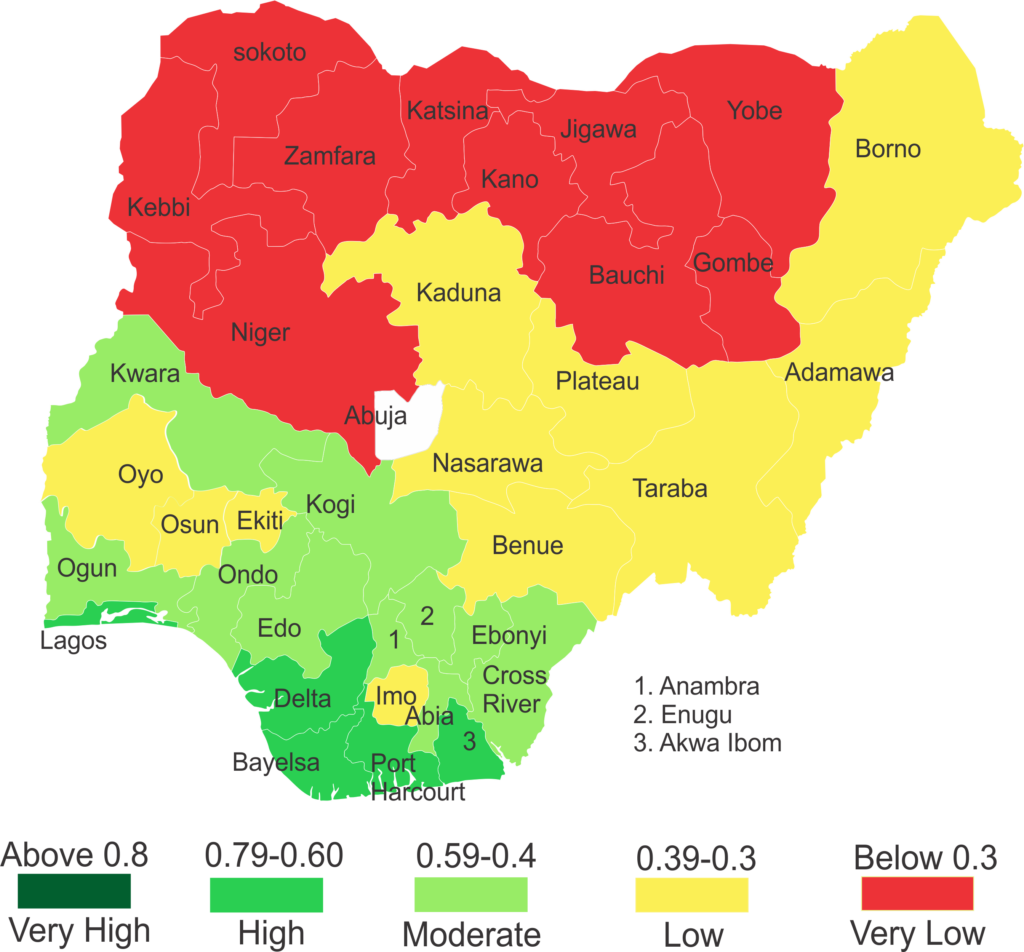
This study develops a comparable Human Development Index for subnational government in Nigeria. While built on the UNDP approach, we extend the generic framework to address challenges at the subnational level such as comparable indicator, data unavailability, and estimation technique. The result shows a wide disparity across states in their human development, with states within the southern region recording more impressive performance. We further examine the key economic and political drivers of the observed variations across the state and found fiscal sustainability and geopolitical zoning as the key determinants.