This policy insight synthesises the findings of six sub-Saharan African country case studies, analysing their government policy responses to the trade and employment shocks prompted by the COVID-19 pandemic. Vulnerability to the shock was most pronounced in the wealthier, more open, diversified and formalised economies (South Africa and Senegal); in Nigeria, where trade and government balances are very sensitive to oil price fluctuations; and in Uganda, which reacted with a strict domestic lockdown.
By contrast, growth decelerated only marginally in Benin and Tanzania, where government reactions were minimal or delayed. The capacity to offer a counter fiscal stimulus, liquidity support through loan guarantees and concessional debt, and an accommodative monetary policy depends on the income status of the economy, depth of financial markets, size of the government sector, and access to global development finance channels.
South Africa and Senegal were able to put into effect the most substantive stimulus packages, while Nigeria was constrained by having the smallest and most volatile tax base and a high bank liquidity profile. Save for Benin and Uganda, which devoted half their stimulus package to health spending, most countries concentrated on industry support and tax relief. Here South Africa was an outlier, instead using 60% of its package for unemployment and social security benefits owing to a sharp rise in unemployment and food stress.
Data from the National Bureau of Statistics (NBS) shows that the average retail price of Automotive Gas Oil (Diesel) paid by consumers in Nigeria increased by 181 percent from N238.82 in May 2021 to N671.08 recorded in May 2022.4 On a month-on-month basis, the average retail price increased from N654.46 in April 2022, indicating a rise of 2.54 percent compared to the average retail price paid in May 2022. The rising cost of diesel is partly due to the Russia-Ukraine conflict. The economic sanctions imposed on Russia, a leading oil producer, in the international market have disrupted the global distribution chain for crude oil. As a result, diesel produced from crude oil is currently in low supply, resulting in a hike in its price. With the poor power supply in the country, most businesses depend on diesel-powered generators for electricity to carry out their production and other activities. The rising cost of diesel has increased the costs of businesses and put them at risk as their costs have increased significantly. The impact of the increase in diesel on business cost of operation is due to the country’s poor power situation and the reliance on the importation of diesel. In the short run, the government could support businesses by providing financial support to SMEs to survive the current high operating cost induced by high diesel prices. In the medium and long run, the government needs to focus on the power and refinery production capacity. An improvement in the power situation would reduce businesses’ reliance on diesel to power their operation. Also, the government needs to intensity efforts to increase the number of functioning refineries in the country thereby increasing domestic production of refined petroleum products, including diesel. Improvement in the power situation and an increase in domestic diesel production would reduce the businesses expenditure on diesel and reduce their overall cost of operation.
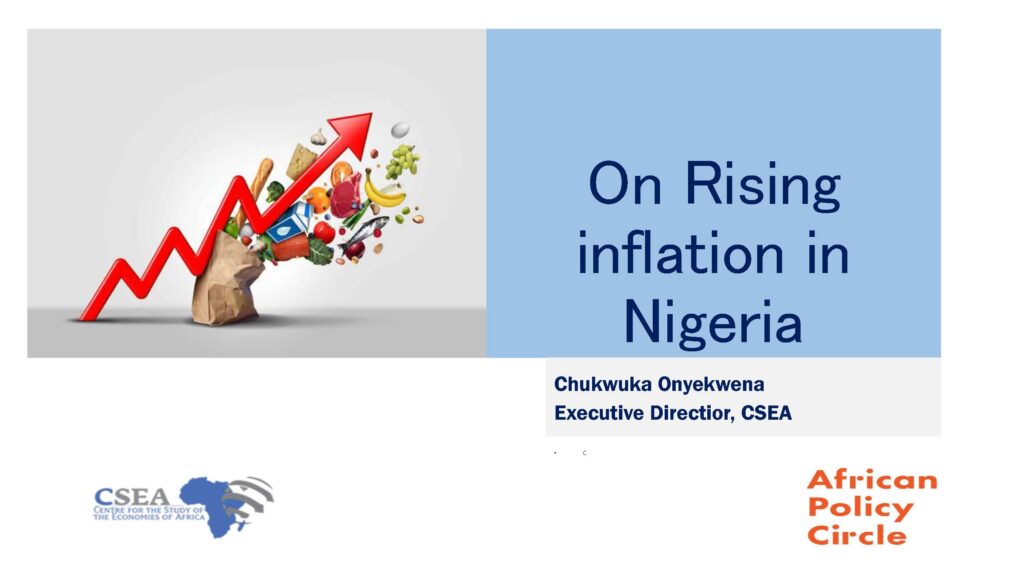
The inflationary episode intensified after the border closure in 2019. The disproportionate impact of inflation on vulnerable households and those working in sectors with low savings, such as agriculture, have worsen living standard over time.
African indigenous businesses (AIBs) are in the nascent stages of becoming data-driven and innovative through data analytics. The data-driven agenda looks promising in industries like manufacturing (distribution), health, agriculture, and online platforms like social media, with enterprises deriving economic and symbolic value from descriptive, diagnostic, and predictive analytics. These data-driven activities tend to be often directly or indirectly enabled by the quest of multinational companies, who as business partners or collaborators of AIBs seek to mutually maximise value-generating activities. Thus, these multinational companies play a key role in creating awareness of the value of data and providing the motivation, and sometimes the technical and human resources, to enable AIBs to develop data analytics capabilities.
Concerning constraints, there is generally a lack of awareness regarding the value of data. AIBs are challenged in providing auxiliary resources and processes for a data-driven agenda (i.e., recruiting the right skillsets, acquiring logistics, paying for software licenses, and meeting regulatory standards, among others). Further, some are yet to scale above existing digitalisation barriers.
The fact is that indigenous firms are still struggling to manage resources to invest in basic IT infrastructure. Hence data analytics adoption, which requires both human personnel and technical infrastructure, is often yet to be strategically considered, shelved for the future, or even when outsourced, it is often poorly managed and under-resourced. Others are also driven by the visibility and immediacy of results or value, which is not a characteristic of data analytics. Data analytics often requires a more intentional strategic alignment to business processes, and otherwise, its value may not be realised. Further, for innovation to occur, data analytics processes must be sustainable. It is often a long-term value realisation activity, which many indigenous firms tend to shy away from due to limited resources and understanding. The report argues for the need to enhance data analytics use at the national and regional levels. It proposes fifteen recommendations for creating an all-inclusive enabling environment for indigenous businesses.
The June edition of the Monthly Oil Market Report (MOMR) of the Organization of Petroleum Exporting Countries (OPEC) shows that Nigeria produced an average of 1,262 million barrels per day (mbpd) in May 2022.2 This indicates a 3.45 percent decline from 1,306 mbpd produced in the preceding month, April. The continuous decline in production is partly due to poor oil sector management, theft, and ageing production facilities. The report also noted that the price of the OPEC reference basket of crude oil rose to $113.87 per barrel over the same period. As an oil-producing nation, the rising crude oil price should serve as a revenue windfall. However, Nigeria is unlikely to experience a wholesome benefit due to the following factors – low oil production, continued petroleum subsidy regime, and increased importation of refined petroleum products. In Nigeria, crude oil accounted for 79.2 percent of total exports in Q1 2022, suggesting that crude oil is still the most significant source of foreign exchange.3 Therefore, the continuous decline in crude oil production indicates a loss of foreign exchange earnings that could have helped bolster the country's foreign reserves and reduce the pressure on the domestic currency. Consequently, the government is encouraged to intensify efforts at replacing ageing infrastructure and providing immediate and lasting solutions to the insecurity in oil-producing areas. These interventions are essential in ensuring that the country reverses the declining trend of crude oil production and experiences maximum earnings gain associated with the current high crude oil prices.
The value of capital importation into Nigeria in the first quarter of 2022 (Q1 2022) decreased to US$1.57 billion from US$2.19 billion recorded in the preceding quarter.1 When compared on a year-on-year basis to Q1 2021, capital importation decreased by 17.46 percent from US$1.91 billion. The largest inflow of capital importation by type was Portfolio Investment, accounting for $957.58 million (60.87 percent), followed by other claims and Loans (Other Investments), which amounted to US$460.59 million (29.28 percent), and Foreign Direct Investment (FDI), which accounted for $154.97 million (9.85 percent). The data shows that Lagos (71.16 percent) and Abuja (28.40 percent) are Nigeria's leading capital inflow destinations. Despite successive GDP growth, the decrease in total capital importation is related to the perceived high political risk and restrictive foreign exchange policy. Consequently, to encourage foreign investments in Nigeria, the Federal Government should move toward a more flexible exchange policy that would place fewer restrictions on the repatriation of capital and profit by investors. In addition, the government should aim to reduce political risk by institutionalizing frameworks that would ensure that political activities do not hinder the implementation of planned reforms to attract investments. Also, there is a need for learning tours at the sub-national level. Underperforming states need to go to states with significant capital inflows to understand how they could reposition their states to attract investments.
This brief provides an analytical snapshot of the economy and public finances in Nigeria. It is based on publicly available data produced by the Government of Nigeria, and a range of secondary analyses. It is part of a package of 6 country briefs commissioned by the Bill and Melinda Gates Foundation (BMGF) and is intended to provide a common analytical backdrop to BMGF programming in the country.
The lead authors of this brief are Owen Willcox, Dumebi Ubogu, Adedeji Adeniran, Mma Ekeruche, Dozie Okoye, Sone Osakwe and Gbadebo Odularu.
The Monetary Policy Committee (MPC) of the Central Bank of Nigeria (CBN) met on the 23rd and 24th of May 2022 to deliberate on local and global economic development. At the end of the meeting, the MPC increased the Monetary Policy Rate (MPR) by 150 basis points to 13 percent from 11.5 percent1. However, the MPC retained the Cash Reserve Ratio (CRR) at 27.5 percent and the Liquidity Ratio at 30 percent. The committee noted that even though the economy has been experiencing growth for six consecutive quarters, inflationary pressures persist. As a result, the MPC thinks that increasing the MPR will reduce the inflation levels in the economy. While the increase in MPR is likely to signal to investors the Bank’s readiness to reduce the inflation rate, there is a need for complementary fiscal policy to ensure that the economy is not severally affected. An increase in MPR is likely to increase the cost of borrowing, which might slow down business activities. Apart from the high cost of borrowing, insecurity, poor transport system, and erratic power supply contribute to the high cost of doing business in Nigeria. A steady power supply, an efficient transport system, and improved security achieved through complementary fiscal policies would reduce the cost of business and contribute to achieving low inflation.


 English
 Arab
Arab
 Deutsch
 Português
 China
China