Publications

Follow via RSS

Artificial Intelligence Usage in Nigeria: Evidence from Digitally Enabled Firms

Nigeria’s digital transformation is advancing within the broader global shift towards Artificial Intelligence (AI), a technology that is rapidly reshaping business models, productivity, and competitiveness across sectors. This report provides empirical findings into the state of AI use in Nigeria, drawing on data from a survey of 528 digitally-enabled firms located in Lagos State, Rivers State, and Abuja. It focuses on identifying key trends, drivers, benefits, barriers, risks, mitigation strategies, and data governance practices that shape AI usage by digitally-enabled firms in Nigeria.

Read More Download PDF

When the Floodwaters Rise, Classrooms Empty: Nigeria’s Overlooked Climate Education Crisis

Despite the policy of free and compulsory primary education, Nigeria has one of the highest numbers of out-of-school children in the world, with an estimated 10.5 million of the country’s children, aged 5 to 14, not currently enrolled. This figure accounts for about 15 percent of the global out-of school population. The scale of exclusion highlights the fragile state of Nigeria’s education system and points to a deep, persistent crisis in access to basic learning opportunities. Yet as daunting as this reality is, it is being quietly and rapidly intensified by another force: climate change. Across the globe, climate hazards disrupted learning for at least 242 million children in 2024 alone, according to UNICEF. In Sub-Saharan Africa (Fig. 1), Nigeria was among the most affected, with over 2.2 million children facing school interruptions due to floods, a major extreme weather event battering infrastructure, displacing families, and derailing education systems.

Read More Download PDF

Nigeria Economic Update, Issue 23

According to the Organisation of Petroleum Exporting Countries (OPEC) monthly report, the global price of crude oil decreased by 7.8% month-on-month in May 2025. The report showed that the OPEC Reference Basket (ORB) value fell by $5.36 to an average of $63.62 per barrel, down from $68.98 in April 2025. Nigeria’s Bonny Light crude also declined by 5.8%, from $68.48 per barrel in April 2025 to $64.55 per barrel in May. Lower Bonny Light prices could reduce oil revenue, thus constraining the government’s ability to implement public spending plans. The report also revealed that Nigeria’s average daily crude oil production (based on direct communication) dropped month-on-month by 2.22%, from 1.486 million barrels per day (bpd) to 1.453 million bpd in May 2025. Moreover, oil production was 3.13% below OPEC’s 1.5 million bpd quota and a significant 30.8% short of the country’s 2025 target of 2.1 million bpd. To address these developments, the Nigerian government should focus on increasing oil production by repairing critical infrastructure, enhancing efficiency, and supporting upstream investments such as exploration and drilling to meet production targets. Furthermore, due to the volatility of the sector, the government should strengthen efforts to diversify the economy by investing in strategic sectors like agriculture, manufacturing, and the digital economy to reduce dependence on oi

Read More Download PDF

Nigeria Economic Update, Issue 22

In April 2025, the Federation Account Allocation Committee (FAAC) distributed ₦1.7 trillion to Nigeria’s three tiers of government, drawn from a total revenue pool of ₦2.8 trillion available for the month. By tier, the allocation included ₦565 billion to the federal government, ₦556 billion to state governments, and ₦406 billion to local governments, while mineral-producing states received ₦152.6 billion as 13% derivation revenue. Total deductions for collection costs in April stood at ₦101.1 billion, while total transfers, interventions, refunds, and savings amounted to ₦1.07 trillion. Revenue from Value Added Tax (VAT) stood at ₦642.3 billion, representing an increase of ₦4.6 billion from the ₦637.6 billion available in the previous month. The Electronic Money Transfer Levy (EMTL) contributed ₦38.9 billion, distributed as ₦5.8 billion to the federal government, ₦19.4 billion to state governments, and ₦13.6 billion to local governments. The increase in revenue was driven by growth in Petroleum Profit Tax (PPT), Oil and Gas Royalty, EMTL, VAT, Excise and Import duties. However, Company Income Tax (CIT) declined significantly. The rise in VAT and EMTL revenue highlights the growing importance of consumption and digital transaction taxes and signals a potential to rebalance revenue away from overdependence on oil. Therefore, there is a need to expand and improve tax compliance, while reforming CIT frameworks to encourage business formalisation and enhance long-term tax performance.

Read More Download PDF

Nigeria Economic Update, Issue 21

Data from the Central Bank of Nigeria (CBN) indicated that in May 2025, the Naira averaged ₦1,595 per US dollar in the official foreign exchange market. This reflects a month-on-month stability of the currency against the US dollar, as it averaged about the same amount in April. The relative stability of the Naira against the US dollar is likely caused by the increase in the country’s foreign reserves. In May 2025, the CBN launched the Non-Resident Diaspora Bank Verification Number (NRBVN) platform to enhance financial integration with Nigerians abroad and boost foreign exchange inflows through increased remittances, thus strengthening the Naira. Additionally, the narrowing gap between official and parallel market exchange rates might have significantly contributed to the currency's stability against the USD. However, additional policies are needed to achieve sustained currency stability and strength. Some of these policies include supporting local businesses to produce import substitutes by improving access to credit and technology. Critical investments in the health and education sectors are also essential to reduce the demand for foreign services such as medical tourism, which

Read More Download PDF

Nigeria Economic Update, Issue 20

Data from the Central Bank of Nigeria (CBN) revealed the Naira exhibited a modest recovery in May 2025, with the average exchange rate settling at ₦1,595.098/$, compared to ₦1,604.70/$ in April 2025. This reflects a month-on-month appreciation of 0.48%, signalling slight improvements in foreign exchange liquidity and easing pressure on the naira. The strengthening can be linked to cautious interventions by the Central Bank. However, on a year-on-year basis, the naira depreciated significantly. The closing rate in May 2024 stood at ₦1,482.98/$, indicating that the naira weakened by 7.39% over the 12-month period. This reflects structural weaknesses in the FX market, including high import demand, limited non-oil exports, and dwindling capital inflows. During the review period, the naira traded within a narrow band, with the lowest rate at ₦1,579/$ (May 23, 2025) and the highest in April at ₦1,644/$ (April 9, 2025), indicating relative stability in May compared to heightened volatility in April. Notably, the naira appreciated for three consecutive days from May 19 21, 2025, suggesting improved market confidence. Despite this temporary easing, exchange rate volatility continues to severely impact consumers and companies through the persistent rise in the prices of goods, services, and input costs. Thus, to ensure long-term currency stability, policymakers must focus on rebuilding external reserves and enhancing non-oil exports by strengthening the manufacturing sector. 

Read More Download PDF

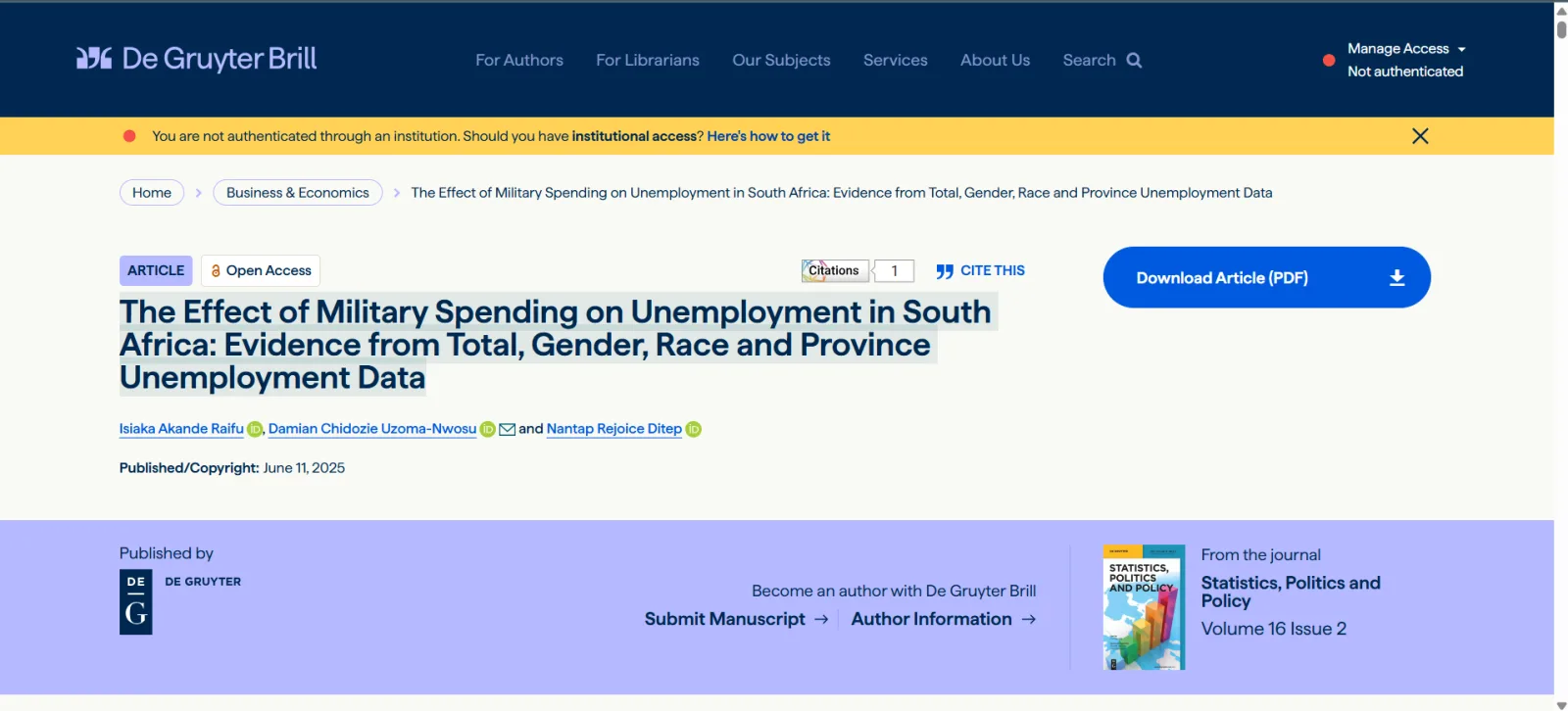
The Effect of Military Spending on Unemployment in South Africa: Evidence from Total, Gender, Race and Province Unemployment Data

Despite the disparity in unemployment rates across gender, race and provinces, no study has captured the influence of military spending on unemployment rates among these groups in South Africa (SA). Thus, this study investigated the effects of military spending on total, gender, racial and provincial unemployment in SA over 2008Q1 to 2023Q4. The study applied Autoregressive distributed lag model (ARDL), Dynamic ARDL and Kernel-based Regularized Least Squares (KRLS), to predict the counterfactual shocks of unemployment rates based on a ±1 % change in military spending. From the ARDL, a rise in military spending reduced total, male, female, black race, and Gauteng, Eastern Cape, Mpumalanga Kwazulu Natal and Northwest provinces’ unemployment rates, in the short- and long run, but increased it among the Coloured, White and the Indian/Asian races and the Western Cape, Northern Cape and Free State provinces, in the short and long run. The DARDL simulation and the KRLS showed that a 1 % decrease (increase) in military spending increased (reduced) total, male, female, Black and North West, Gauteng, Eastern Cape, Mpumalanga, KwaZulu Natal and Limpopo unemployment rates in the short run before flattening in the long run. Conversely, a 1 % decrease (increase) in military spending reduced (increased) the unemployment rates in the Coloured, White and Indian/Asian Races, Western Cape, Northern Cape and Free State Provinces, in the short run while flattening it in the long run. The effect of military spending in SA are not homogeneous among the Races and Provinces. Therefore, government policies aimed at curbing unemployment should recognise the peculiarities of the races and provinces.

Read More

Read More

Nigeria Economic Update, Issue 19

The Monetary Policy Committee (MPC) of the Central Bank of Nigeria (CBN), in its 300th meeting held on the 19th and 20th of May 2025, resolved to retain the Monetary Policy Rate (MPR) at 27.50%, maintain the Cash Reserve Ratio (CRR) of Deposit Money Banks (DMBs) at 50%, and retain the Liquidity Ratio at 30%. This tight monetary stance was adopted to combat inflation and stabilise the economy. Members of the committee noted that rising inflation was driven by high electricity prices and persistent pressure from foreign exchange demand. They also expressed concerns about the recent decline in crude oil prices, attributed to increased production by non-OPEC member countries. The current MPR marks the committee’s second consecutive hold since January 2025. While the elevated MPR and CRR help curb demand-side inflation by reducing excess liquidity in the financial system, inflation in Nigeria remains largely supply-driven. As such, monetary tightening alone may not be sufficient. Furthermore, with a CRR of 50%, domestic banks are required to keep a significant portion of their funds with the CBN, limiting banks’ lending. Therefore, emphasis should not be on monetary policies alone but should be complemented by fiscal policy. This includes investments in energy infrastructure to increase electricity supply, which in turn would lower firms' spending on alternative energy use. In addition, the government should strengthen the development bank to scale targeted lending for micro, small, and medium-sized enterprises to bolster production, which in turn would curb inflation. 

Read More Download PDF

Nigeria Economic Update, Issue 18

The Central Bank of Nigeria’s (CBN) Purchasing Managers’ Index (PMI) report for April 2025 revealed that composite PMI stood at 52.2 index points, marking the fifth consecutive month of economic expansion, signalling sustained positive momentum in the Nigerian economy. The industry sector (51.8 index points) recorded expansion for the fourth consecutive month, driven by increased outputs. Similarly, the services sector index, at 51.8 index points, signalled an expansion of economic activities in the month under review, which is attributable to increases in the number of incoming businesses. Most importantly, the agriculture sector led by 53.8 index points, extending its expansion streak to nine months, with increases in new orders fuelling the identified expansion in the month under review. Composite output (53.2 points), new orders (53.2 points), and employment level (50.7 points) also recorded growth in the month under review. This overall expansion sets a positive tone for Q2 2025. Despite these gains, the report reveals ongoing pressure on business profit margin as input costs continue to outpace output prices. To moderate input costs and ensure that economic expansion is sustained, there is a need to extend grants, tax reliefs, and other incentives to input manufacturing firms in Nigeria.

Read More Download PDF