Macroeconomic Report & Economic Updates

  • Home
  • Macroeconomic Report & Economic Updates
Follow via RSS

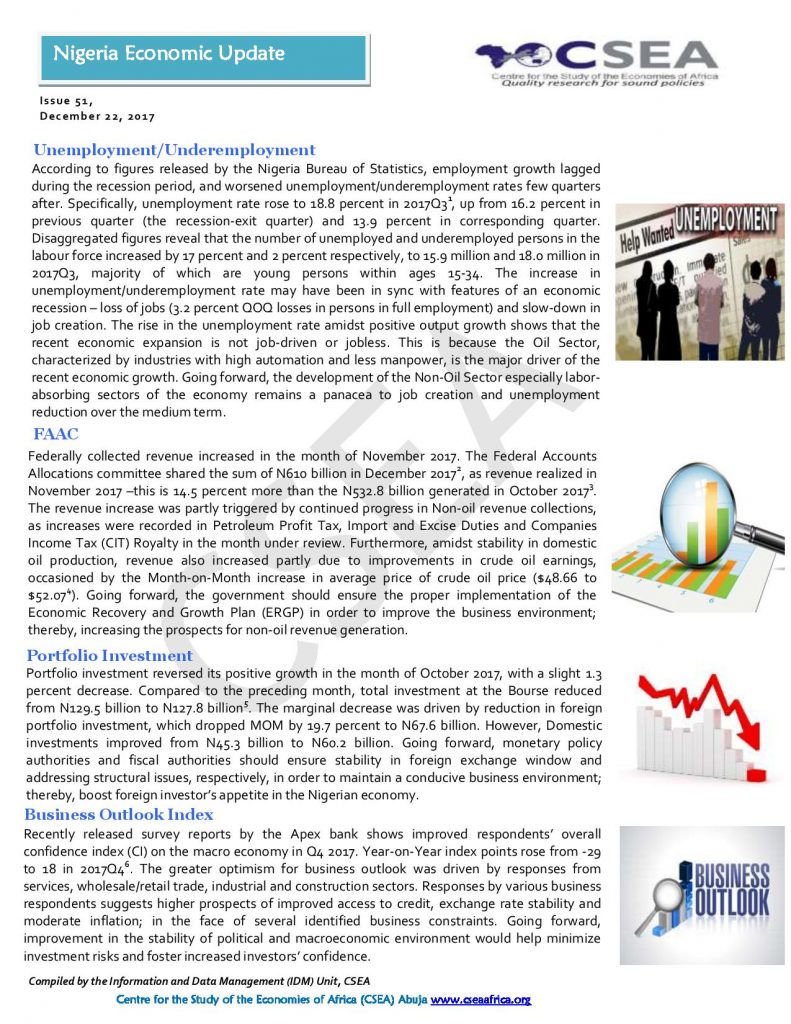
Nigeria Economic Update (Issue 51)

According to figures released by the Nigeria Bureau of Statistics, employment growth lagged during the recession period, and worsened unemployment/underemployment rates few quarters after. Specifically, unemployment rate rose to 18.8 percent in 2017Q31, up from 16.2 percent in previous quarter (the recession-exit quarter) and 13.9 percent in corresponding quarter. Disaggregated figures reveal that the number of unemployed and underemployed persons in the labour force increased by 17 percent and 2 percent respectively, to 15.9 million and 18.0 million in 2017Q3, majority of which are young persons within ages 15-34. 
Read More Download PDF

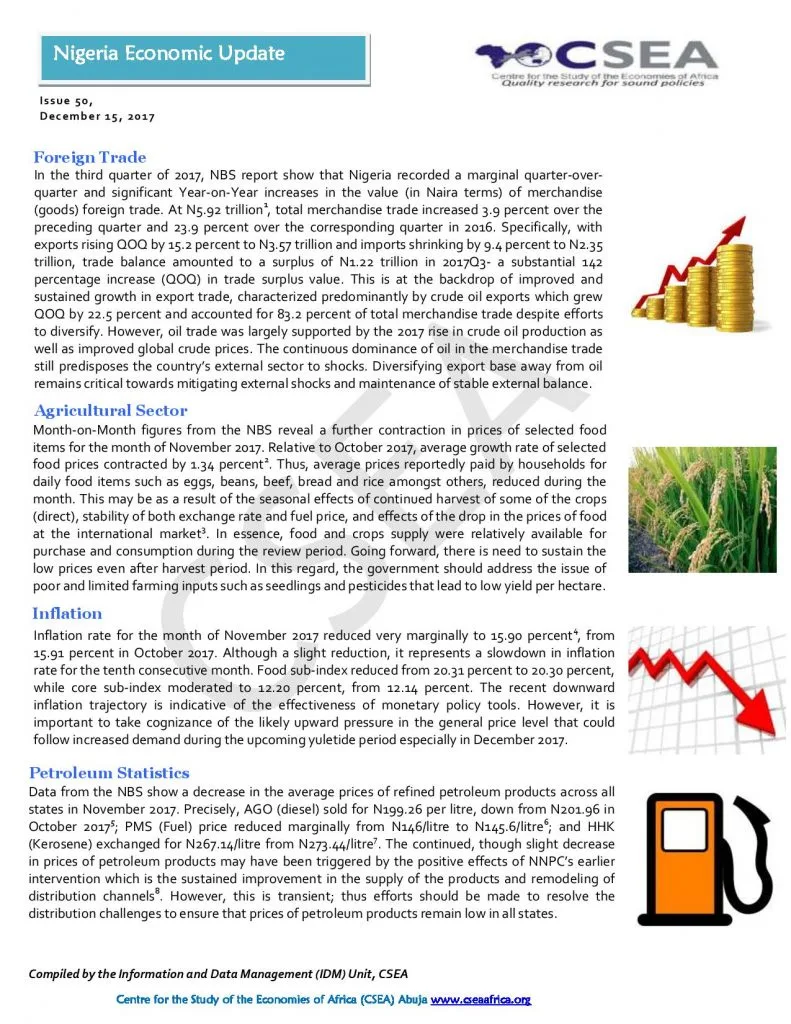
Nigeria Economic Update (Issue 50)

In the third quarter of 2017, NBS report show that Nigeria recorded a marginal quarter-overquarter and significant Year-on-Year increases in the value (in Naira terms) of merchandise (goods) foreign trade. At N5.92 trillion, total merchandise trade increased 3.9 percent over the preceding quarter and 23.9 percent over the corresponding quarter in 2016. Specifically, with exports rising QOQ by 15.2 percent to N3.57 trillion and imports shrinking by 9.4 percent to N2.35 trillion, trade balance amounted to a surplus of N1.22 trillion in 2017Q3- a substantial 142 percentage increase (QOQ) in trade surplus value.
Read More Download PDF

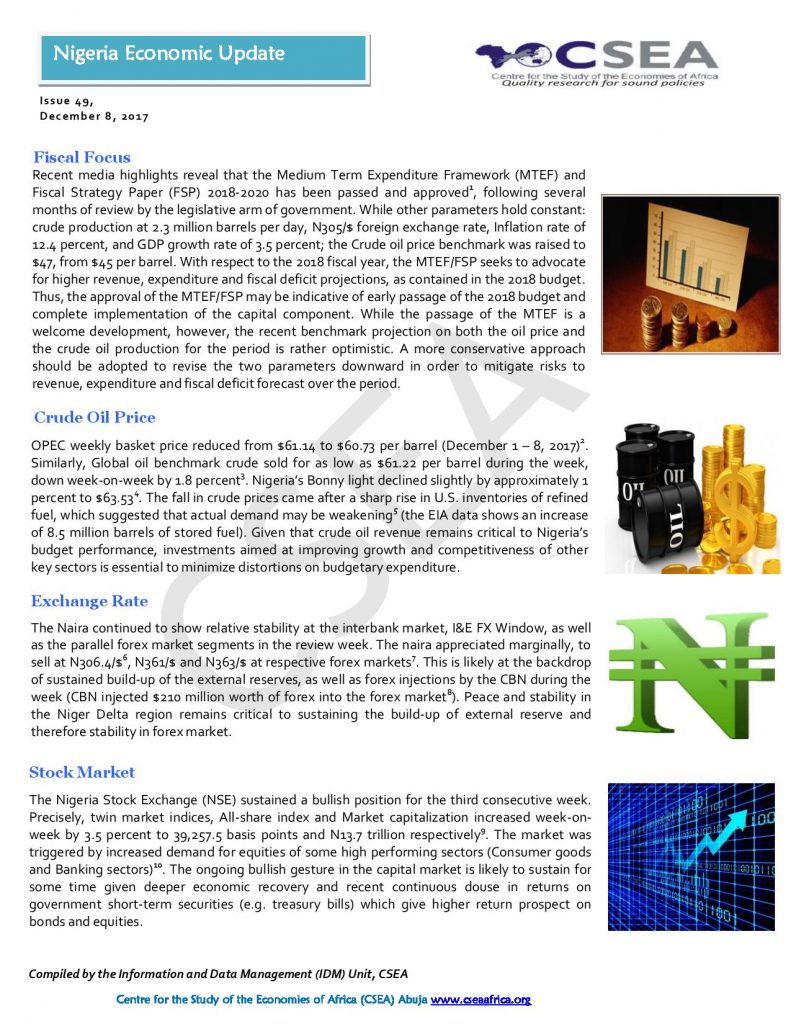
Nigeria Economic Update (Issue 49)

OPEC weekly basket price reduced from $61.14 to $60.73 per barrel (December 1 8, 2017). Similarly, Global oil benchmark crude sold for as low as $61.22 per barrel during the week, down week-on-week by 1.8 percent. Nigerias Bonny light declined slightly by approximately 1 percent to $63.534. The fall in crude prices came after a sharp rise in U.S. inventories of refined fuel, which suggested that actual demand may be weakening5 (the EIA data shows an increase of 8.5 million barrels of stored fuel). Given that crude oil revenue remains critical to Nigerias budget performance, investments aimed at improving growth and competitiveness of other key sectors is essential to minimize distortions on budgetary expenditure.
Read More Download PDF

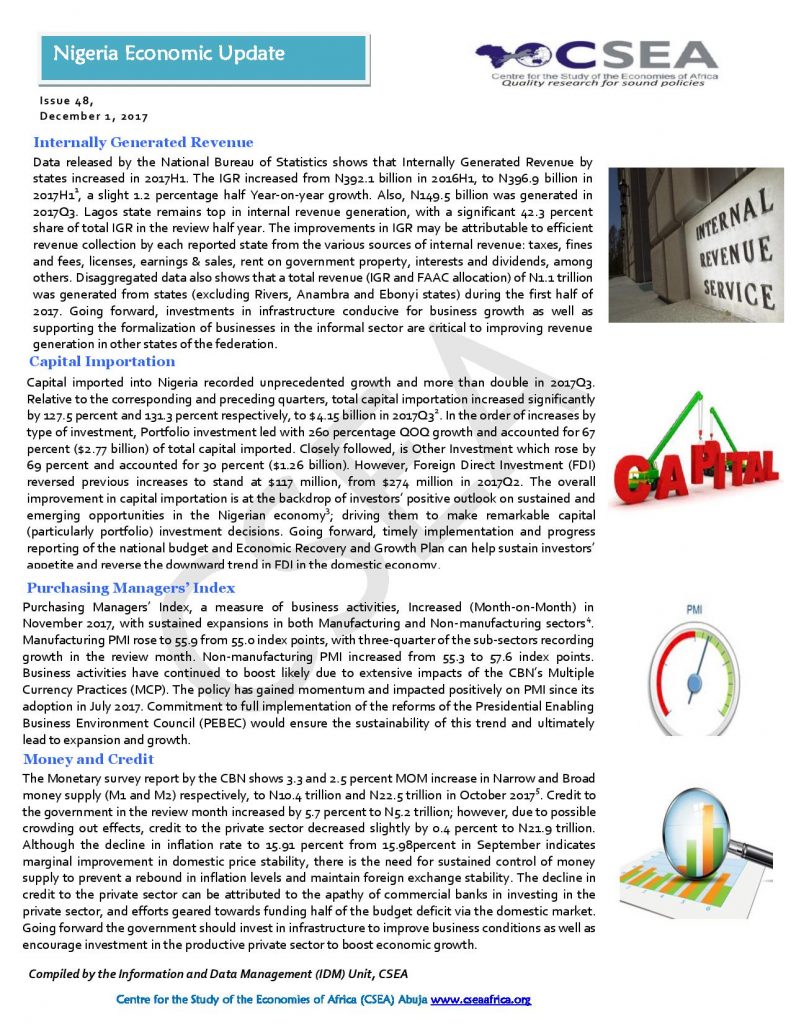
Nigeria Economic Update (Issue 48)

Data released by the National Bureau of Statistics shows that Internally Generated Revenue by states increased in 2017H1. The IGR increased from N392.1 billion in 2016H1, to N396.9 billion in 2017H1, a slight 1.2 percentage half Year-on-year growth. Also, N149.5 billion was generated in 2017Q3. Lagos state remains top in internal revenue generation, with a significant 42.3 percent share of total IGR in the review half year. The improvements in IGR may be attributable to efficient revenue collection by each reported state from the various sources of internal revenue: taxes, fines and fees, licenses, earnings & sales, rent on government property, interests and dividends, among others. 
Read More Download PDF

Nigeria Economic Update (Issue 47)

Recently released data by the Debt Management Office reveals a further increase in Nigerias debt stock as at the end of 2017Q3. Total debt stock stood at N20.37 trillion as at September 20172, increasing by 3.75 percent Quarter-over- Quarter and 20.67 percent Year-on-Year. External debts rose 2 percent to N4.69 trillion, while domestic debts (FGN and States) grew by 4.3 percent to N15.68 trillion both accounting for approximately 23 percent and 77 percent of total debt stock respectively. Obviously, Nigerias increasing debt accumulation at a rate faster than GDP growth rate, clearly exacerbates difficulties in meeting debt repayment and sustainability of debt servicing measures. The recent borrowing surge should be utilized to provide socially viable and profitable infrastructure so as to minimize the future debt burden.
Read More Download PDF