Macroeconomic Report & Economic Updates

  • Home
  • Macroeconomic Report & Economic Updates
Follow via RSS

Nigeria Economic Update (Issue 13)

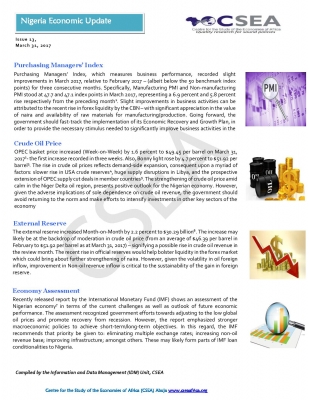
OPEC basket price increased (Week-on-Week) by 1.6 percent to $49.45 per barrel on March 31, 2017- the first increase recorded in three weeks. Also, Bonny light rose by 4.7 percent to $51.92 per barrel. The rise in crude oil prices reflects demand-side expansion, consequent upon a myriad of factors: slower rise in USA crude reserves, huge supply disruptions in Libya, and the prospective extension of OPEC supply cut deals in member countries. The strengthening of crude oil price amid calm in the Niger Delta oil region, presents positive outlook for the Nigerian economy. However, given the adverse implications of sole dependence on crude oil revenue, the government should avoid returning to the norm and make efforts to intensify investments in other key sectors of the economy
Read More Download PDF

Africa Economic Update (Issue 2)

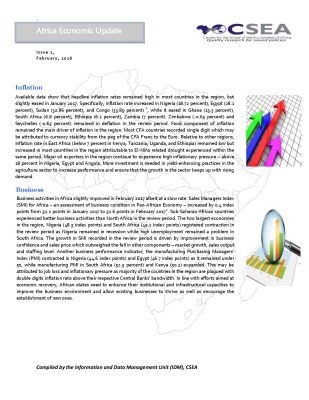
Business activities in Africa slightly improved in February 2017 albeit at a slow rate. Sales Managers Index (SMI) for Africa an assessment of business condition in Pan-African Economy increased by 0.4 index points from 52.2 points in January 2017 to 52.6 points in February 2017. Sub-Saharan African countries experienced better business activities than North Africa in the review period. The two largest economies in the region, Nigeria (48.5 index points) and South Africa (49.2 Index points) registered contraction in the review period as Nigeria remained in recession while high unemployment remained a problem in South Africa. The growth in SMI recorded in the review period is driven by improvement in business confidence and sales price which outweighed the fall in other components market growth, sales output and staffing level. 
Read More Download PDF

Nigeria Economic Update (Issue 12)

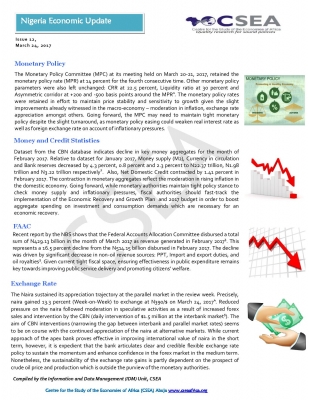
The Naira sustained its appreciation trajectory at the parallel market in the review week. Precisely, naira gained 13.3 percent (Week-on-Week) to exchange at N390/$ on March 24, 2017. Reduced pressure on the naira followed moderation in speculative activities as a result of increased forex sales and intervention by the CBN (daily intervention of $1.5 million at the interbank market.) The aim of CBN interventions (narrowing the gap between interbank and parallel market rates) seems to be on course with the continued appreciation of the naira at alternative markets. While current approach of the apex bank proves effective in improving international value of naira in the short term, however, it is expedient that the bank articulates clear and credible flexible exchange rate policy to sustain the momentum and enhance confidence in the forex market in the medium term. Nonetheless, the sustainability of the exchange rate gains is partly dependent on the prospect of crude oil price and production which is outside the purview of the monetary authorities.
Read More Download PDF

Nigeria Economic Update (Issue 10)

Nigerias external reserve rose to its 19-month high in the week under review (March 3, 2017 to March 10, 2017). Precisely, the reserve improved by a daily average-percentage-increase of 0.21 percent, from $29.79 billion on March 3, 2017 to $30.04 billion on March 10, 2017  the highest level since August 2015. The rising reserve at the backdrop of steady revenue from improved domestic crude oil production/prices and forex inflows from rising exports, has reduced pressure on the Naira the naira has witnessed marginal but steady appreciation. While the recent improvement in oil revenue is a welcome development, concerted efforts need be made to develop the Non-oil sector so as to mitigate future oil revenue shocks.  
Read More Download PDF

Nigeria Economic Update (Issue 11)

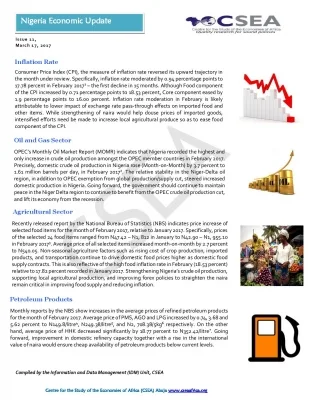
Recently released report by the National Bureau of Statistics (NBS) indicates price increase of selected food items for the month of February 2017, relative to January 2017. Specifically, prices of the selected 24 food items ranged from N47.42 N1, 812 in January to N42.90 N1, 955.10 in February 2017. Average price of all selected items increased month-on-month by 2.7 percent to N540.05. Non-seasonal agriculture factors such as rising cost of crop production, imported products, and transportation continue to drive domestic food prices higher as domestic food supply contracts. This is also reflective of the high food inflation rate in February (18.53 percent) relative to 17.82 percent recorded in January 2017. Strengthening Nigerias crude oil production, supporting local agricultural production, and improving forex policies to straighten the naira remain critical in improving food supply and reducing inflation.
Read More Download PDF