The World Bank, at the launch of November 2021 edition of Nigeria’s Development Update discussed the state of Nigeria’s economy and made several policy recommendations. One of the notable suggestions was that of fixing the exchange rate policies in the country. According to the report, the existence of parallel rates in the foreign exchange market is one of the drivers of inflation in the country, which has pushed about 8 million Nigerians into poverty since 2020. The bank recommended that to curb inflation in the economy, exchange rate management ought to be predictable and flexible, thus, emphasise the need to have a uniform exchange rate. Given the administrative goal of lifting 100 million Nigerians out of poverty by 2030, it is imperative to address high inflation rate by introducing policies that would bring the rate below a single digit. The unification of the exchange rate might be important in achieving lower inflation by reducing arbitrage in the foreign exchange market. However, persistent shortage of foreign exchange due to low export earnings posits a challenge to effective management of the foreign exchange. Hence, there is a need for the government to support firms operating in the country in terms of simplifying export regulations and making credits available for firms to expand their scale of operation and the quality of their products to gain traction in the global market, thereby increasing export earnings.
The Debt Management Office (DMO) is set to issue Sovereign Sukuk bond valued between N200 - N250 billion before the end of the year. The government stated that the fund would be used to finance critical road projects across the country.2 The Sukuk is a strategic initiative designed to support the development of infrastructure, promote financial inclusion and deepen the domestic securities market. Subsequent to the debut Sovereign Sukuk in 2017, in which N100 billion was raised, two additional Sukuk bond had been raised, N100 billion in 2018 and N162.557 billion in 2020. Thus, a total of N362.577 billion has been issued between 2017 and 2020. The proposed new commitment would be devoted to road infrastructure, which is expected to improve road connectivity and reduce transport costs within and outside cities in Nigeria. While the use of Sukuk would expedite the completion of the designated projects, emphasis should be placed on effective evaluation and monitoring processes to ensure that the projects are not only completed, but also match sustainable standards, especially in terms of scope and durability. Furthermore, there is a need for the government to maintain the culture of transparency in the utilisation of the funds.
Agriculture has been an integral part of the human society, the most persisting productive human engagement across times and space. Globally, about 5 billion hectares are classified as agricultural land (comprising native as well as cultivated pasture). Of this figure, 25 percent is accounted for by the industrialized countries, an amount that at the global scale, has only little scope for expansion. Conversely, South, East and Southeast Asia account for only about 20 percent of the global agricultural land, while Sub-Saharan Africa accounts for about 18 percent. Global agricultural population is also reported to stand at around 2.6 billion people. In Africa, particularly, no less than half of the continent’s labour force is employed under agriculture, all pointing to the significance of agriculture as a sector in the human productive business and general development. Sadly, despite its contribution to the continent's development, agriculture in Africa suffers from a severe funding deficiency.
Estimates from the Organization of Petroleum Exporting Countries (OPEC) show that Nigeria produced about 1.25 million barrels per day (mbpd) in October 2021. This is below the budgeted crude oil production level of 1.86 mbpd in the 2021 budget. Furthermore, crude oil production recorded a decrease of 9% year on year from 1.3 million in October 2020 to 1.2 mbpd in October 20211.Similarly, on a month-on-month basis, Nigeria’s total oil production decreased slightly from 1.25 mbpd, decreasing by about 200,000 bpd. The decrease in output is primarily due to vandalism and bunkering in oil-producing regions, which causes damage to oil installations. As oil production level falls, government revenue falls, thereby shrinking the fiscal space and leaving the government with the option of borrowing to invest in vital sectors of the economy. Further, the fall in oil output level puts pressure on the value of the naira, as crude oil remains Nigeria’s primary export. To actualise the revenue projection from the oil sector, the government in collaboration with security agencies should strengthen relations with host communities in securing oil installations. The government can also leverage on technology by utilising satellite with geo information system to effectively monitor pipelines
The Anchor Borrowers’ Programme (ABP) was established to create economic linkages between smallholder farmers (SHFs) and reputable companies (anchors) involved in the production and processing of key agricultural commodities. Its main goal is to provide loans to SHFs via these links in order to increase agricultural productivity, create jobs, cut food import bills, and conserve foreign reserves. As at September 2021, the CBN had disbursed a total of N798.09 billion to SHFs through the Programme since its inception in November 2015.3 However, current economic trends indicate that the established goals are not being accomplished, as food prices continue to rise, and farmers are defaulting their obligations. In view of these developments, the CBN has changed the program's guidelines to reflect contemporary realities and developments, as well as to promote best practices for program implementation.4 The new development seeks to sanction and blacklist from all CBN interventions any stakeholder found to be undermining the programme. Furthermore, the new guidelines have two windows: public sector- led and the private sector-led models, which in turn provides the state governments an opportunity to key into the programme through an Irrevocable Standing Payment Order (ISPO). Since most States prioritise agricultural sector in their agenda, this revision provides states with the opportunity to help their farmers gain access to finance provided by the Bank under the ABP.
Tobacco consumption is associated with about 29,472 deaths in Nigeria alongside other health and economic impact. Meanwhile, evidence has shown that exposure to health warnings reduces tobacco consumption by providing information about the risks of tobacco. Consequently, evaluating the effect of affixing health warnings on cigarette packs on prevented premature deaths and disease events, years of lives lost due to premature death and disability, and savings in health costs is important in the Nigerian context.
Aim: The paper sought to estimate the health and economic implications of existing, new, and the WHO-recommended labelling policies in Nigeria.
Data and Methodology: The data utilized include costs, demographic, epidemiologic and economic data. An individual-level microsimulation model was employed to examine the impact of the current cigarette labelling policies (text only health warnings); new cigarette labelling policies (text and graphic health warnings with the total display area covered increasing from 50% to 80% over 10 years); and the WHO-recommended labelling policies (plain packaging and health warnings covering at least 80% of the pack).
The impact of the COVID-19 pandemic has had devastating effects globally, and necessitated changes in the routines and operations of institutions and societies.
Differences in research quality is a key element of the assessment of universities, and most high ranking universities in the world have impressive scores in research quality
Ever wondered why some countries win medals while others do not? Neither do they have the ability to win medals if they participate in sports event such as the Olympics? In developing countries, there are a number of economic concerns regarding sports. Arguments are made that a country’s performance in sports (Olympics) is relative to its economic resources, and that achievements in sport should be measured in terms of a country's Gross Domestic Product (GDP) per capita and investment in sport.
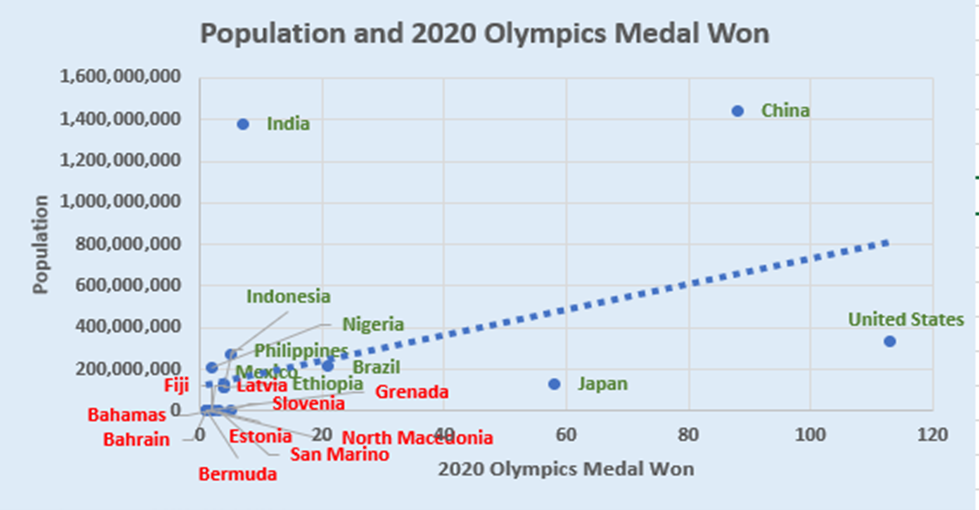
A well-organized sport development structure and a high level of funding can propel a country to the top of the medal table. Population is likewise salient, and with 1.4 billion people, China was well represented at the 2020 Olympic medal table, with a total of 88 medals won, trailing only the United States of America which had 113 medals won, a country with more than 300 million people.
Stylized facts on Sport and Economic Development
The three strongest markers of sports development in any economy are the degree of investment, the extent of population participation, and the level of political stability that exists. High investment correlates positively with buoyant economy, which has a knock-on effect on the amount of leisure time utilized. With more leisure hours, a larger proportion of the population can indulge in sports. Developed economies make significant investments in sport facilities, coaching skills, and sports science support programs, all of which are essential for sport sustainability. Sport investment can be an effective stimulus for developing the quality and quantity of sporting activities especially at the international level.
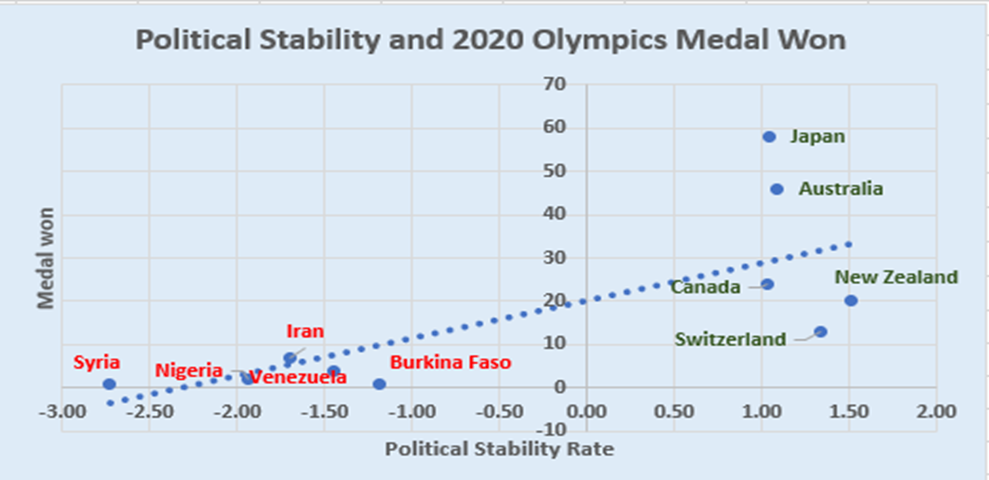
Figure 1 shows a positive correlation existing between political stability and the 2020 Olympic medal table. There is a clear disparity in the number of medals won between countries with stable political systems and those battling political instability.
Figure 1: Political Stability and 2020 Olympics Medal Won
Source: World Governance Indicators 2020 & International Olympic Committee 2021
Figure 2: Population and 2020 Olympics Medal Won
Source: Worldometers 2021 & International Olympic Committee 2021
Figure 2 also shows that population matter for the number of medals won. However, we note that this is secondary, as countries like New Zealand and Australia do well in the Olympics despite their relatively smaller population. Large population size, on the other hand, is not a sufficient prerequisite for sport development. Figure 2 however supports the hypothesis that the larger the population, the more athletes with different physical qualities and skills.
Another notable factor is investment, investment in sport clearly plays an important role in some athletic activities than in others. Games like rowing, cycling, golf, shooting, sailing and equestrian require exclusive equipment and amenities; Nigeria have never won medals at any of these sports. Even in less expensive sports, there is a huge inequality in access to coaching and training facilities. A survey in developing countries by UNESCO in 1995, referred to in Manzenreiter (2007), found that 16 of the least developed countries had an average of just 71 football pitches, 31 volleyball courts, 13 athletics tracks and 3 swimming pools per country. In recent times, the African continent has in total, 141 constructed Soccer stadiums and about 78 volleyball courts. The combination effect of investment in sport and human capital, political stability, and high population participation rate are necessary and sufficient for sport development.
Nigeria and Olympics
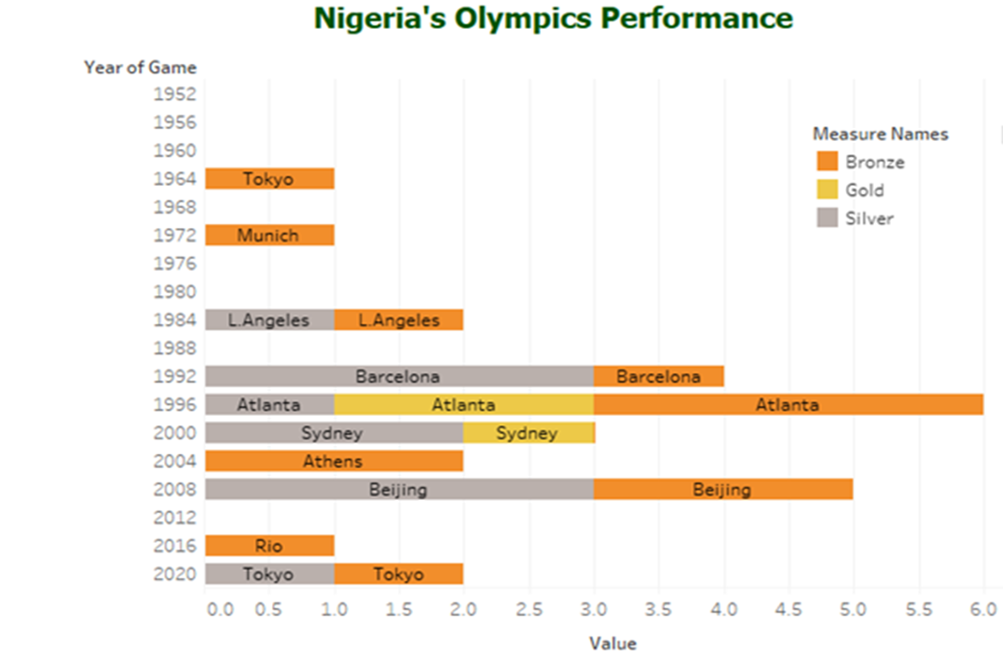
Nigeria officially competed in the Olympic Games in Helsinki 1952 and has since sent representatives to every Summer Olympic Games, apart from the 1976 Summer Olympics, which was boycotted. Nigeria has won 27 Olympic medals in total, including 3 gold, 10 silver and 14 bronze. The majority of the medals come in athletics and boxing. Nigeria achieved her finest result to date in the 1996 Atlanta Olympics, when the Dream Team football team were decorated with gold and Chioma Ajunwa won gold in the athletics division. Nigeria’s second best performance was in the 2008 Beijing Olympics where the men’s football team won a silver medal and Blessing Okagbare, an athlete won a silver medal.
Figure 3: Nigeria’s Olympics Performance
Since then, Nigeria's games have been on a downhill spiral. Lamentably, neither the men's nor women's football teams qualified for the 2020 Tokyo Olympics, which was compounded by the disqualification of ten athletes.
Socio-economic benefits of Sport
Sports impact on the Nigerian economy may be evaluated in terms of its contribution to GDP, employment, and the indirect multiplier effect on improving public health, reducing crime rates, and supporting other sectors.
Sport is now a significant aspect of vast entrepreneurial activities, providing on the one hand, job creation for many in the various components of sport, and on the other hand, income and revenues to individuals and governments respectively. Currently, assessing the impact of sport on Nigeria's GDP is challenging because sport is not one of the key sectors considered by statisticians when estimating GDP. However, the sector is computed as part of the entertainment and recreation sector, which contributed 0.19, 0.31, and 0.33 percent to the Nigerian GDP in 2019, 2020, and 2021 respectively. Sport contribution remains below one percent due to inadequate finance and investment.
Sport also helps to improve fundamental social and interpersonal skills, which aids in crime reduction and building national unity. Football tournaments, for instance, are regarded as one of the few events in Nigeria that have fostered a sense of national cohesion among the country’s heterogeneous population. In addition, sport provides an important platform for youths to develop life skills that will enable them to cope better with everyday life challenges and transition away from drug abuse, violence, and crime. Sport can be utilized as a medium to advocate for sustainable human rights, such as the right to social security and equality across gender and race.
Strategies to support sport development in Nigeria
Clearly, finance is the major constraint to sport development in Nigeria. There is a need to support national sporting bodies to implement targeted fund-raising programs and prioritize the allocation of resources for sport.
Furthermore, the Nigerian government should strive to implement a comprehensive sports policy that includes encouraging participation in all sporting activities in primary, secondary, and tertiary educational institutions as well as promoting local sports development. There is a need to boost private investors' confidence in the industry so they can fully participate in the business aspect of sports. These will help make the sports sector more appealing for the youth to pursue as a career and profitable for businesses.



 English
 Arab
Arab
 Deutsch
 Português
 China
China