The International Monetary fund (IMF), in its April 2022 Economic Outlook, has revised its growth projection upward for the Nigerian economy in 2022 to 3.4 percent.1 The IMF had earlier forecasted a 2.7 percent growth for the Nigerian economy in 2022, suggesting an increase of 0.7 percent point. Also, the forecast for 2023 was revised upward from 2.8 percent, indicating an increase of 0.4 percent point. Despite the upward revision, Nigeria’s growth forecast still lags behind the Sub-Saharan growth rate of 3.8 percent and the world growth rate of 3.6 percent. The forecast for Sub-Saharan Africa was revised upward by 0.1 percent point, and the world was revised downward by 0.8 percent point. The Fund expected that the sanctions imposed on Russia would disrupt the global value chain, resulting in a slow global economic growth rate. The upward revision for Nigeria was premised on the surge in crude oil prices, putting Nigeria in a beneficial spot for the Russian invasion of Ukraine. In other words, the forecast suggests that the Fund anticipates that Nigeria would optimise the oil revenue gains associated with the invasion. There is a need for the Nigerian government to match the positive image of the Fund by reforming the Nigerian oil and gas sector to address legacy issues that have adversely affected investment in the sector and resulted in low production levels.
Sudan has transitioned to the era of demographic dividend. Yet, evidence from various sources shows that adequate policies have not been put in place to enable the country to achieve this dividend. While there are indications of progress on policies geared towards achieving demographic dividend, a lot more needs to be done. Hence, after assessing the challenges and opportunities presented by the demographic transition in Sudan, this policy brief recommends five strategic policy areas needed to adequately position Sudan for a demographic dividend. The policy areas cover policies on education, health, economic growth, and political commitment.
Budgetary institutions play a fundamental role in a country’s economic development and prosperity. First, the efficient and effective utilization of public resources, the strategic alignment of finances with a country’s priorities, and the maintenance of a sustainable fiscal programme all require sound budgetary institutions. Second, fiscal management and stabilisation policies, especially the adoption of counter-cyclical fiscal policies, are dependent on the quality of budgetary institutions. Third, budgetary institutions are also critical for ensuring government accountability and transparency and delivering pro-poor policies. According to Raudla (2014), budgetary institutions cover two aspects of institutional arrangements. The first is fiscal rules, which entail constraints in taxation, debt, and public spending, and the second is budgetary process rules, the procedures associated with public budgeting which outline the process that governs the preparation, adoption, and implementation of the budget.
Based on the ravaging effects of the covid-19 pandemic, the 2021 Budget sought to reposition the Nigerian economy towards recovery, growth and resilience. The latest 2021 budget implementation report, the third quarter, released by the budget office of the federation (BOF), shows that the actual net revenue in the quarter was ₦1.93 trillion, and 8.3 percent less than the budgeted net revenue of ₦2.11 trillion.2 Of the ₦1.93 trillion revenue generated, non-oil contributed 65 percent, and the remaining came from oil revenue. The low contribution of oil revenue was due to fiscal deductions and federally funded upstream projects. The actual amount for both items is higher than budgeted and constitute about 65 percent of the initial oil revenue of ₦1.3 trillion, resulting in net oil revenue of ₦674.3 billion. On the expenditure side, actual expenditure in the quarter was ₦3.78 trillion, which is higher than the budgeted expenditure of ₦3.13 trillion by ₦654.96 billion. The high variation in expenditure arises from debt service. The budgeted debt service was ₦831.1 billion in the quarter, and the actual debt service was ₦1400 billion, indicating a variation of about ₦568.9 billion. As a result, debt services constitute about 37 percent of total expenditure in the third quarter. The relative size of the debt service in total expenditure and the low ratio of revenue to total expenditure indicates weak revenue collection. While the final budget implementation report for the whole of 2021 is being anticipated, efforts toward improving the country’s revenue generation in 2022 are urgently expedient. Specifically, the ease of tax payment through digitalization would strengthen revenue collection and increase tax revenue.
Data from the Central Bank of Nigeria shows that as of April 8, 2022, external reserves were $39.66 billion.1 This indicates an increase of about $122 million from $39.54 billion recorded on April 1, 2022, but still lower than $39.79 billion recorded on March 8, 2022, and $40.5 billion at the commencement of the year. External reserves are used to settle external obligations, import payments, and manage the exchange rate. The relative improvements in the external reserves are partly due to the recent $200 billion in foreign exchange repatriation (RT200FX) policy of the CBN and the hike in crude oil prices. For a country with an average monthly import bill of $4.3 billion in 2021, the current external reserves cover about 9.1 months of import bills, which puts pressure on the domestic currency. The government needs to sustain existing non-oil export promotion strategies and payments through the official channels to improve export earnings, and external reserves. Furthermore, improvement in business environments through reliable electricity would help reduce the cost of production and make Nigerian products price competitive in the global market.
In many countries, myriad policy efforts and initiatives have been launched toward achieving the goal of Education for All. These include: grass-roots lobbying for the importance of schooling, political declarations for universal access to education, introduction of school fees abolition initiatives, and/or pro-poor education financing frameworks, among others (UNICEF, 2018, p.2). Despite these efforts, too many children are still excluded from schooling. One of the most recent statistics on out-of-school children and youth (OOSCY) shows that globally, 258 million children and youth are excluded from education, 59.1 million of which are of primary school age, 61.5 million of lower secondary school age, and 137.8 million of upper secondary age (UIS, 2019). Half of the world’s OOSCY population are concentrated in fourteen countries alone, nine of which are in sub-Saharan Africa and of which five are from West Africa including: Nigeria, Ghana, Mali, Burkina Faso and Cote d’Ivoire (Milan & Nicholas, 2015). Nigeria ranks highest among these five in terms of its number of out-of-school children, currently reaching up to 10.5 million.
The latest foreign trade data by the National Bureau of Statistics (NBS) shows that in 2021 Nigeria imported N1.29 trillion worth of durum wheat.2 An increase of 71.1 percent over the N756.92 billion recorded in 2020 and more than triple the N401.31 billion recorded in 2019. Wheat is the third most consumed grain in Nigeria after Maize and Rice. The product was the second-highest contributor to Nigeria's import bill in the review year and the highest imported food item, accounting for 6.2 percent of the total import bill. The increase in the value of wheat importation reflects the high unmet demand for wheat in the domestic market. In the meantime, the recent invasion of Ukraine by Russia has affected the wheat supply chain globally, pushing prices of wheat to record highs. The current happening suggests that the demand for wheat produced in Nigeria would increase from firms within and outside the country. Before the invasion, the Central Bank of Nigeria (CBN) created the Nigeria Brown Revolution to reduce Wheat importation by 35 percent in 2022. And as of November 2021, the CBN had disbursed N41.2 billion under the Revolution to improve funding of large wheat production.3 Aside from funding, the Bank also needs to strengthen partnerships with the Bank of Agriculture and the Ministry of Agriculture to address the non-financial challenges that lower wheat farmers' productivity. Through the partnerships, wheat farmers should be coordinated and introduced to farming techniques, efficient post-harvest storage facilities, and modern extension services. These partnerships and interventions should help in boosting local production and make the country a net exporter of wheat within the next few years.
The Monetary Policy Committee of the Central Bank of Nigeria (CBN) held the second meeting for the year on the 21st of March, 2022, and voted to retain the Monetary Policy Rate (MPR) at 11.5 percent. The MPC also voted to retain other monetary parameters1. The asymmetric corridor was retained at +100/-700 basis points around the MPR; Cash Reserve Ratio (CRR) was retained at 27.5 percent; the Liquidity Ratio was retained at 30 percent. The Committee acknowledged the rising inflation, which was attributed to supply-side factors including persisting insecurity and scarcity of PMS. As a result, effective collaboration with fiscal authority was highlighted in the meeting as a plausible strategy to tame the rate of increase in the price level. Furthermore, there is a need for the Bank to evaluate existing interventions such as the Anchor Borrowers’, Real Sector Support Facility – Differentiated Cash Reserves Requirement (RSSF-DCRR), and Nigeria Electricity Market Stabilisation Facility, to understand their performance and challenges. This is important because an increase in the disbursement of intervention funds without a corresponding increase in productivity contribute to an increase in the price level.
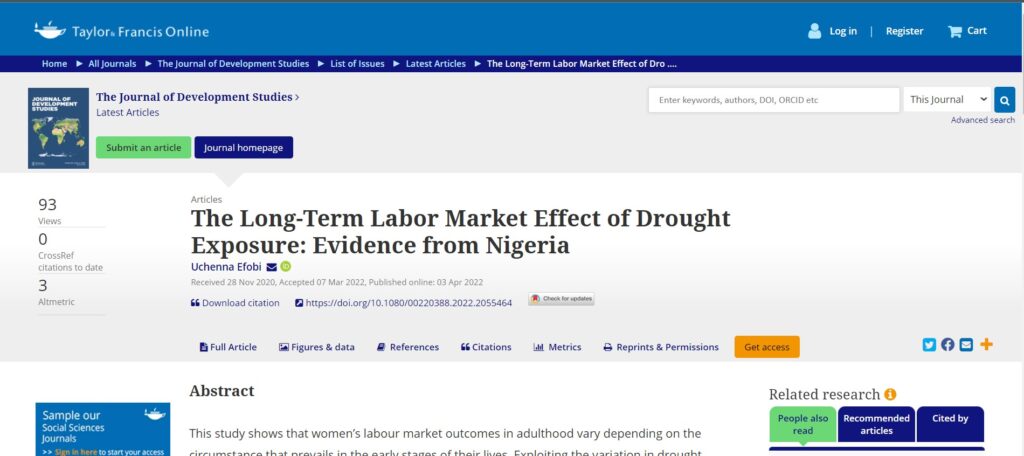
This study shows that women’s labour market outcomes in adulthood vary depending on the circumstance that prevails in the early stages of their lives. Exploiting the variation in drought incidences across Nigerian states with a nationally representative household survey for the periods 2008 and 2013, the result shows that women exposed to the drought at early periods of life see adverse labor market outcomes (including the probability of working and the standard of such work). Educational outcomes also declined with exposure to the drought, suggesting that poor human capital formation is a potential channel for these effects. Impacts on a related supplementary outcome, age at marriage entry, is also a consistent operative channel of impact. These findings further shed light on potential labor supply deficits for women from early life exposure to adverse climatic conditions.