Macroeconomic Report & Economic Updates

  • Home
  • Macroeconomic Report & Economic Updates

Nigeria Economic Update, Issue 41

The October 2025 Nigeria Development Update (NDU) report from the World Bank revealed that, between 2019 and 2023, average consumption decreased by 6.7%, particularly in urban areas. The report also indicated that the percentage of Nigerians unable to meet healthy caloric requirements, even if they spent their entire income on food, rose from 14% to 27% between 2019 and 2023, equivalent to 139 million Nigerians living in ultra-poverty in 2023.The World Bank report indicated that while the reforms (mainly exchange rate unification and subsidy removal) are addressing previous policy errors, significant improvements in living conditions will depend on sustained disinflation, more robust inclusive growth, enhanced public services, and consistent targeted assistance for the most vulnerable. The report also emphasised that macroeconomic reforms need to continue advancing to strengthen stability and protect against risks, given that the economic outlook remains vulnerable to both external and domestic risks. Thus, policymakers’ priority should include the transparent expansion of social protection programs to protect vulnerable households and the efficient implementation of the tax reform policies to lessen the tax burden, potentially boosting employment. Also, the informal economy should be supported through targeted credit schemes and steady and affordable energy.  

Read More Download PDF

Nigeria Economic Update, Issue 40

Data from the National Bureau of Statistics (NBS) show that Nigeria’s public debt stock, which includes external and domestic debt, stood at ₦149.38 trillion in the first quarter of 2025, indicating a growth of 3.27% quarter-onquarter from ₦144.66 trillion in Q4 2024. Total external debt stood at ₦70.63 trillion, while total domestic debt stood at ₦78.75 trillion in Q1 2025. The share of domestic debt to total public debt recorded the highest percentage, standing at 52.72%, while external debt accounted for 47.28% of total public debt in Q1 2025. State-wise, Lagos State recorded the highest domestic debt at ₦874.03 billion, followed by Rivers with ₦364.39 billion. Meanwhile, Jigawa and Ondo states recorded the lowest domestic debt stocks at ₦1.06 billion and ₦11.76 billion, respectively. The increase in debt stock occurred as a result of the depreciation of the Naira, which inflated the values of local currency borrowing and new borrowings from the federal government, intended for funding public expenditure. Rising debt stock implies increasing debt servicing costs, which strain government finances, especially as Nigeria makes efforts to stabilise the Naira and improve foreign exchange liquidity. Furthermore, while heavy reliance on domestic borrowing may reduce external vulnerability, it can crowd out private investments and push up domestic interest rates. Therefore, there is a need for the government to enhance debt management frameworks and control borrowing at both the federal and state levels. Furthermore, borrowings should be channelled toward growth-enhancing and revenue-generating projects, especially in productive sectors such as energy and manufacturing.  

Read More Download PDF

Nigeria Economic Update, Issue 39

The Central Bank of Nigeria's (CBN) Business Expectations Survey report for August 2025 reflects optimism regarding the macroeconomic outlook. The Confidence Index increased to 28.9 index points in August 2025 from 21.4 index points in July 2025. All sectors expressed positive expectations for the business outlook, with Services leading at 29.7 index points, Industry at 28.5 index points, and Agriculture at 27.1 index points. This optimistic trend is expected to continue over the next six months, with Industry projected to rise to 59.9 index points, Agriculture to 52.8 index points, and Services to 55.1 index points. This, therefore, reflects growing business confidence in the Nigerian economy. The Business Confidence Index (BCI) further highlights this positive sentiment, with Mining & Quarrying leading at 21.1 index points, followed by Agriculture at 17.5 index points, Non-Market Services at 16.8 index points, Market Services at 16.7 index points, Manufacturing at 8.5 index points, and Construction at 2.0 index points. These figures indicate strong confidence across sectors in the economy. However, despite the positive momentum, respondents identified the top three business constraints in the month under review, including Insecurity (71.2%), Insufficient Power Supply (69.5%), and High Interest Rates (68.6%), highlighting factors that continue to affect operational stability and profitability. To maintain positive business confidence, the government should focus on targeted policies that address the key operational challenges, improve business conditions, and create a more supportive environment for investment and growth. Addressing insecurity is crucial, as well as driving investment in energy infrastructure to provide affordable and steady electricity to firms 

Read More Download PDF

Nigeria Microeconomic Snapshot October 2025

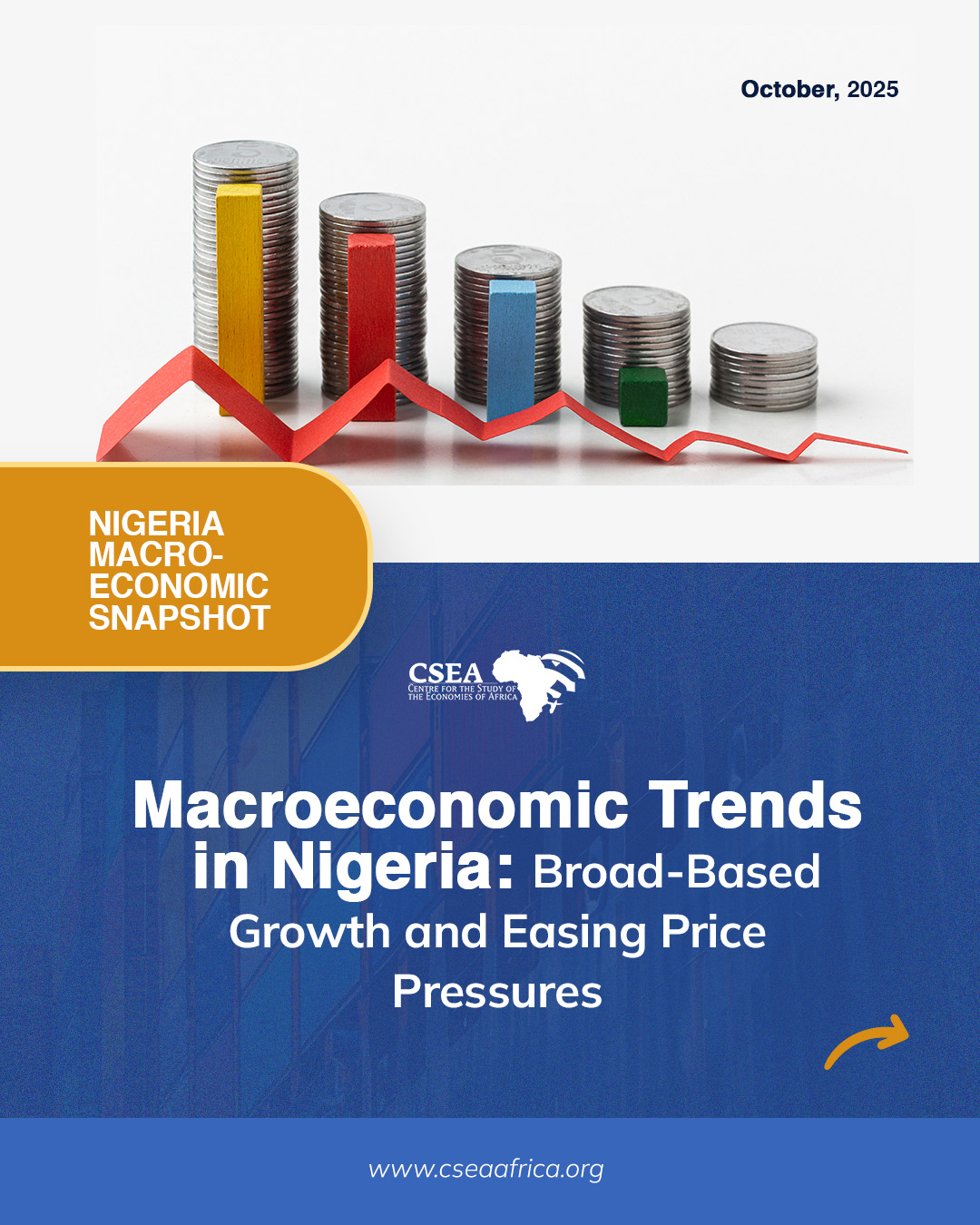
Nigeria's economy maintained its upward growth trajectory in the second quarter of 2025, expanding by 4.23% year-on-year compared to 3.48% in the same period of 2024. The improved performance followed the GDP rebasing, using 2019 as the base year reflecting stronger activity across key sectors. The industry and services sectors recorded notable growth of 7.45% and 3.94%, respectively, while agriculture grew modestly by 2.82%. 

Read More Download PDF

Nigeria Economic Update, Issue 38

According to the National Bureau of Statistics’ GDP Report for Q2 2025, Nigeria’s real GDP grew by 4.23% year-on-year, higher than the 3.48% recorded in Q2 2024 and above the 3.13% reported after the rebasing in Q1 2025. Aggregate nominal GDP stood at ₦100.73 trillion, up by 19.23% from ₦84.48 trillion in the same quarter of 2024. In the quarter under review, the oil sector recorded strong growth of 20.46%, a sharp rebound from 1.87% in Q1 2025 and higher than the 10.08% in Q2 2024, supported by increased crude oil production at 1.68 million barrels per day. Similarly, the non-oil sector grew by 3.64% in real terms, driven by agriculture, telecommunications, real estate, finance, trade, and construction. Growth in the agricultural sector stood at 2.82%, an improvement from the 2.60% recorded in the corresponding quarter of 2024. Furthermore, growth in the industrial sector reached 7.45% in Q2 2025, up from 3.72% in Q2 2024, contributing 17.31% to aggregate GDP compared to 16.79% in the same quarter of 2024. The services sector also recorded growth of 3.94%, compared to 3.83% in Q2 2024. This improved performance occurred largely due to stronger oil output and resilient non-oil activity. However, it also implies that while the non-oil sector has shown resilience, the oil sector’s rebound remains vulnerable to disruptions in global oil prices. Furthermore, the 2.82% growth in agriculture remains below the sector’s potential, with negative implications for food security, employment, and inflation management. Therefore, there is a need for the government to invest more in local agricultural production, focusing on mechanisation and improved access to finance for smallholder farmers and the provision of improved seedlings and technical support, among others.

Read More Download PDF