Fundraising remains a challenge for most organizations, and the need to explore innovative ways to remain sustainable and competitive is becoming imperative. In this digital age, organizations are continuously exploring innovative approaches to fundraising to remain relevant in an increasingly dynamic landscape. Nonprofits are no exemption from this pressure, as they continue to face multiple sustainability challenges. As non-profits engaged in the production and dissemination of ideas to inform policies think tanks are currently facing serious existential challenges which require innovative solutions. The challenges faced by think tanks come from both the demand-side and the supply-side of the market for ideas.
The need for an innovative strategy was prompted by the reality faced by CSEA: as a beneficiary of the 10-year Think-Thank Initiative grant, which ends in 2019, it is imperative for the Centre to reflect on its fundraising experience and creatively design a fundraising approach that can ensure its financial sustainability beyond 2019. While the Centre places emphasis on the production of high-quality research, and on building a sustainable relationship with other policy stakeholders, a well-defined resource mobilization, and fundraising strategy is required to provide guidance towards approaching targeted and potential funders.
Human development indicators show that Nigeria does not adequately invest in its people. Nigeria continues to perform abysmally in key health and education indicators. The country is the Download File">second largest contributor to the world’s maternal mortality rate. Worse still, pregnant women are not the only ones faced with this bleak reality as the average Nigerian is expected to die at Download File">age 53. On education, Download File">10.5 million children are not enrolled in school, the world’s highest number of out-of-school children, and Download PDF">four out of five children who have completed primary education cannot read.
The country’s low human capital has caught the attention of philanthropists: the founders of the Download File">Tony Elumelu Foundation, Dangote Foundation, and more recently, Download File">Bill and Melinda Gates Foundation. While at the National Economic Council in March 2018, Bill Gates, co-founder of the Bill and Melinda Gates Foundation pointed out that the government’s low investment in the education and health sectors has contributed to these poor outcomes. In 2018, the proposed national budget for education as a percentage of GDP is a meagre 0.005 percent which is a significant shortfall from the UN-recommended 6 percent. In the same year, the budget share for health stood at 4 percent, significantly lower than the AU-recommended 15 percent.
However, increased funding is not the sole pathway to positive outcomes in these sectors. According to Gates, availability of facilities, stock of medicine and equipment, among other non-financing mechanisms, are equally critical in achieving improvements in the health sector. A Download File">paper by my colleague, Joseph Ishaku, shares the same opinion. The study shows the importance of school quality - class size, textbook availability, school organization, and feeding programme – in the learning outcomes of children.
Alternatives to Increased Funding
With the same funding, the government can deliver better education and health outcomes by leveraging on the skills and resources of relevant stakeholders. Partnerships with the private sector, donor community and development institutions will share risks and expertise, promote coordination and prevent duplication of efforts. On education, Abia state is a notable example on public-private partnerships. Abia, which has topped WAEC results across the country for three years (2015, 2016 and 2017) in a row, adopted the Download File">Friends of Abia School Adoption Initiative (FASAI) in 2015. Through FASAI, indigenes of the state contribute to the state’s educational system by paying for the fees of school children and/or renovating school buildings.
Infusing technology is another means to help the government accomplish more for less. In the health sector, technology can aid in providing access to healthcare services in rural areas and fragile zones, curtail diagnostic errors and reduce mortality. In 2009, Ondo state government demonstrated how technology can be deployed to solve a health problem. The government initiated the Download File">Abiye (Safe Motherhood) Program which offered cell phones to expectant mothers in order to connect them to health workers, increasing skilled-attendance of birth by fifteen-folds.
Lastly, improved data collection is critical in deploying proven methods rather than wasting time and resources by reinventing the wheel. Establishing a unified data collection system at both federal and state levels will aid in making fact-based decisions, utilize scarce resources more efficiently and track improvement in outcomes.
According to economic theory, investments in human capital – skills, knowledge and health of people - is essential to a country’s economic growth process. U.S. history tells the story of how five men - Download File">Cornelius Vanderbilt, John D. Rockefeller, Andrew Carnegie, J. P. Morgan, Thomas Edison and Henry Ford – and their workers transformed the U.S. into a global super power. Chinese entrepreneurs, in part, transformed the former communist nation to capitalism, turning China into the second biggest global economy. Nigeria with its young population structure (over half of the population is below age 18) stands a great chance of reaping significant demographic dividends if its citizens are productive and actively participate in the economy. Investments in education and health sectors will develop Nigeria’s most valuable resource – the Nigerian people - and engender long-term economic growth.
The Presidents of forty-four (44) African countries just recently signed the agreement for the creation of African Continental Free Trade Area (AfCFTA). The success of AfCFTA will make it the biggest trade agreement since the formation of the World Trade Organization in 1995. By reducing barriers to trade, such as removing import duties and non-tariff barriers, the AfCFTA is expected to boost intra-African trade given its potential of bringing over 1.2bn people together into the same market. According to the African Development Bank (AfDB), the AfCFTA “will stimulate intra-African trade by up to $35 billion per year, creating a 52 per cent increase in trade by 2022;Download File"> and a vital $10 billion decrease in imports from outside Africa.”
However, despite the expected benefits from AfCFTA, nine other African countries, including Nigeria and South Africa have delayed assent to the treaty. In Nigeria, various concerns have been raised which includes the exposure of the already struggling local manufacturing sector to undue competition. According to the Manufacturers Association of Nigeria (MAN), the agreement will lead to job losses and increase unemployment. In addition, due to the poor export capacity in the non-oil sector and low industry capacity, stakeholders suggest that there is a need to review trade agreements and policies at this time at because most of the developed countries grew by closing down their borders for a while. A brief discussion of some major factors that affect the scale of free trade effects is provided below.
Size of the Market: Enlarging a trade bloc increases the size of the market, to which all countries have easy access; this also implies that the importance of the size of the domestic market of individual decreases, which favors the small countries. Let’s take the three key players in this debate; consumers, producers, and exporters. Consumers in smaller countries would always gain from mutual trade liberalization because they would not only have access to cheaper goods and products of high quality, but also to more variety. Exporters in the smaller countries would also benefit from the trade liberalization, as they gain access to larger markets and more competitive inputs. This means that with cheap labor in smaller countries, lowering import restrictions allows farmers, builders, and factory owners to access production inputs and resources, therefore increasing their production capacity. Producers in the smaller country present a mixed picture, with the more productive ones gaining and the less efficient losing. When foreign competition increases, it exerts pressure on producers to become more efficient and increase productivity. Firms unable to improve productivity could be pushed out of the market. However, this can be counterbalanced by other firms that benefit through availability of better and cheaper inputs, which helps them Download File">become more competitive both at home and abroad.
Supply-Side Constraints: Supply-side constraints include not only government policies but also the country’s physical and institutional infrastructure, its human resources and all the other elements determining the short-term flexibility of an economy. The extent to which countries can benefit from improved market access depends on their ability to supply goods and services to export markets and to compete effectively. The weak capacity of participating countries to shift resources into the production of goods and services for which the free trade area (FTA) created new demand could lead to adverse effect on the economy. The lack of an enabling environment in participating countries creates difficulties in withstanding competition, makes them vulnerable to price variations and to collusive behavior of larger firms and price setting. In addition, they are in a weaker position to search for information, enforce contracts and property rights and to protect themselves from protectionist tendencies.
This implies that market access by itself is not sufficient to promote growth in countries facing supply side constraints. In such cases, market access has to be complemented by measures to relax supply-side constraints Therefore, it is important for all parties’ economies to be well-informed and able to respond to new opportunities that come with FTA. Unless a free trade agreement has indirect supply-increasing effects (such as might flow from greater investment), binding constraints to an increase in trade may remain in the form of limits to how far and how quickly a partner can increase production.
Tariff Provision: The extent to which an FTA actually changes tariff policy is an important factor that could influence the effect of free trade. Existing literature suggest that smaller, deferred tariff cuts will reduce the trade effect directly, and that the smaller the tariff cut the less likely it is that firms will bother with any additional red tape required to access FTA provisions. Therefore, extent to which an FTA will result in effective policy change (and hence produce a significant impact) depends partly on the relative importance of the tariff barriers that it cuts and the non-tariff barriers that are outside its scope.
In conclusion, analyzing the conditions for benefiting from a free trade agreement allows governments to display stronger leadership and readiness for the transition process. For key sectors where there are concerns about large job displacements, the liberalization process can be gradually phased in over a credible and finite time frame. On the other hand, to take full advantage of market access (and also better withstand enhanced import competition), policies to enhance competitiveness can be implemented as priority. Policy makers can use their political capital to take bolder steps that deepen mutual economic cooperation and help accelerate shared prosperity. Lastly, the smaller the tariff cut within an FTA the less likely it is that firms will find it commercially worthwhile to tackle non-tariff barriers.
Public budget plays a crucial role in economic management and broader development policies. Importantly, it is the main transmission mechanism of fiscal policy and the key tool through which government could stabilize and influence the economic direction. Global experience in public budgeting indicates that countries adopt a defined time horizon or standardized budgetary calendar. The budgetary calendar does not necessary synchronize with the Gregorian dating but only requires a fixed start and end periods for each fiscal cycle. The importance of having budgetary calendar is to reduce uncertainty that could affect optimization behavior and expectation of economic dramatic personae. The rigid time frame also ensures discipline and enhances coordination.
In the case of Nigeria, public budgeting is expected to follow the Gregorian dating, beginning on January 1 and ending on December, 31. Based on Section 82.1 of the 1999 constitution, it is anticipated that appropriation bill will have been passed before the beginning of a financial year. In fact, the constitution considers delay in budget passage as an aberration, such that new government expenditure is restricted and only functional spending, which is fixed to the corresponding period estimate, is allowed. However, in the past two decades of democratic governance in Nigeria, budget delay has become a norm, with the standardized budgetary calendar adhered to only twice in the past twenty years. In this piece, we shed light on economic impact of budget delay, to highlight on an important area for public sector reform.
The Nigerian budget cycle and the source of budget delay
The budget cycle starts with the executive articulating its vision and plan for the economy to the Ministry of Finance (MoF) and the Budget Office of the Federation (BOF) through the medium-term fiscal framework. Depending on the division of functions, the MoF and Ministry of Budget and Planning alternate this role. After this, the BOF and MoF introduce a form of transparency by involving stakeholders such as NASS, the National Economic Council organized private sector, Civil Society and Public Sector through series of interactive sessions. Through this multi-stakeholder process, the revenue is estimated and MDAs expenditure ceilings are set. Thereafter, the FMF circulates the Budget Call Circular in June of each year, which is a formal invitation for MDAs to begin budget submission.
Figure 1 shows how budget proceeds from the stage when the MDAs submit their estimates, in line with zero-based budgeting. All submissions are evaluated and consolidated by the BOF and the draft is presented to the President and the Federal Executive Council for approval. The proposed budget is then submitted by the President to the National Assembly for review, deliberations and approval around October of each year. The budget is at this stage scrutinized and evaluated separately by the Senate and Representatives through debates and various committees. However, there is no time limit for the National Assembly to draw up the final budget. Final phase involves the assent of the appropriation bill and implementation by the executive.
Figure 1: Nigerian budget process
" alt="" width="1017" height="522">
The budget process in Nigeria has never been as smooth as expected. The cause of the delay is multifaceted. However, the budget is substantially delayed at the legislative action phase. This is because the two legislative layers separately review the budget and subsequently harmonize it into a single budget document. Also, disagreement between the legislature and executive on the expenditure items and level could drag the process, playing back-and-forth between the legislative action and the final phase.
Measuring the cost of delay
To provide a sense of economic impact of budget delay, we compare economic growth in quarter(s) before and after budget is passed. The rationale is that if budget delay is costless, growth in the two periods should not be significantly different. The result is shown in Figure 2. We interrogate the economic effect further by fitting the trend line and deriving the regression coefficients between budget delay and various economic outcomes. The results are graphical displayed using scatter diagram in Figure 3 Budget delay is measured by numbers of days between January, 1 and the when the President assented the budget. Also, we focus on four economic outcomes: GDP growth, FDI growth, domestic investment growth and the percentage of budget implementation. The analysis covers 2000 to 2017, the entire fourth republic.
Figure 2: Comparison of economic growth in quarters before and after budget signing
Data source: NBS, 2018 and Authors compilation
Figure 3: Scatter diagram of Budget delay and GDP growth, FDI, Domestic Investment and budget Implementation
Data source: NBS, 2018 and Authors compilation
The emerging facts
Based on analysis in Figures 2 and 3, the following observations can be drawn on the economic cost of budget delay:
Conclusion
Public budget is an important policy document that provides a roadmap for government activities and programmes for a fiscal year. To meet this goal, it needs to operate within a define time horizon and engender economic stability. Nigeria’s experience of endlessly dragging the budget process has needlessly imposed substantial economic costs on the public and private sectors. The policy implication is obvious—policymakers must ensure a standardized budgetary calendar. Less obvious is whether there is an alignment of political interests to realize it. It is not clear who benefits from the delay, but budget actors seem to stall the process in a ‘war of attrition’ to maximize their benefits. Essentially, budget delay reflects the power and interest frictions among political actors. In this respect, it might be exigent for Nigerian fiscal rule to be broadened to also include a mandatory standardized budgetary calendar and a define timeframe for each budget process

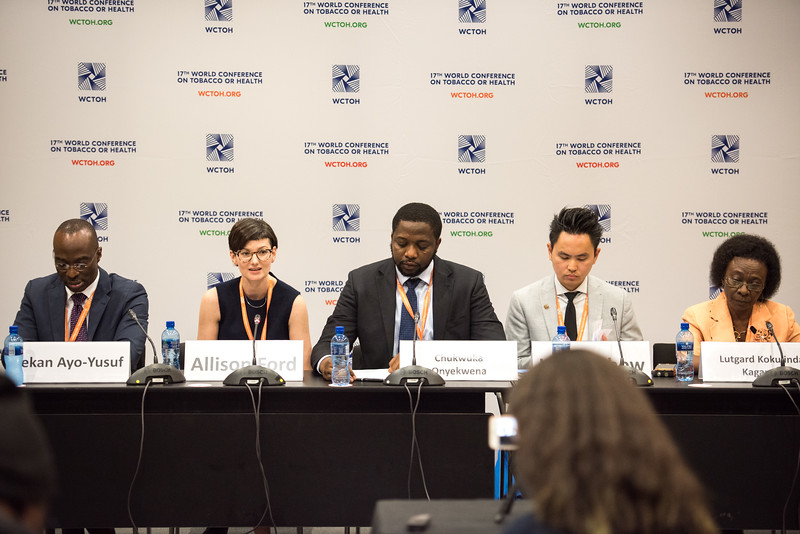
In furtherance of its research study Tobacco, CSEA participated in The 17th World Conference on Tobacco or Health. Participants from around the world presented research papers to highlight the huge strides being made in tobacco control globally.
Dr. Chukwuka Onyekwena reported a study on the potential for tobacco tax to improve public health in Nigeria. The study reported that to be truly effective, tobacco control tax policy in Nigeria would need to see a 275 percent increase in excise tax, a change in tobacco tax structure, and stronger tax administration and revenue-collecting.
Earlier in February, CSEA organized a Download File">policy dialogue on Tobacco control to disseminate the Centre’s findings on the study “The Economics of Tobacco Control: Modelling the Fiscal and Health Effects of a Tobacco Excise Tax Change in Nigeria”.
The study examines the potential for tobacco tax to improve public health and raise government revenues in Nigeria. Economic losses in the form of medical treatments and loss of productivity from tobacco-related diseases is estimated at US$ 591 million in 2015 (Tobacco Atlas, 2015). Thus, there is an urgent need to implement an effective tobacco control program to curb the epidemic of rising smoking prevalence rates and their impacts.
Among the several measures for tobacco control, tobacco taxation is widely recognized as the most effective policy tool. Tobacco taxation can prevent millions of smoking-attributable deaths, reduce the number of young people initiating smoking, and contribute to the achievement of national public health objectives in Nigeria. At the same time, it can create the fiscal space needed to finance the country’s economic development and public health programmes.
Yet, the current level of excise tax in Nigeria (at 12 percent of retail price) is very low and well-below the WHO benchmark (set at 75 percent of retail price). This has adverse impact on smoking prevalence and smoking intensity, with attendant health and economic costs at households and national levels. Thus, from the perspective of public health and public finance, there is an urgent need to raise excise tax on tobacco products in the country.The event was held 7-9 March 2018,in Cape Town, South Africa.