Data from the Central Bank of Nigeria shows that as of April 8, 2022, external reserves were $39.66 billion.1 This indicates an increase of about $122 million from $39.54 billion recorded on April 1, 2022, but still lower than $39.79 billion recorded on March 8, 2022, and $40.5 billion at the commencement of the year. External reserves are used to settle external obligations, import payments, and manage the exchange rate. The relative improvements in the external reserves are partly due to the recent $200 billion in foreign exchange repatriation (RT200FX) policy of the CBN and the hike in crude oil prices. For a country with an average monthly import bill of $4.3 billion in 2021, the current external reserves cover about 9.1 months of import bills, which puts pressure on the domestic currency. The government needs to sustain existing non-oil export promotion strategies and payments through the official channels to improve export earnings, and external reserves. Furthermore, improvement in business environments through reliable electricity would help reduce the cost of production and make Nigerian products price competitive in the global market.
In many countries, myriad policy efforts and initiatives have been launched toward achieving the goal of Education for All. These include: grass-roots lobbying for the importance of schooling, political declarations for universal access to education, introduction of school fees abolition initiatives, and/or pro-poor education financing frameworks, among others (UNICEF, 2018, p.2). Despite these efforts, too many children are still excluded from schooling. One of the most recent statistics on out-of-school children and youth (OOSCY) shows that globally, 258 million children and youth are excluded from education, 59.1 million of which are of primary school age, 61.5 million of lower secondary school age, and 137.8 million of upper secondary age (UIS, 2019). Half of the world’s OOSCY population are concentrated in fourteen countries alone, nine of which are in sub-Saharan Africa and of which five are from West Africa including: Nigeria, Ghana, Mali, Burkina Faso and Cote d’Ivoire (Milan & Nicholas, 2015). Nigeria ranks highest among these five in terms of its number of out-of-school children, currently reaching up to 10.5 million.
The latest foreign trade data by the National Bureau of Statistics (NBS) shows that in 2021 Nigeria imported N1.29 trillion worth of durum wheat.2 An increase of 71.1 percent over the N756.92 billion recorded in 2020 and more than triple the N401.31 billion recorded in 2019. Wheat is the third most consumed grain in Nigeria after Maize and Rice. The product was the second-highest contributor to Nigeria's import bill in the review year and the highest imported food item, accounting for 6.2 percent of the total import bill. The increase in the value of wheat importation reflects the high unmet demand for wheat in the domestic market. In the meantime, the recent invasion of Ukraine by Russia has affected the wheat supply chain globally, pushing prices of wheat to record highs. The current happening suggests that the demand for wheat produced in Nigeria would increase from firms within and outside the country. Before the invasion, the Central Bank of Nigeria (CBN) created the Nigeria Brown Revolution to reduce Wheat importation by 35 percent in 2022. And as of November 2021, the CBN had disbursed N41.2 billion under the Revolution to improve funding of large wheat production.3 Aside from funding, the Bank also needs to strengthen partnerships with the Bank of Agriculture and the Ministry of Agriculture to address the non-financial challenges that lower wheat farmers' productivity. Through the partnerships, wheat farmers should be coordinated and introduced to farming techniques, efficient post-harvest storage facilities, and modern extension services. These partnerships and interventions should help in boosting local production and make the country a net exporter of wheat within the next few years.
The Monetary Policy Committee of the Central Bank of Nigeria (CBN) held the second meeting for the year on the 21st of March, 2022, and voted to retain the Monetary Policy Rate (MPR) at 11.5 percent. The MPC also voted to retain other monetary parameters1. The asymmetric corridor was retained at +100/-700 basis points around the MPR; Cash Reserve Ratio (CRR) was retained at 27.5 percent; the Liquidity Ratio was retained at 30 percent. The Committee acknowledged the rising inflation, which was attributed to supply-side factors including persisting insecurity and scarcity of PMS. As a result, effective collaboration with fiscal authority was highlighted in the meeting as a plausible strategy to tame the rate of increase in the price level. Furthermore, there is a need for the Bank to evaluate existing interventions such as the Anchor Borrowers’, Real Sector Support Facility – Differentiated Cash Reserves Requirement (RSSF-DCRR), and Nigeria Electricity Market Stabilisation Facility, to understand their performance and challenges. This is important because an increase in the disbursement of intervention funds without a corresponding increase in productivity contribute to an increase in the price level.
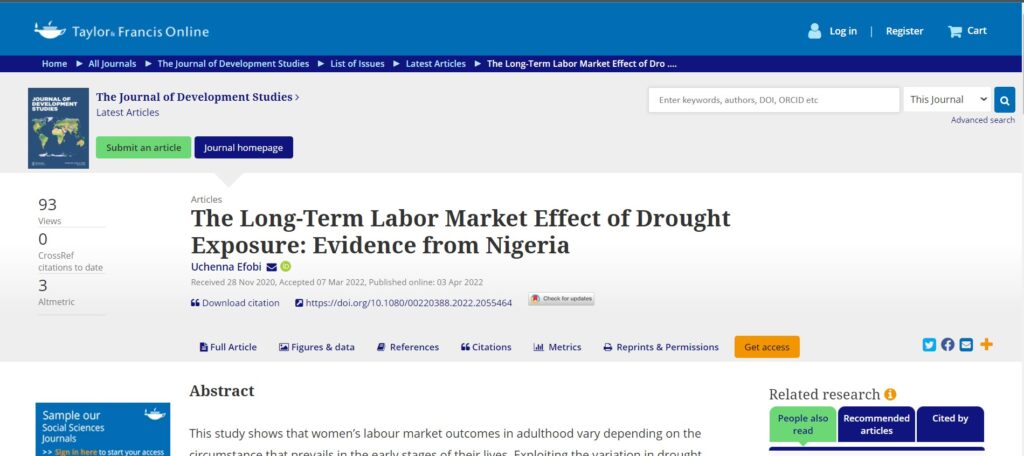
This study shows that women’s labour market outcomes in adulthood vary depending on the circumstance that prevails in the early stages of their lives. Exploiting the variation in drought incidences across Nigerian states with a nationally representative household survey for the periods 2008 and 2013, the result shows that women exposed to the drought at early periods of life see adverse labor market outcomes (including the probability of working and the standard of such work). Educational outcomes also declined with exposure to the drought, suggesting that poor human capital formation is a potential channel for these effects. Impacts on a related supplementary outcome, age at marriage entry, is also a consistent operative channel of impact. These findings further shed light on potential labor supply deficits for women from early life exposure to adverse climatic conditions.
Following the food inflation of 17.1 percent in February 2022, the Selected Food Price Watch of the National Bureau of Statistics (NBS) indicates an increase in the average cost of most food items, including beans, sliced bread, groundnut oil, and tomato2. The average price per kg of beans rose by 50.1 percent from N331.5 in February 2021 to N497.5 in February 2022. Similarly, the average price of 500g sliced bread increased by 34.1 percent from N326.6 in February 2021 to N418.7 in February 2022. The cost of other food items such as groundnut oil (per bottle) and tomato (per kg) also increased over this period (year-on-year) by 43.5 percent and 46.0 percent, respectively. The increase in the average food price implies high food insecurity and a reduction in the standard of living. These increases are attributable to the higher cost of production inputs, low production, and increased distribution costs. And with the energy crisis lingering since February, food inflation is likely to increase further, worsening the poverty situation. To reduce the effect of the rising food prices on household welfare, the government should strengthen existing social protection measures to cushion the effect of rising food prices on the poor. Also, increased production is required to slow down the rate of the food price increase. As a result, there is a need to evaluate existing government interventions in the agricultural sector to understand ways to strengthen the interventions to enhance agricultural yields and reduce post-harvest loss
The National Bureau of Statistics (NBS) data shows that headline inflation for February 2022 was 15.7 percent. Headline inflation in February 2022 is 0.1 percent points higher than 15.6 percent recorded in January 2022 (month-on-month), although 1.63 percent points lower than 17.3 percent in February 2021 (year-on-year).1 Food inflation was 17.1 percent, and core inflation was 14.0 percent. This means that food inflation continued to drive headline inflation. The increase in the prices of bread and cereals, potatoes, yam and other tubers contributed more to food inflation. The increase in core inflation is mainly due to the increase in the prices of gas, liquid and solid fuels, wine, tobacco, and transport equipment. Furthermore, urban inflation was 16.3 percent, and rural inflation was 15.2 percent. This suggests that inflation is 1.1 percent points higher in urban areas. High inflation erodes households’ purchasing power and increases firms’ cost of production. The strong linkage between the transportation sector and other sectors of the economy suggests that a rise in the cost of transportation would lead to an increase in the price of goods and services. The recent hike in fuel prices arising from the shortage of fuel needs prompt government action to prevent citizens’ hardship and inflation induced by an increase in fuel price. Also, there is a need for deliberate government policies to address bottlenecks to agricultural productivity, which has consistently led to high food inflation.
The National Bureau of Statistics (NBS) Power Sector Data report shows that Nigeria generated 36,397.92 Gwh of electricity in 2021, a 2 percent increase of over 35,720.27 Gwh generated in 20201. Despite the increase, the data suggests that about 4200MW of power was generated in 2021, which is grossly inadequate for a population above 200 million people. For instance, developing economies require about 1000MW per million people to meet their electricity demand, which translates to over 200,000MW for Nigeria. The situation is further worsened by the losses encountered during the transmission and distribution stages. Power generation has been a significant impediment to economic prosperity in Nigeria, as demand exceeds supply, which negatively affects both businesses (by increasing the cost of production through alternative sources of electricity) and general living conditions. Since electricity is crucial for activities in any economy, improving power generation in Nigeria remains an urgent imperative. The Power Purchase Agreement (PPA) is an important strategy to consider. It is expedient to aggressively explore renewable energy sources to boost generation and eventually increase power supply across the country.
Data from the Central Bank of Nigeria (CBN) revealed that crude oil price rose above $100 in February 2022 and has exceeded its historical price since 20143. The rise in crude oil is mainly due to the shortage of supply and the ongoing crisis between Russia and Ukraine, which has heightened the level of uncertainty in energy supply. Russia is the third-largest producer of crude oil in the world after the United States and Saudi Arabia. The current rise in crude oil prices is temporary, and the extra revenues due to the higher prices are term revenue windfall. Therefore, the government should create a special fund to keep the revenue windfall and serve as fiscal buffers against low crude oil prices. The existing challenges affecting crude oil production in the country, such as insecurity, infrastructural decay, and inadequate investment in the oil sector, might limit the gains associated with the current increase in oil prices. Hence, the prompt passage of the proposed revision of the petroleum industry Act is crucial in addressing the Nigerian oil industry challenges.