Macroeconomic Report & Economic Updates

  • Home
  • Macroeconomic Report & Economic Updates

Nigeria Economic Update, Issue 45

Data from the Central Bank of Nigeria (CBN) revealed that Nigeria’s gross external reserves rose to $43.32 billion as of November 6, 2025, the highest level recorded in six years. This marks a 1.83% month-onmonth increase from $42.54 billion on October 6, 2025, and a 5.87% rise from $40.92 billion on January 6, 2025. The recent build-up in reserves is largely attributed to the successful issuance of the Federal Government’s $2.3 billion Eurobond, which injected fresh liquidity into the economy and strengthened Nigeria’s external position. Beyond the Eurobond inflow, other contributory factors may include modest improvements in oil export earnings, tighter monetary policy measures, and a gradual recovery in foreign investment sentiment. The steady accumulation of reserves is a positive signal for the economy, reflecting improved external liquidity, a stronger ability to meet foreign obligations, and enhanced investor confidence in Nigeria’s macroeconomic management. Higher reserves also serve as a buffer against external shocks, helping to stabilise the exchange rate and reduce vulnerability to global financial volatility. To sustain this momentum, the government should diversify external inflows, deepen non-oil export capacity, improve diaspora remittance channels, and strengthen foreign investment inflows to ensure that reserve growth is built on sustainable, longterm drivers rather than temporary inflows.

Read More Download PDF

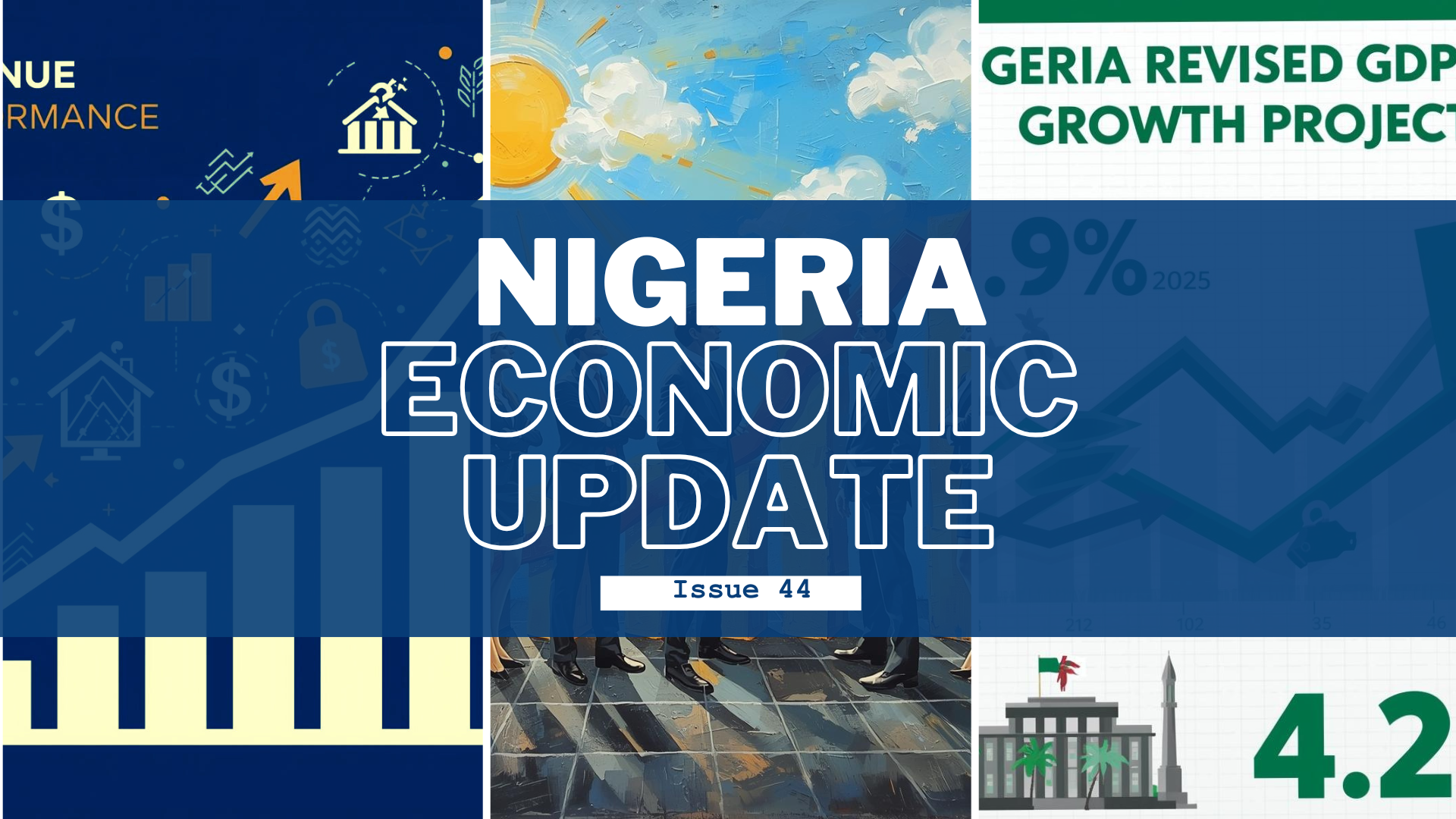
Nigeria Economic Update, Issue 44

The International Monetary Fund, in its October 2025 World Economic Outlook report, revised Nigeria’s GDP growth projections to 3.9% in 2025 and 4.2% in 2026. These figures represent increases of 0.5 and 1.0 percentage points, respectively, from the previously projected 3.4% and 3.2% in July 2025. These upward revisions reflect improving economic conditions, including increased oil production, stronger investor confidence, and a supportive fiscal stance. The improved outlook for 2025 and 2026 is also attributed to reduced uncertainty and the limited impact of U.S. tariffs on Nigeria, given the country’s relatively low exposure to volatile global trade dynamics. While Nigeria’s growth forecast was revised upward, the growth forecast for Sub-Saharan Africa is expected to remain unchanged at 4.1% in 2025, rising modestly by 0.3 percentage points to 4.4% in 2026. Despite steady economic conditions, the outlook remains fragile, with risks tilted to the downside. For Nigeria, the revised growth forecast indicates strengthening macroeconomic stability, but the economy remains heavily reliant on oil revenues, making it vulnerable to price fluctuations and production shocks. To ensure sustainable growth, the government must reduce dependence on oil by investing in other sectors such as manufacturing, agriculture, and services. In addition, targeted reforms that enhance government transparency and ensure regulatory consistency are essential to boost investor confidence.

Read More Download PDF

Nigeria Economic Update, Issue 43

The October 2025 report from the Organisation of Petroleum Exporting Countries (OPEC) indicated that Nigeria's oil production declined by 0.045 million barrels per day (bpd), falling from 1.434 million bpd in August 2025 to 1.39 million bpd in September 2025. This represents a 3.1% decline and marks the second consecutive month of reduced output, bringing the average third-quarter production to 1.444 million bpd – down 2.5% from 1.481 million bpd in the second quarter. The production level is 7.3% below Nigeria’s OPEC quota of 1.5 million bpd and 33.8% below the national target of 2.1 million bpd. This consecutive decline in output is particularly concerning, given the nation's reliance on crude oil as its primary source of revenue.According to the Nigerian Upstream Petroleum Regulatory Commission (NUPRC), a three-day strike by the Petroleum and Natural Gas Senior Staff Association of Nigeria (PENGASSAN) contributed to the decline in oil production in September. To mitigate the risks associated with fluctuating oil revenues, policymakers should prioritise reforms that enhance alternative revenue sources, including the effective implementation of the tax reform bill.Restoring and efficiently operating local refineries will increase revenue and strengthen economic resilience. Furthermore, diversifying the economy away from oil by investing in sectors such as technology, mining, and agriculture, supported by loan incentives and capacity building for MSMEs in these sectors, will promote sustainable growth.

Read More Download PDF

Nigeria Economic Update, Issue 42

The World Bank’s Africa’s Pulse report on pathways to job creation in Africa (October 2025) indicated that Nigeria ranks highest among countries facing significant employment challenges. The report noted that only one in six workers in Sub-Saharan Africa holds a wage-paying job, compared to one in two in highincome countries. Despite a projected increase of over 620 million people in Sub-Saharan Africa’s labour force between 2025 and 2050, a 1 percentage point rise in GDP growth yields only a 0.04 percentage point increase in wage employment. The data also revealed that 98 million Nigerians experience employment challenges, a figure significantly higher than the 72 million recorded for the Democratic Republic of Congo, 67 million for Ethiopia, and 40 million for Tanzania. High levels of underemployment and informality persist in Nigeria, driven by limited firm/business growth, reliance on selfemployment, and weak labour bargaining power. The report emphasised that Africa’s growth trajectory remains positive but insufficiently inclusive. To leverage Nigeria’s growing youth population, government policies must prioritise productivity-enhancing investments in education and skills development, strengthen infrastructure and access to finance, and translate firm growth into sustainable employment opportunities to ensure that economic expansion benefits a broader segment of the population. 

Read More Download PDF

Nigeria Microeconomic Snapshot November 2025

The International Monetary Fund's October 2025 World Economic Outlook revised Nigeria's growth forecast upward to 3.9% in 2025 and 4.2% in 2026, an increase of 0.5 and 1.0 percentage points from earlier projections. The improved revision occured as a result of higher oil production, stronger investor confidence, and a supportive fiscal stance. 

Read More Download PDF