

Highlight

Ensuring learning continuity for every African child in the time of COVID-19

Due to the COVID-19 pandemic, over 250 million primary and secondary children are out of school in Africa. If schools only reopen when normalcy returns, which is estimated to be in 2021 at the earliest, an inclusive learning approach that leaves no child behind, especially in Africa, is essential.

According to the World Bank, 87 percent of children in sub-Saharan Africa are learning poor and lack functional skills in a dynamic labor market. While the shutdown only creates a temporary out-of-school problem, prolonged closure can make being out of school permanent for some children, especially older ones that might be more easily lured into precarious job markets. This will add to the millions of children that were already out of school prior to the pandemic. Additionally, ancillary school services like school meals, sanitary pads, and immunization are disrupted while schools are closed.

The various stopgap measures to continue learning are not suitable for Africa and could in some instances amplify learning inequalities. Remote learning platforms require internet and hardware that are inaccessible to rural and poor households. In fact, a recent Brooking report estimated that less than 25 percent of low-income countries provided remote learning opportunities compared to about a 90 percent adoption rate in high-income countries.

Widely accessible mediums like radio and television are centered around mass education and will be difficult to target to children that are not learning under normal school settings. Sierra Leone’s experience with Ebola is instructive and points to the possible trajectory for other African countries with prolonged school closures. After eight months of closed schools, most children returned unable to recall material pre-Ebola, despite the use of radio and television mediums.

Based on what is known about COVID-19 and the effectiveness of social distancing in reducing its spread, a partial reopening of school can be implemented at no cost or disruption to flattening the curve. The optimal approach for reopening will be context specific, but here is a simple approach that illustrates the basic idea.

Let us imagine the most disadvantaged location with no access to digital platforms for personalized learning, which is reflective of many African regions. The approach is to open the school but replace face-to-face student-teacher interaction and regular school activities with contactless exchange of learning materials and progress.

Teachers will prepare the reading lists and assignments, while children simply pick up the daily task and submit the assignment from the previous day; school will serve as exchange, rather than meeting point. Based on grade, children might be allotted different times to avoid overcrowding and improve social distancing while ensuring more targeted learning. This simple cycle can be improved based on the reality on the ground. For example, targeted lessons can be given for children lagging behind.

The priority can be given to core academic subjects, such as mathematics and language, while other subject teachers in the interim act as assistants. The government can also recruit volunteers to assist teachers in implementing the plan, and the education workforce should be declared essential. Children can temporarily attend the school closest to their homes, and other costless adjustments should be considered.

This approach does not in any way preclude use of digital platforms, when and where available. With this arrangement, children can access other ancillary school services amid the pandemic.

MULTISTAKEHOLDER SUPPORT CAN MAKE THE APPROACH WORK

The government will be crucial to the successful implementation of this approach. Effective information sharing, investment, and purchase of learning materials are required, as is adequate sanitation of school premises. With appropriate copyright negotiation, learning materials can be mass produced using local resources. Mobilization of private sector resources and other innovative solutions is also needed. In all of this, peer learning about what works both within and outside a locality is essential.

Community and civil society also have a role to play. Through mobilizing local resources, they can help fill the likely financing gap for education, given the recent shock to government revenue. Their role in monitoring and evaluating both government support and school management and teachers’ activities could help drive success of the partial reopening. Community support will drive parents’ confidence in sending children to school.

The COVID-19 pandemic has made an already difficult task of providing inclusive and quality education for all even harder. The economic impact will be ephemeral as normalcy returns and economies grow again. However, the impact on education can be lifelong and irreversible for children who lose learning opportunities or completely drop out. For a continent with an enormous human capital deficit, learning cannot wait for complete normalcy to return and a partial reopening of schools will help in this regard.

This article was first published on Brookings

Read More

Some thoughts on new poverty numbers in Nigeria

With the recent release of the 2018/2019 Harmonized Nigeria Living Standard Survey (HNLS), the true scale and scope of poverty in Nigeria will become clearer. When the World Data Lab's Poverty Clock in 2018 released its poverty estimate which put Nigerian as the country with most extremely poor people, the federal government through the ministry of National Planning and Budget dismissed it saying ‘the National Bureau of Statistics is the statutory agency of government with responsibility for producing Nigeria’s official statistics, including poverty estimates.’ Finally, NBS-own estimate shows 82.9 million Nigeria, 40.1% of the population, live on less than ₦376.52 per day. This officially confirms Nigeria as the poverty capital of the world. Here are other notable highlights from the newly released poverty figure.

Poverty resides in rural areas in Nigeria. You are 65% more likely to be poor if you reside in a rural area. In addition, rural dwellers are farther below the poverty line relative to urban dweller (Figure 1). This means that the average urban poor person requires a smaller improvement in their consumption to cross the poverty line relative to rural dwellers. Specifically, the rural poor will require almost a threefold increase in their consumption just to be on par with the urban poor.

Figure 1: Depicting the poverty gap

Distinguishing those who are just a little away from the poverty line and those who are significantly away from the line.

Poverty does not obey federal character. Northern states have higher rates of poverty relative to Southern states. The poverty estimates from some states are worth highlighting. Sokoto state has the highest poverty rate in Nigeria at 87.73%. Lagos state has the lowest poverty rate in Nigeria. This seems not to be mainly driven by level of urbanization as Abuja, one of the major urban centers in Nigeria, has a poverty rate that is over 8 times that of Lagos.

Male headed households turn out to be consistently poorer than female headed households. Across all levels of disaggregation available in the preliminary report published by the NBS, female headed households tend to have lower poverty rates. Is there a selection issue with more empowered women heading the female headed household on average? We would have to wait for the complete dataset to study the mechanisms through which households’ outcomes differs based on the head’s sex.

Having at least a secondary education tends to beat living in an urban area without similar qualification in reducing the likelihood of living in poverty. Again, this observation is from simple descriptive analysis. The relative impact of education and residence on the likelihood of living in poverty will require more rigorous causal inference.

Smaller households are less likely to be poor relative to larger families. In fact, two out of three household with more than nine members turn out to be living in poverty. Conversely, only about one in five of the households with less than five members are considered poor.

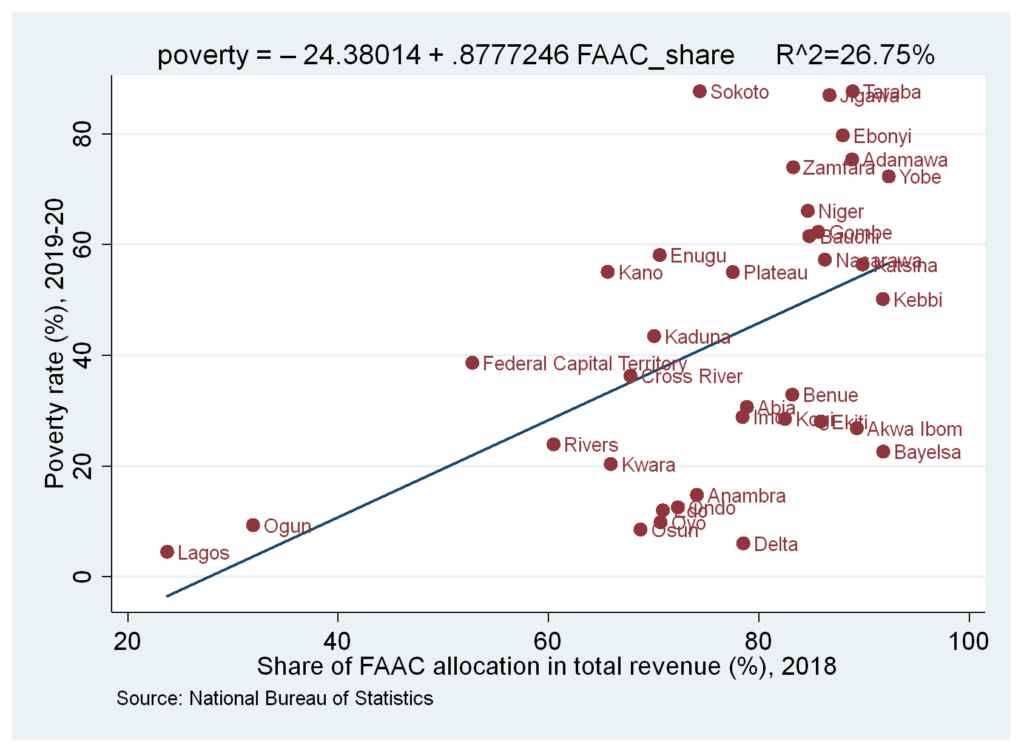
Poverty is higher in revenue-dependent states. States that rely on Federation Account Allocation Committee (FAAC) allocations as their major source of revenues tend to have higher poverty (Figure 2). Lower internally generated revenue (IGR) signals low levels of economic activities within a state as well as weak state capacity. None of the nine oil producing states recorded a poverty rate of up to 31%, again underscoring the importance of state capacity.

Figure 2: Higher poverty in revenue-dependent states

What to make of the numbers?

The preceding analysis is based on descriptive summaries provided by the NBS. A full report and accompanying micro dataset, which should be published soon, will provide better opportunity for generating clearer insights. However, the following recommendations follow from the preliminary analysis.

  • The rural-urban divide in poverty rates signals that poverty can be reduced by either developing the rural areas into urban centres or encouraging rural-urban migration. The latter seems like a less daunting task to undertake in the short term. However, a more enduring solution lies in development of a comprehensive rural development programme that effectively link economic transformation between rural and urban areas. Low hanging fruits such as improving the availability of agricultural inputs and infusing productivity-enhancing farming practices through extension workers can work wonders for Nigeria’s food security, nutrition, and rural poverty reduction. 
  • Educate rural girls! Only 10.15% of female headed rural households with post-secondary education live in poverty compared to 31.2% of male headed households with similar qualification. This pattern is observed throughout the data, signalling the impact of education on households’ outcomes. If you are looking for an intervention that can produce massive multidimensional impacts, you do not need to look beyond girl child education.
  • Promote family planning and encourage smaller household sizes. The preceding analysis indicates that larger household sizes are a good predictor of poverty in Nigeria even if we may be led to believe that things get ‘cheaper by the dozen’. Promoting family planning should be an integral part of the government’s poverty reduction strategy.
  • Make it easier for MSMEs to operate. A list of recommendations for improving development outcomes in Nigeria will not be complete without stressing the need to improve the conditions within which businesses operate. So, plug the normal trope about power, credit, other infrastructure, etc. here yourself.

This article was written by Joseph Ishaku and Adedeji Adeniran

Read More

Effective Targeting of COVID-19 Aid in Nigeria

Faced with an invisible and novel enemy to fight, governments across the globe have deliberately shut down their economies and placed cities on lockdown in order to stem the spread of the COVID-19 virus. In Nigeria, two states and the federal capital territory, have so far enforced a total lockdown, while other control measures have been implemented in other states. These mitigation strategies, albeit necessary, have affected the livelihood of most citizens, especially those operating in the informal sector who rely on daily incomes for survival. The Federal Government has introduced various social protection policies to support vulnerable groups during the COVID-19 crises. These policies are primarily targeted towards the 2.6million households on the social registry for the vulnerable, and an additional 1 million households are to be provided conditional cash transfer for 2months. 

The present social registry uses a three-stage targeting process based on geographical targeting, community-based validation, and proxy-means-testing (PMT) in order to identify the poorest of the poor in Nigeria. With over 90 million Nigerians living in extreme poverty, the social registry covers only about 2% of the poor, excluding many households given the enormous financial requirement for universal social protection. While the coronavirus lockdown will negatively affect most Nigerians, the impact will vary markedly across groups, even amongst the poor. There are legitimate questions about the suitability of the existing social registry as a reference for the groups most vulnerable to the economic shocks induced by the coronavirus lockdown. 

For the COVID-19 social protection interventions to be effective in curbing severe drops in basic consumption (largely food and housing), they need to be well targeted to those most vulnerable to Covid-19 shocks. Those most likely to be affected by COVID-19 lockdown measures are not necessarily the most vulnerable groups nationwide, and are likely to be missing from the social registry used for the Federal Government’s social protection measures.

What is known about the current social protection registry is that it largely covers agricultural and rural households, especially those with human capacity constraints. However, these groups are also less likely to be negatively affected by the economic shocks induced by the lockdown for a number of reasons: First, they are largely isolated from the major economic centers, being primarily rural and agricultural, hence basic livelihoods remain minimally unaffected by the lockdown. Second, the transportation of food items is excluded from the lockdown, which means that rural farmers may continue to get their produce to markets. Third, and more important, most households in this group produce a majority of what they consume, and are therefore better able to maintain basic consumption levels during the lockdown.

In order to more effectively target groups of the poor that are most vulnerable to negative consumption shocks during the COVID-19 lockdown, we need to ask, in the most basic terms: which groups of people need to earn an income every day in order to purchase food? Put another way, poor households whose basic income and consumption patterns are more closely tied to the market would be most likely to be negatively affected by the lockdown. In this piece, we profile the characteristics of the groups that are most likely to be affected by the government lockdown and restriction of economic activities vis-à-vis those on the social registry, explain why COVID-19 social protection interventions ought to be better targeted to these groups, and suggest ways to improve poverty targeting for those affected by the coronavirus shock. 

Using data from the Nigeria Demographic and Health surveys (2008 and 2013), we find that the urban poor is more likely to work in non-agricultural occupations, which often involves commuting between suburbs and satellite towns into the urban core. Here, we may think of drivers, cleaners, sales associates, and operators of micro-enterprises, etc. Incomes from these occupations that involve work in the city’s core are the most likely to be affected by the lockdown in economic activities. While most agricultural activities will slow down, the exception to food transportation, storage, and sales, means that income loss here will be minimized. Furthermore, data from the National Living Standards survey (2010) shows that 64% of the food consumed by the poor in rural areas comes from food that they produce themselves (auto-consumption), compared to just 22% for poor urban households. This implies that the urban poor is significantly more likely to experience a greater decrease in food consumption with a decrease in market income. 

Overall, the data reveal that the urban poor are more likely to suffer a decline in incomes as a result of the economic lockdown introduced to control the spread of COVID-19. As a result, the urban poor is also substantially more likely to suffer a decrease in food and other consumption, because unlike rural households, they largely consume what they are able to buy from market incomes. The urban poor have their livelihoods more closely tied to the market, and with a market shutdown, they are better targets for supplementary incomes/consumption intended to alleviate the hardships induced by COVID-19. This category of the poor is largely underrepresented in the current social protection registry.

Alternative Targeting Mechanism for the Urban Poor

The preceding discussion highlighted the inadequacy of the present social register as the urban poor are not sufficiently captured. However, it is difficult or impossible to rebuild or update the social registry in the midst of the pandemic. The government will need to explore alternative targeting mechanisms in the immediate term. One key characteristic of the urban poor is that they mostly live in slums, which enables them to minimize rental costs in cities. Social security targeted at the slums and other geographical locations where the urban poor people reside will be crucial.  The Government can also leverage on the social infrastructure and local knowledge of non-governmental organizations (NGOs) that have worked with urban poor in the past. With proper accountability in place, non-state actors can assist in the identification of the vulnerable households and suggest other effective ways of reaching them. This suggests a combination of geographic targeting complemented by community identification.

The efficacy of targeting through direct deposit into individuals’ accounts using their unique Bank Verification Number (BVN) will be weak in the present circumstances. With 36.8% of the adult population in Nigeria still financially excluded, targeting only those with a low balance in their account will exclude the most vulnerable people, who are less likely to have a bank account, and might find it more difficult to get into a bank location where they are able to withdraw cash. Further, using the banking approach also means individuals rather than households will be targeted. Without a quality system for auditing to check duplication, using BVN alone is susceptible to abuse. In some households, multiple members might be able to take advantage of the palliatives at the expense of financially excluded households. 

Irrespective of the mechanism adopted by the government, it is important to emphasize that apart from food security, adequate measures are required to prevent the spread of COVID-19 among urban poor. The optimal poverty targeting for the urban poor must, therefore, incorporate social distancing at its core.

Read More

Nigeria Education in Focus (Issue 5)

According to UNESCO, about 35.9 million primary and secondary school learners are currently out-of-school as a result of the school closures. For primary schools, this number totals approximately 25.6 million students, of which about 87 percent (23.5 million) are students enrolled in public schools. The numbers are just as stark for secondary school learners. Of the roughly 10.3 million secondary school students who are out-of-school as a result of the closures, approximately 81 percent (8.4 million) of them are public school students.
In Nigeria, school opportunity is correlated to income level, and public schools differ from private schools in the populations they serve. While private schools serve learners from higher socio-economic backgrounds who are willing and able to pay more to access the better resources offered by private schools, public schools which are usually free, comprise students from lower socio-economic households and low-income areas. In instances where distance learning opportunities are available, uptake will be low from the students in the public school's category, as a result of poor infrastructure such as no electricity, or poor/no internet connectivity, etc.
Opportunities to learn within the homes are also limited, given that a parent’s ability to provide education support to their children will be shaped by their own level of educational attainment, general literacy level, and other commitments. Given the significant relationship between educational attainment and income level, and the correlation between parentals income level and school choice, we can infer that the literacy level of parents in public schools in Nigeria might be lower than their private school counterparts. In instances where the parents are educated, investing the time in training their children during this time might be a luxury.
For Nigeria, the reality is simple - while the school closures are necessary to curtail the spread of the COVID-19 virus until the ban on movement is lifted and schools are reopened, the majority of students will not be learning.

Read More Download PDF

The implication of Covid-19 pandemic on the Nigerian Economy

The Global Health Hazards and Economic Impacts of COVID-19

In December 2019, a cluster of pneumonia cases from an unknown virus surfaced in Wuhan, China. Based on initial laboratory findings, the disease named Coronavirus disease 2019 (abbreviated as COVID-19), was described as an infectious disease that is caused by severe acute respiratory syndrome coronavirus 2. The COVID-19 outbreak has since spread to about 196 countries and territories in every continent and one international conveyance across the globe. While there are ongoing efforts to curtail the spread of infection which is almost entirely driven by human-to-human transmission, it has accounted for over 400,000 confirmed cases with over 18,000 deaths[1].

Beyond the tragic health hazards and human consequences of the COVID-19 pandemic, the economic uncertainties, and disruptions that have resulted come at a significant cost to the global economy. The United Nations Trade and Development Agency (UNCTAD) put the cost of the outbreak at about US$2 trillion in 2020. Most central banks, finance ministries and independent economic experts around the world have taken solace in the prediction that the impacts might be sharp but short-lived, and economic activities would return to normal thereafter. This line of thought mirrors the thinking of the events that shaped the 2007 global financial crisis. However, it is quite instructive to note that the 2007 crisis which emanated from the United States’ subprime mortgage crisis was mainly an economic phenomenon, with its fallout spreading across many regions of the world. When compared to COVID-19, the 2007 crisis could be described as minor and manageable. The tumultuous events that COVID-19 had spread across the globe cut across every facet of human existence and the consequences may linger beyond the second half of 2020.

The slowdown in the global economy and lockdown in some countries, such as Italy, Spain and most Eurozone economies and beyond, as a result, COVID-19 has also taken its toll on the global demand for oil. The decline in oil demand is estimated to surpass the loss of nearly 1 million barrels per day during the 2007-08 recession. This is also coming at a time when two key players in the global oil industry – Russia and the OPEC cartel – are at loggerheads on the decision to cut output. The unequivocal oil price war started between these two global oil market giants may have more dire consequences on the oil price that has started to dive. .  

Sector-specific implications and impacts could vary. For example, the impacts on the global aviation and tourism sectors are a result of the implications of the pandemic on global travel. As discretionary spending by consumers continues to decline, cruise companies, hotels, and hospitality are facing declining demand and patronage. For example, in Hungary alone, about 40 to 50% of hotel reservations have been canceled. Also, the pandemic is placing up to 8 million jobs in the leisure and hospitality sector at risk, with travel crashes and cancellations expected to continue. Moody’s Analytics, a rating agency, stated that more than half of the jobs in the United States which is about 80 million may be in jeopardy.

The virus is also taking its toll on health facilities and infrastructures across the globe. Italy is currently the largest affected country with a number of deaths surpassing China, since the outbreak of coronavirus. Across northern Italy, the virus has pushed the country’s National Health Service to a breaking point, emphasizing the test that other countries, especially developing and low-income countries, might face in their approach to contain the virus spread. Most hospitals and health facilities that could not handle the hazards are resulting to operating below their capacity by taking a few regular health-related cases or shutting down. What could be more devastating is the fact that the economic pains that accompanied the virus might not go away soon as envisaged. 

The conventional policy measures currently being taken such as reducing interest rates and costs of borrowing, tax cuts and tax holidays are quite remarkable. However, these conventional policy measures are quite potent when there are demand shocks. There are limitations to the successes that can be recorded when demand shocks are combined with supply shocks. It is already apparent from the emergence of the current crisis that there are implications on the economy from both the demand and supply sides. Some of the demand factors include social distancing with consumers staying at home, limitations in spending and declining consumptions. On the supply side, factories are shutting down or cutting down production and output, while in other instances, staff work from home to limit physical contact.

The decision to close educational institutions and schools around the globe in an attempt to contain the pandemic has also led to a soaring number of children, youth and adults not attending schools. According to UNESCO Monitoring report on COVID-19 educational disruption and response, the impact of school closures in the over 100 countries that have implemented the decisions around the world has impacted over half of the global students’ population. These educational disruptions are being escalated particularly for the most vulnerable members of society.

Bracing up for COVID-19 consequences on the Nigerian economy

For most developing economies, the odds of sliding into a downturn are gradually expected as the global coronavirus outbreak puts severe pressure on the economy. For Nigeria, the country is still sluggishly grappling with recovery from the 2016 economic recession which was a fall out of global oil price crash and insufficient foreign exchange earnings to meet imports. In the spirit of economic recovery and growth sustainability, the Nigerian federal budget for the 2020 fiscal year was prepared with significant revenue expectations but with contestable realizations. The approved budget had projected revenue collections at N8.24 Trillion, an increase of about 20% from 2019 figure. The revenue assumptions are premised on increased global oil demand and stable market with oil price benchmark and oil output respectively at $57 per barrel and 2.18 Million Barrels Per Day.

The emergence of COVID-19 and its increasing incidence in Nigeria has called for drastic review and changes in the earlier revenue expectations and fiscal projections. Compared to events that led to recession in 2016, the current state of the global economy poses more difficulties ahead as the oil price is currently below US$30 with projections that it will dip further going by the price war among key players in the industry. Unfortunately, the nation has grossly underachieved in setting aside sufficient buffers for rainy days such as it faces in the coming days. In addressing these daunting economic challenges, the current considerations to revise the budget downward is inevitable. However, certain considerations that are expected in the review must not be left out. The assumptions and benchmarks must be based on realizable thresholds and estimates to ensure optimum budget performance, especially on the non-oil revenue components.

Furthermore, cutting expenditures must be done such that the already excluded group and vulnerable are not left to bear the brunt of the economic contraction. The economic and growth recovery program which has the aim of increasing social inclusion by creating jobs and providing support for the poorest and most vulnerable members of society through investments in social programs and providing social amenities will no doubt suffers some setbacks. Besides, the downward review of the budget and contractions in public spending could be devastating on poverty and unemployment. The last unemployment report released by the National Bureau of Statistics (NBS) ranks Nigeria 21st among 181 countries with an unemployment rate of about 23.1%. The country has also been rated as the poverty capital of the world with an estimated 87 million people living on less than $2 a day threshold.

The decision to cut the retail price of gasoline under a price modulation arrangement is a welcome development. The cut is expected to curb rising inflation, especially food price inflation which will mainly benefit the poor. However, rather than the price capping regime introduced, by which it is expected of the Petroleum Products Price Regulation Agency (PPPRA) to constantly issues monthly guide on appropriate pricing regime. It is expected that the government will use this opportunity to completely deregulate the petroleum industry in line with existing suggestions and reports. In the event that the global economy becomes healthier and crude oil prices increases, the government might return to the under-recovery of the oil price shortfall by the Nigerian National Petroleum Corporation (NNPC). A policy that annually costs the government huge revenue and recurring losses to the NNPC.

Basically, the Nigerian government essentially must lead economic diversification drive. It is one practicable way to saddle through the current economic uncertainties and instabilities. What the consequences of COVID-19 pandemic should further offer the Nigerian economic managers and policymakers, is that the one-tracked, monolithic reliance on oil is failing. Diversification priorities to alternative sectors such as agriculture, solid minerals, manufacturing and services sectors, should be further intensified.
 

[1] These figures were recorded as a 24th March, 2020.

Read More