More than a year after the height of the global coronavirus pandemic, researchers, businesses, and policymakers are keen to fully understand the impact of the pandemic on our economies. Moreover, unpacking the long-term implications and policy responses are critical to successfully navigate the economic crises.
To this end SAIIA and CSEA organised a webinar on August 11, 2021 to share empirical evidence of the impact of Covid-19 on Africa’s two largest economies, South Africa, and Nigeria. Researchers from the Covid-19 Macroeconomic Policy Research in Africa (CoMPRA) project were joined by policymakers from the respective countries to further explore policy dimensions of Covid-19 in these two economies and contemplate the way forward to successful sustainable and inclusive economic recovery.
Download the speakers’ biographies.
Watch Webinar on YouTube
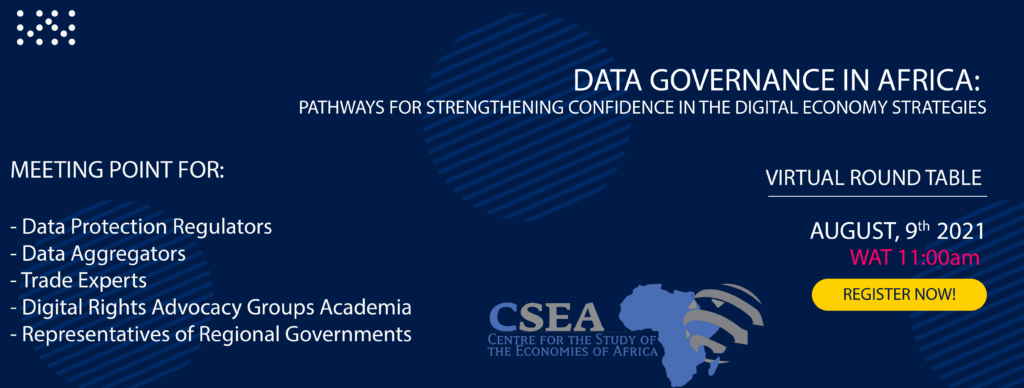
CSEA organized a virtual roundtable on Monday, August 9th, 2021, to discuss pathways for strengthening confidence in the digital economy in Africa under the following:
- Trends in digital growth and data threats on the continent.
- Present landscape for governing data use and sharing in Africa.
- Role and scope for a harmonized regional data governance structure under the AfCFTA.
-Areas for further investigations to gain deeper insights to the factors hindering advancement of data governance on the continent.
The event was a meeting point for stakeholders including: data protection regulators, data aggregators, trade experts, digital rights advocacy groups, representatives of regional economic communities among others.
The event also featured an unveiling of CSEA’s African Digital Preparedness Webpage.
EVENT DETAILS
Read the event summary report
Watch the fully recorded video of the event on our YouTube platform
Download the Key note address by the Director General of the World Trade Organisation(WTO), Dr Ngozi Okonjo-Iweala
Access the newly launched African Digital Preparedness Webpage
Download the slide presentation of CSEA Research team
Download the inception report- Strengthening Data Governance in Africa
ABOUT THE SPEAKERS
KEY NOTE SPEAKER
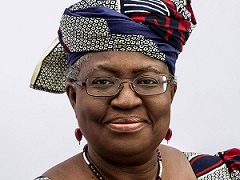
DR NGOZI OKONJO-IWEALA

Dr. Ngozi Okonjo-Iweala is the Director General of the World Trade Organisation (WTO). She is an economist and international development expert with over 30 years of experience. She was Chair of the Board of Gavi, the Vaccine Alliance (2016 – 2020), the African Risk Capacity (2014 – 2020) and Co-Chair of The Global Commission on the Economy and Climate. Previously, she served as Senior Advisor at Lazard and sat on the Boards of Standard Chartered PLC and Twitter Inc. Dr Okonjo-Iweala was appointed as an AU COVID-19 Special Envoy and WHO COVID-19 Special Envoy.
Dr Okonjo-Iweala served twice as Nigeria’s Finance Minister (2003-2006, 2011-2015), the first woman to hold the position, and spent a 25-year career at the World Bank rising to the No.2 position of Managing Director.
In 2020 Dr Okonjo-Iweala was named Forbes African of the Year. She has been ranked by Fortune as one of the 50 Greatest World Leaders (2015) and by Forbes as one of the Top 100 Most Powerful Women in the World consecutively for four years. She holds a Bachelor’s in Economics from Harvard University and a PhD from the Massachusetts Institute of Technology.
PANELISTS
TEKI AKUETTEH FALCONER

Teki Akuetteh Falconer is an ICT/Telecom Lawyer, a Privacy/Data Protection Consultant and Senior Partner at a law firm based in Accra, Ghana. She is also the Founder and Executive Director of the Africa Digital Rights Hub LBG, a member of the UN Global Pulse Privacy Advisory Group, and a non-resident fellow of the Center for Global Development.
Previously, Teki has worked for the Government of Ghana in the development of several key legislations for the ICT sector including the Data Protection Act, 2012 (Act 843), Electronic Communications Act, 2008 (Act 775), and Electronic Transactions Act, 2012 (Act 772). She was also the first Executive Director of the Data Protection Commission of Ghana.
Teki holds an LLM in Information Technology and Telecommunications Law from the University of Strathclyde, Glasgow, Scotland and a Bachelor of Arts in Law and Political Science from the University of Ghana (Legon), Accra – Ghana.
MRS DRUDEISHA MADHUB

Mrs Drudeisha Madhub is the Data Protection Commissioner of the Republic of Mauritius, a position she assumed since August 2007. Prior to her appointment, she was Senior State Counsel at the Attorney General’s Office for six and a half years.
She is a respected member of various international networks such as: Association Francophone des Autorités de Protection des Données Personelles’ (AFAPDP), Réseau Africain des Autorités de Protection des Données Personelles (RAAPDP), Global Privacy Enforcement Network (GPEN), Common Thread Network (CTN), the Council of Europe, and United Nations Global Pulse.
She was appointed as data protection and human rights expert by Interpol and a member of the Commission for the Control of Interpol’s Files from 2011 to 2018 with the specific function of judging data protection and human rights issues in Interpol’s cases.
Mrs Madhub was appointed UN Emeritus expert, joining the UN Global Pulse Data Advisory Group in 2014 to provide expert advice on data protection.
KAMAL TAMAWA

Kamal Tamawa is the Director of Public Policy for Sub-Saharan Africa at the GSMA. A seasoned Telecommunications Regulation and Policy expert, Kamal is involved in coordinating the delivery of GSMA Advocacy programmes in the Sub-Saharan Africa region, anddriving engagements and interventions on a wide variety of telecommunications policy topics.
Kamal has worked with the Nigerian Regulator and, prior to joining the GSMA, he worked with Etisalat Nigeria where he managed Regulatory Compliance, Spectrum Policy and Technical Regulatory matters. Kamal is also been a member of the Technical Advisory Committee that prepares Nigeria’s participation at International fora on Telecommunications.
Kamal holds a B.Sc in Computer Engineering from the American University of Cyprus and an M.Sc in Mobile and Personal Communications from King’s College London.
DR ADEDEJI ADENIRAN

Dr Adedeji Adeniran is the Director of Research at CSEA. He holds a Ph.D from the University of Witwatersrand, South Africa. He also holds a Masters’ and Bachelor’s degree in Economics and Educational Management/Economics from the University of Ibadan.
He previously worked as a seasonal Lecturer in the Department of Witwatersrand, as a Data Analyst at the Analyst Data Services and Resources(ADSR) and as a Teaching Assistant in the Department of Economics University of Ibadan. His research interests cuts across macroeconomics,development finance,public economics and policy analysis and experimental economics.
SONE OSAKWE

Sone Osakwe is a Research Fellow at CSEA. As a development economist, she is committed to understanding how poverty and inequality can be reduced to achieve improved welfare and more inclusive societies. Her expertise include research, policy and practice, domestic revenue mobilization strategies, advocacy, among others.
Before joining CSEA, Sone worked as a fiscal policy advisor at Deloitte. She holds a Master’s degree in International Development and Economics from University of Bath, and a Bachelor’s degree in Accounting from the University of Nigeria, Nsukka. She is also a chartered accountant.

China’s investment in African infrastructure as part of its Belt and Road Initiative has proven to be both transformative and controversial. While investment projects are helping Africa to close its infrastructure gap, they have also raised fears of runaway debt levels. Overall, more research is needed on the development impact of Chinese investment activities on the continent, including the financial implications thereof. This report aims to address this knowledge gap. Drawing on diverse datasets, it examines Chinese infrastructure projects in three countries: Ethiopia, Kenya and Nigeria. A key result of the study is that while many of these projects are still under way, they are likely to have a positive impact in the future. In particular, they will boost trade and development in the commodities and services sectors. Nevertheless, the benefits of the Belt and Road Initiative will not be evenly distributed in Africa. Top commodity producers and exporters will continue to benefit more than some other African countries. Countries should take cognisance of and mitigate the downside risks associated with Chinese interventions in Africa, including growing their debt loads and minimising the negative effects on the environment.
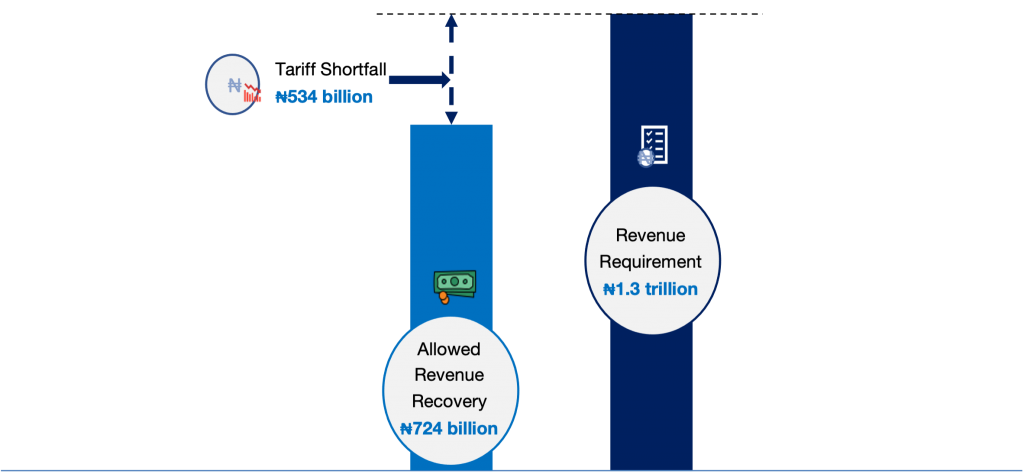
Tariff reform is often listed as a high-priority issue in Nigeria. In March 2020, the Nigerian Electricity Regulatory Commission (NERC) issued an order to transition from demand-based to cost-reflective and service-reflective tariffs. Consumers are now supposed to pay based on how long they receive electricity daily, divided into groups commensurate with the quality of services offered. After several delays due to COVID-19, this change finally took effect in September 2020.
FIGURE 1: Projected Revenue Requirement, Allowed Revenue Recovery and Tariff Shortfall in 2020 (Data was sourced from NERC, 2020).

TABLE 1: The new service-reflective tariff bands (Data sourced from NERC, 2020).
| TARIFF BAND | ELECTRICITY SUPPLY (HOURS PER DAY) | TARIFF REVIEW |
|---|---|---|
| A | Minimum of 20 hours | Highest tariff band |
| B | Minimum of 16 hours | Second highest tariff band |
| C | Minimum of 12 hours | Moderate tariff increase |
| D | Minimum of 8 hours | No tariff increase |
| E | Minimum of 4 hours | No tariff increase |
This article was first Published at Energy for Growth Hub
With the passing into law of the reformed Company and Allied Matters Act (CAMA, 2020) which replaces the CAMA 1990 Act, Nigeria is uniquely positioned to be in the top 20 of doing business rating globally by 2030. At this time when the African Continental Free Trade Area (AfCFTA), one of the world largest Continental Trade Area (CTA)- with 54 African member nations signed, the reformed CAMA Act could be a big boost to the Ease-of-Doing-Business (EoDB) for Nigerian Micro-Small and Medium Enterprises (MSMEs) to flourish under a competitive environment. This piece highlights some of the critical changes which the new CAMA Act introduces to the principal framework regulating the business climate in Nigeria and how it could promote MSMEs to be competitive under the AfCFTA.
Background of Companies and Allied Matters Act in Nigeria
Companies and Allied Matters Act (CAMA) is one of the critical pieces of legislation which enhances better business climate and promotes Micro, Small and Medium Scale Enterprises (MSMEs). The Act provides a regulatory framework for how businesses should be carried out in the country.The CAMA 1990 Act, which repeal CAMA act of 1968 reshaped the business environment of Nigeria in the 90’s. CAMA 1990 was passed into law to establish the Corporate Affairs Commission (CAC), providing for the incorporation of companies and incidental matters, registration of business names and the incorporation of Trustees of certain Communities, bodies and Associations. The Act was promulgated to repeal the Companies Act of 1968. However, in the last 30 years of promulgation into law, the Nigerian corporate landscape has transformed with global and regional demand for business integration. Hence, the CAMA 1990 Act was heavily hamstrung by several provisions of the Act which limits modern business practices in the light of national and global reforms.
The private sector had clamoured for a reformed CAMA because the economy has changed, there are new parameters in the way of doing business both domestically and internationally. As a result of this, the need for public-private partnership in promoting sustainability in the business climate of the country after several attempts to review the CAMA 1990 was inevitable. Also, technological innovation in the business sector had propelled for collaboration for a new legislation that would align with global business practices. The signing into law of the CAMA 2020 has raised hope for the private sector with the recent regional trade integration (AfCFTA). However, without effective monitoring and implementation, this new reform especially in promoting MSMEs which are drivers of growth in developing nations would never fulfil its purpose.
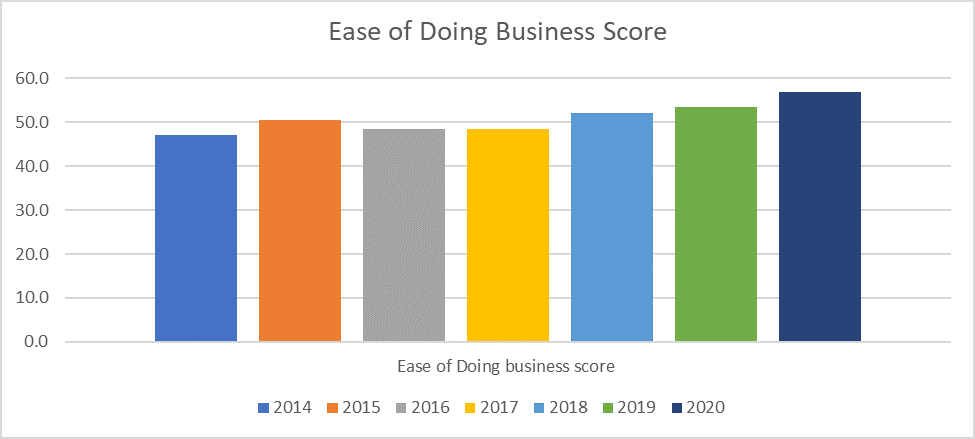
Figure 1.

Source: World Bank Group- Doing Business Reports
Nigeria had never been ranked in the global top 50 economies by the Doing Business report of the World Bank since inception, but the country had a steady EoDB score as shown in Figure 1. Also, Nigeria is reported as one of the 20 improvers of the ease in doing business among others- Saudi Arabia, Jordan, Togo, Bahrain, Tajikistan, Pakistan, Kuwait, China, and India.
The impact of CAMA 2020 Act in the Ease of Doing Business
The objective of the reformed CAMA 2020 Act is to promote legislation for regulatory quality and efficiency which would enable efficient EoDB for Nigerian businesses in general, and MSMEs in particular. MSMEs are the engine of growth for most developing nations. As can be expected, without reforms for enabling business environments to sync with global business evolution, most businesses may shut down due to economic and environmental shocks. It follows logically that without reforms in a rapidly changing global market, most firms-MSMEs especially may not survive beyond the unanticipated COVID-19 pandemic.
Specifically, the reformed CAMA 2020 Act among other things, made the starting and running of business more seamless and less expensive by operationalizing electronic platforms that integrate the tax authority and the Corporate Affairs Commission (CAC). Considering that Nigeria is largely dominated by Medium and Small-Scale Enterprises (MSMEs), making business registration or company incorporation easier will bring in more businesses into the formal space. This also will enhance tax revenue for the government. The Act has 870 sections and divided into 7 parts as against 612 sections in the repealed Act of 1990. 167 sections were completely new, while 91 sections were modified.
Some of the major alterations made to the Act which directly promote the ease of doing business in Nigeria compared to the repealed Act and its implications on EoDB are highlighted in Table 1 below:
Table 1.
| S/N | ITEM | CAMA 1990 | CAMA 2020 | IMPLICATIONS |
| 1. | Single member shareholding | All registered companies with CAC and under CAMA must either be a private company or public company. | Introduced limited liability partnership and limited partnership. Also, introduces Single member, single share/holding company. | Section 18(2) of the new CAMA 2020 now makes it possible for one member or shareholder to establish a private company which may encourage MSMEs to register their companies and may shrink the informal sector. |
| 2. | Registration of company | To register a company with CAC, the applicant must meet the CAMA 1990 requirements of registration. | Introduction of Electronic filing, electronic share transfer, and E-meetings. | The Act permits electronic filing, share transfers and electronic tax payments.it also allows E-meetings for private limited companies and virtual annual general meetings for public limited companies. |
| 3. | Statement of Compliance | Declaration of Compliance also known as the ‘Attestation of Compliance’ required to be made by a Legal practitioner. | The new Act introduces the Statement of Compliance which does not require attestation by a Legal practitioner. | With the Statement of Compliance, the promoters/owner(s) of the company can take and give an undertaking that all papers of registration requirements have been met and signed off by themselves. |
| 4. | Minimum share Capital | Companies must meet a minimum authorized share capital before incorporation which shall be N10,000 for private companies and N500,000 for public companies | Introduces minimum issued share capital as against authorized share capital. Private companies upon incorporation must have an initial issued share of N100,000 in nominal value from its share capital while for public companies, N2,000,000 in nominal value of its share capital must have been issued. | This implies that what is required now is number of shares but no longer the share capital of the company. |
| 5. | Audit obligations | Every company is mandated to appoint auditor/auditors to audit their financial records/statements in respect of a financial year and presented during the annual general meeting of such company. | Audit obligation is no longer required for MSMEs and companies that had not carried out business since incorporation (excluding Banks and insurance companies) are now exempted from audit obligation. | This will positively impact the profit margins for small companies because audit fee and bureaucratic challenges involved has been removed. |
| 6. | Filing fee and acquisition of Company seal | The company seal is a requirement for incorporation and every company would be charged a filing fee. | Company seal and share certificate, an optional requirement may now be issued as a way of deed duly signed by the company. Also, reduction of fees to 0.35% which is 65% reduction in the entire regime. | The use of company seals has become dormant all over the world. Therefore, it promotes the ease of doing business in Nigeria. |
| 7. | Insolvency regime | Under this Act, the first recourse taken by creditors to recover bad-debts Without exploring other options by which debtors could achieve business recovery in order to repay their debts is insolvency. | Introduction of an extensive insolvency regime. The CAMA 2020 introduces concept of corporate voluntary arrangement which allows a company to settle its debts by paying only a proportion of the amount which it owes to its creditors. | The new CAMA allows companies to explore other alternatives by which to avoid insolvency such as restructuring |
The amendments made in the CAMA 2020 Act may positively impact the EoDB in Nigeria especially at this time when the AfCFTA is implemented. Although, the Act had factored in new methods while embracing technological changes in the business world. It is expected that without practical implementation of the CAMA 2020 by the CAC, the country’s business landscape would not catch up with international business practices. Therefore, it is hoped that the practical administration of the new CAMA will help ease the strain of doing business, and will enhance productivity and promote ease of doing business in Nigeria.